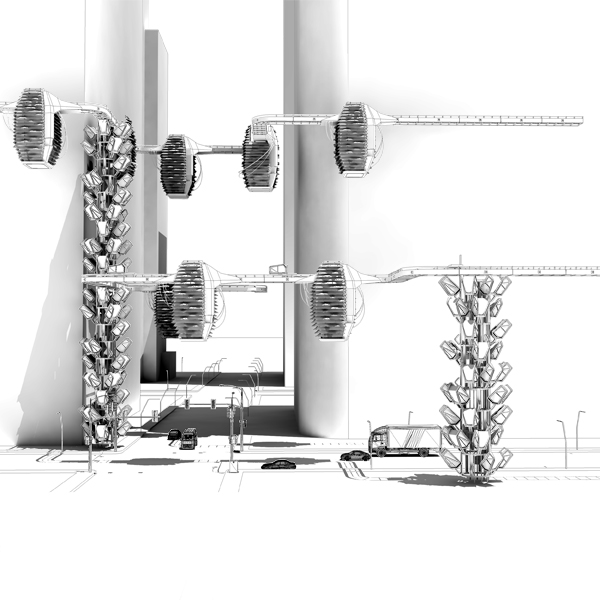
Cocoon Housing is a highly conceptual housing typology that was designed by John Farrace at the USC School of Architecture for the purpose of exploring techniques of representation. The project is an attempt to reduce both technical and experiential drawings to their essence (at a graphic level), and hybridize them into a homogenous set of drawings that reference the mediated experience of a camera lens (in perspective) and the raw look of black and white technical line drawings. Each drawing fits into a given category — plan, elevation, perspective, for example — but have specific components of other categories, leaving an “in-between drawing” that represents and speaks to multiple ideas at once. Read the rest of this entry »
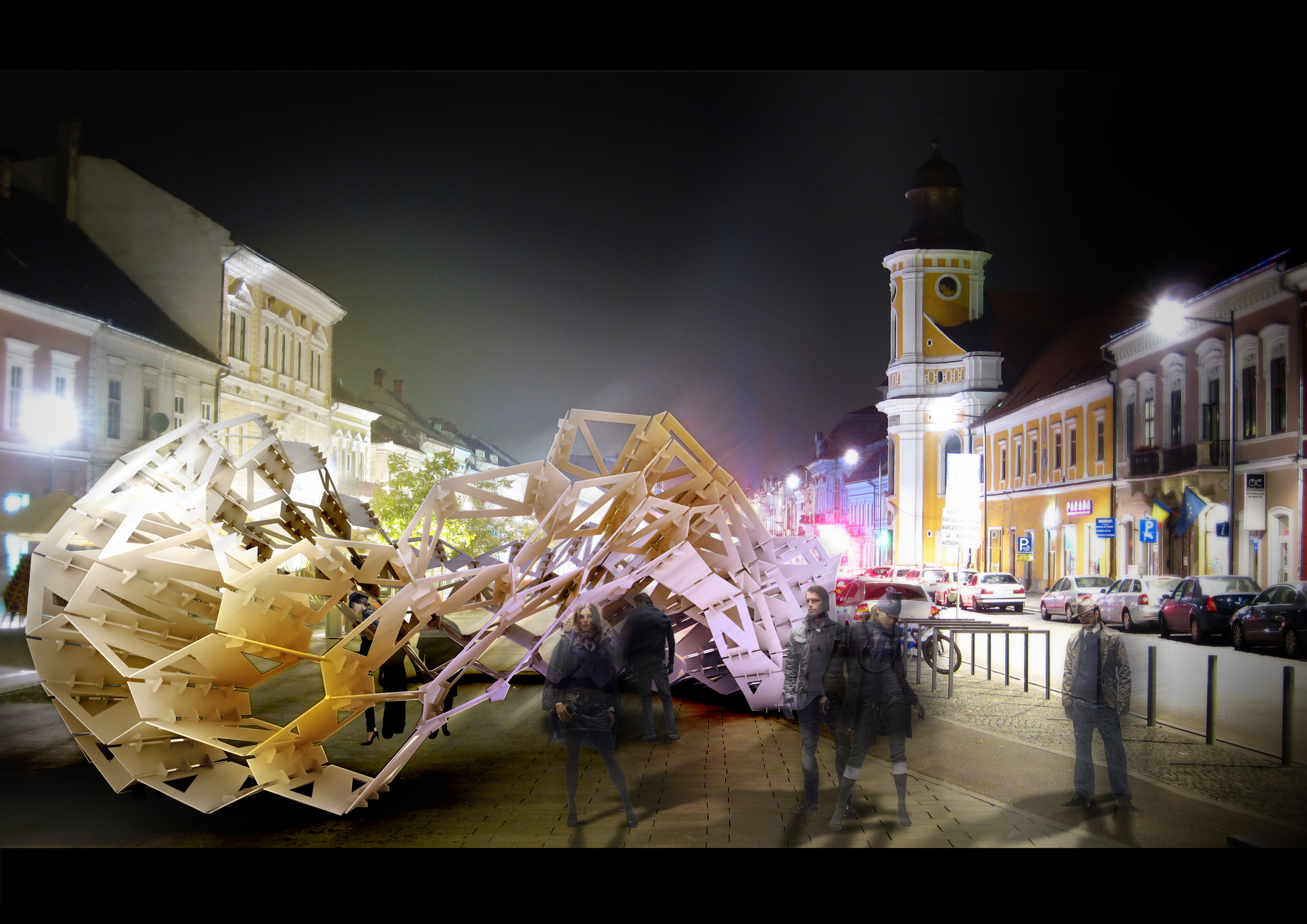
Parametric Designed Wooden Pavilion in Romania / Stefanescu-Bedarf-Hambasan
This parametric project designed by Dimitrie Stefanescu, Patrick Bedarf, and Bogdan Hambasan started out as an ambitious student-powered endeavor to design and fabricate at a 1:1 scale the flagship pavilion for the ZA11 Speaking Architecture event in Cluj, Romania; while at the same time integrating it into its historically-charged context. The design boasts a strong representational power which was much needed in order to fulfill its main goal: attracting passers-by to the event. At the same time, the object, through its tectonic characteristics, tries to make legible the new ontology which is slowly defined by computational architecture and thus becomes a showcase for the design processes empowered by digital tools. Read the rest of this entry »
Resonance: Geometry and Sound Animation with 30 Artists
The short series of films in the project Resonance are works by teams of audio artist and studios paired with visual artist and studios. Based on the idea of matching geometry (SEE) with sound (HEAR) each movie vignette is an abstract experiment of 4D design immersion. Organized by SR Partners, over 30 groups participated.
Pieces are 20 seconds long or less and represent a diverse set of design modeling formulations both in content and aesthetic, with only occasionally representational or natural backgrounds incorporated. Narrative is downplayed in the short pieces, with both organic and geometric kinetic forms often shape shifting, changing scale or context matched with corresponding soundscapes. Sounds are musical and descriptive of the movement, using ambiance techniques to underscore the tone of the visual environment. Read the rest of this entry »
Joenniemi Manor Museum in Finland / studioBang
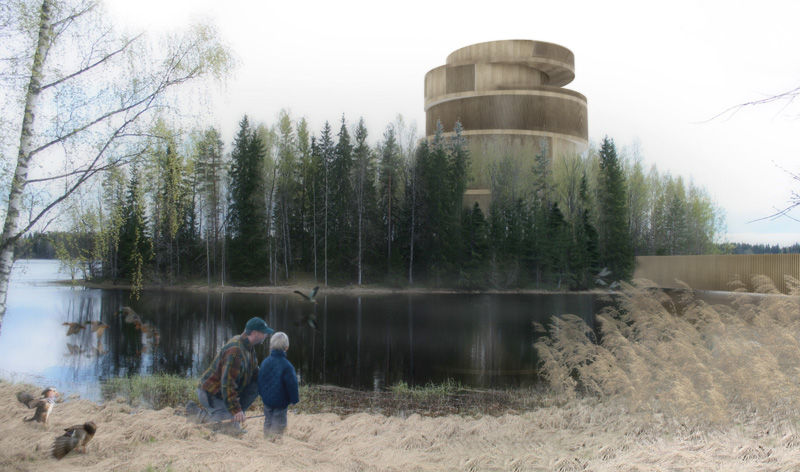
Joenniemi Manor in Finalnd was originally built as a large residence before it was converted into a museum with 500 sqm of exhibition spaces. Due to its original planning as a home, large-scale travelling exhibitions cannot be conveniently displayed in the current exhibition facilities. In addition, the service facilities are insufficient, and the collection and office areas are also inadequate. The program, the necessary heights, and its integration with the landscape led to the idea of piling up the functions to minimize the groundfloor area of the building and keep intact as much landscape as possible. Read the rest of this entry »
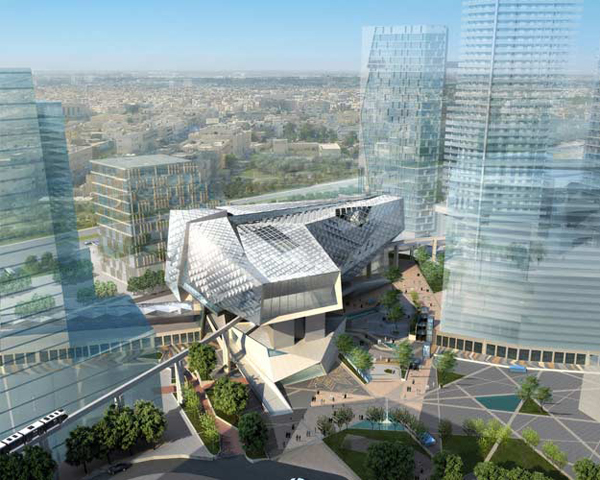
Super-Stadium for the 2022 Winter Olympics / Alan Lu
Super-Stadium is a proposal designed by Alan Lu for an Olympic complex for Harbin’s bid for the 2022 Winter Olympics that seeks to integrate the multitude of Olympic arenas and villages into one continuous entity, allowing for a seamless transition between programs and events. Read the rest of this entry »
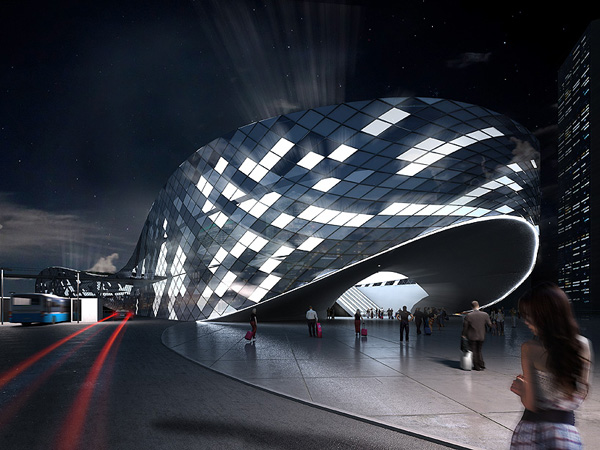
Musée Cantonal des Beaux-Arts / Allied Works Architecture
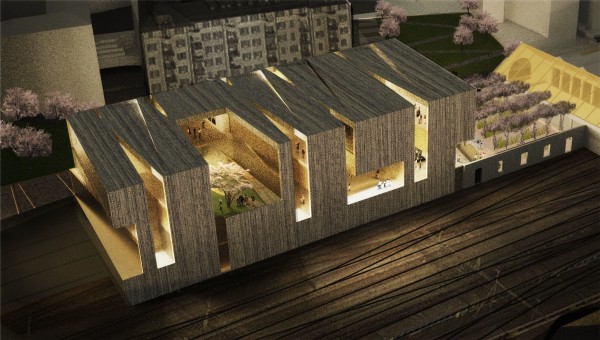
Allied Works was named one of eighteen international finalists to create the Pôle Muséal Lausanne, which encompasses transforming an historic train shed and industrial site into a new cultural district. The design was developed in collaboration with an international team of designers, including Latz+Partner for Landscape, Resnicow Schroeder Associates for Cultural Planning, and Nicolet Chartrand Knoll for Structural and Civil.
The forms and spaces of the new museum are both monumental and transparent. The building’s geologic form is fractured by activity, providing glimpses into and through the heart of the building. Ideal gallery proportions establish a rhythm of space and structure along the Arts Walk and rail lines. Between galleries, structure, circulation and light form fissures of transparency – filtering and diffusing light into the galleries, providing views to the landscape and city while connecting the building vertically. Read the rest of this entry »
Registration – eVolo 2012 Skyscraper Competition
eVolo Magazine is pleased to invite architects, students, engineers, designers, and artists from around the globe to take part in the eVolo 2012 Skyscraper Competition. Established in 2006, the annual Skyscraper Competition is one of the world’s most prestigious awards for high-rise architecture. It recognizes outstanding ideas that redefine skyscraper design through the implementation of novel technologies, materials, programs, aesthetics, and spatial organizations along with studies on globalization, flexibility, adaptability, and the digital revolution. It is a forum that examines the relationship between the skyscraper and the natural world, the skyscraper and the community, and the skyscraper and the city.
The participants should take into consideration the advances in technology, the exploration of sustainable systems, and the establishment of new urban and architectural methods to solve economic, social, and cultural problems of the contemporary city including the scarcity of natural resources and infrastructure and the exponential increase of inhabitants, pollution, economic division, and unplanned urban sprawl.
The competition is an investigation on the public and private space and the role of the individual and the collective in the creation of a dynamic and adaptive vertical community. It is also a response to the exploration and adaptation of new habitats and territories based on a dynamic equilibrium between man and nature – a new kind of responsive and adaptive design capable of intelligent growth through the self-regulation of its own systems.
There are no restrictions in regards to site, program or size. The objective is to provide maximum freedom to the participants to engage the project without constraints in the most creative way. What is a skyscraper in the 21st century? What are the historical, contextual, social, urban, and environmental responsibilities of these mega-structures?
eVolo Magazine is committed to continue stimulating the imagination of designers around the world – thinkers that initiate a new architectural discourse of economic, environmental, intellectual, and perceptual responsibility that could ultimately modify what we understand as a contemporary skyscraper, its impact on urban planning and on the improvement of our way of life.
Registration
Architects, students, engineers, and designers are invited to participate in the competition. We encourage you to have multidisciplinary teams.
- Participants must register by January 17, 2012.
- Early Registration: US $65 until November 15, 2011.
- Late Registration: US $85 from November 16, 2011 to January 17, 2012.
- One registration = One project
- Participants may submit various projects, but must register each entry.
- There is no limit as to the number of participants per team. Individual entries are accepted.
After your registration has been approved eVolo will send the registration number, which will be necessary for submission boards.
Schedule
- June 27, 2011 – Competition announcement, registration begins, acceptance of questions.
- November 7, 2011 – Deadline for submitting questions.
- November 15, 2011 – Early registration deadline
- November 30, 2011 – Answers to questions posted on website
- January 17, 2012 – Late registration deadline
- January 24, 2012 – Project submission deadline (23:00 hours US Eastern Time)
- February 27, 2012 – Winners’ announcement
Submission Requirements
This is a digital competition and no hardcopies are necessary. Entrants must submit their proposal via email no later than January 24, 2012 (23:00 hours US Eastern Time) to the following email address: skyscraper2012@evolo.us. Participants can send their entries through yousendit.com (free) or similar if the files exceed 10mb or their email capacity.
The project submission must contain the following files:
- Two boards with the project information including plans, sections, and perspectives. Participants are encouraged to submit all the information they consider necessary to explain their proposal. These boards should be 24″(h) X 48″(w) in HORIZONTAL format. The resolution of the boards must be 150 dpi, RGB mode and saved as JPG files. The upper right corner of each board must contain the participation number. There should not be any marks or any other form of identification. The files must be named after the registration number followed by the board number. For example: 0101-1.jpg and 0101-2.jpg.
- A DOC file containing the project statement (600 words max). This file must be named after the registration number followed by the word “statement”. For example: 0101-statement.doc.
- A DOC file containing the entrants’ personal information, including name, profession, address, and email. This file must be named after the registration number followed by the word “info”. For example: 0101-info.doc.
- All the files must be placed in a ZIP folder named after your registration number. For example: 0101.zip
Jury
Maria Ailova [principal Terreform One]
Chris Bosse [principal LAVA – Laboratory for Visionary Architecture]
Gaël Brulé [principal Atelier CMJN, winner 2011 Skyscraper Competition]
Julien Combes [principal Atelier CMJN, winner 2011 Skyscraper Competition]
Marc Fornes [principal THEVERYMANY]
Florian Idenburg [principal SO-IL Solid Objectives – Indenburg Liu]
Minnie Jan [principal MisoSoupDesign]
Mitchell Joachim [principal Terreform One, professor at New York University]
Jing Liu [principal SO-IL Solid Objectives – Indenburg Liu]
Daisuke Nagatomo [principal MisoSoupDesign]
Alexander Rieck [principal LAVA – Laboratory for Visionary Architecture]
Michel Rojkind [principal Rojkind Arquitectos]
Michael Szivos [principal Softlab, professor at Pratt Institute]
Tobias Wallisser [principal LAVA – Laboratory for Visionary Architecture]
Ma Yansong [principal MAD Architects]
Regulations
- This is an anonymous competition and the registration number is the only means of identification.
- The official language of the competition is English.
- The registration fee is non-refundable.
- Contacting the Jury is prohibited.
- eVolo Magazine, as the competition organizer, reserves the right to modify the competition schedule if deemed necessary.
- Entrants will be disqualified if any of the competition rules are not considered.
- Participation assumes acceptance of the regulations.
Awards
- 1st place – US $5000
- 2nd place – US $2000
- 3rd place – US $1000
Winners and special mentions will be published in several print magazines including eVolo_06.
Previous winners have been featured in:
ABC Magazine – Czech Republic, About:Blank Magazine – Portugal, Aeroflot – Russia, Architect Builder – India, Architecture and Culture – Korea, Architektura Murator – Poland, AT Architecture Technique – China, AWM – The Netherlands, Azure – Canada, B-1 – Thailand, Bauwelt – Germany, Blueprint – United Kingdom, BusinessWeek – USA, C3 – Korea, CAAOH – Ukraine, Casamica – Italy, Casas y Mas – Mexico, Concept – South Korea, Courier Mail – Australia, Discover Magazine – USA, Donga – South Korea, Enlace – Mexico, Focus – Canada/Italy, Future Arquitecturas – Spain, Geolino Extra – Germany, Grazia Casa – Italy, Kijk – The Netherlands, L’Installatore Italiano – Italy, L’Arca – Italy, L’Uomo Vogue – Italy, La Razon – Spain, Le Courier de l’ Architecte – France, Le Fourquet – Mexico, Mark Magazine – The Netherlands, Maxim – USA, Mercedes Benz Magazine – Germany, Mladina – Slovenia, Modulo – Italy, Modulor – Switzerland, NAN – Spain, New Scientist – United Kingdom, Oculus – USA, Of Arch – Italy, Pasajes de Arquitectura – Spain, Peak Magazine – Singapore, Popular Mechanics – USA/Russia, Puls Biznesu – Poland, Quo – China/Spain, Rogue Magazine – Philippines, RUM – Sweden, Salt Magazine – The Netherlands, Science et Vie – France, Sciences et Avenir – France, Shanghai Morning Post – China, Space – Korea, Spade – Canada, Spazio Casa – Italy, Specifier Magazine – Australia, SMW Magazine – Taiwan, Stafette – Germany, Tatlin – Russia, The Broker – The Netherlands, The Outlook Magazine – China, Time Style and Design – USA, Travel and Leisure – USA, Vida Simples Magazine – Brazil, Vogue - Australia, USA, Vox Design – Poland, Wettbewerbe Aktuell – Germany, Wired – USA/Italy, Woongjin – Korea, World Architecture – China
Questions & Answers
Who can participate in the competition?
This is an international competition and everyone is invited to submit a project.
Can we submit more than one project?
Yes, but each project must have a registration number.
Do we need to submit hard copies of the boards?
No, this is a digital competition. You have to send your boards by e-mail to skyscraper2012@evolo.us. Participants can send their entries through yousendit.com (free) or similar provider if the files exceed 10mb or their email capacity.
What is the minimum required height for the skyscraper?
There is no minimum height.
Is there a specific site for the project?
No, each participant decides on the location.
Will there be an extension of the registration and submission deadlines?
No, the registration deadline is on January 17, 2012 and the submission deadline is on January 24, 2012.
Where are the results going to be published?
The best projects of the competition will be featured in several international print and online publications. We will also include them in eVolo 06.
Can we submit our boards in Spanish or French?
No, English is the only accepted language.
Can we submit more than two boards?
No, only two boards will be accepted.
Taiwan Tower-The New Gateway to the East / OODA + OOIIO
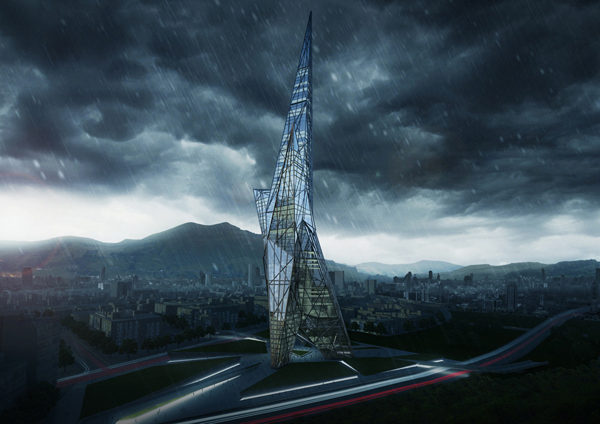
The project can be interpreted as an attempt to create an urban landmark and a new identity for contemporary Taiwanese architecture. As a result of collaboration between two firms, OODA and OOIIO, the design won the Merit Award at the Taiwan Conceptual Tower International Competition in 2010.
The 300 meters high tower would include offices for Taichung City Government, leisure and recreational functions, retail and educational centers and the new Museum of Taichung City Development. The three entrances are located in three separate volumes joining approximately at the middle of the rise. The main body of the structure would accommodate most of the public activities. The sky lobbies form sightseeing zones offering numerous views of the city. Read the rest of this entry »
The Aldgate Landmark Pavilion – 2012 Olympics / EASTON+COMBS
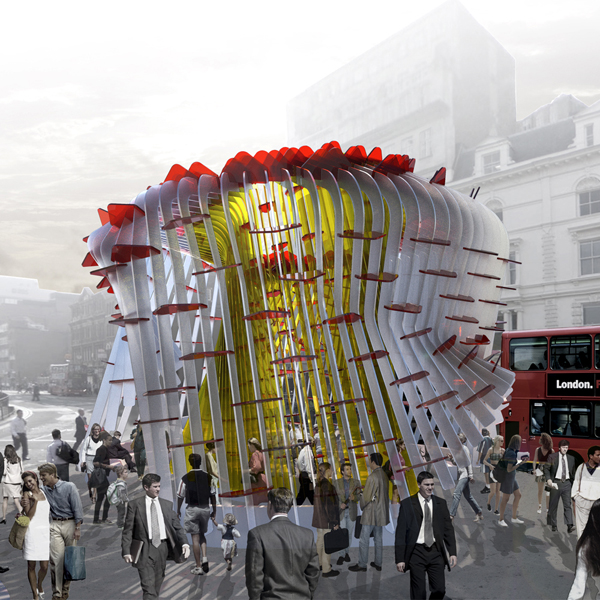
The Aldgate Landmark Pavilion designed by Easton + Combs is a temporary entrance marker to the City of London in celebration of the 2012 Olympics. The site’s importance is that it is the location of the former city gate, the Aldgate, a historically significant point of entry to the city of London that was famous for being open to all social classes when the other city gates were reserved for various elites.
As the architects state, the Pavilion serves as a symbolic greeting hall, a light filled, multicolored, transparent surface that creates a momentary envelope for the celebration of the 2012 Olympics and a spatial marker of London’s archeology of social exchange. The Aldgate 2012 Pavilion addresses the city as a multilayered set of possibilities that constitute an urban theater. As an architectural celebration of the 2012 Olympics, the structure is vibrant and porous yet asserts a sense of place and provides for a variety of possible events. Readings, music and gatherings are accommodated in the large room with a unique cylindrical inverted crown that suggests a space of performance and social exchange. Read the rest of this entry »
Museum of the Built Environment in Riyadh / FXFOWLE Architects
The New York-based firm FXFOWLE has six active projects in the King Abdullah Financial District in Riyadh, a 55 million-square-foot, mixed-use development. Among them is the Museum of Built Environment, which aims to explore the role that social, economic, and environmental forces have played in the region’s constructed landscape, both historically and in recent times.
The 340,000-square-foot museum will be sited near a large plaza by a sunken pedestrian parkway. It will house galleries for permanent and temporary exhibitions, a 150-seat auditorium, and a restaurant, in addition to a monorail station and a network of skywalks. Read the rest of this entry »