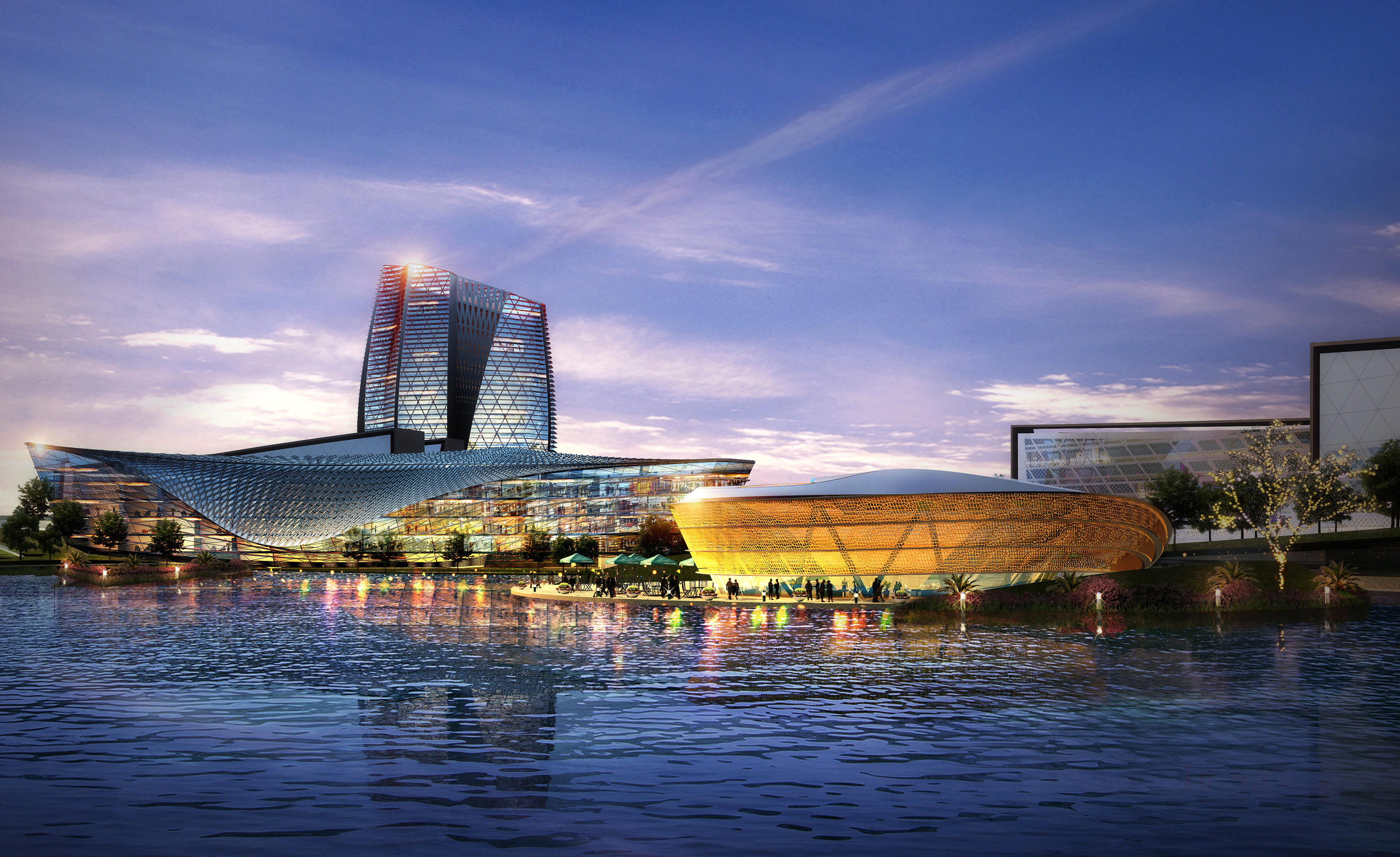
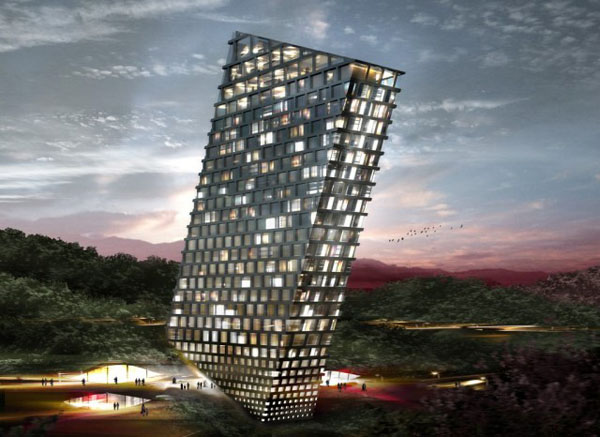
Spear tower is a five-star luxury hotel designed by architecture students Milica Stankovic and Vuk Djordjevic from Belgrade University in Serbia. The main idea was to create a high-rise hotel as a new land-mark for the city. The tower is 201 meters tall and has 80,000 square meters of space. The structure itself consists of an inner core and an outer shell as a chamfered triangle supported by seven rotated trusses. Green floors are repeated every six floors while extended green floors are open-space gardens accessible to guests and visitors. The gap between the inner core and the extended trusses provides an excellent source of natural ventilation to the entire building. The hotel has four restaurants, three bars, a large conference area, a wellness center, an art gallery, a library, several shopping areas, and over 250 rooms. Read the rest of this entry »
Aberrant Architecture Residential Urban Farm Tower
In an increasingly dense urban fabric, residents become further disconnected from the origin of food they consume. Urban vertical farms challenge this disconnect, often through challenging design. Emerging architect Scott Johnson has hyperlocalized the vertical farm into a program that supports the tower’s residences with a tiered farm in the core of the building.
The Chicago based concept tower is based on the structure of a sea cucumber. The animal is a part of the Echinoderms family with a spiny exterior skin protecting soft tissues dedicated for digestion and reproduction. The provocatively named project Aberrant Architecture is conceived similarly as a ridged exterior frame supporting the floor plates. An outer section is for a hotel and residential units, making up the bulk of the program of the outer ring. The southern face is reserved to food production and dips to provide exposure for an inner tower which is dedicated for growing crops. Each level is reserved for one of twelve foods, depending on solar exposure and humidity. Read the rest of this entry »
Design Agency Headquarters in Enns, Austria
Hertl Architekten unveiled their completed project for a design agency and apartments situated directly on the bank of the river Enns in Austria, the site offers a meadow with old fruit trees and a view to a forest slope above the water in the west. The house for a design agency and an apartment moves close to the street in the east. It’s nearly without openings there. The building regulations allow one and a half stores. That is why diagonally roofs determine the form of the design. They are arranged as three layers of different length and hereby react on the scape of the site and the internal functions.
The sculptural volume is covered with a concisely surface made of a black rubber film. It is roof and façade at the same time and it plays with the analogy to the media industry. Light domes of different dimensions are scattered over the surface, meant as a metaphor of water droplets. They illuminate the office and emphasize on the black covering.
The entrance to the office is at the street corner. It’s emphasized by a loggia and the fact that it stands alone. A stairway in a ravine at the east side of the middle tract leads to the second floor. The open office space, which makes the form of the roof visible inside, is seperated from the ravine only by parapet wall. The space is structured by a discussion area which is thought as a box. There is only one view through a small strip window to the river. Read the rest of this entry »
Foster + Partners Designs the UAE’s New Zayed National Museum
The new plans for the Zayed National Museum, a monument and memorial to the United Arab Emirates founding President Sheikh Zayed bin Sultan Al Nahyan, were recently unveiled by Foster + Partners, an international architecture firm based in the United Kingdom.
The museum, which will be located on Saadiyat Island, 500 meters off the coast of Abu Dhabi, seeks to blend modern, sustainable architectural design with traditional Arabic forms and cultural values. The result is a warm and hospitable complex that, while forward-thinking in design, is also uniquely of its place.
The museum will be warm culturally, but literally as well: the complex is comprised of a dramatic lobby that sits within a man-made hill, and is topped, in addition to a thick layer of earth, by five wing-shaped, solar thermal towers that act as thermal chimneys. Fresh air that flows into the lobby is pushed through the complex and up through the towers, giving a constant, cool airflow to the museum. The towers are made of lightweight steel to mirror the light, aerodynamic design of a bird’s wing. This design is functional but also references Sheik Zayed’s love of falcons. Read the rest of this entry »
Lush Garden Bubbles Pop up in Paris’s Wintery Streets
Part art installation, part portable sanctuary, the “Ma Bulle, Ma Plante, & Moi” (My Bubble, My Plant, & Me) exhibition by Amaury Gallon recently placed several transparent, plant-filled bubble structures on the streets of Paris to provide passers by with 15 minutes of inspiration, beauty, and fresh air.
Four bubble gardens in total were constructed. One bubble overflowed with plants to be a “jungle;” another was filled with hundreds of orchids that were woven around the metal supports that comprised the bubble’s frame. All featured hundreds of lush plants and flowers, which were visible through the clear cover that enclosed the bubbles, which were wrapped around the metal frame. Read the rest of this entry »
Multi-Agent Design Methodology / TU Delft Research
“Progression Through Unlearning” is part of an ongoing research by Bao An Nguyen Phuoc, Arie-willem De Jongh, and Mingy Seol from TU Delft into an architecture which explores the generation of programmatic, structural and spatial order through a multi-agent based design methodology which operates in a high pressure environment. The intention was to achieve highly varied heterogeneous spatial formations, catering to a wide variety of human activities and programmatic demands. The strategy of the project was to explore the possibilities of connecting exclusive programmatic and hard threshold zones through a continuous and gradient experience of the multifunctional voids and green areas. Read the rest of this entry »

Jewish Memorial in Frankfurt, Germany / AquiliAlberg
AquiliAlberg unveiled their project for a new Jewish Memorial in Frankfurt, Germany inspired by the work of British author Zygmunt Bauman. The project consists of a path where tension reaches very high levels, a memorial that marks the point where more than 10,000 Jews were captured and later transported to concentration camps. Two sculptural geometries rest in a reflecting pool that extends toward the old Market Square. The sculptures morph into elongated geometries that delineate a pedestrian path with seating areas and contemplation gardens – a profound place for meditation. Read the rest of this entry »

Reiser + Umemoto Wins First Prize for the New Port and Cruise Service Center in Kaohsiung
Reiser + Umemoto (RUR) has been awarded First Prize in the international competition for a new Port and Cruise Service Center in the city of Kaohsiung in southern Taiwan, ROC.
For the Kaohsiung Port Terminal, RUR proposes a dynamic 3-dimensional urbanism that takes advantage of the site’s unique lateral positioning with respect to the city grid. Existing public pedestrian flows along the proposed elevated boardwalk can be amplified, rather than interrupted by creating a continuous elevated public esplanade along the waterfront. Cruise and ferry functions, meanwhile, are located just below the public level and are kept distinct to maintain secure areas for departing/arriving passengers.
The Main Hall splits up into three different partitions, each related to a different itinerary for travelling by ship, while the concourses are oriented parallel to the waterfront to maximize the interface between water and land. By vertically separating the functions of the general public, port business, and travelers along this waterfront edge we are able to keep the various operational uses highly efficient while at the same time allowing for the synergy of mixed functions for the general public. Vertical circulation is organized around thickened zones in the building’s skin which also house structure, utilities, and ventilation. The structure is a system of nested, long-span shells, which are composed of an underlying steel pipe space frame which is sandwiched by cladding panels to create a useable cavity space. Overall an experience of directed yet functionally separated flows will lend an aura of energy to the point terminal space. Read the rest of this entry »

The Opus, Mixed-Use Development in Dubai / Zaha Hadid
Zaha Hadid Architects revealed the Opus, a mixed-use commercial and retail development located in the Business Bay district of Dubai. The Opus is a fluid, spatial building that refutes traditional definitions of office functionality. Constructed of three separate towers the building will appear as a singular unified whole, that hovers from the ground, with a distinctive free form void. The interiors of which will be clad with a fully engineered curved glass curtain wall to allow for eye-catching views into the void. Reflexive fritting patterns in the form of pixilated striations will be applied onto the glass facade to provide a degree of reflectivity and materiality to the cube while assisting in the reduction of solar gains inside the building. Read the rest of this entry »

The Hill House Brings an Extreme Green Roof to Residential Architecture / BIG
The “Hill House” designed by Bjarke Ingels Group is, simply, a single family home with a green, living roof. However, the roof is special in how large it is: the elongated roof essentially serves as the structure’s roof and side walls simultaneously, wrapping from the top of the building down the sides, and connecting with the earth. The surface is covered in living sedum plants, which are low maintenance and drought tolerant.
The sedum roof protects the home from the hot sun in the summer, and keeps warmth in during the cold winter. Ingles also envisions it as a playful architectural element: the roof, he shows in renderings, can be used as a recreational greenspace, and perhaps could even be a hill for sledding or skiing down during Denmark’s long winters. Read the rest of this entry »