Editors’ Choice
2025 Skyscraper Competition
Abolfazl Malaijerdi
Iran
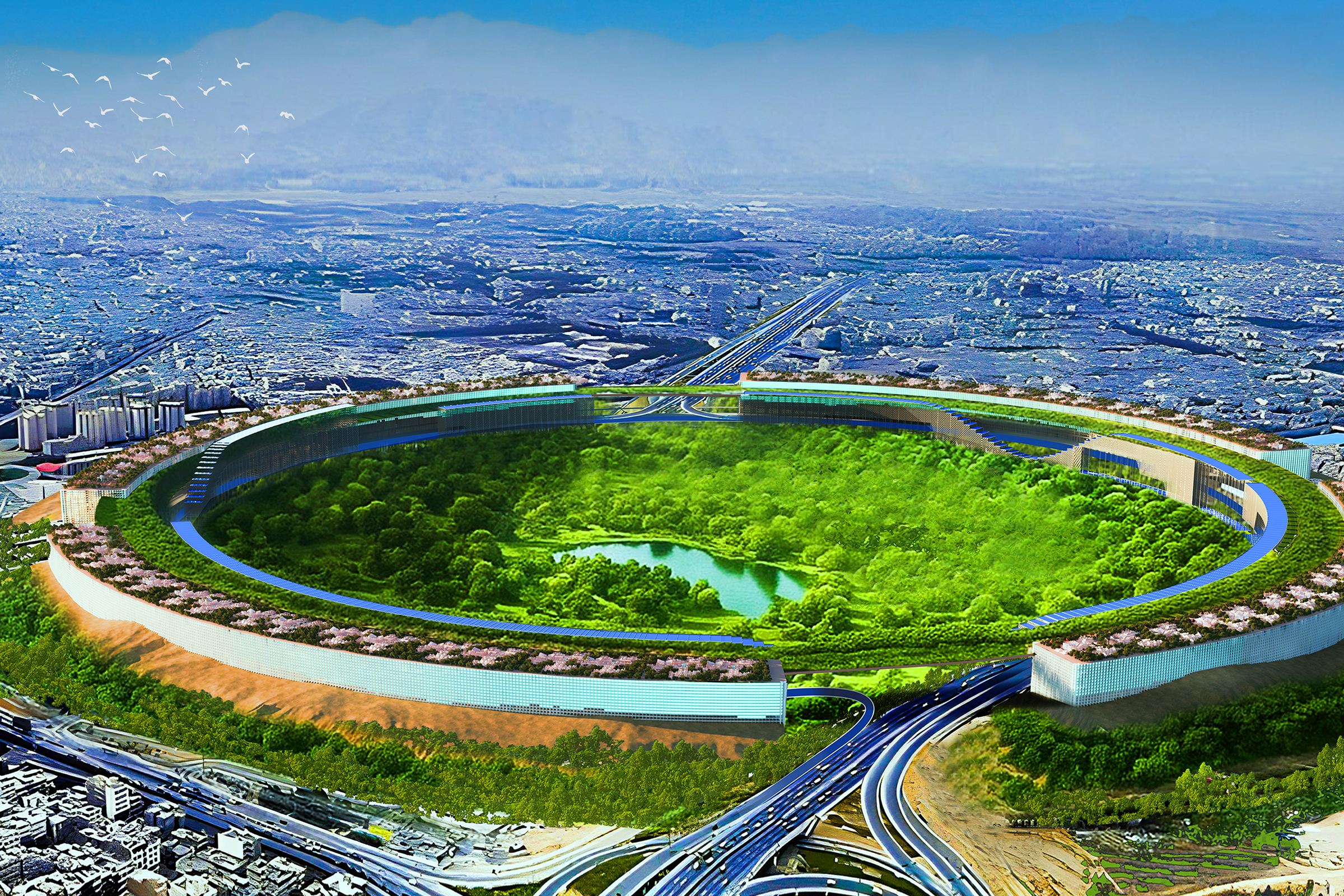
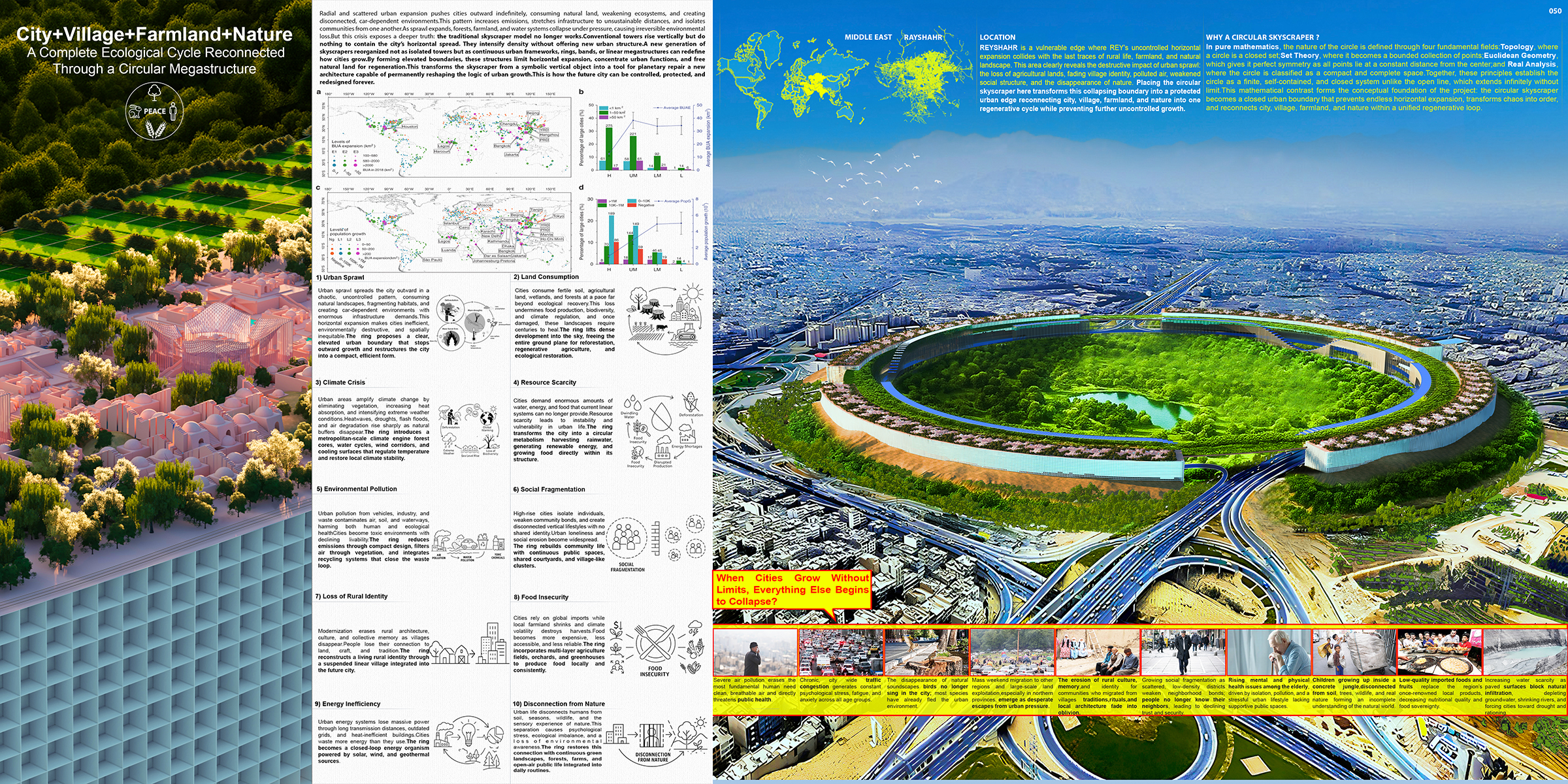
Contemporary urbanization has reached a geometric and ecological breaking point. Cities expand horizontally in a pattern that resembles an infinite open line—consuming land, erasing rural identity, destroying biodiversity, and exhausting infrastructures far beyond their intended limits. This project proposes a radical, mathematically defined alternative: a circular megastructure that transforms uncontrolled sprawl into a self-regulating urban boundary, allowing nature, agriculture, and community to re-emerge within a protected central territory.
The proposal is set at the edge of Reyshahr, a region where the city grows aggressively toward remaining agricultural grounds and historical rural settlements. The aim is not to design a vertical object but to redefine the skyscraper as a territorial system—one that reorganizes land consumption, energy cycles, and human settlement patterns. Instead of extending outward, the city becomes a continuous ring that contains its own growth. The interior, once threatened by expansion, is reclaimed as a large-scale ecological reserve: forest, productive farmland, natural water systems, and restored wildlife.
The circular geometry is not symbolic. It originates from the principles of pure mathematics. In topology, a circle is a compact set—finite, closed, and self-containing—an exact opposite of a divergent line. In Euclidean geometry, the circle distributes distance uniformly, enabling equal access, symmetric organization, and coherent spatial hierarchy. In real analysis, the circle represents the elimination of infinity: the act of turning limitless extension into a closed, stable, regulated form. These mathematical characteristics become architectural logic: the circular skyscraper becomes a limit, a boundary that stops sprawl, and a framework that reconnects the fragmented systems of modern metropolitan life.
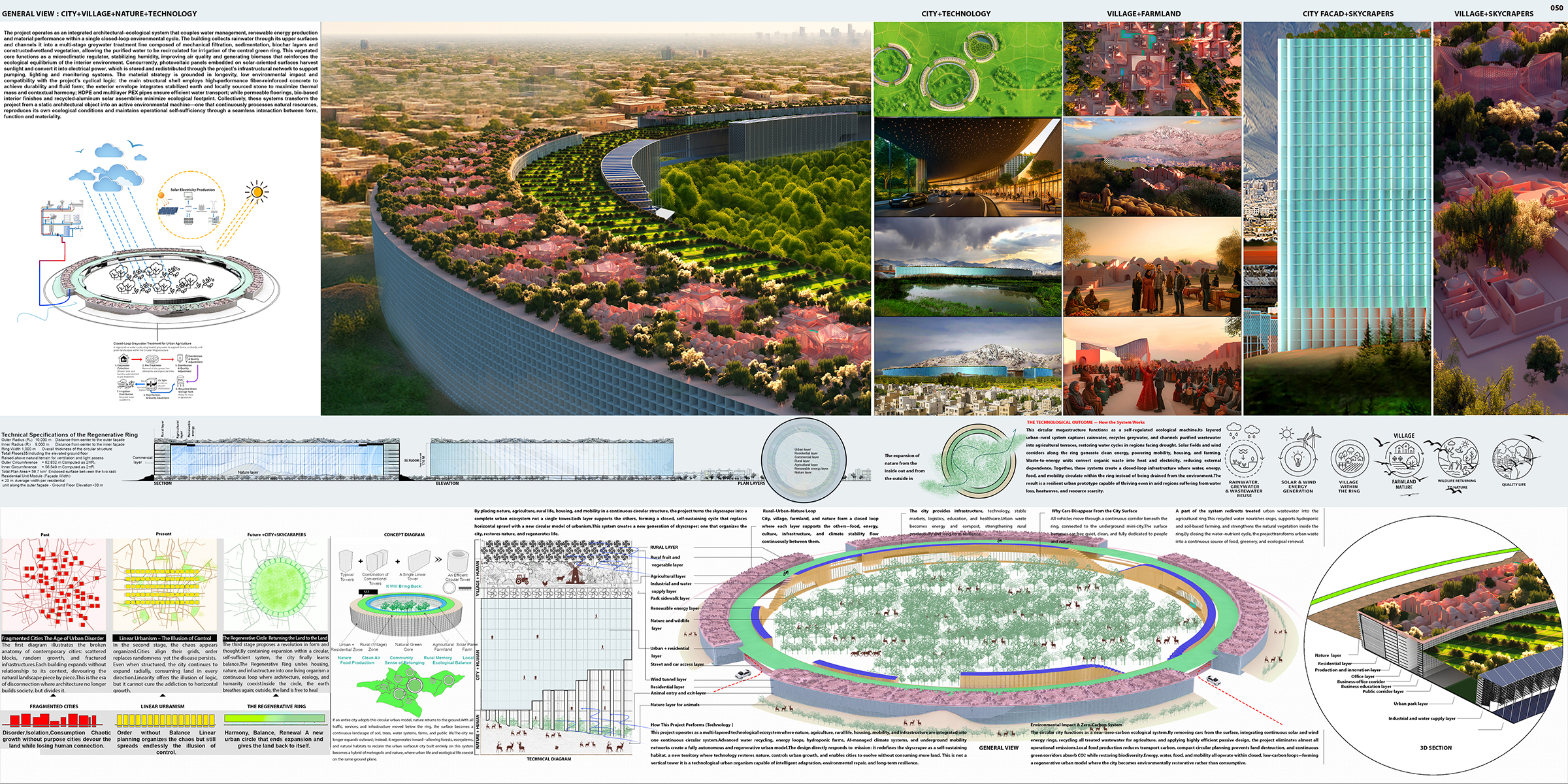
The megastructure contains three major layers interacting in a continuous ecological loop:
1. The Urban Layer
High-density housing, public institutions, cultural spaces, mobility corridors, and clean energy networks are integrated into a compact circular band. All vehicular systems are relocated beneath the ring, connecting to an underground sub-city. As a result, the entire upper surface becomes pedestrian, silent, and pollution-free. The ring produces its own energy through solar, wind, thermal, and kinetic systems embedded in the façade and roof structure.
2. The Rural-Productive Layer
This layer restores what rapid urbanization erased: local agriculture, orchards, micro-farms, and village-style clusters. Traditional rural morphology is reinterpreted through modular, low-rise units with shared courtyards and communal productive spaces. Food cycles shorten, quality improves, and communities regain identity and resilience. Organic waste returns to the soil, and greywater is treated and reused for agricultural irrigation.
3. The Nature Layer (The Central Forest)
At the heart of the ring lies a rewilded natural reserve—a protected habitat where forests regenerate, wildlife returns, and native ecosystems flourish. This zone functions as a carbon sink, a biodiversity corridor, a climate stabilizer, and a long-term environmental archive for the city. It reverses heat islands, restores groundwater, and reintroduces the natural cycles that sprawl had fragmented.
Together, these three layers form a closed-loop environmental machine. Energy is produced on-site, water is recycled and reinfiltrated, food is grown locally, mobility becomes electric and hidden, and nature is restored rather than displaced.
This proposal redefines the skyscraper not as vertical ambition, but as territorial responsibility—a typology capable of shielding land, regenerating ecosystems, and restructuring human settlement patterns at the metropolitan scale. If applied as a systemic model, entire cities could transition from destructive expansion to circular ecological renewal, allowing nature to return to the surface of urban civilization.