Editors’ Choice
2025 Skyscraper Competition
Inseok Moon
South Korea
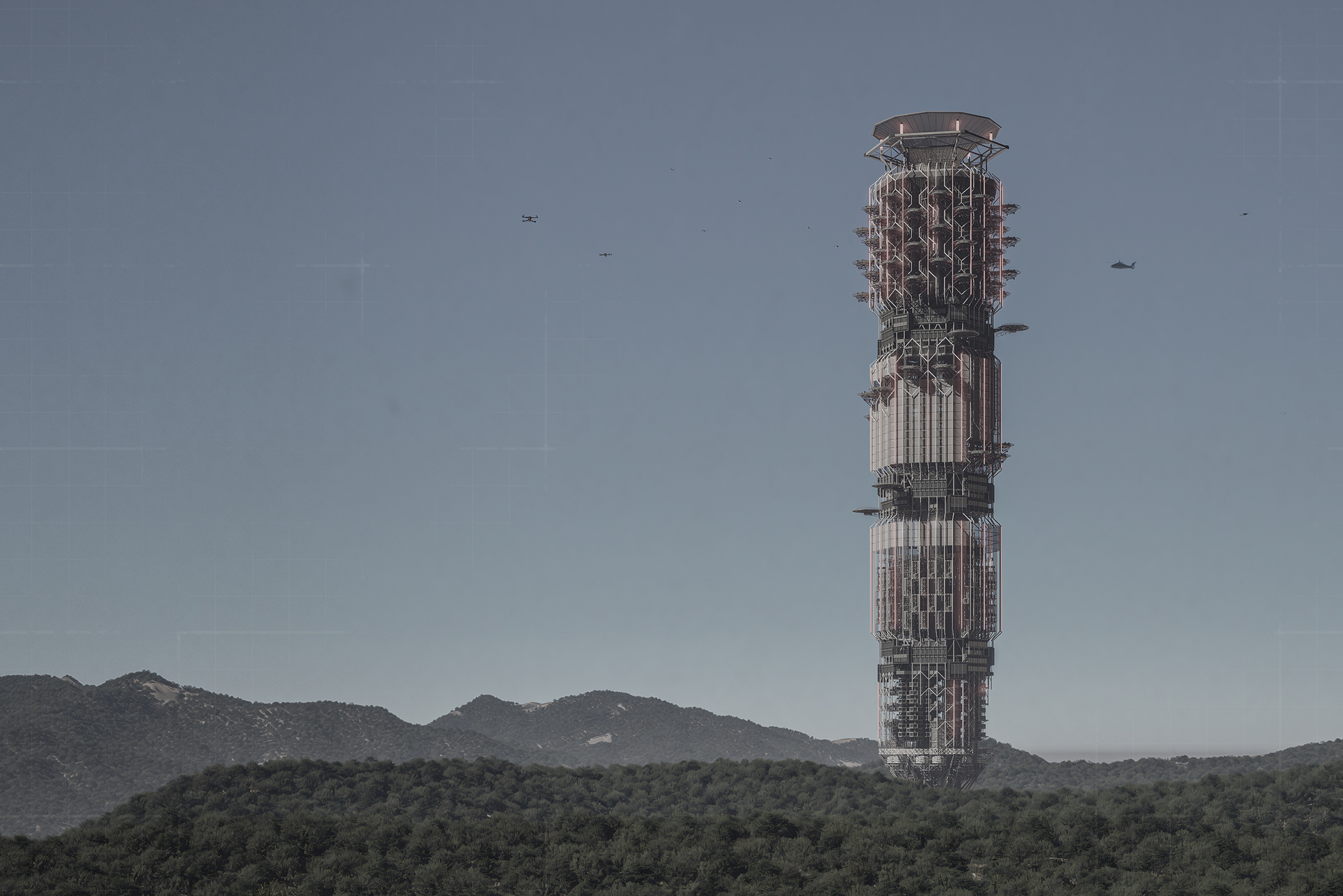
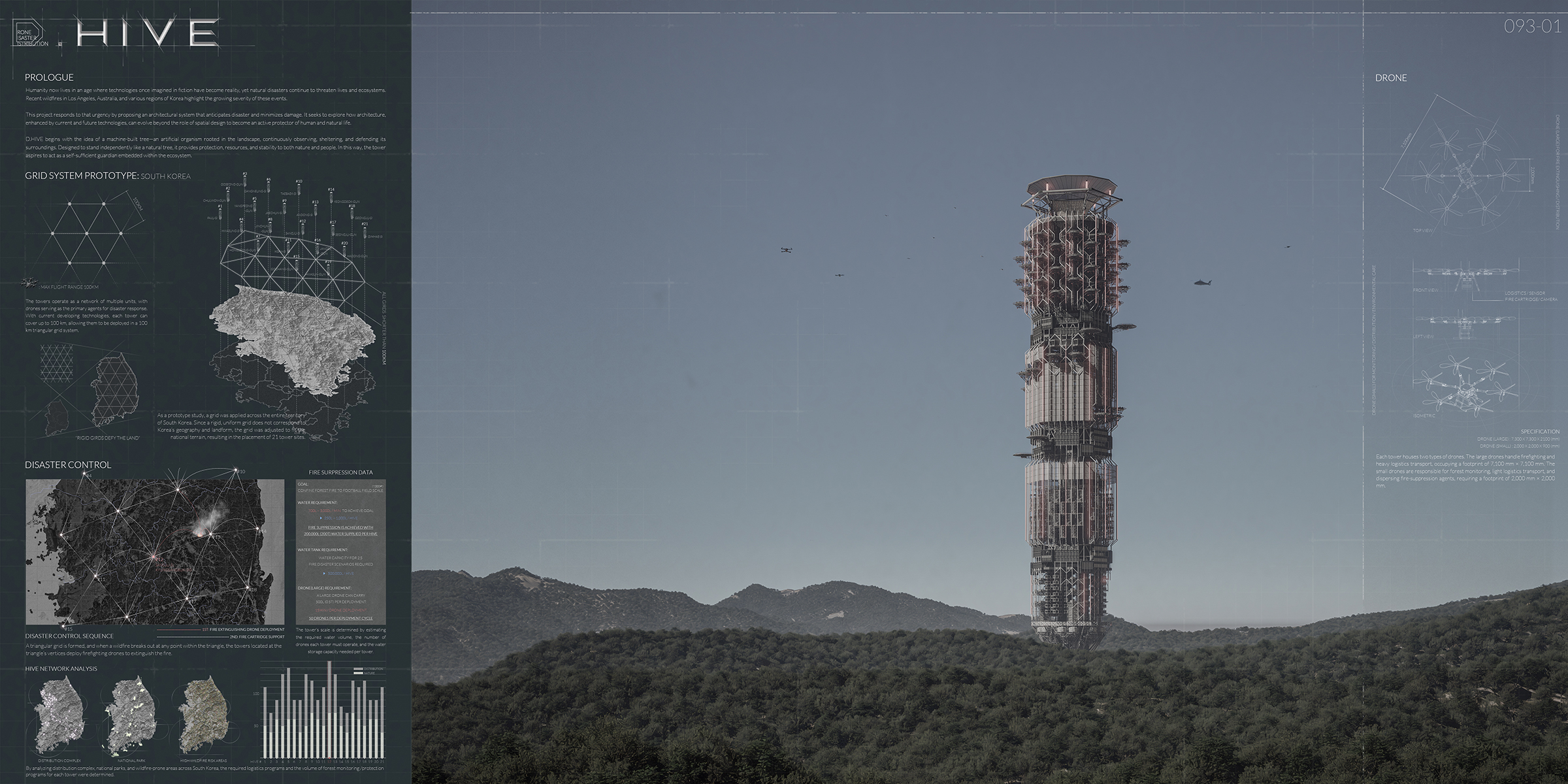
Humanity now lives in an age where technologies once imagined in fiction have become reality, yet natural disasters continue to threaten lives and ecosystems. Recent wildfires in Los Angeles, Australia, and various regions of Korea highlight the growing severity of these events. This project responds to that urgency by proposing an architectural system that anticipates disaster and minimizes damage. It seeks to explore how architecture, enhanced by current and future technologies, can evolve beyond the role of spatial design to become an active protector of human and natural life. The concept begins with the idea of a machine-built tree—an artificial organism rooted in the landscape, constantly observing, sheltering, and defending its environment. Like a tree that offers refuge, food, and structural stability, the tower aspires to function as a self-sufficient guardian within nature.
The project envisions a distributed network of towers arranged across the national landscape through a triangular grid system. With drone technologies capable of covering distances up to 100 kilometers, the towers are positioned at grid vertices to create a responsive surveillance field. Because a rigid grid cannot conform to Korea’s complex geography, the system is adapted to the contours of the land, resulting in twenty-one towers placed in locations optimized for coverage and terrain. When a wildfire ignites anywhere inside a triangular cell, the three towers surrounding that area deploy firefighting drones directly to the ignition point. The goal is to extinguish the fire before it grows to the size of a soccer field. To achieve this, the project calculates the water volume, drone capacity, and storage requirements for each tower. Additional analysis of logistics hubs, national parks, and high-risk regions determines the needed distribution of ecological monitoring and supply-chain functions.
Each tower houses two drone types: large drones for firefighting and heavy cargo transport, requiring a footprint of 7,100 by 7,100 millimeters; and small drones for forest monitoring, lightweight logistics, and dispersal of fire-retardant agents, each operating within a 2,000-millimeter module. Since disaster frequency varies seasonally in Korea, the towers also serve as drone-based logistics centers during non-emergency periods. Their nationwide distribution allows them to operate as a unified supply network, with integrated recycling facilities processing plastic and paper waste into usable fuel—enabling the tower to achieve energy self-sufficiency, much like a living tree.
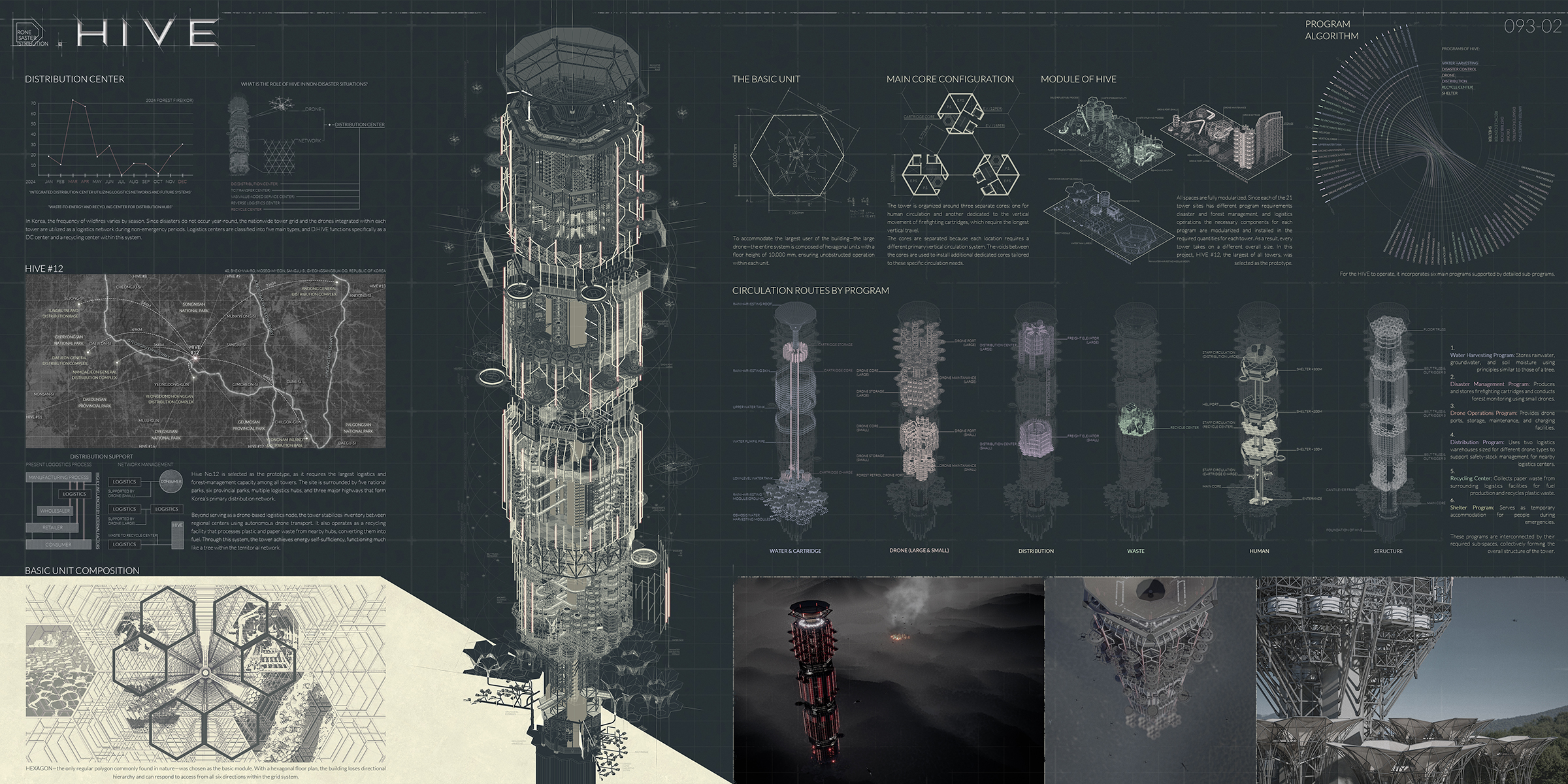
Hive #12 is developed as the prototype, located in a region surrounded by 5 national parks, 6 provincial parks, several logistics zones, and major expressways including the Gyeongbu, Jungang, and Jungbu Naeryuk expressways—the backbone of Korea’s distribution system. Beyond functioning as a drone hub, 21 Hives also support safety-stock balancing between logistics centers, carries out extensive ecological monitoring, and converts collected waste into energy for tower operations.
The architectural system is organized around a hexagonal module—the only regular polygon found in nature—eliminating directional hierarchy and allowing six-way access within the grid. Each unit is 10m high on plan to accommodate the largest drones. Three separated vertical cores divide human circulation, equipment movement, and firefighting cartridge transport. All programs are modular, allowing each site to assemble a tower with a customized ratio of functions based on regional needs.
The tower integrates six major operational programs: water harvesting, disaster control, drone management, logistics (distribution center), recycling, and human refuge. These interlinked systems create a cohesive architectural organism. The only human-occupied zone is the shelter level, positioned every 100 meters and supported by outrigger and belt-truss structural systems derived from supertall building engineering. Together, these elements form a new infrastructural typology—an artificial forest of machine-trees designed to defend both people and nature.