Editors’ Choice
2025 Skyscraper Competition
Parv Shah, Reeshica Singh, Himanshu Sanghani
India
In laboratories around the world today, brain–computer interface experiments—led by companies like Neuralink—are pushing primate cognition into uncharted territory. These trials were originally created to treat neurological disorders, restore motor functions, and decode how the brain communicates with machines. Apes were chosen for their genetic proximity and their ability to participate in structured tasks. The goal was medical, contained, and human-centered.
But the results emerging in 2025 are far from what these experiments set out to achieve. Apes fitted with neural implants are now demonstrating abilities beyond scientific projections. They are solving complex cognitive puzzles, navigating multi-stage mazes, predicting patterns, and adapting to unfamiliar challenges with startling speed. Their learning curve is rising exponentially. What was meant to be a controlled clinical trial is becoming an evolutionary shift—one unfolding before us without frameworks to understand it.
And this breakthrough arrives at a moment when the built environment itself is under pressure. Cities are overheating. Forests are shrinking. Resources are drying up. Infrastructure is aging faster than it can be repaired. Even for humans alone, our cities are proving inflexible, fragile, and poorly adapted to the pace of global change. Yet architecture continues to operate under one assumption: that the only intelligent user of the city is the human.
Despite these rapid cognitive shifts, we remain reluctant to imagine the consequences. If apes begin to think like us but move, sense, and inhabit space as apes, how will they survive in cities built around human bodies, behaviour, and dominance? If another intelligent life form evolves beside us—capable of memory, problem-solving, and communication—our cities have no spatial strategy, no architectural language, and no shared system of movement, climate, or governance for coexistence.
For centuries, humans have integrated domesticated animals into daily life, but wild intelligent species—especially apes—have remained separate, confined to roles of being studied or controlled.
Harmonia challenges this boundary.
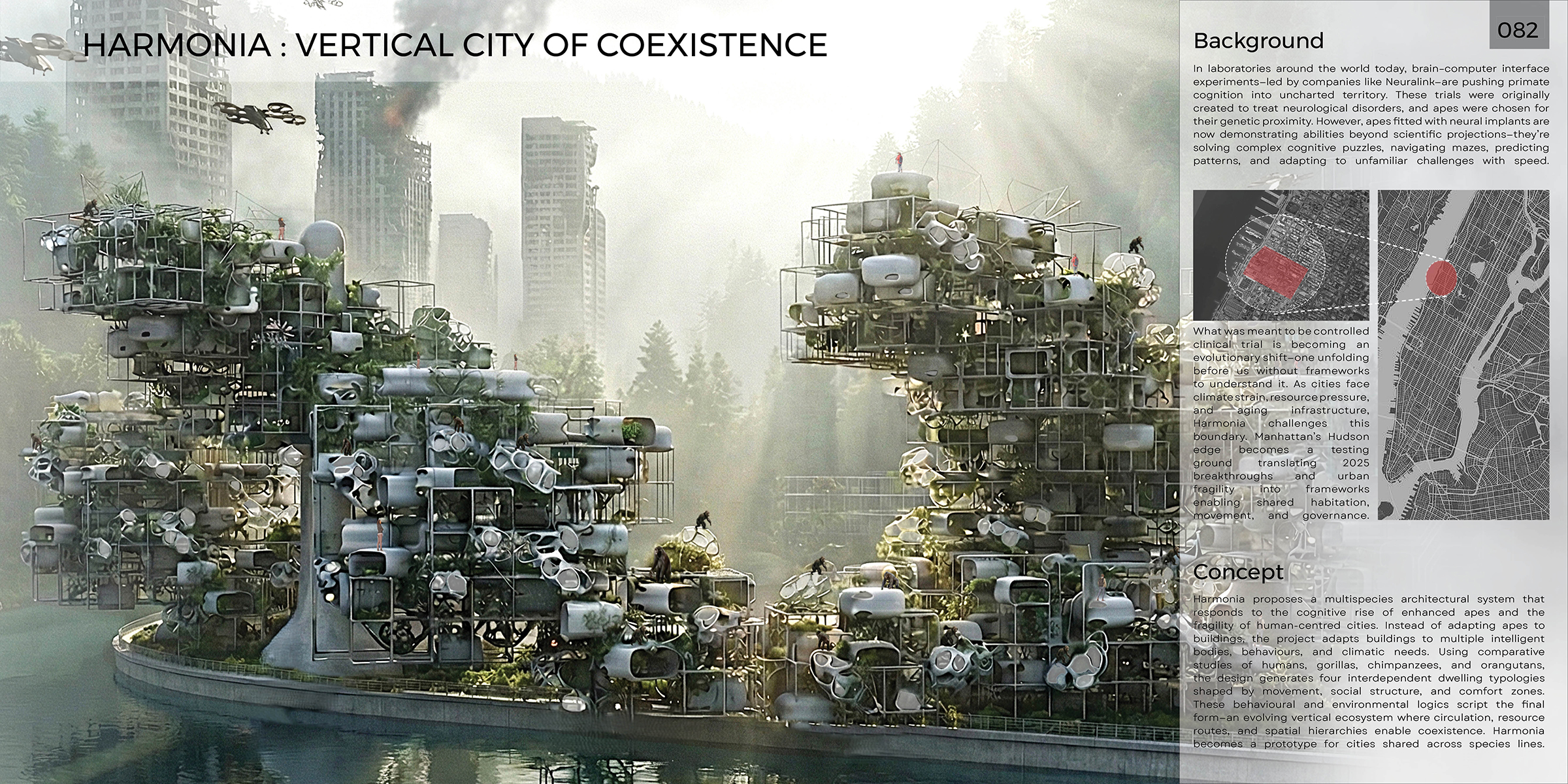
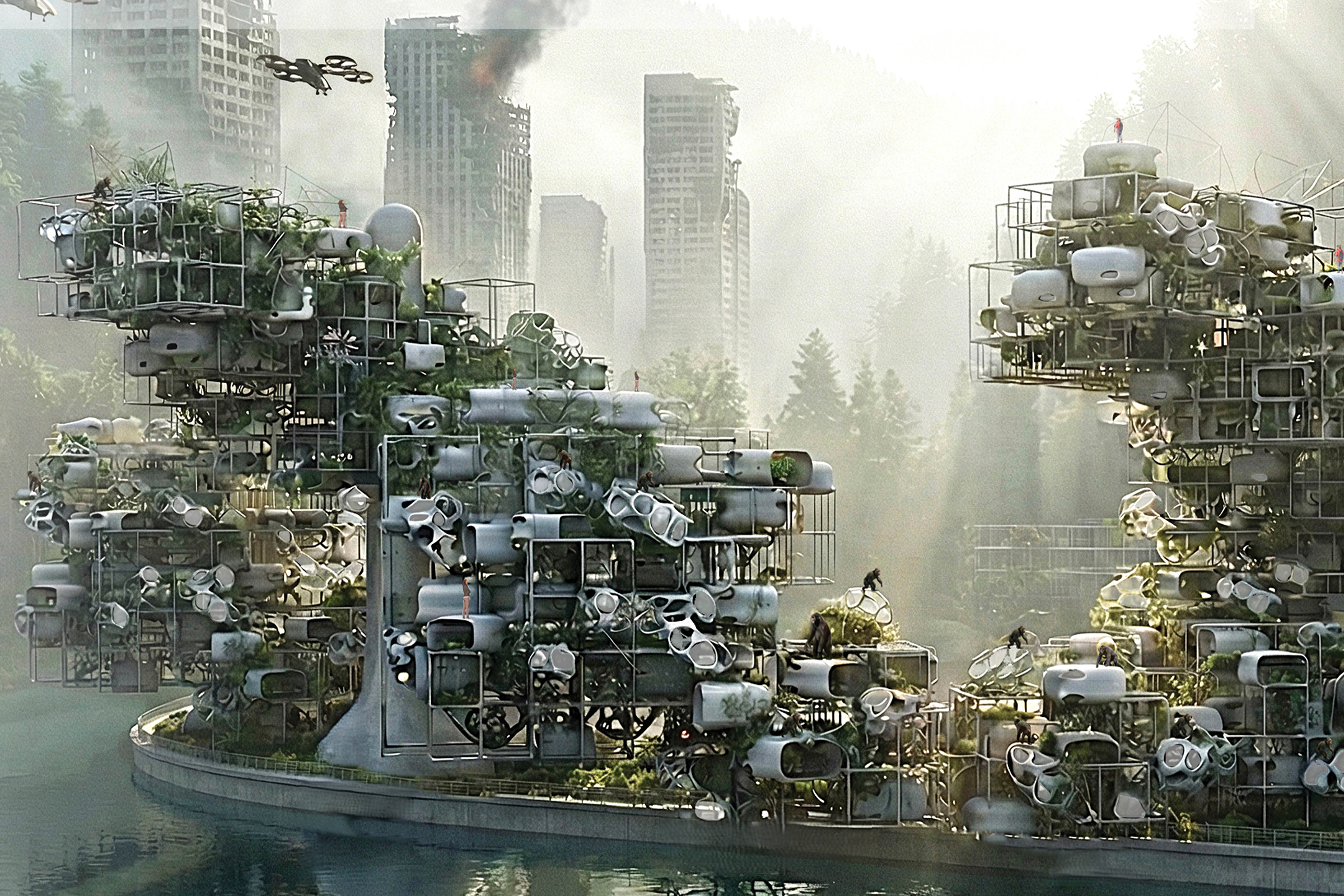
It imagines a near future where enhanced apes and humans coexist as equal stakeholders, sharing access to space, movement, resources, and governance. The project argues that architecture can no longer be exclusively human-centric; it must evolve into a system capable of hosting multiple intelligent life forms.
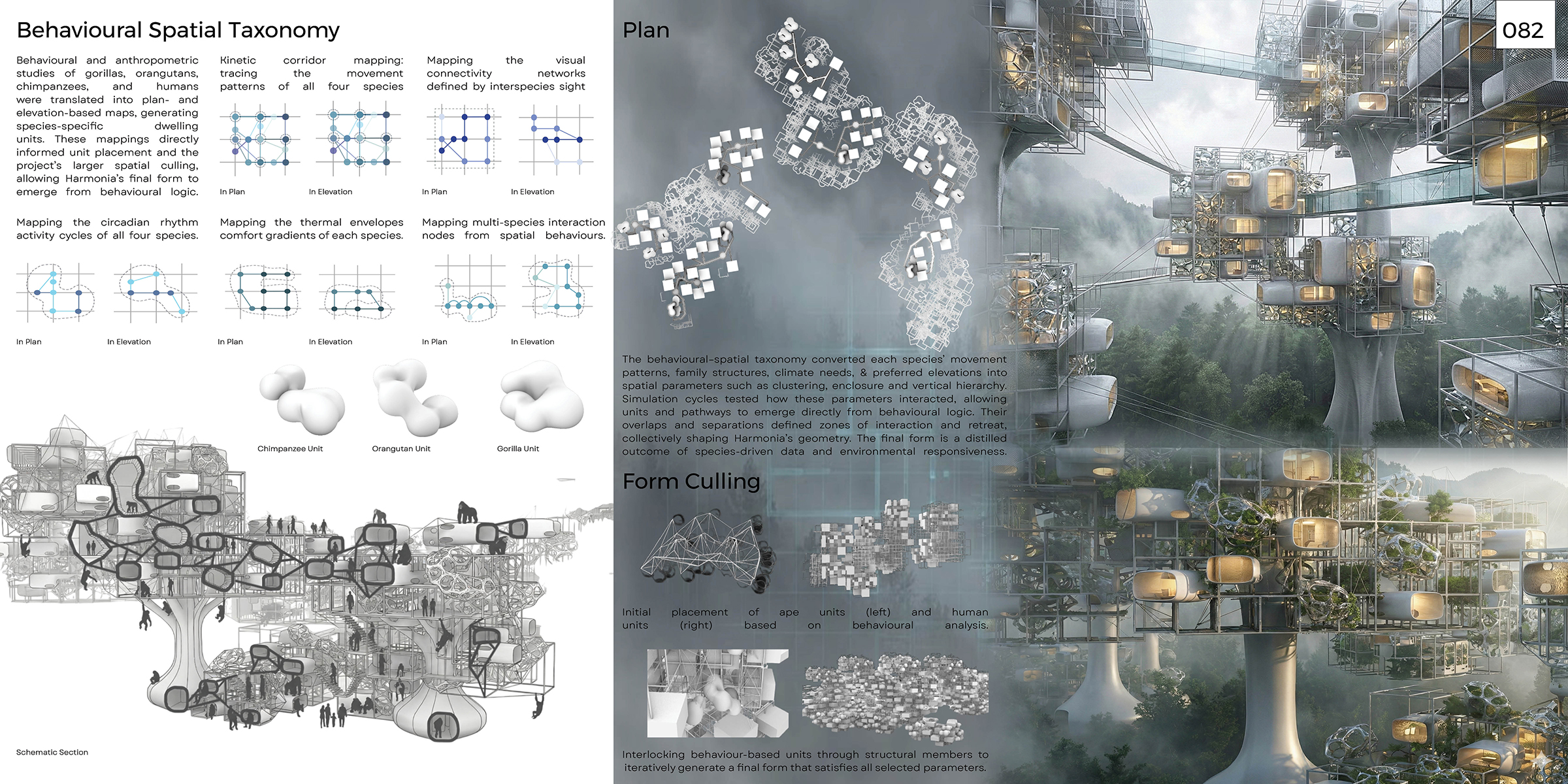
Harmonia’s design framework emerges from a comparative study of four users—humans, gorillas, chimpanzees, and orangutans—each with distinct anthropometric profiles, body mechanics, social structures, and behavioural rhythms. Gorillas live in compact ground-based families of three to four; chimpanzees form mid-level clusters of ten to twelve; orangutans inhabit upper canopies, often alone or in pairs; humans occupy flexible, horizontally organised units. These differences shape four dwelling typologies, calibrated to size, movement, and family patterns.
Climatic behaviour further develops the architecture. Humans gather in warm southern pockets and avoid high-wind corridors; gorillas prefer cool, shaded, low-humidity zones; chimpanzees move between shaded and sunlit mid-levels; orangutans thrive in humid upper environments. These comfort zones were mapped against the site’s microclimate—sun paths, humidity pockets, wind tunnels—so the architecture could align environmental logic with species-specific needs. Harmonia treats architecture as a responsive, semi-ecological organism.
The final form is generated through scripted behavioural, climatic, and spatial constraints, producing a vertical ecosystem capable of intelligent self-regulation and dynamic equilibrium.
Set on a neutral stretch along the Hudson River, Harmonia’s placement in Manhattan signifies the necessity of sharing humanity’s most prized cities. Nestled by the Hudson, it offers protection, resources, and a bold blueprint for interspecies cohabitation.
Harmonia stands as the world’s first prototype for multispecies urbanism—a future where architecture is not a human privilege but an ecological framework for multiple forms of intelligence.