Header Image
  • Home
  • news
  • magazine
  • competition
  • About
  • Shop
  • Jobs
  • News
  • architecture
  • design
  • art
  • 2022
  • 2023

La Tour Bioclimatique: Luxury Sustainable High-Rise For Paris

By: Marija Bojovic | June - 4 - 2014

UNStudio, Paris, France, bioclimatic, tower, sustainability, second skin, active strategies, passive strategies, flexibility

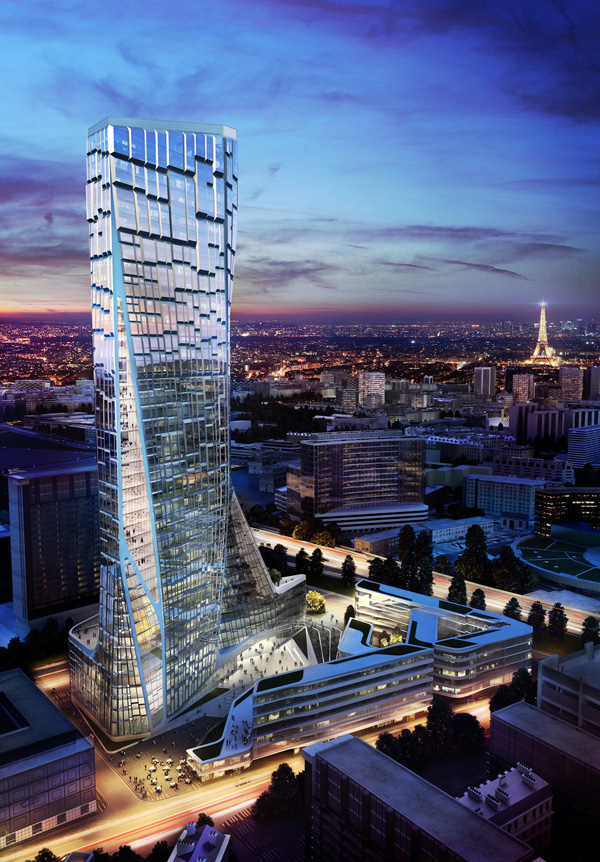
La Tour Bioclimatique office tower by UNStudio was designed as an organizing element for the previously disconnected programmatic clusters within the Issy-Les-Moulineaux area of Paris. In order to find the most optimal placement on the site, a typological study was performed, resulting in a streamlined plan that gives an optimal basic plan.This basic plan of the building has been further optimized into a smart organization by utilizing software driven form-finding processes which take into account optimal floor area in relation to compact core design, optimal facade length and daylight penetration for the offices.

As they state at UNStudio, sustainability is an integral part of the design process as three interconnected entities – passive sustainability which focuses on non-technological parameters such as building efficiency, flexibility and materials; active sustainability which integrates fully the design of technological techniques to advance the operational efficiency and social sustainability which caters on the level of user comfort and the influence of the building on its surroundings on multiple scale levels. Next to building efficiency, flexibility is an equally important factor for ensuring future usability. The floor plan and vertical distribution are designed in such a way that many different tenant scenarios can be realized.

The facade functions as a skin for the building that contains all the key factors of a sustainable high-rise building. The concept of the natural ventilated double facade is limited to a height range of 1-4 floors to prevent the risk of overheating, allowing the system to perform to highest standards in all seasons. The building influences the comfort and well-being of individuals by incorporating working environments with different qualities, such as communal work spaces, concentration work spaces, lounges, meeting centers, team work centers. By connecting floors through the expanded double facades and by planting these spaces, vertical office gardens can be created to provide pleasant working environments. Read the rest of this entry »
architecture, featured, news

Floating City By AT Design Office Is A Proposal For A New Sustainable Metropolis

By: Marija Bojovic | May - 27 - 2014

AT Design Office, sustainable design, sustainability, floating city, metropolis, ocean, mixed-use, adaptive, environment

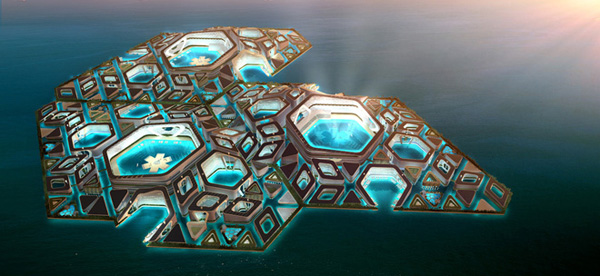
AT Design Office has developed sustainable concept for an ocean metropolis, as a healthy alternative to destroying the earth’s valuable countryside. The existing landmass on earth has been built up so extensively that the remaining free land is under extreme pressure and needs to be preserved as much as possible. Therefore news settlements should be planned in such a manner that important social and environmental conditions are improved and can provide for better future living. Environmentally adaptive measures, higher densities, mixed uses and efficient, smart designs and infrastructure strategies need to be considered.

The floating city has a perfect internal and external traffic system, linking it within but also with the outside world. A cruise dock serves giant ships; a yacht dock serves private vessels and civilian submarine traffic. Submarines and electric vehicles are the main means of transport on the island – keeping the island free form air pollution and congestion caused by automobiles. The main traffic flows and facilitated via the water canals above and below the water surface.

Vertical gardens are interconnected with the public greenery system above and below the water. The Floating City will provide world class facilities, as well as additional supplies of new areas, in order to satisfy the long-term demand for human habitable land. Environmental impacts will be managed via innovative strategies. The proposed development and the associated infrastructure will bring positive change to the community and its economy; therefore the design will meet long-term infrastructure and sustainable development need, while bringing new opportunities to various city activities. Read the rest of this entry »
architecture, featured, news

Algaetecture: Algae Urban Canopy For Milan Expo 2015

By: Marija Bojovic | April - 22 - 2014

Sustainable design, sustainability, algae, algaetecture, cesare griffa, ecologicstudio, carlo ratti associati, Milan expo, future food district project

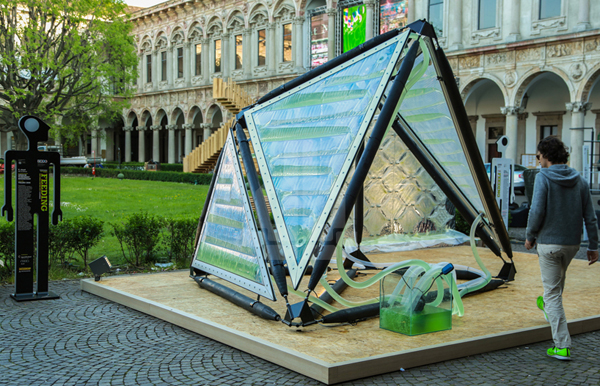
Algae Urba Canopy, as part of the Future Food District project, is being developed by Carlo Ratti Associati at the central crossroads of the Milan EXPO site. The pavilions’ façades and canopy utilize new systems of micro-algae, designed by Cesare Griffa and ecoLogicStudio. Two prototypes – full scale models of the façade and canopy – are being previewed as part of INTERNI’s Exhibition-Event ‘Feeding New Ideas for the City’ during Milan Design Week.

The functioning principle of these prototypes is based on the exceptional properties of micro-algae organisms, which are ten times more efficient photosynthetic machines compared to large trees and grasses. The façade and canopy currently being developed for EXPO Milano 2015 develop a natural man-made ecology and explore the use of algae as an integrated architectural cladding and urban agriculture system. Algae can represent an important part of creating a healthy and live-able planet. Giving life to mysterious urban gardens, algae can be used as an innovative energy and food production system within our cities.

The Urban Algae Canopy, based on ecoLogicStudio’s ‘HORTUS’ system, is presented with a 1:1 scale prototype of the world’s first bio-digital canopy integrating micro-algal cultures and real time digital cultivation protocols on a unique architectural system. The potential of micro-algae have been integrated within a custom designed four-layered ETFE cladding system, whilst the flows of energy, water and CO2 are controlled and regulated in real-time and made to respond and adjust to weather patterns and visitors’ movements. Once completed, as part of the EXPO Milano 2015 Future Food District, this special edition of the Urban Algae Canopy will produce the equivalent amount of oxygen as four hectares of woodland, and up to 150 kg of biomass per day – 60% of which are natural proteins.

The Urban Algae Façade – based on Cesare Griffa’s ‘WaterLilly 2.0’ system – is the prototype of a micro-algae façade, being developed in a special edition for EXPO Milano 2015. ‘WaterLilly 2.0’ is a project for a micro-algae vertical farm to be implemented as an architectural skin. The intention here is that, integrated into the green system of the cities, micro-algae can help in absorbing carbon dioxide and producing oxygen, while acting as a second skin of buildings, boosting passive cooling and increasing shading of the façade. Read the rest of this entry »

architecture, featured, news

Powerhouse at Brattorkaia / The World’s Northernmost Energy-Positive Building

By: Marija Bojovic | April - 8 - 2014

Brattørkaia, Snøhetta, sustainability, sustainable design, Norway, heat pumps, heat exchanger, solar power, solar cells, holistic approach, energy-positive construction

The Powerhouse Alliance is creating the first office building in Norway that produces more energy than it uses. The Powerhouse is designed by Snøhetta and the result is a completely new architectural concept for what will be the world’s northernmost energy-positive building. Buildings account for 40 percent of the world’s energy consumption, and energy-positive construction is an important part of the solution to global warming. The development is a complex and challenging task that requires holistic approaches and thinking. The building is unique and shaped by its surrounding conditions.

Solar energy harvesting is the main design driver for this project. Solar cells, heat exchangers and heat pumps will produce electricity and heat for the building, and sea water will contribute to both the heating and cooling system. The building rises from the fjord towards the north creating a south-facing sloping roof, an optimal condition for solar energy production. The location of the solar cells and windows in the façade accounts for the sun’s intensity to optimize day lighting conditions and minimize energy consumption. In the areas most exposed the sun, the window openings are reduced to minimize the solar heating of the building, while the dense construction of the façade maximizes use of solar energy.

This new construction is designed with the intent that the excess energy produced during the building’s operational lifetime will exceed the energy used to create the building. Brattørkaia is located by the sea in downtown Trondheim and is the planned site of Norway’s first energy-positive office building. Read the rest of this entry »

architecture, featured, news

MVRDV Wins Competition To Build The Collection Building In Rotterdam

By: Marija Bojovic | March - 11 - 2014

BREEAM Excellent, sustainability, reflective, MVRDV, Dutch, Netherlands, Collection Building, art depot, Rotterdam, Museumpark

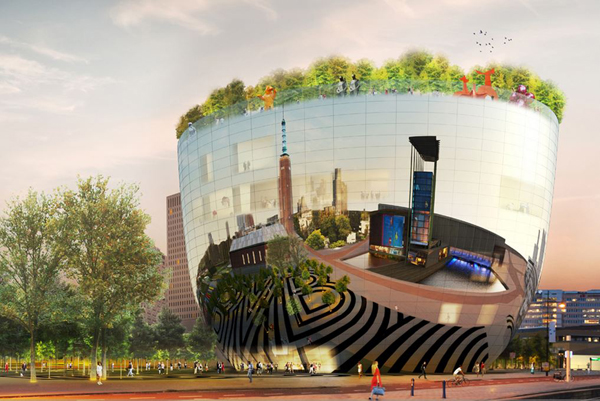
Collection Building by MVRDV is a reflective-skin art depot open to the public. The Dutch architectural practice won the competition to construct the art depot, expected to be completed in 2017. A public route zigzags through the building, from the lobby on the ground floor where a café can be found up to an exhibition space, sculpture garden and restaurant on the roof. On the way up the route passes along and through art depots and restoration workshops. In depots visible from the route, the exhibition can be changed on a daily basis by simply moving storage racks so each visit to the building can offer a unique experience.

The building – which will store the precious art collection of Rotterdam – will also have spaces not accessible to the general public. Logistics, quarantine and room for private art collections whose owners can visit their art and even enjoy it in private spaces comparable to the art-equivalent of a sky box. This is a new commercial service offered by the museum. The roof featuring a restaurant, sculpture garden and exhibition space offers wide views over Rotterdam and will be the new home for the Futuro, the ufo-shaped house of Finish architect Matti Suuronen. Read the rest of this entry »

architecture, featured, news

Exciting Mixed-Use Undulating Towers For Kuala Lumpur

By: Marija Bojovic | March - 6 - 2014

Eco-friendly, kuala lumpur, Malaysia, 10 design, ring, kl gateway, oasis, office tower, tower, high rise, sustainable design, sustainability

IO Design envisioned KL Gateway to be a peaceful green oasis mixed residential and retail development in the heart of Kuala Lumpur, Malaysia. The heart of the project is an outdoor courtyard surrounded by a series of garden spaces. The courtyard is designed to be a public room attracting people from the surrounding neighborhood and city. The ring binds the courtyard to a surrounding retail mall and becomes a gathering spot for the entire mixed use complex. The roof of the ring becomes an outdoor jogging trail and garden for the surrounding residential towers.

Using the latest technology in sustainability, the Corporate Office Towers will be covered in a nano-coating of Titanium Dioxide. This is a photo-catalytic coating that will remove dirt, bacteria and pollution triggered by light. KL Gateway takes bold, responsible steps to be one of the First towers in Malaysia using this green technology. As a green building, it is structured to be environmentally responsible and resource-efficient throughout its life-cycle, hence able to save energy and resources as well as harmonize with the local climate, traditions, culture and the surrounding environment. KL Gateway acts as one of the climate saviors with environmental-friendly features. Read the rest of this entry »
architecture, featured, news

Shenzhen Energy Mansion / BIG

By: Marija Bojovic | January - 6 - 2014

BIG Architects, BIG, Bjarke Ingels, Shenzhen, China, SEM, Shenzhen Energy Mansion, invited competition, first prize, ARUP, Transsolar, sustainability, energy efficiency

Shenzhen Energy Mansion – SEM is BIG’s proposal for an invited competition, organized by Shenzhen Energy Company. The skyscraper proposal is the result of the successful synergy between Bjarke Ingels group and ARUP and Transsolar, and its currently under construction.

The skyscraper typology has evolved as an economically efficient way to provide flexible, functional and well-illuminated work spaces for very dense population of professionals. However, since the early 20th century, air conditioning and electric lighting have served as modern solutions to highly increasing demand without seriously thinking to environmental consequences or energy shortages. Today the tower needs to evolve into a new sustainable species. It must, however, retain highly developed qualities such as daylight, flexibility, views and overall usability while still exercising new and untested attributes. Read the rest of this entry »
architecture, featured, news

MARS’s Efficient Hybrid Wins Walltopia Competition In Sofia, Bulgaria

By: Marija Bojovic | December - 5 - 2013

MARS Architects, Walltopia, Sofia, Bulgaria, architectural competition, winning entru, first price, sustainable architecture, sustainability, enviroment

MARS Architects recently won open architectural competition to design Walltopia Headquarters in Sofia. The building will be Bulgaria’s first sustainable activity center. Walltopia was founded in 1996 as a manufacturer of artificial climbing walls and holds. Now the company is global leader in its field, supplying its products to every country in the world where climbing is popular – including all West European countries, USA, Canada, Japan, and Australia. Starting with just 5 people, the company now employs over 300 people working in the areas of design, engineering, manufacturing and installing of the climbing walls.

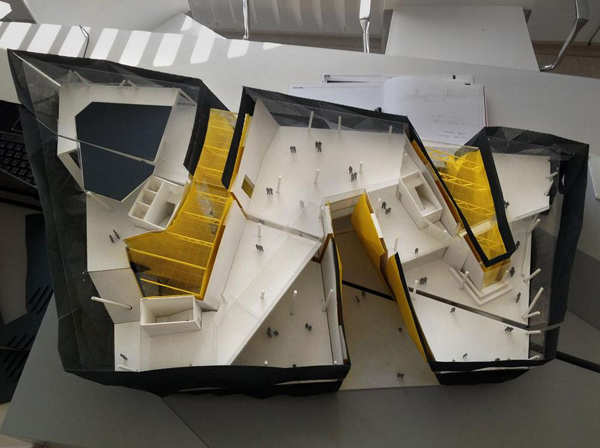
MARS’s proposal is a hybrid structure whose program is folded by an interweaving climbing atrium. The proposal is characterized as flawless integration of a complex program with a spectacular user experience and it undoubtedly showed that sustainable can be seductive.

The authors found inspiration in emerging market of Bulgaria and its refreshing vitality. The program, consisting of climbing and brand head offices is supplemented by a diversity of functions – from leisure and entertainment to health and wellness. The climbing walls of the winning entry are folded through the entire office program therefore the constant crossover is achieved.  The project reveals the outer limits of what can be achieved with these climbing walls as sculptural interior spaces. Read the rest of this entry »

architecture, featured, news

Pure Tension Volvo Pavilion Is A Portable Charging Station / SDA

By: Marija Bojovic | November - 15 - 2013

Volvo, SDA, Synthesis Architecture + Design, V60, Frei Otto, tensile structure, sustainable design, sustainability, Italy, membrane structure, membrane, organic form, Buro Happold, Fabric Images

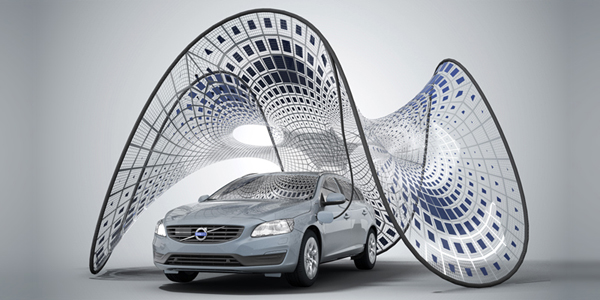
The “Pure Tension” Volvo Pavilion is a joint venture of Synthesis Design + Architecture, Buro Happold and Fabric Images. This tensile structure is a lightweight, rapidly deployable, free-standing membrane, a portable charging station, commissioned by Volvo Car Italia. The membrane is an experiment, developed through a process of rigorous research that investigated methods of associative modeling, dynamic mesh relaxation, paneling, geometric rationalization and pure material performance. It illustrates the dialogue between design, engineering and fabrication. Read the rest of this entry »

architecture, featured, news

Sculptural Twin Towers In China / Raffles City By UNStudio

By: Marija Bojovic | October - 28 - 2013

Sustainable design, sustainability, Ben Van Berkel, UNStudio, China, Raffles City, Hangzhou, Shanghai, LEED gold, mixed-use

Ben Van Berkel of UNStudio stated that the philosophy behind the Raffles City, located near the Qiantang River in Hangzhou 180 kilometres southwest of Shanghai, is to integrate mixed-use in an urban context, but in a such way as to give this concept a twist by focusing on where the urban context meets the landscape of the city. The project incorporates retail, offices, housing and hotel facilities and marks the site of a cultural landscape within the Quianjiang New Town Area. Raffles City Hangzhou is designed to reach a height of 60 stories, presenting views both to and from the Qiantang River and West Lake areas, with a total floor area of almost 400,000 square meters.

In author’s own words, in the design of the towers the urban element of the project twists towards the landscape, whilst the landscape aspect, in turn, twists towards the urban context, thereby effecting the incorporation and consolidation of these separate elements in one formal gesture. Read the rest of this entry »

architecture, featured, news
Page 1 of 3123»
  • Skyscraper Competition

    • 2025 Skyscraper Competition
  • BUY EBOOKS ON GOOGLE

    • EVOLO SKSYCRAPERS 3
  • BUY EBOOKS ON APPLE

    • EVOLO SKYSCRAPERS
  • Retractable Fountain Pen

    • RETRACTABLE FOUNTAIN PEN
  • Follow On Instagram

    • Instagram
  • Competition Sponsors

    • Archinect
    • architecture.competitions.yearbook
    • bustler
    • competitions.archi
    • e-architect
    • Skyscrapercity
    • YoungBirdPlan
  • Subscribe to Newsletter

© 2006-2021 This work is licensed under a Creative Commons License permitting non-commercial sharing with attribution. eVolo is a trademark of EVOLO, INC. in the United States and other countries.

Webdesign by: SOFTlab
Header Image