Editors’ Choice
2025 Skyscraper Competition
Haimiao Zhang, Biying Li, Yifan Ma, Linzhi Lu
China
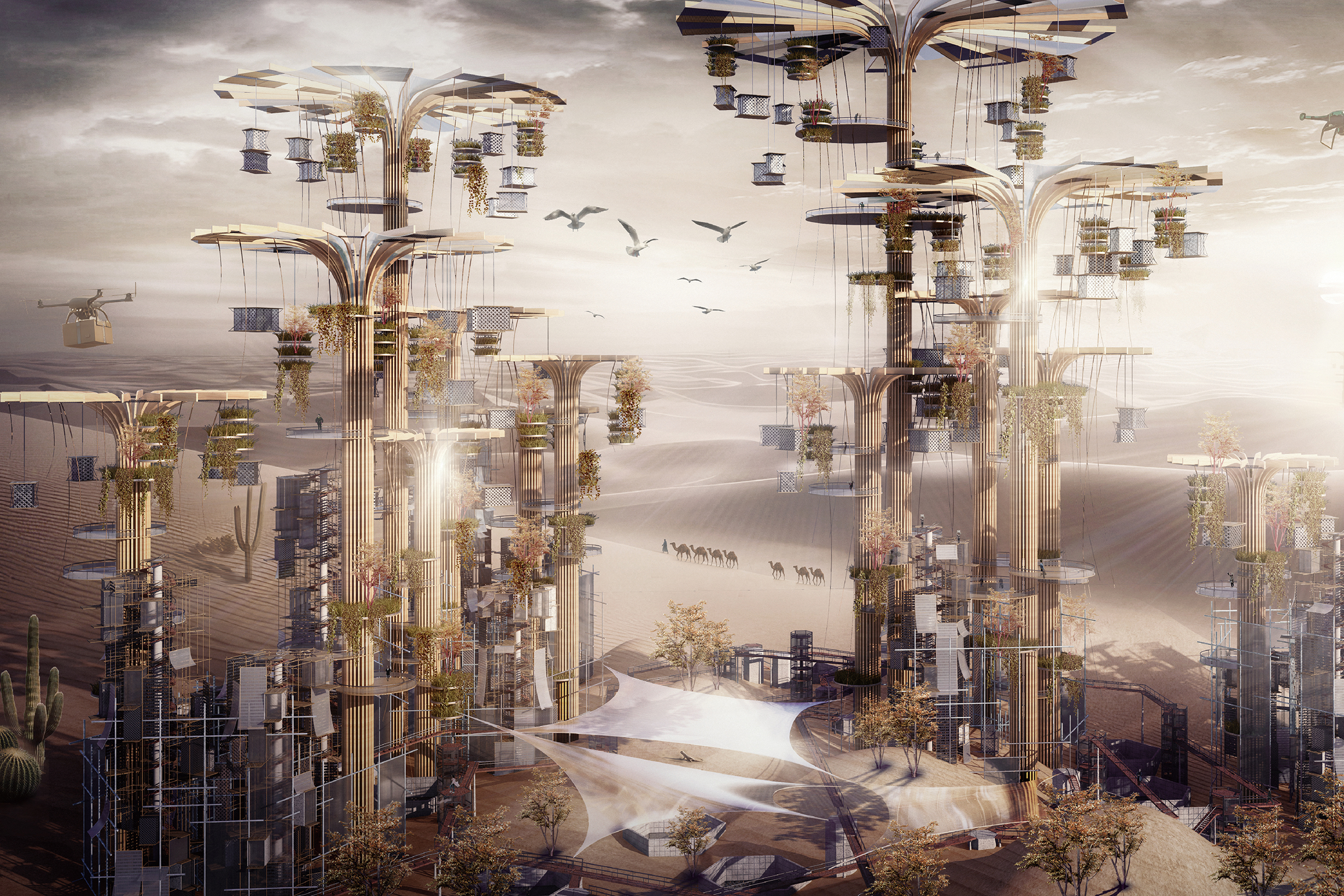
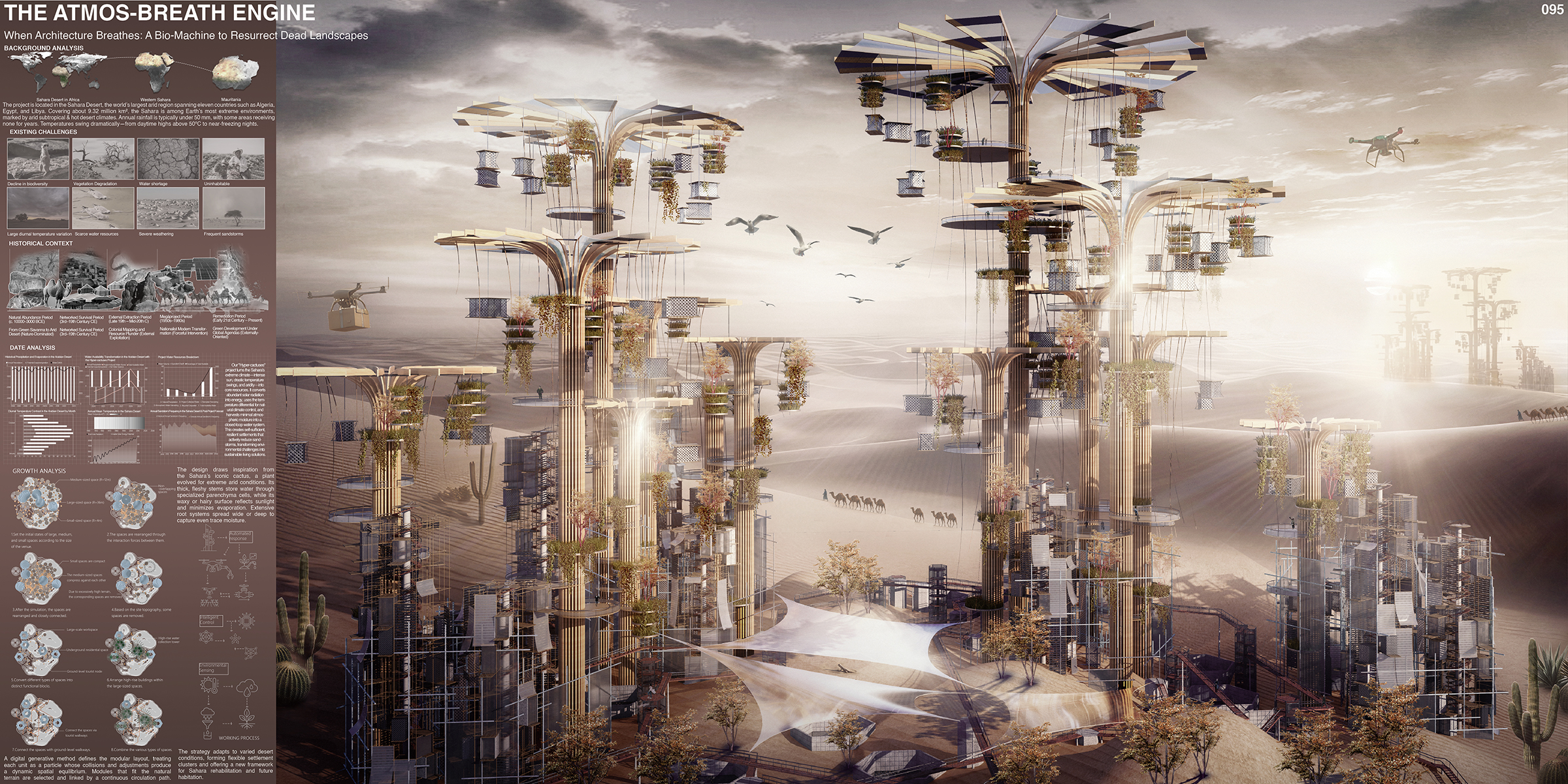
The project is situated in the vast expanse of the Sahara Desert—Earth’s largest and most extreme arid landscape. Stretching from the Atlantic Ocean to the Red Sea and spanning 11 nations, the Sahara covers nearly 9.32 million square kilometers. It endures less than 50 mm of rainfall annually, experiences decades-long droughts, and oscillates between scorching days of over 50°C and freezing nights. These relentless conditions render large portions of the region almost entirely uninhabitable.
Inspired by one of the desert’s most resilient native species—the cactus—the project reimagines how architecture might survive, adapt, and regenerate life in hyper-arid environments. Cacti possess an evolved suite of survival mechanisms: thick aqueous stems for water storage, waxy or hairy epidermis for solar reflection and moisture protection, and extensive root systems capable of absorbing scant moisture across vast ground areas. These biological strategies form the conceptual and technical foundation of the proposed architectural system.
At the urban scale, a digital generative method is used to determine the distribution of modular units. Each unit behaves like a particle released into the terrain, interacting through collision and pressure until reaching a state of spatial equilibrium. By filtering units that align with the existing dune morphology and connecting them through elevated walkways, the method yields adaptable settlements capable of being deployed anywhere in the Sahara—offering a new framework for both desert rehabilitation and inhabitation.
This process can be deployed anywhere in the Sahara and replicated endlessly, allowing the system to grow in clusters and form distributed ecological settlements across the desert.
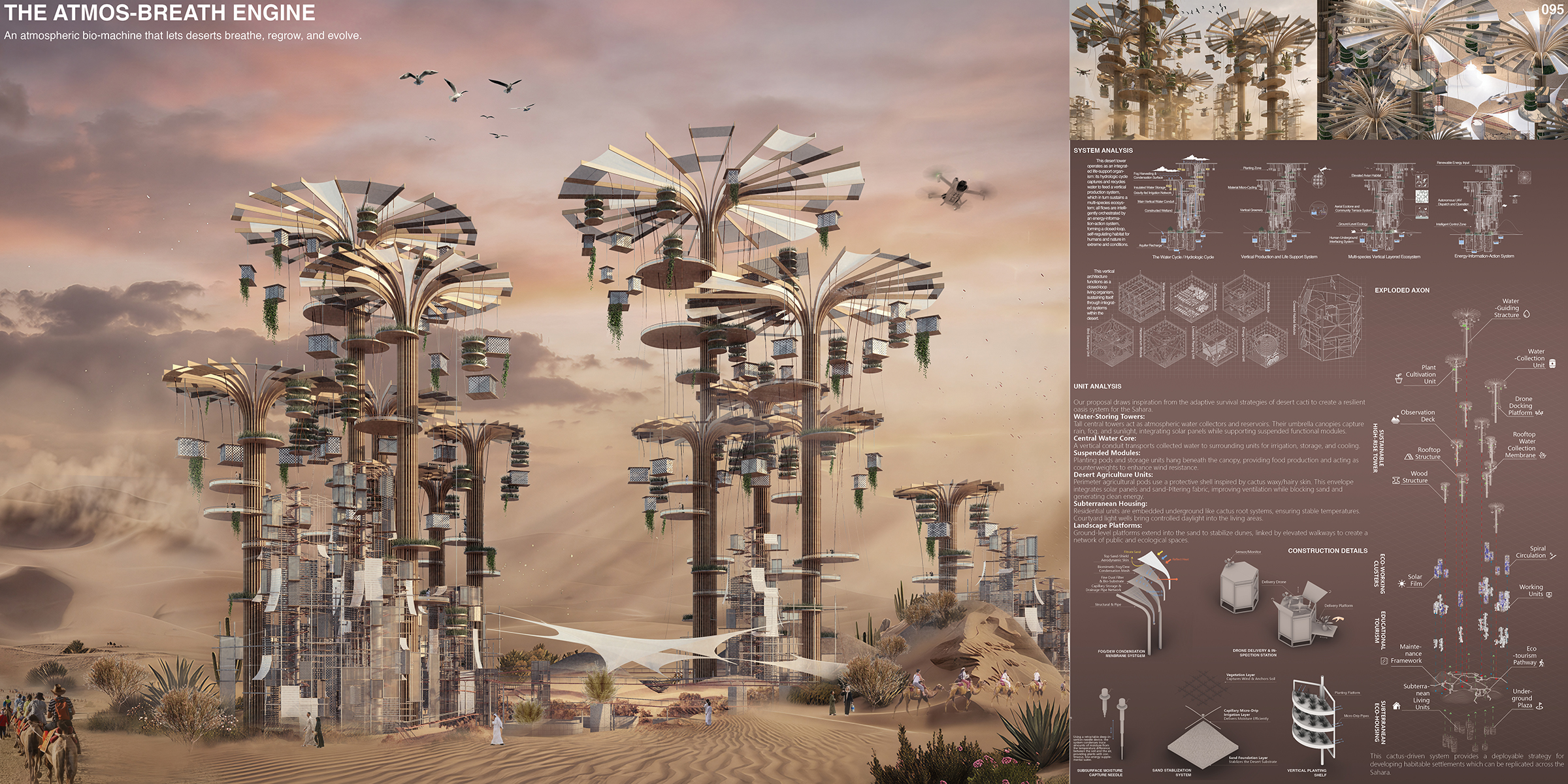
At the architectural scale, the project translates cactus survival logic into a multi-functional vertical ecological infrastructure:
Atmospheric Water-Storing Towers
Tall atmospheric collectors form the backbone of the settlement. Their umbrella-like crowns harvest rainwater, fog, and dew while embedding solar panels. A central structural core stores and transports collected water to surrounding units.
Suspended Ecological Modules
Hanging from the canopy, plant pods and storage baskets provide micro-agricultural production, food supplements, soil regeneration, and counterweights that help stabilize the structure in high-wind conditions.
Protected Desert Agriculture Units
Surrounding the towers, circular agricultural clusters reinterpret the cactus skin. Their porous, fabric-lined exteriors shield crops from sandstorms and excessive radiation while hosting flexible photovoltaic membranes that generate energy and modulate airflow.
Subterranean Housing
Learning from cactus root systems, residential units are positioned below ground to offer cool, stable living environments. Central courtyards allow daylight penetration and natural ventilation while minimizing exposure to heat.
Anchoring Landscape Platforms
Deep-reaching ground platforms anchor the system, increase dune stability, and create shaded public spaces, connected by walkways that form a continuous experiential network across the terrain.
Drone-Based Monitoring & Delivery Network
A dedicated drone network circulates between towers, monitoring microclimates, mapping dune migration, delivering supplies, and assisting with ecological restoration—functioning as airborne caretakers in an environment too vast for human maintenance.
Dune Stabilization & Living Landform System
A ground-level dune–stabilization system, formed by deep landscape wells and wind–redirecting membranes, anchors shifting sand, protects agricultural zones, and creates pockets of humidity that allow vegetation and wildlife to reestablish themselves.
Together, these systems constitute an adaptive, water-driven desert architecture capable of supporting ecological renewal and human habitation in one of the harshest environments on Earth. By fusing biomimicry, computational design, and environmental engineering, the project proposes a new model for self-sufficient, resilient settlements that can transform the future of desert living.