Editors’ Choice
2025 Skyscraper Competition
Jae Woo Lee
South Korea
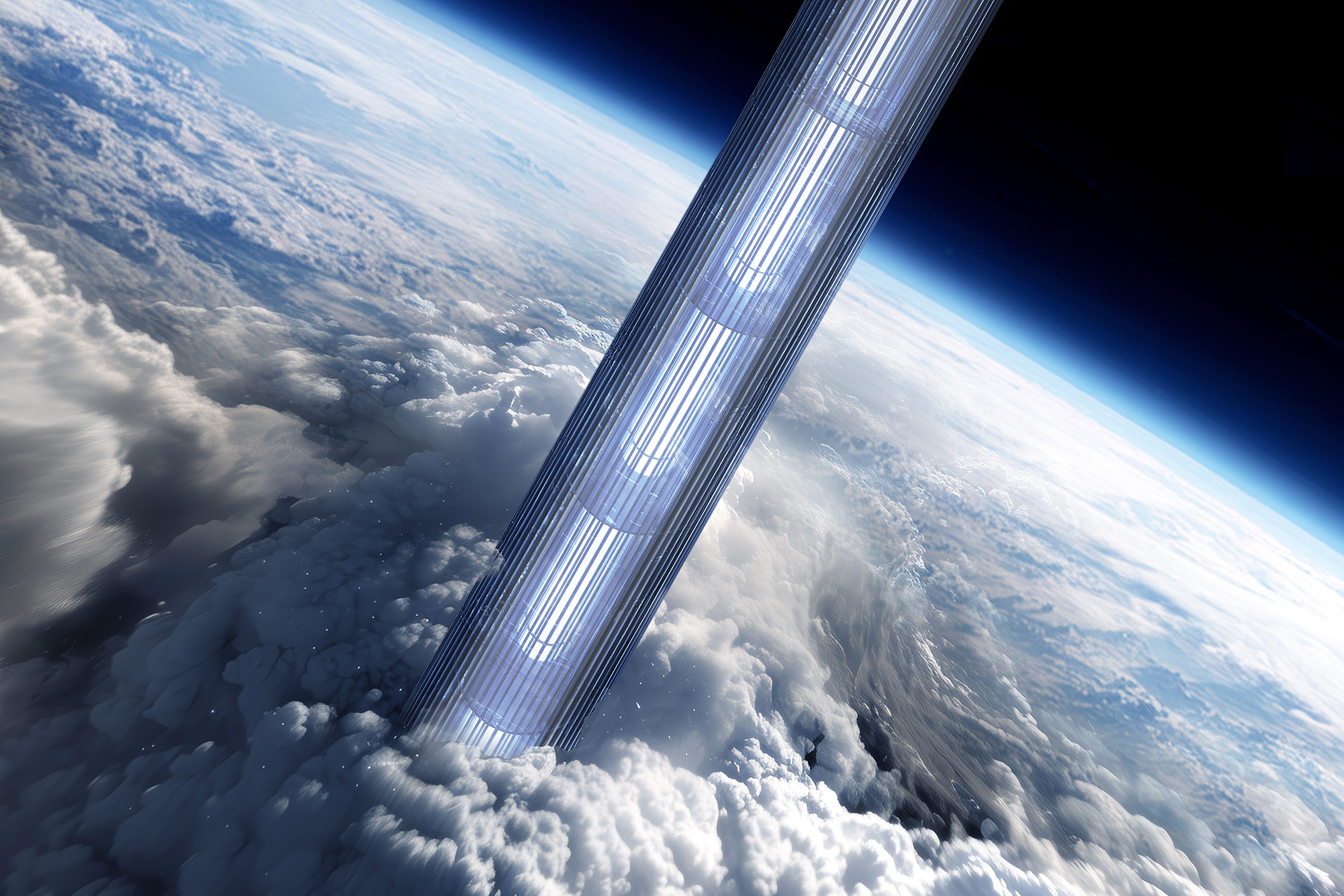
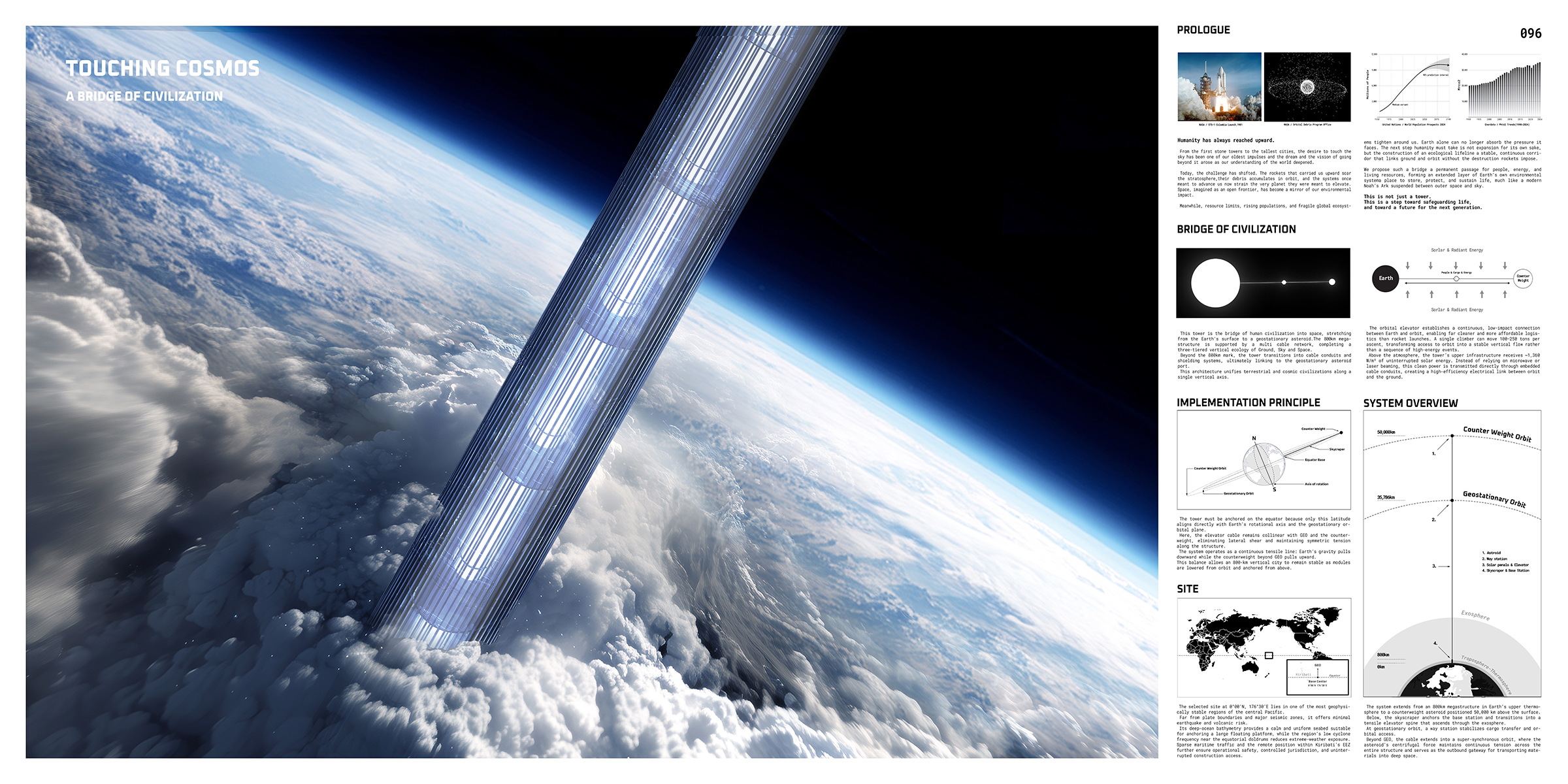
Architecture is no longer bound to the surface of the Earth. As humanity extends its ecological, economic, and cultural systems vertically into near-space, the role of architecture must transform from composing cities on land to shaping planetary-scale vertical habitats. This project envisions an integrated megastructure that merges building, infrastructure, and orbital mechanics into a single spatial organism. a new architectural typology for the age of Earth Orbit urbanism.
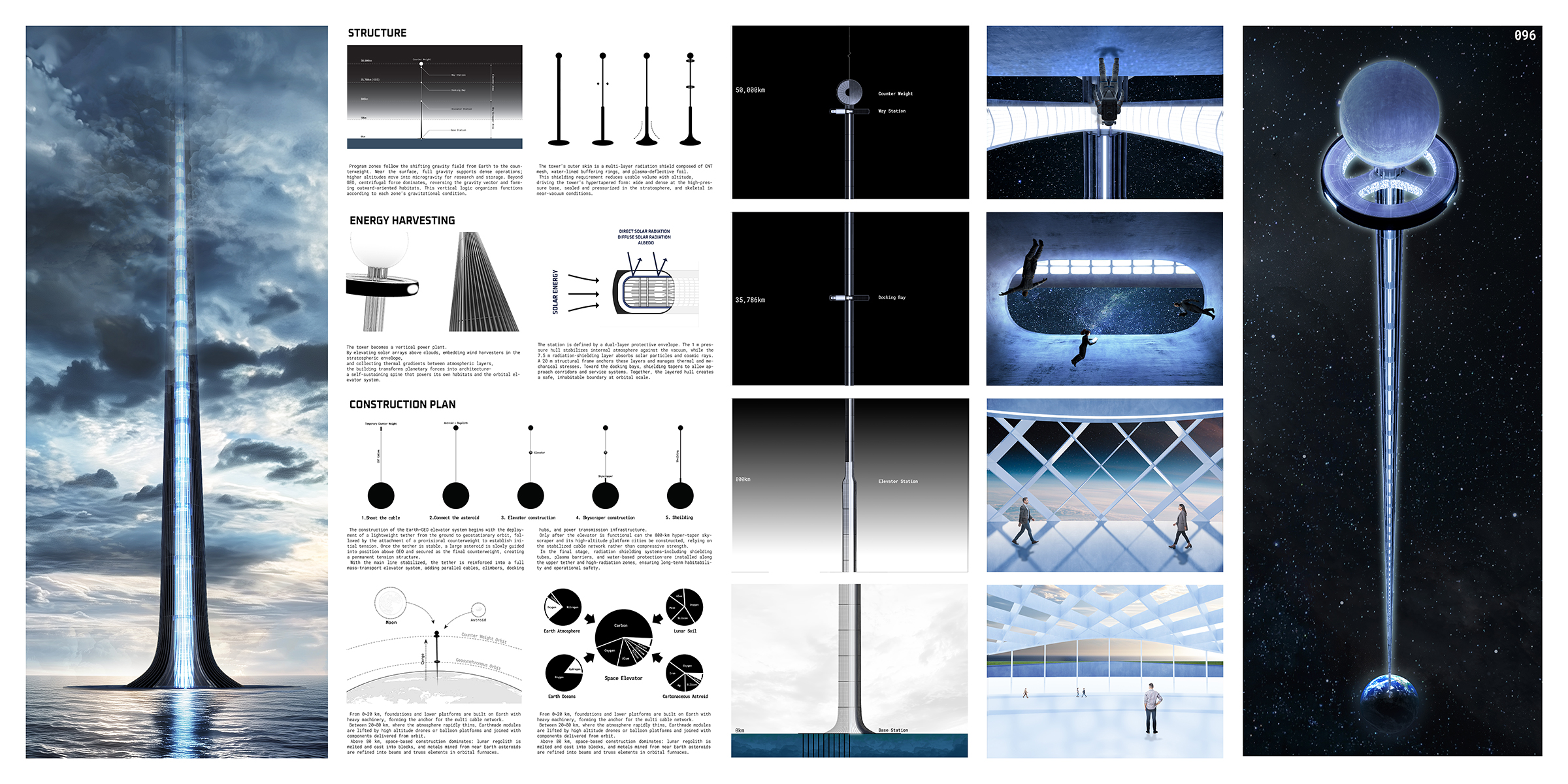
At its core is an 800 km hyper-tapered tower that rises from the equatorial ocean. Its geometry follows a precise structural and aerodynamic logic:
800 m in diameter at sea level, narrowing at 800 km.
The lower atmosphere demands a softened, aerodynamic skin; the upper strata transition to a cable-supported exoskeleton, and beyond that, to a radiation-shielded pressure hull. This continuous gradient expresses the tower’s central thesis: architecture, when stretched across the atmosphere, must evolve by altitude.
The tower is not a monolith but a sequence of ecological layers.
The troposphere hosts dense programs—research districts, vertical agriculture, energy decks—behaving like a new vertical city.
The stratosphere transitions into low-gravity laboratories and observation rings.
The upper thermosphere offers microgravity environments where traditional architectural assumptions—orientation, load, enclosure—dissolve and reform.
Above 800 km, the architectural logic shifts entirely. Here the structure becomes a multi-cable spine, protected by layered radiation shielding and pressure vessels. Human occupation reappears only near the geostationary terminus, where a ring-shaped spaceport functions as Earth’s orbital gateway. This terminal is not a vessel that floats in orbit; rather, it is anchored by tension from a counterweight asteroid positioned between 50,000km. The asteroid, stabilized through orbital mechanics, acts as a massive gravitational anchor, allowing the entire structure to remain taut.
This composite system—tower, cables, asteroid—is not merely infrastructure. It is a deliberate architectural claim to expand the domain of the built environment from ground to orbit, forming a single continuous civic axis for humanity.
The interior programs follow this vertical logic of shifting gravity.
Full gravity at the base supports dense habitation and industry.
Reduced gravity zones enable new athletic, biomedical, and manufacturing typologies.
Near zero-gravity rings invite speculation on how culture, ritual, and collective life transform when freed from weight. The project posits that architecture’s ultimate task in space is not only survival but the shaping of new ways of living.
Light, pressure, radiation, and vacuum become not obstacles but design materials. Windows—30 m by 12 m glass modules supported by deep pressure frames—open toward Earth only where atmospheric loads permit. In the orbital terminal, vast apertures reveal Earth as a suspended sphere, shrinking to a few degrees of visual angle at 50,000 km. This changing perception of Earth becomes a spatial experience: the planet gradually recedes from building to landscape to icon.
This is a structure that connects the planet to its orbit, a civic axis that merges Earth-based urbanism with orbital life, and a prototype for future settlements where architecture mediates between gravity, vacuum, and human aspiration.
More than a megastructure, the project argues for a shift in architectural imagination—from horizontal sprawl to vertical planetary continuity,
from cities of land to cities of altitude, from buildings that stand on Earth to structures that bind Earth to space.