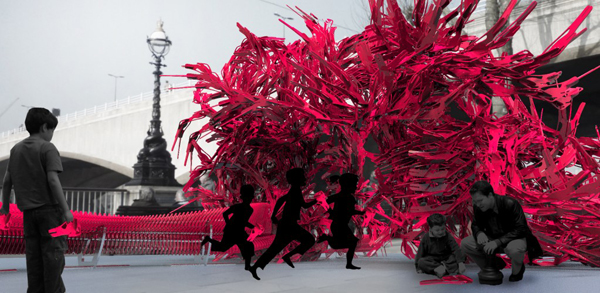
BLOOM is what its designers call an “urban toy.” It is a “distributed social game and collective ‘gardening’ experience that seeks the engagement of people in order to construct fuzzy BLOOM formations.” These formations are aggregate volumes composed of repeated, identical parts, which the designers refer to as “cells.” These “cells” are designed and fabricated by the designers themselves, Alisa Andrasek of Biothing, and Jose Sanchez of Plethora Project, in London. Meant to contribute an air of jovial democratized design in relation to the 2012 London Olympic Games, BLOOM is representative of the artistic, collective act. Each individual component, as the designers explain, can do nothing on its own, but instead, reach their full and limitless potential when arrayed en masse. Read the rest of this entry »
London’s Other Distributed Social Game: A Collective Gardening Experience
National Library of Israel / ODA Architecture
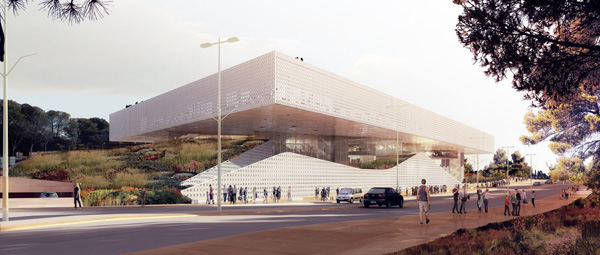
Designed by ODA, the National Library of Israel is organized around a variety of platforms of activity that enhance interaction between the users. The library is transformed into a forum for cross-disciplinary conversations. The floating monolith form connects o the foundations of Parliament, the library underscores the idea that education and learning are the bedrock of democracy. Read the rest of this entry »
Hangzhou Civic Sports Center / BLUA
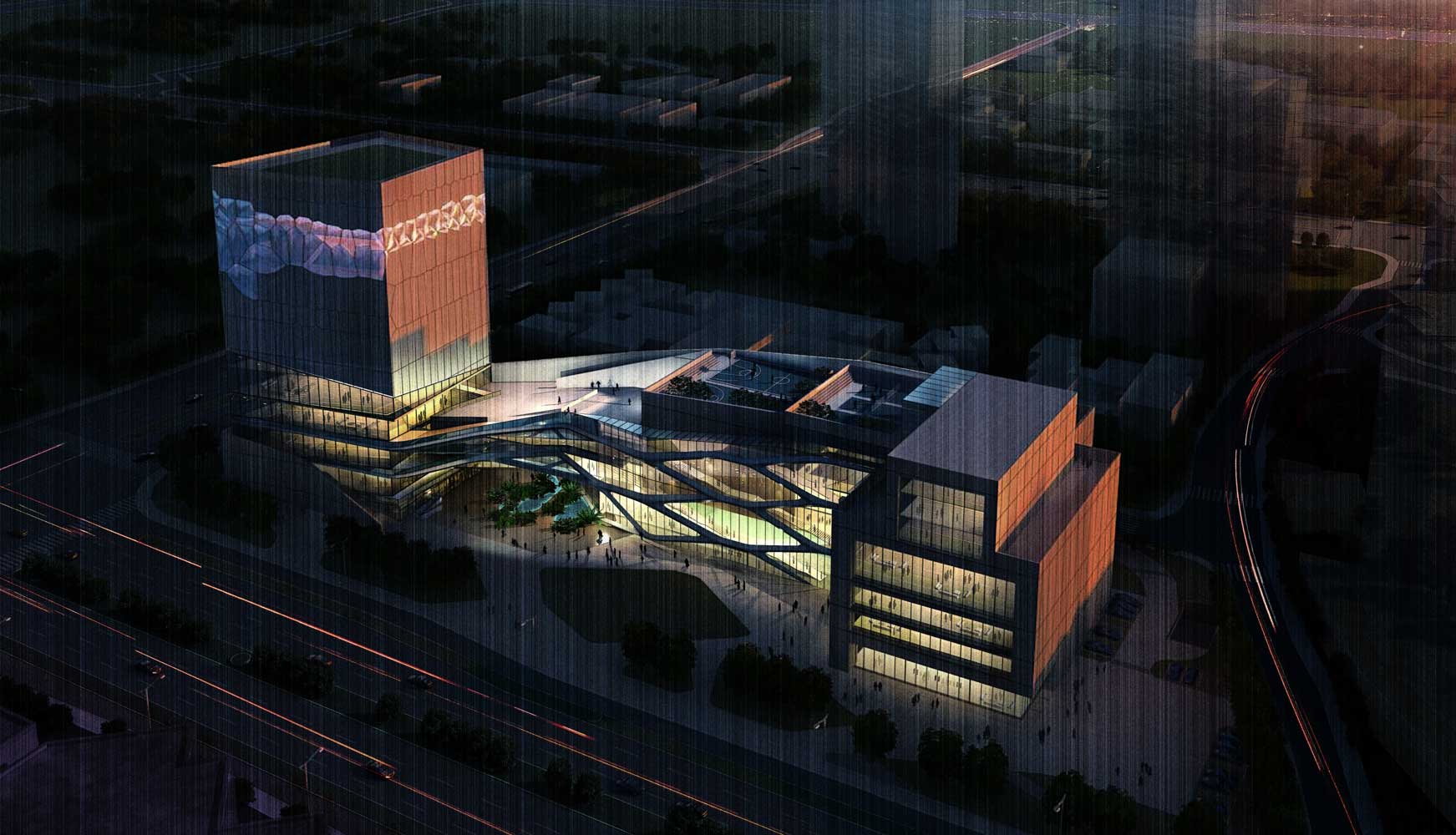
The site for this project designed by BLUA is located at the west side of Hangzhou new city, 2.6km to the CBD center. The facility has a total built area of 15,500 square meters. Above ground floor area is 46,700 square meters. The southwest corner is the entrance for the planned Metro Line and around the site are high-end residential districts. The north side is bounded by a primary school. Adjacent to Qian Jiang River, the site is a connector between the natural and urban life of the city, making it a perfect location for a sports complex. Our project is based on creating an urban plaza while also creating an icon for the lack of large-scale commercial facilities and distribution of leisure spaces. With the convenient transportation, the sports center radiates across the whole city. Read the rest of this entry »
A Chair Made From Recycled Milk Jugs
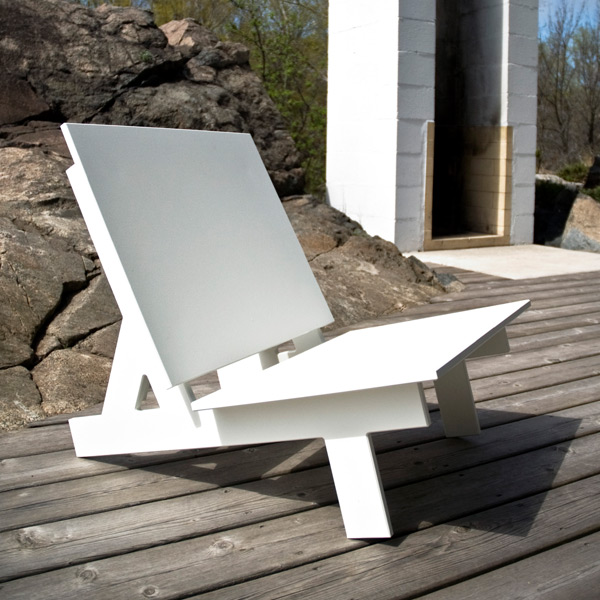
The Taavi Chair, chair designed by Minnesota-based American architect David Salmela and manufactured in Duluth, Minnesota by Loll Designs, is an excellent example of sustainable design. The chair, with its elegant, simple design, is made, on average, from a common household item: milk jugs. Each chair is made from roughly 256 of these recycled milk jugs. Milk jugs, made from high-density polyethylene (HDPE) are highly recyclable, with a chemical composition that lends itself to molded, weather-resistant outdoor furniture.Taavi is inspired by low profile lounge chairs of Mid-Century Modern lore, perfectly suited to outdoor contemplation and leisure. This chair, aside from being formally streamlined and minimal, is also inherently sustainable: it is made from recycled materials that can be recycled once again, features interchangeable, replaceable parts, and is fabricated in America. Furthermore, the manufacturing process itself is based on ‘lean manufacturing’ principles, economizing material, labor, and mitigating industrial byproducts. This chair is an example of sustainable, American-made design and manufacturing. Read the rest of this entry »
A Food Garden Ceiling Made From Undulating Profiles
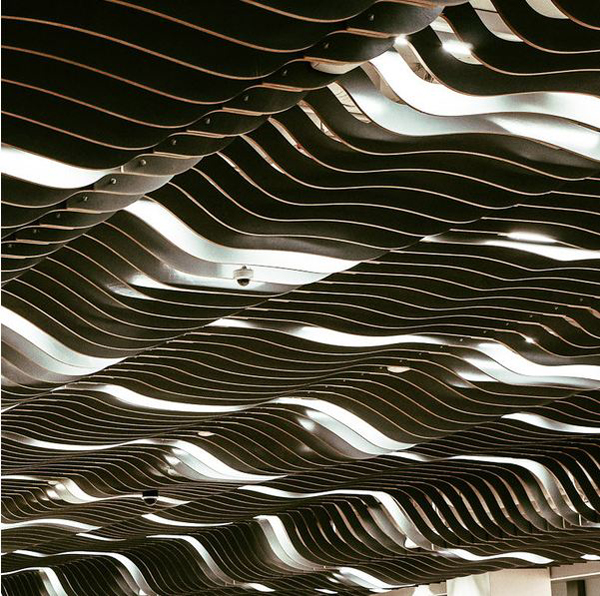
The Digital Design Ceiling by ABWB & Associates is located on the top floor of the Pelli Clarke Pelli Architects-designed Costanera Center Mall in Santiago, Chile. At 300 meters tall, the Costanera Center is the tallest building in both South America and the Southern Hemisphere. The ceiling covers the mall’s central ‘Food Garden.’
Made up of undulating laser cut steel profiles, the ceiling renders a fluid, wave-like dimension to a normally-flat and boring surface. These digitally-derived profiles echo the geometries and rhythm of the Andes Mountains located just outside Santiago’s city limits, gesturing movement laterally, as well as into the horizon. They oscillate along their vertical axis, returning regularly to the level of the underlying structural fabric, where the tracks these profiles are screwed into, are revealed. Embedded within this matrix of profiles are a myriad of functional systems, including recessed lighting, heating and ventilation ducts, and security sensors and cameras. This elaborate and decorative ceiling system functions exactly like a drop-ceiling, providing both a cavity for functional systems, as well as acoustical interruption for what can often be a loud and bustling space. Read the rest of this entry »
Parametric Designed Performative System for Outer Space Habitat / OpenSystems
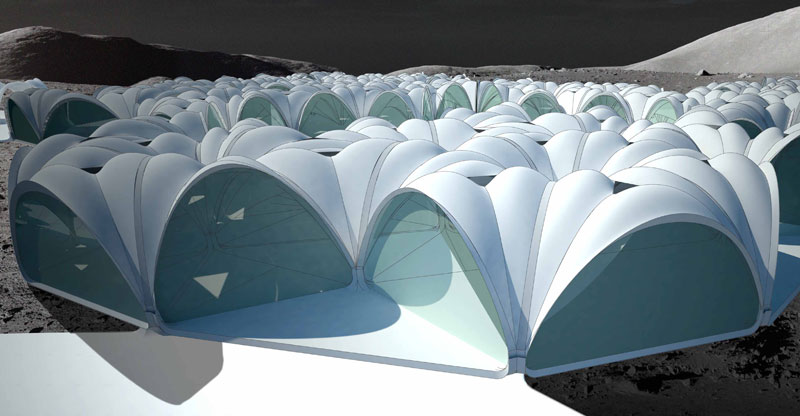
In emergency circumstances, man’s successful fit into the hosting environment depends on the possibilities for change and adaptation within a context of conservative use of resources. The project by OpenSystems (Marco Vanucci) illustrates a differentiated and performative system attempting to overcome an existing dichotomy between standardization and need for diversity and change in environmental structures. The design uses parametric design protocols to develop a semi-modular system formed by the aggregation of differentiated cellular units. Each unit consists of a monocoque rigid shell and a pedestal. The differentiated monocoque shells are made of Fibre-Reinforced Plastic and their design is achieved by structuring an adjustable mould. Each individual unit is designed to provide self-sufficiency within extreme emergency conditions. The lightweight modular construction provides a minimum inventory / maximum diversity system. The minimum inventory of components (a kit of parts) is generated from the same topological matrix so standardized construction processes provide different design outputs. The units generated can then be assembled and reconfigured to better suit specific local conditions while retaining their individual effectiveness. Read the rest of this entry »
Daphne Installation for Santorini Biennale Built Entirely with Watercolor Paper
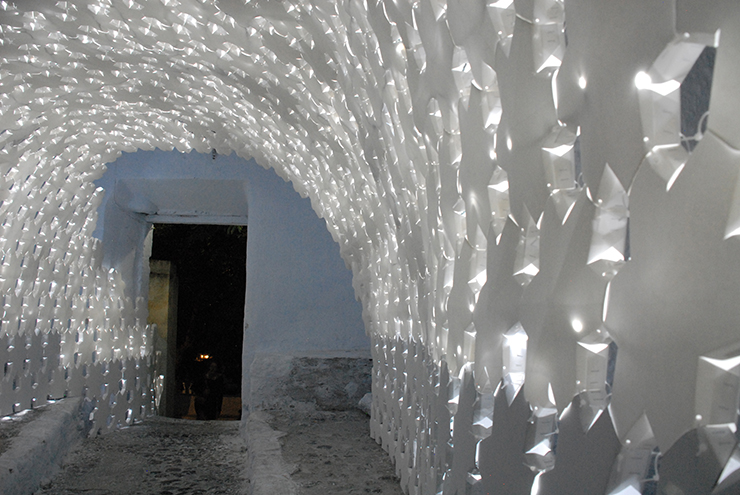
Daphne is a site-specific installation situated within the tunneled stairway that interplays with the notion of concealing and revealing the ancient interior surfaces of the tunnel leading to the peak of Pyrgos, Santorini. Made entirely of self-supporting paper panels, Daphne creates an enclosure that intervenes the visitors’ perception of the existing conditions as a container of conglomerated memory as the paper panels age and take their shape accordingly to the local condition. The installation is part of Santorini Biennale of Arts that will take place until September 30, 2012.
The Past. History, Time, Memory and Nostalgia: A village is a vessel of memory, and reaching to the highest peak at Pyrgos from the main village square is, therefore, an excursion to its past memory where every surface contains a history. During the excursion to the Kasteli, visitors will have to encounter a tunnel stairway that leads to the destination. The history of the tunnel may be unknown to visitors and the space of the tunnel may seem insignificant to the passers by at first. Read the rest of this entry »
21st Century Industrial Housing in the United Kingdom
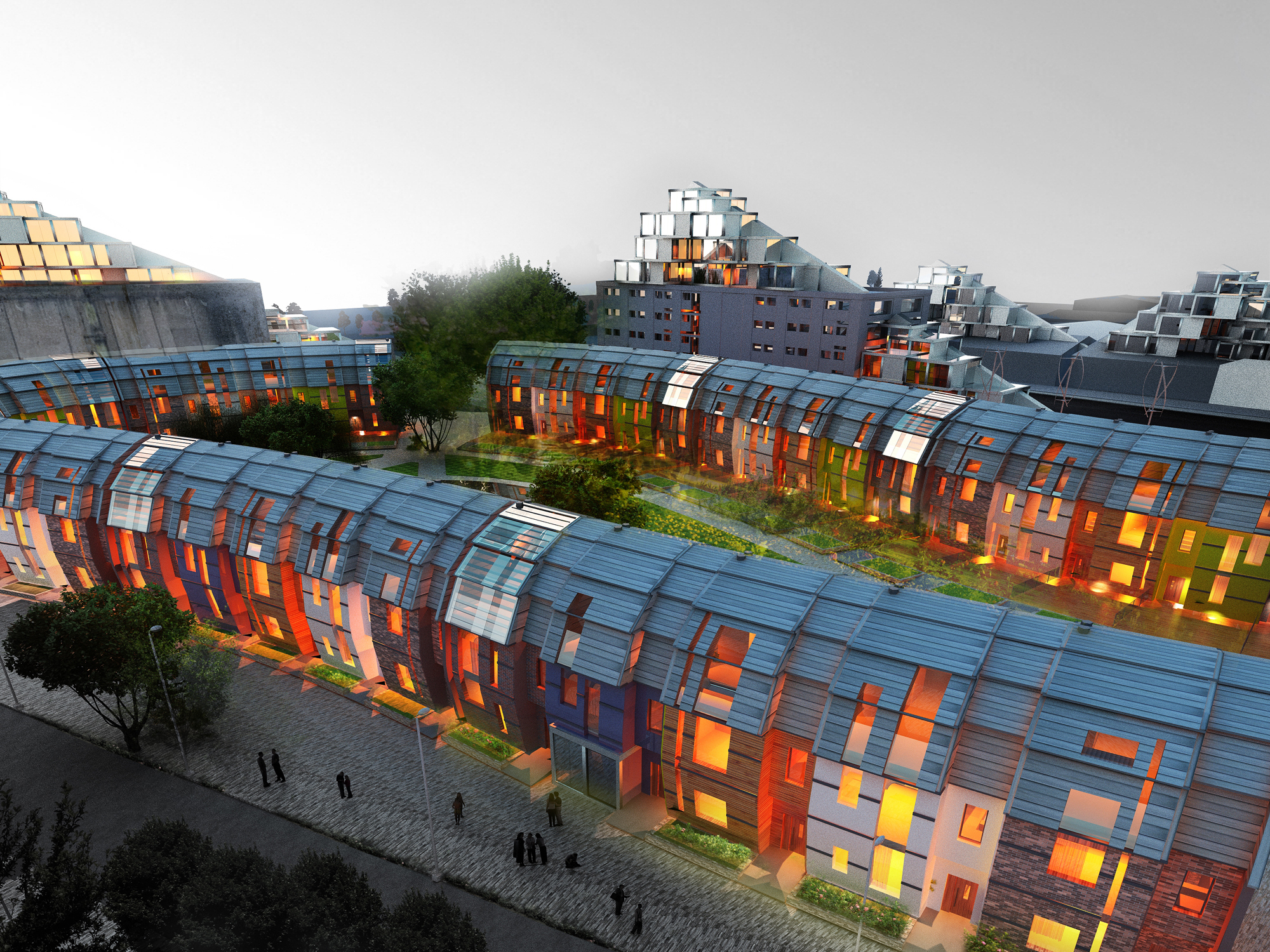
Under the current economic pressure, cities are no longer able to develop the way they used to, especially in the regeneration of unused industrial areas, which have become increasingly in demand due to lack of housing and infrastructure. Although nearby, they represent disconnected areas from the city centers. Considering that city expansion and large regeneration schemes remain as unrealized masterplans due to shortage of public funds and lack of incentive to private initiatives, its now a challenge to devise schemes which could trigger progressive regeneration in harmony with existing urban structures. From an environmental perspective, large amounts of infrastructure and many buildings, which could have been adopted and reused, have been destroyed. The destruction of heritage and memory, the environmental cost of willful demolition and the scale, speed of erection and brutality of the new are most of the time too much for communities to absorb. Therefore, revitalizing bits of the city that need repair, that need healing is becoming increasingly important.
The main feature of the proposal by Evgeni Leonov Architects is minimization of the A/V ratio of the building. Minimal external surface means minimal heat losses. Egg shape is used as inspiration to this project. As known, the egg is one of the most energy-efficient forms of nature. To make A/V ratio minimal, we blocked houses together, linked walls, chose effective dimensions, delete corners, using egg shape in section, and adopted form to site. The result is twice reduced A/V ratio (0,39). Read the rest of this entry »
A Contemporary Take On An Ancient Structure
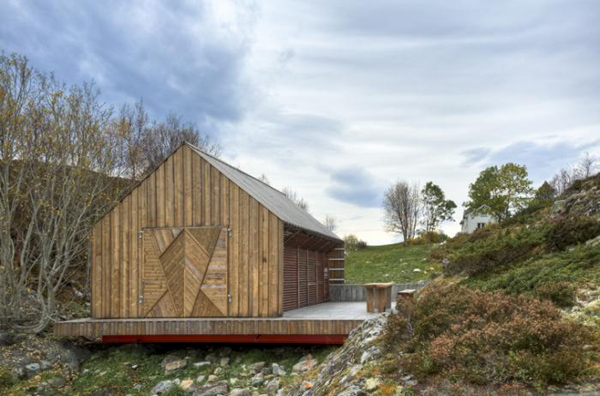
Norwegian Architecture firm Tyin Tegnestue has designed what it dubs a ‘Once and Future Boathouse:’ a hybrid structure that utilizes both ancient wooden elements from an existing boathouse with contemporary methodology, simple design, and construction of fully articulated dock doors. Though boathouses have a long history in Norway, their contemporary usage has changed from that of lore. Boathouses, in the modern, integrated European economy, have been morphed into hybrid spaces, taking on the utilitarian functions of storage- as per tradition- while simultaneously becoming prized for their contemporary leisure and cultural functions. The boathouse in question was built in the mid-1800s and had deteriorated to such a deplorable state as to merit demolition. This structure, with its sensitive site location- on the northwest coast, amid the trees, and just tip-toeing into the water-, simple design, and honest use of local materials, inspired the newer construction’s formal and material expression. Read the rest of this entry »
Interactive, Tactile, Digital, Analog: Breakfast In New York City
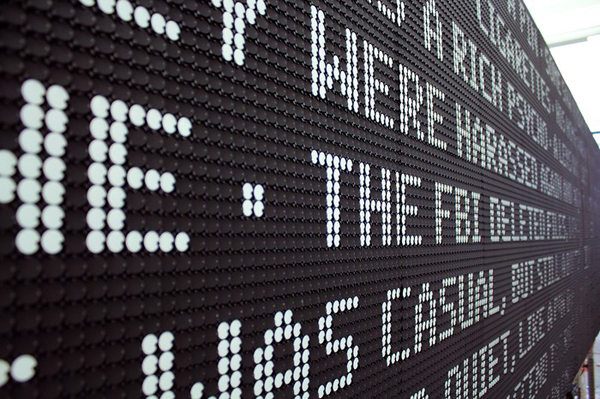
Breakfast New York City is an interactive installation in Midtown Manhattan that both mimics and responds to interactive movement. Located that the intersection of 32nd Street and 6th Avenue, this installation is a revival of an antique sign technology that utilizes over 40,000 metallic spinning dots on a computerized surface to broadcast messages, including scrolling text and images. Because of its analog technology, the mechanism that is analogous to digital pixels, actually mimics the movement and rotation of pistons on a mechanical engine. The dots are either black or white, depending on which side is exposed, creating a binary that, when taken in aggregate and seen from afar, render images and text. This literal movement, however, from black to white, is done so through mechanical means, creating various clicks, like those made on a typewriter. Read the rest of this entry »