Editors’ Choice
2025 Skyscraper Competition
Junyang Chen, Xiaoqi Cheng, Huaiyu Li, Tonghao Liu
China
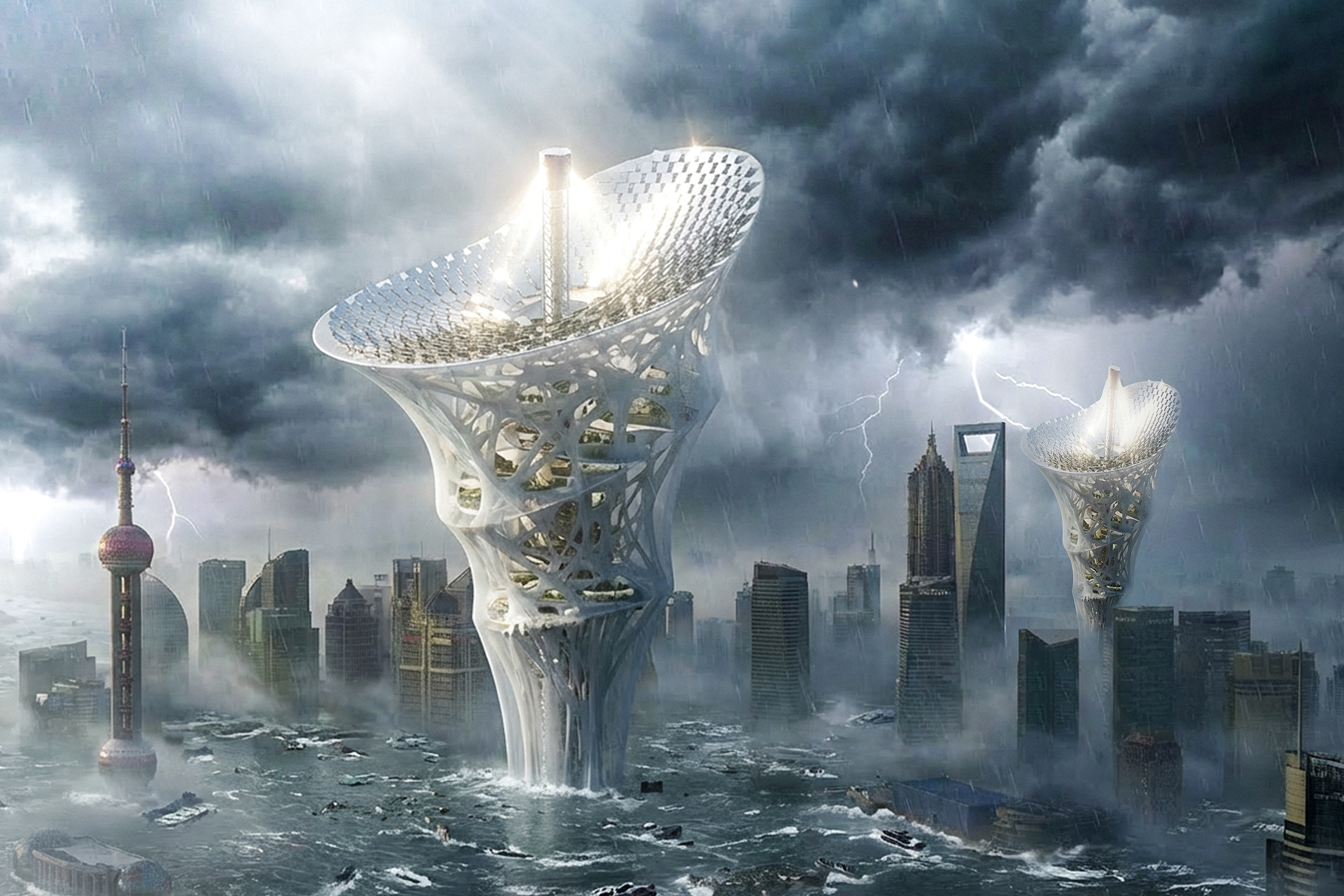
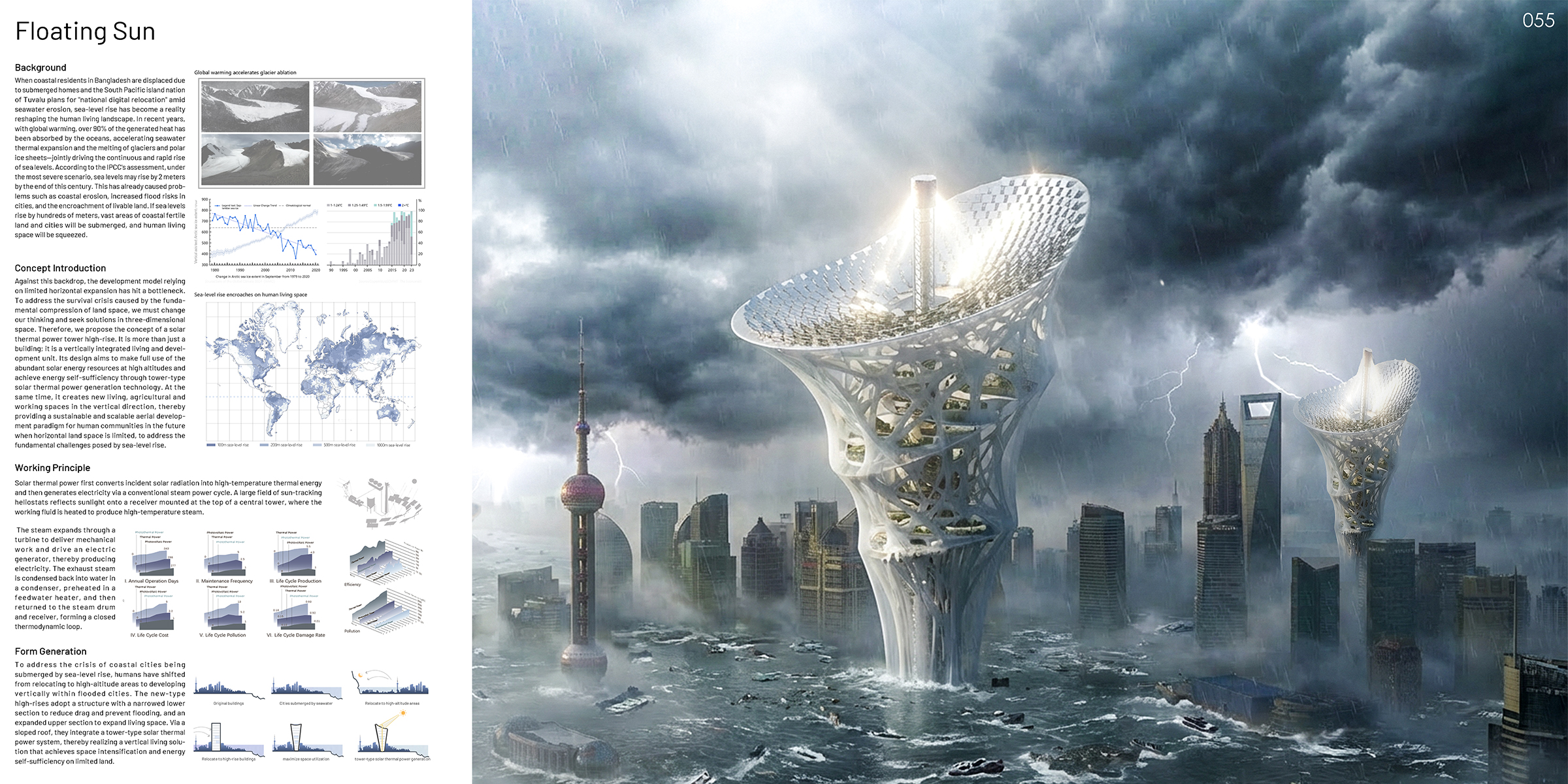
In a future scenario where global warming causes sea levels to keep rising, existing coastal cities are gradually swallowed by surging seawater. Yet humanity cannot easily abandon its established urban infrastructure and deep-rooted cultural memories. In response, an “umbrella-shaped city” rising from the water’s surface is envisioned as a new prototype of habitation.
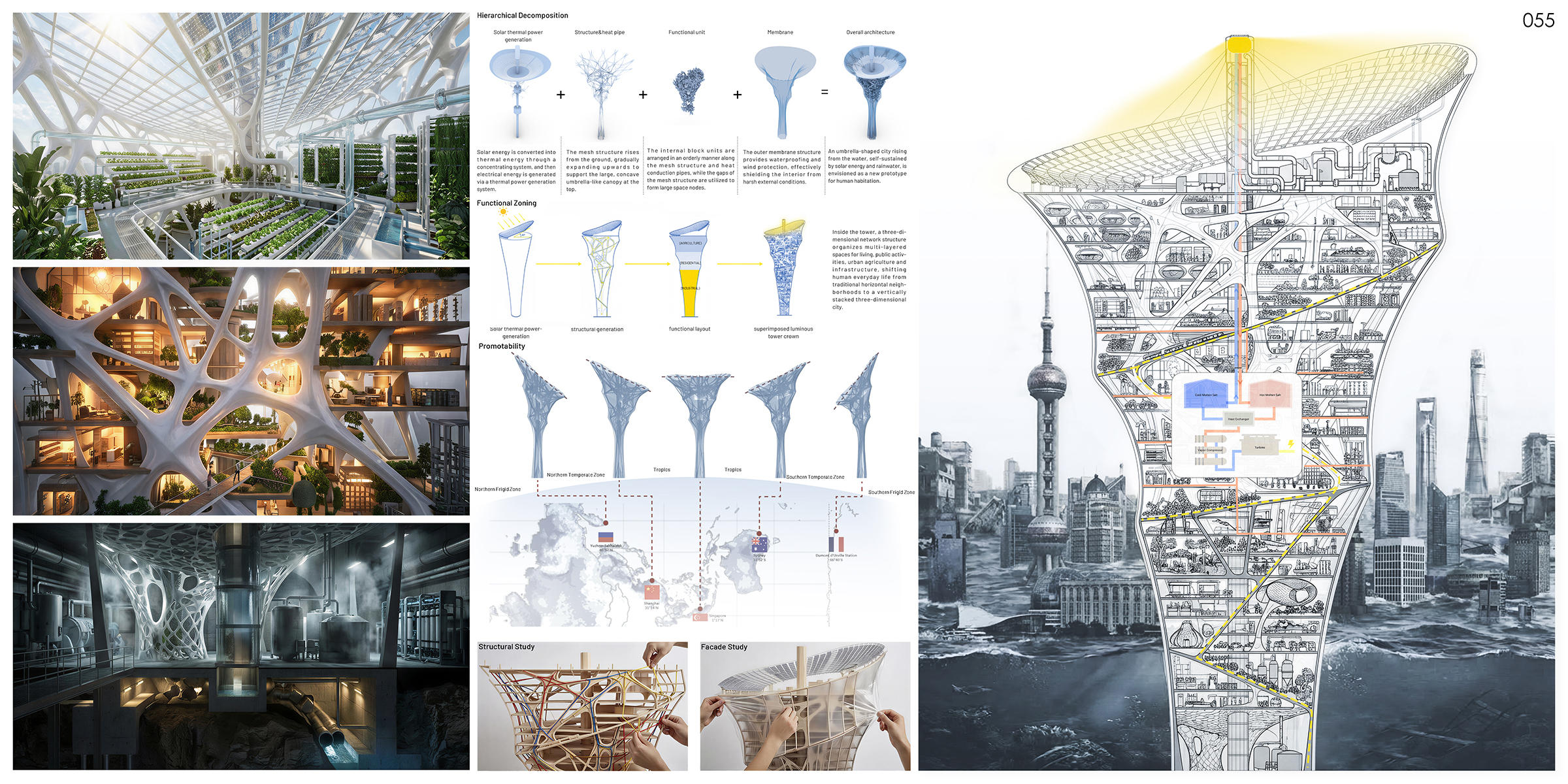
The tower is entirely lifted above sea level, presenting an organic form somewhere between natural growth and artificial construction: a slender “stem” rises from the submerged old city, gradually spreading outward and upward to support a vast, concave canopy at the top. Inside the tower, a three-dimensional network structure organizes multi-layered spaces for housing, public activities, urban agriculture, and infrastructure, shifting everyday life from traditional horizontal neighborhoods to a vertically stacked, three-dimensional city. At the same time, fragments of iconic buildings from the original city are extracted, scaled, recomposed, and embedded at key nodes within the tower. Appearing as viewing halls, aerial streets, or memory gardens, these elements allow residents to maintain an ongoing connection with the images and stories of the old city within a new spatial order.
The concave upper surface of the canopy is composed of a dense array of heliostats, forming a “sky mirror field” that acts like a vast, sky-facing concentrator. It reflects and focuses scattered sunlight onto a central heat-absorbing column, where a solar-thermal power system supplies stable, renewable energy for the vertical city. The geometry of the mirror field is linked to the city’s latitude: in low-latitude regions, the mirrors unfold more horizontally, while in higher latitudes they tilt more steeply along the sun’s path to maintain concentrating efficiency throughout the year. Closely coupled with the tower’s structural system, the energy apparatus turns the tower itself into a self-sufficient “energy machine,” sustaining urban operations in an isolated environment surrounded by water.
In this setting, the once-familiar city is partially submerged yet re-emerges on the same site in a new, vertically growing form. On the one hand, it addresses the pressures of survival under climate crisis; on the other, through spatial and formal translation, it extends the infrastructure and cultural memory of the drowned city, pointing toward a regenerative model for future urban form.