Editors’ Choice
2025 Skyscraper Competition
Chen Zhengwen, Zhang Hexiang, Chen Chi, Jiang Jiang
China
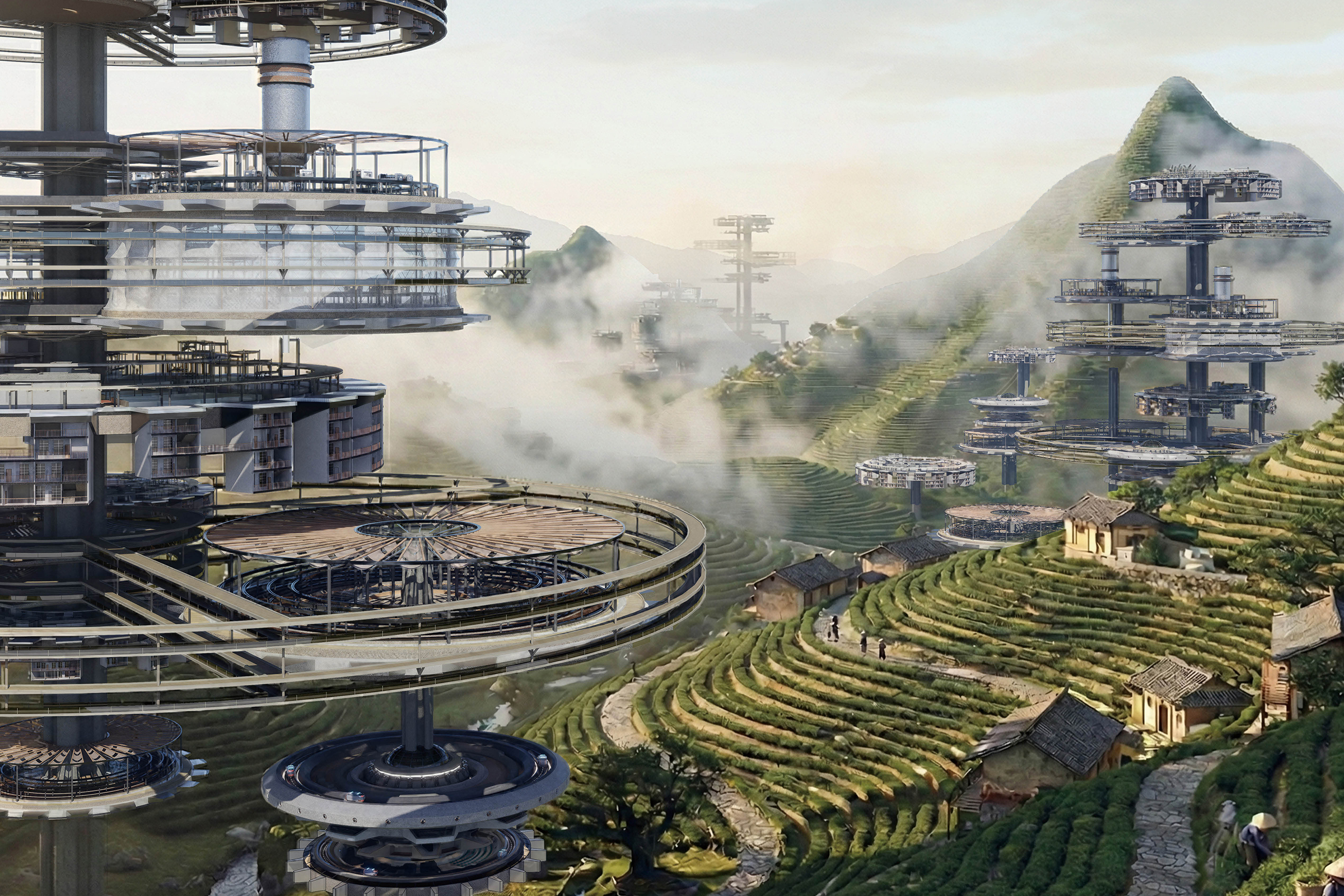
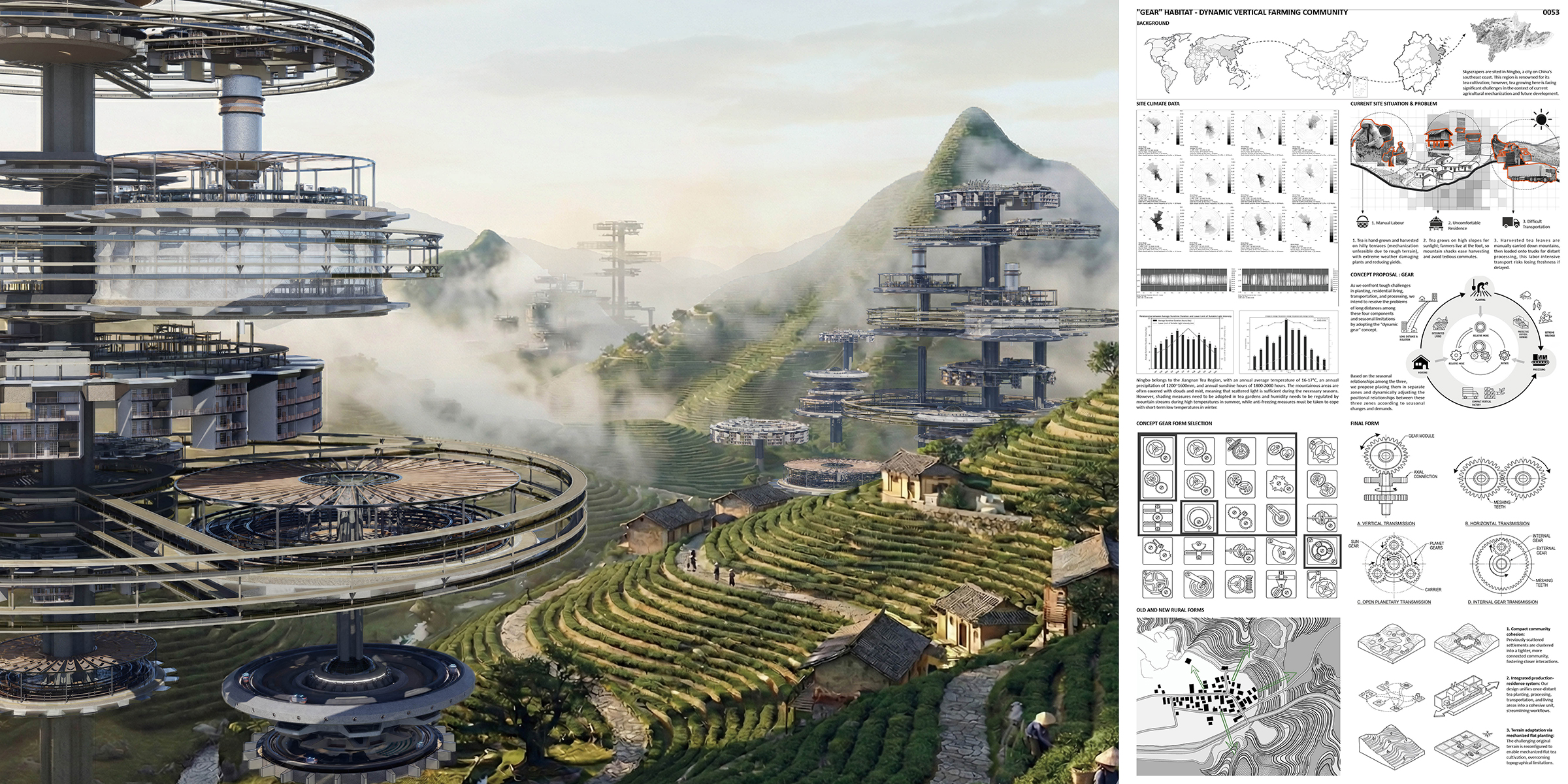
Under counter-urbanization trends, population growth in natural areas is driving the emergence of agricultural towns. Currently, such towns often prioritize farming conditions at the expense of living quality. For example, in Ningbo’s tea region, tea thrives in the humid mountaintop environment, while farmers typically live at the foothills. During harvests, they reside in temporary sheds, and processing occupies household space. This context creates an urgent need for an innovative vertical spatial model that reconciles optimal growing conditions with dignified living, resolving the inherent conflict in traditional horizontal layouts and meeting future demand for vertical farming villages.
This proposal explores a new adaptive vertical farming settlement system, using Ningbo tea cultivation as a case study to inform future agricultural communities. To balance living and farming, the system must dynamically integrate various functions within a vertical structure. Inspired by the interlocking logic of mechanical gears, we translate precise coordination into spatial relationships among farming, living, and processing, proposing the concept of a “Dynamic Adaptive Vertical Farming Settlement.”
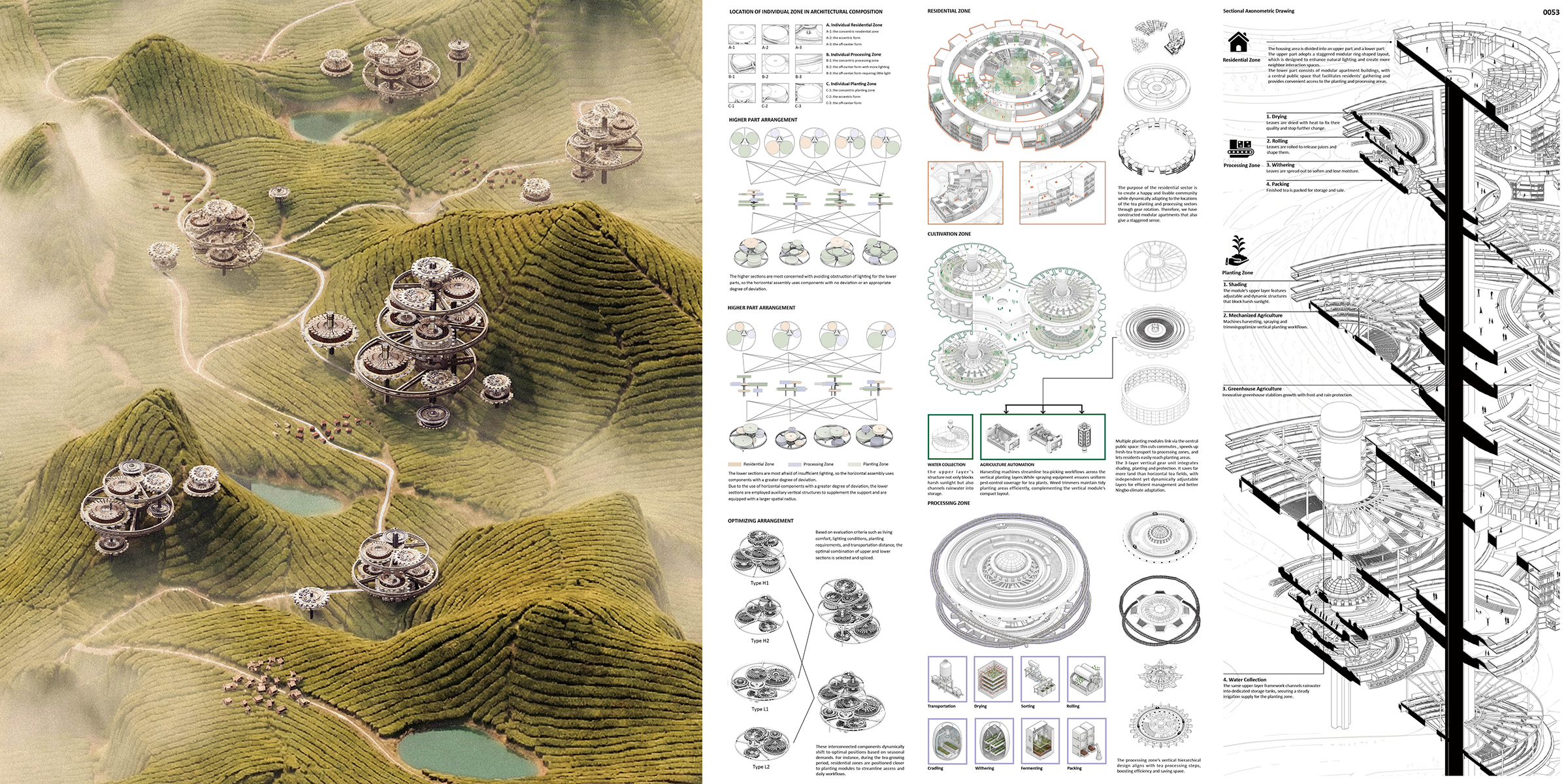
The settlement core is an organic system capable of intelligent growth through self-regulation. Inspired by precisely meshed mechanisms, we establish a digitally coordinated relationship among three movable unit types: farming, residential, and processing. The farming unit, as the system’s core, is a highly mechanized intelligent device that autonomously manages light and water. Its surface panels unfold on cloudy days to capture diffuse light and close to provide shade; they also channel rainwater to storage for drip irrigation during dry periods, achieving fully mechanized climate control. The residential unit uses a fan-shaped rotatable modular design, allowing housing units to slide along the structure to adapt to varying seasonal needs, exploring new relationships between public and private spaces in a dynamic vertical community. The processing unit follows a mechanized workflow for tea production—drying, sorting, rolling—with a flexible position linked to farming areas via efficient logistics. Connected by a vertical circulation system, these units form a coherent organic whole operating like interlocking gears.
In the aggregation strategy, we spatially explore new habitats based on a dynamic balance between humans and nature. Unit positions are categorized as concentric, eccentric, or centrifugal. The design divides the whole into higher and lower sections, each permitting varied horizontal and vertical combinations. By pairing 2–3 arrangement modes and evaluating them for optimal farming daylight, residential sunlight, and mutual shading, we select several high-performing schemes. This optimization directly addresses the core contradiction: through precise vertical configuration, it simultaneously delivers ideal growing conditions and comfortable living quality.
More than an agricultural settlement proposal, this project explores future habitats and territories. Through a dynamic, adaptive architecture, it integrates production, living, and ecology vertically, forming an organic living system capable of self-regulation and intelligent growth. It offers a new paradigm for developing high-density sustainable farming communities.