Cloud Capture

By:  | March - 26 - 2015

Honorable Mention
2015 Skyscraper Competition

Taehan Kim, Seoung Ji Lee, Yujin Ha
Republic of Korea

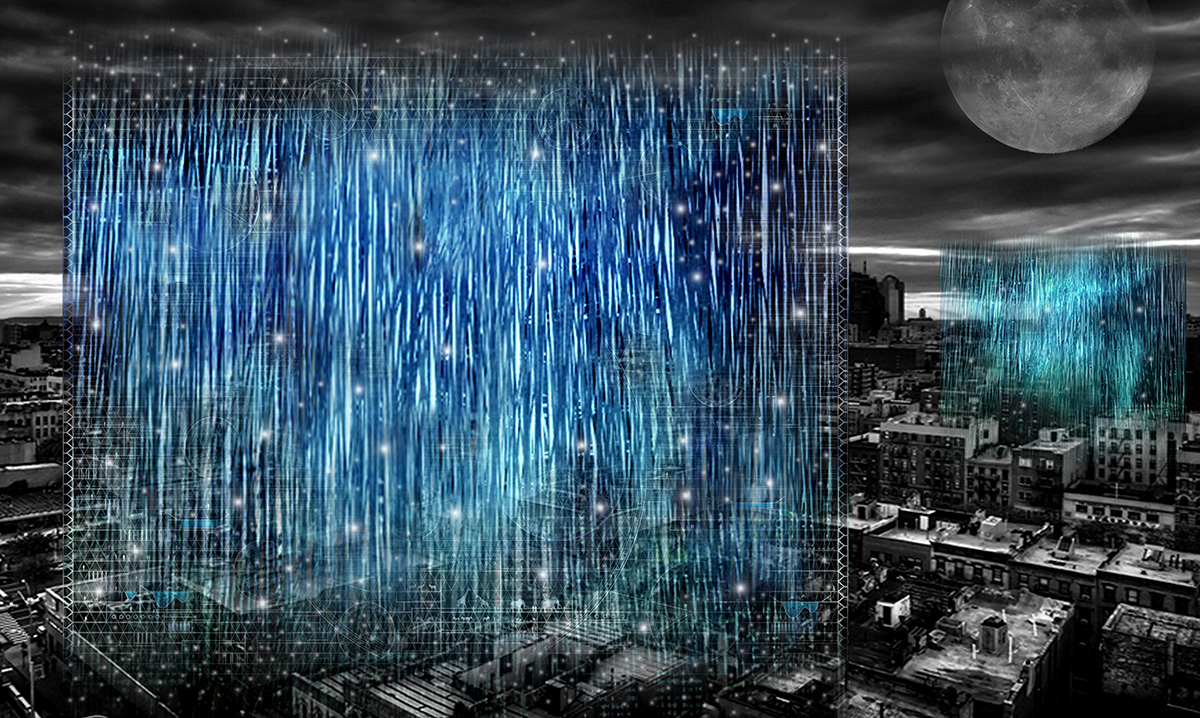
Neither did we know at first that the juvenile yet ingenious imagination of touching and catching the cloud would bring balance to the Earth…

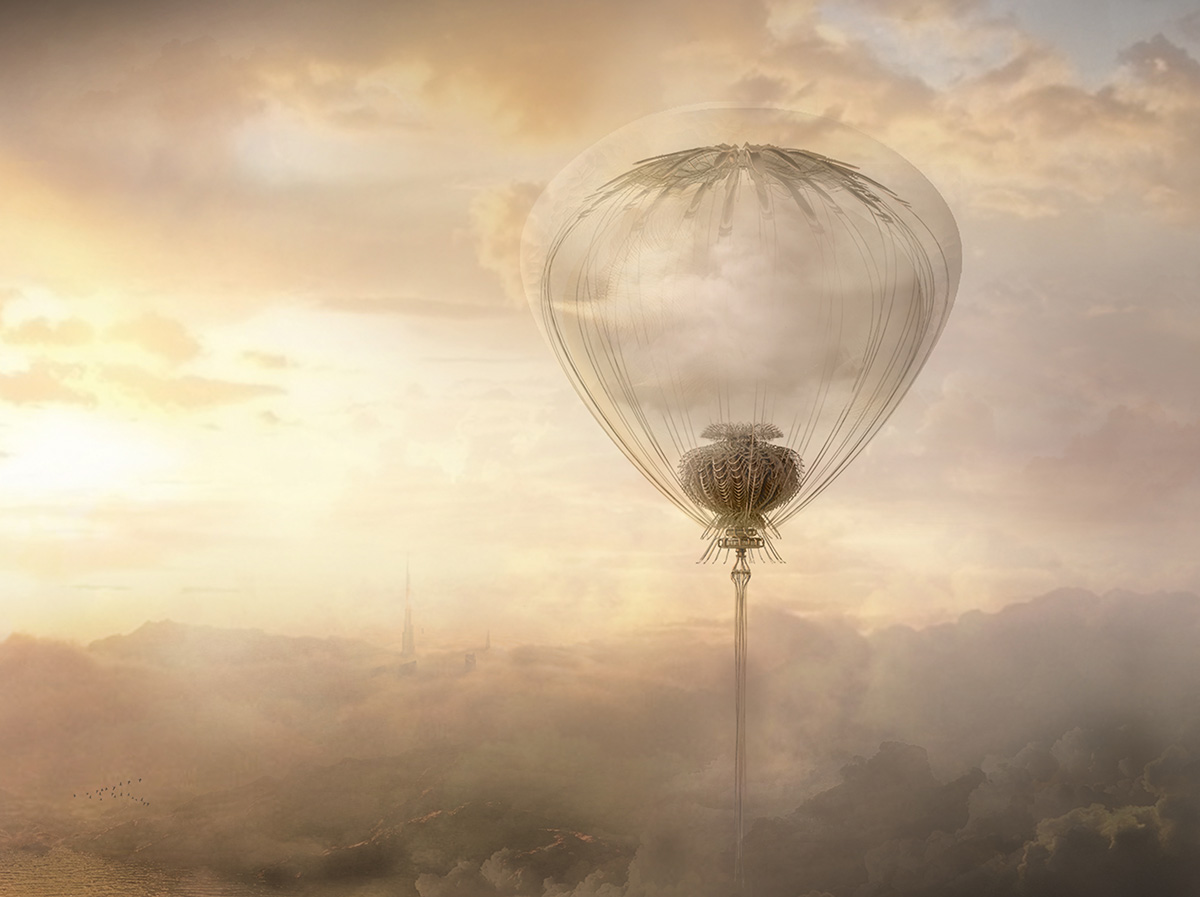
The mankind, despite their remarkable advancements, could not for once surpass the greatness of nature. In the face of devastating floods and droughts, our bests were mere building of dams and planting of trees. But one day, the abnormalities of climate started to exhibit signs of balance.

The balance comes from redistribution of cloud. Capturing then releasing the clouds from where they are affluent to scarce started to change the color of the planet Earth. The arid-yellow deserts transformed themselves as fresh green. Changes in the nature were only the start of all the other transformations to follow. Read the rest of this entry »

Honorable Mention
2015 Skyscraper Competition

Zhang Zehua, Song Qiang, Liu Yameng
China

So forgettable, so engraved. Time dating back to April 26, 1986 ,a quiet night. With a big bang , the fourth reactor which is located in the Chernobyl nuclear power plant exploded, the amount of radiation is about 400 times of the atomic bomb which is dropped on the Hiroshima. There are about seven million people were forced to leave their homeland in two days, they even had on time to say goodbye to their present life.

But not everyone accepts the arrangement of fate. The negative effects of radiation have been dafeated by a large group of settlers, more and more people are returning to their homeland which located in the restricted area, what can be sure is that they use a different way to look at the risk which they bear . They survived from the harshest environments in the 20th century, Stalin caused the Great Famine in Ukraine in 1930s,which caused millions of people to death, they also experienced the atrocities of the Nazis in 1940s. Therefore, after the Soviet government is stable for years, the Chernobyl incident happen, they do not want to leave because of the enemy which is invisible . There is a kind of heroic toughness and frank reality in their character.

For the people who return , home is no longer a transitory concept , it is a force even to resist the radiation. Their spirit will let us review the meaning of the relative risk and grab a kind of internal emotional contact of motherland— Fallen leaves return to the roots.

Purpose: This project aims to build a skyscraper for them, the air purification equipment and water purification equipment are contained in the skyscraper, the solar power is used to provide energy for internal devices. the skyscraper is just like a Garden of Eden, a new and safe life will start from here.

Principle: Nuclear radiation is consisted of three particles, α,βandγ.In the atomic nucleus, electron will absorb the radiation and give out light when it promoted from lower energy level to higher energy level.Fluorescent plates are used to construct the facade of the skyscraper to shield and use the radiation ,which create a safe and stable living environment for people inside. Read the rest of this entry »

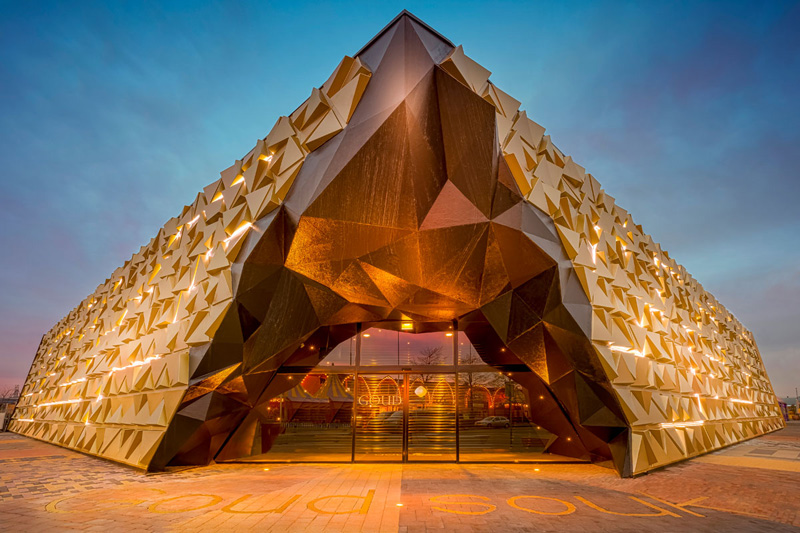
The exterior is defined by a 35 meter long facade that explains the visitors in a glance what they can find here: all that glitters is gold! The entrance is clearly marked. Here, the ‘nugget of gold’ has opened up to provide access to the ‘cave’ where the real golden treasures are safely displayed.

Contrary to the exterior of the building, which is very visible and prominent, the design of the interior is very modest. Everything is black, even the reflective floors and ceiling. In combination with the lighting, the attention is directed to the shining of the displayed jewelry of the gold dealers! And in the end, that is what it’s all about.

The building and its surroundings are designed in such a way with safety and ‘crash’ protection as part of the design. The inverted pyramids aren’t just functional – because of their triangular form they also enhance the design of the facade and match with the character of the Goud souk.

The golden facade of the Goud souk consists of relief panels with a triangular pattern. By repeating these panels throughout the whole facade with a varied orientation, a very diverse facade emerges, a real eye catcher. Thanks to the lighting between the panels, the golden facade shimmers day and night.

The power of the layout design of the interior of the Goud souk is the simplicity: the faceted form of the display cases provides a very large show case surface and excellent visibility. The displays of the jewelry are in fact extended into the hall.

Design: Liong Lie Architects
Photography: Hannah Anthonysz Read the rest of this entry »

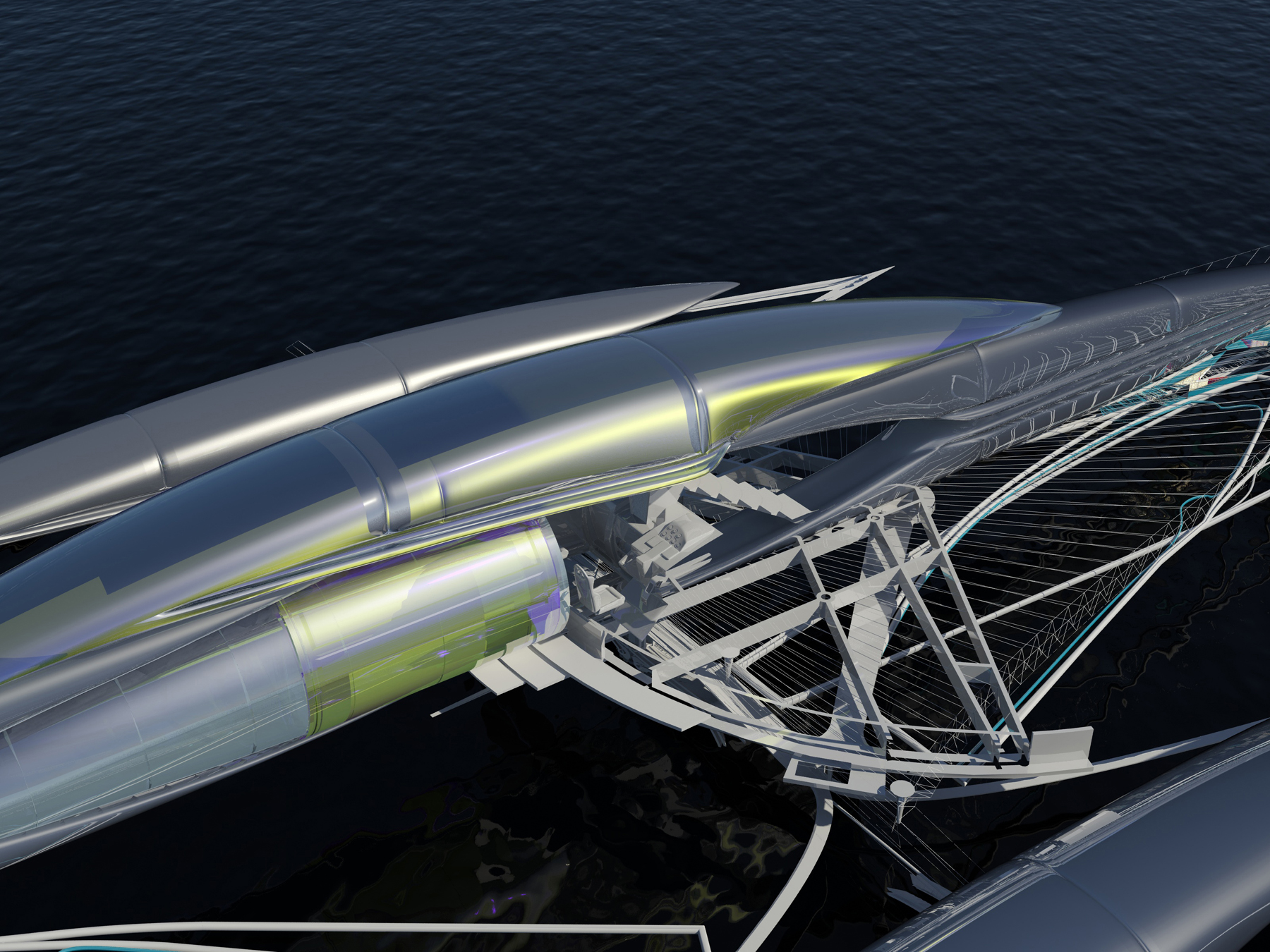
The Fresnel Trimaran designed by Margot Krasojević has a folding wingsail for a better lift to drag ratio, the sail’s frame is a built up mechanical structure similar to an airplane wing constructed from carbon fibre with a retractable Kevlar sail covered in aero-nautical film. The sail rotates around the mast and has a series of motorised creases which catch the wind, the wingsail is actuated by motors that control these movements using solar cells and wind energy.

The combination of the Fresnel lens and holographic film clad outrigger concentrates solar power for more of an efficient output. The form of the main hull acts as one unit with the wingsail, which wraps into the main body of the hull creating a continuous surface resulting in the motorised mast changing the shape of the sail allowing it to harness more wind. The outriggers detach to transform the yacht from racing multihull Trimaran to a cruise boat for leisure. The multi-hulls use recycled carbon fibre materials to reduce the environmental damage caused during processing new carbon fibre sheets.

The multi-hull wingsail design does not carry a heavy ballast which slows down vessels, all the materials used are strong yet lightweight.

A triangulated woven polyester mesh trampoline with a vinyl coating runs the length of the Trimaran, it is connected to the wingsail which wraps itself into the main composite carbon fibre hull, the trampoline frame acts as a water piercer with a heavy ensuring a smoother ride. Wind flows over wingsail and uplift drives the Trimaran forward.

The Wingsail generates wind energy, internal gearing systems convert wind energy to electricity which can be used to part run the motors or contribute to the integrated desalination unit along with the solar cell/ fresnel clad outriggers which run the desalination unit providing up to 4 litres of drinking water per hour.

Flexible solar panels located on the top and bottom of the wingsail surfaces generate electricity using wind and solar energy.
During bright windless days, wingsails face the sun and only solar energy is generated.
On windy days, wingsails rotate to generate largest combined energy from wind and sun. At night, wingsails generate just wind energy.

The outrigger hulls can detach themselves from the main hull, they are constructed from a double section vacuum bonded PVC surface lined with Fresnel lenses and holographic film to focus the light intensity towards the sandwiched solar cells. The Fresnel trimaran also has a set of fold-out hydrofoils. When it’s in monohull mode, these hydrofoils can be deployed, pushing the main hull up above the water, reducing water resistance by up to 80 percent, allowing for a fast, smooth ride that uses less fuel.

The main cabin is lined with holographic film which defracts incident light, it also acts as a prismatic concentrator which channels light towards the photovoltaic material.
The second stage to the project involves a series of elliptical tracks running across the yacht’s boards attempting to harness the main hull pendulum motion to run the perpetual retrieving magnetic turbine motor. Read the rest of this entry »

New Qatar Courthouse

By:  | March - 11 - 2015

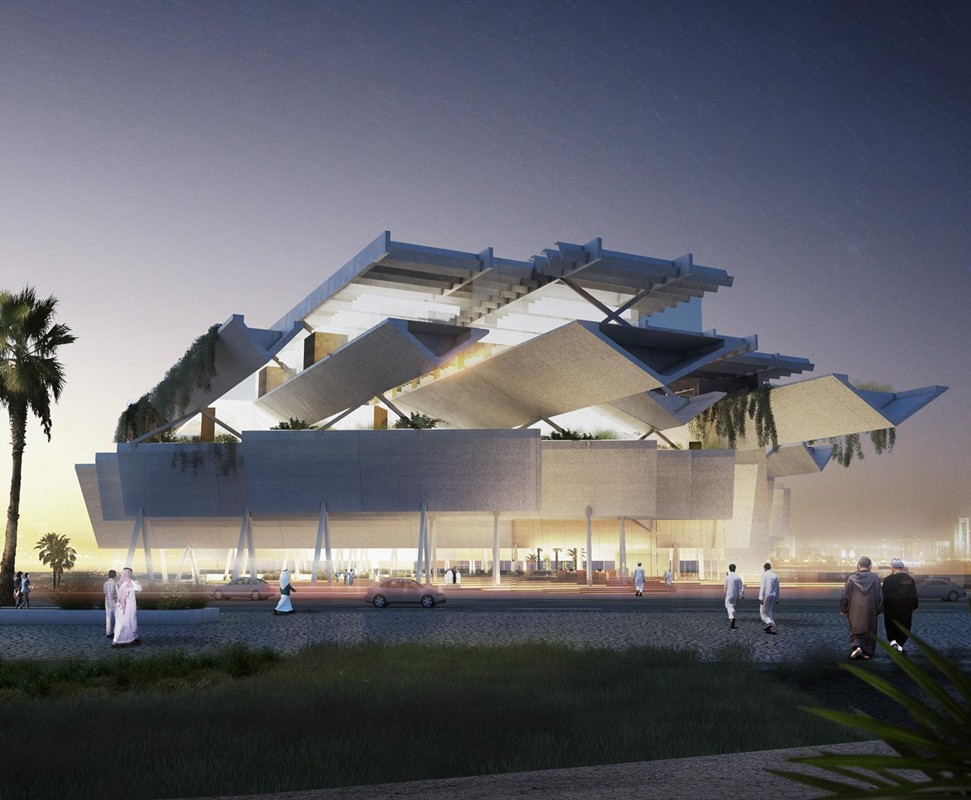
The proposal developed by AGi architects for the Qatar Courthouse restricted competition, organized by the Qatar Government, has been awarded second prize.

Institutional buildings need to embody the ideals and value system of any given society, with order being one of the core principles of any group. No society can prosper and thrive without it. Order is structure, it is the law, it is justice; without it, there is chaos. It is therefore extremely important that the Qatar Court House be aspirational and reflect these basic principles. The building is designed on two basic grids that are site driven, one linking it to its immediate context and the second to the larger context of Doha. These grids create stunning structural and spatial possibilities that make the building stand out visually so that people can see their ideals reflected in built form -structure, order, transparency, ambition -all of which are the ideals of Qatar’s growing society.

One of the fundamental questions for a civic structure is how is it approached and how is it perceived? The project brief contained a dense program that would occupy only 40% of the site, which would yield a type of vertical structure. This verticality however in the context of modern day Doha does not read as institutional. We sought to expand the ground plane across the entirety of the site, creating a public plaza and in doing so altering the proportion of the building. Floating above the plaza is the main structure carrying the central courtrooms, signifying that the law is above everyone. These subtle gestures ensure that the plaza act as a threshold between society at large and the justice system, making the Qatar Court House an open and welcoming building, rather than an ominous, insular one. At this scale, the floating structure acts as a literal and figurative canopy: it offers protection from the elements and a place where one can seek refuge from the greater population. The geometry of the floating structure ensures that there is ample light that fills the plaza, making the building feel lighter. At night, this very interplay between the volumes themselves makes the building visually striking. Read the rest of this entry »

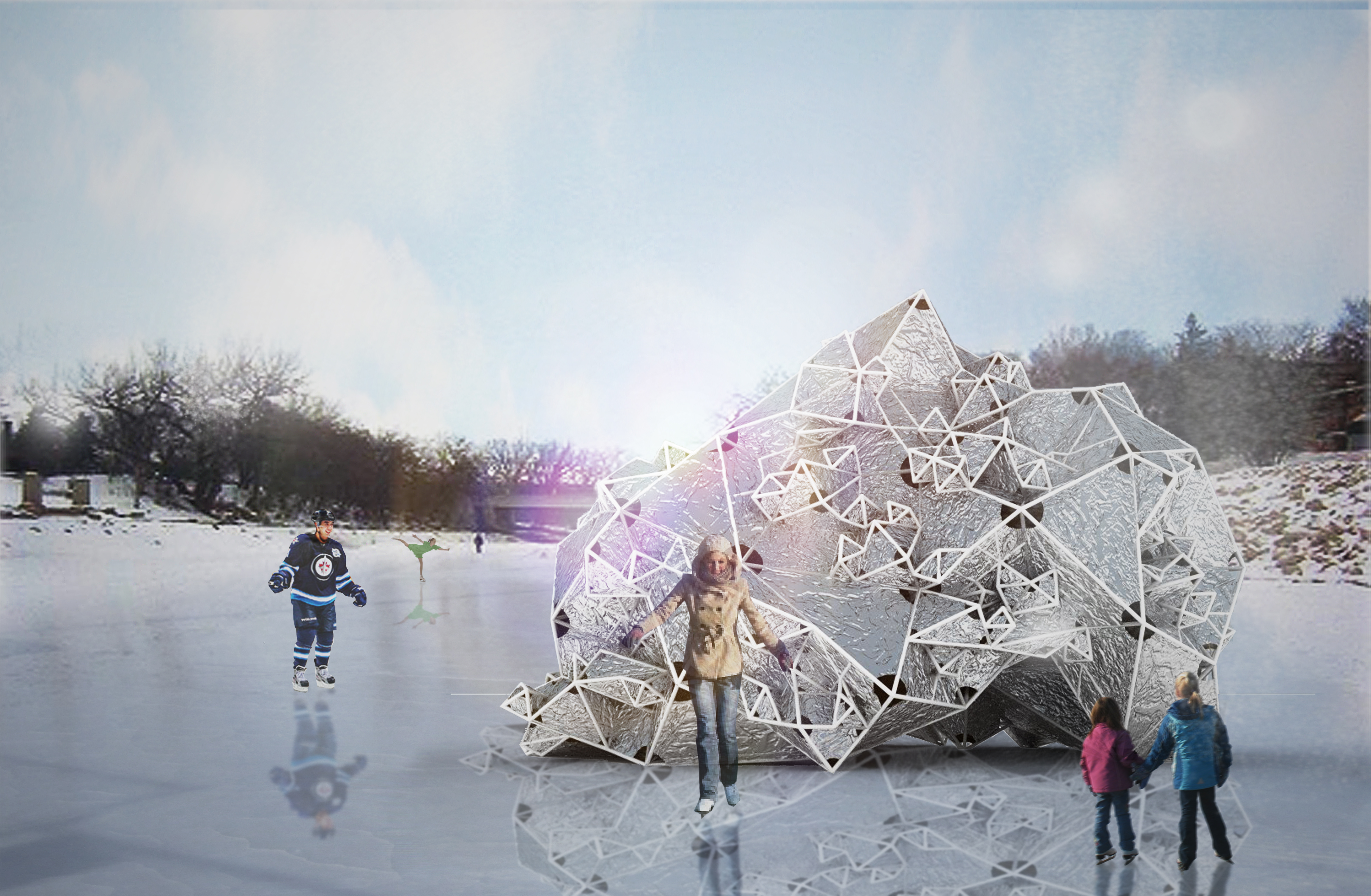
Ice Crystal designed by Virginia Melnyk arrives from a series of aggregations and adjustments inspired by the way that snowflakes and ice crystals are formed. Using computational design to generate growth cycles and manually manipulating outputs for desired proportions and organization, the structure arises from the assembled tetrahedrons. Each of the different generations which combine to shape the pavilion built on top of one another and decrease in scale every new generation. The proposed frame work  would be made from PVC pipes with unique connectors at all the joints digitally fabricated with 3d printing. The surfaces of the tetrahedrons is made from silver Mylar, commonly used as “space blankets” or emergency blankets. The space blanket feels warm by reflecting heat from the body back onto the body. The Ice crystal warming hut feels warm, in contrast it’s cool iceberg  like appearance on the icy landscape. But once inside colors of the skaters clothes begin to reflect around the Mylar walls producing and kaleidoscope effect inside the Ice Crystal warming hut. Read the rest of this entry »

Symmetryscope

By:  | March - 3 - 2015

Experimental project SYMMETRYSCOPE tryes get to the bottom of symmetry and reveal its possibilities. At first step the liner symmetry was investigated and several columns were made. The principle consisted in the rotation and mirroring geometrically simple shapes (tetrahedron). However, the geometry of the column did not allow any internal spaces and so were unusable for architectural purposes. Another move forward was done by the planar symmetry. The principle was similar to the columns. The effort was to achieve interior spaces.

The fascination with symmetry has not been exhausted. From the mirror surface we moved into the space. I started from the tetrahedron, I used its internal organization. The mirroring planes match his faces axes, internal axes and perpendicular planes to theses axes in vertexes. Geometry results in kaleidoscopic effect. It can be rotated, target structure changes.

DOMINIK CÍSAŘ (AUTOR)

/ AIII / Imrich Vaško, Martin Gsandtner
ACADEMY OF ARTS, ARCHITECTURE AND DESIGN, PRAGUE Read the rest of this entry »

Nanling Exhibition Hall

By:  | February - 27 - 2015

We understand the whole as an exquisitely meticulous sculpture that contains space and hosts knowledge. Our intention is to convey a strong character and presence for the building, exemplifying how it as an urban cultural container. The building stands as an entity able to transcend from the local to the provincial scale, capable of reflecting the collective consciousness, feelings, and future visions of the Chinese society.

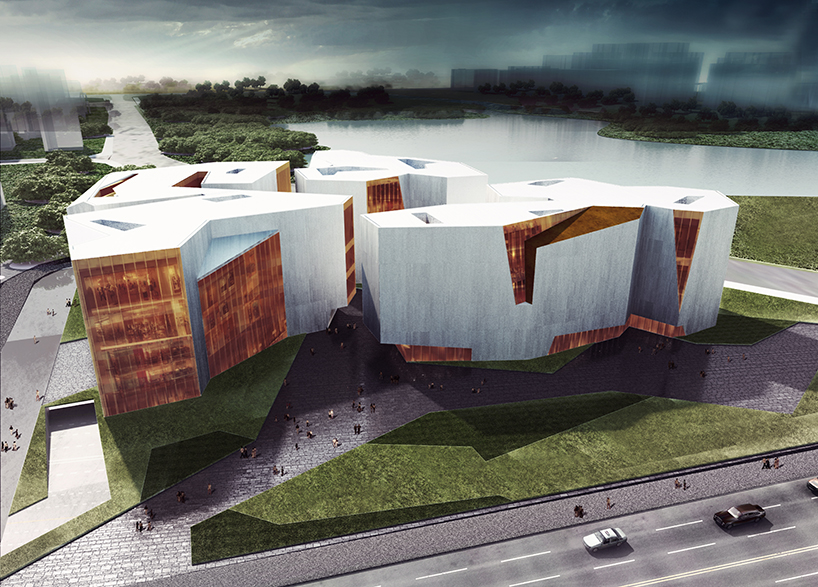
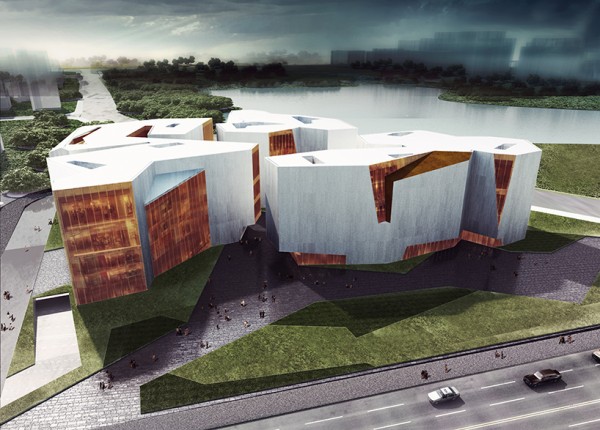
The Exhibition Hall of Nanling Town should be an important landmark building that represents the town and its local culture. In order to achieve this we looked for local sources of inspiration. The interesting rock formations that cover the Yashan Mountain inspired us to create the lines of the building and to make a landmark that is easy to recognize by anyone.

We organized the project into 3 buildings with a public space in the middle. The volumes are shaped like the rocks with cuts and cracks that act as entrances and windows to bring the natural light inside. The cuts in the volumes are made from different materials. Outside the volumes look rough but inside they are shinny, similar to a cut natural stone. On the edges the building looks solid with only a few carefully placed cuts, but inside the courtyard the building opens to receive natural light.

Although the project is unitary and all the buildings use the same language, we can talk about two different types of facades.One of them is solid, in white color, to give the image of rocks to the buildings and the idea of compactly and solidness.In this solid skin, we draw some cuts to allow the entrance of light inside and to break the volume. In this cuts, the material is glass or metal, like copper or cor-ten steel. The second facade is the opposite, made of glass, very translucent.This facade is necessary for the entrance of light in the parts where we have office.

The main idea is to leave the maximum possible space for people. That’s why, by placing a perimetral car street, the major part of the inner project is pedestrian.This configuration is perfect for creating squares, enforce pedestrian circulation and create people-oriented public spaces.The accesses to the buildings are inside the plot, to reinforce the use of the public areas and create lively space.

Because the major part of the open space of the project is pedestrian, the landscape has a big importance in our project.The first important concept is that we wanted to create a connection between the green park in front of the plot and the inner square of the project.The idea is the use of simple materials to create a soft and elegant landscape in order to set up a friendly and calm environment, The materials chosen are traditional materials like stone, wood, grass and bamboo.We also wanted to reinforce the idea of “green environment”, that’s why we dispose very big green areas. Essentially, the program is divided into three main uses: exhibition, office, and archive. Each of these uses are allocated into one of the different buildings, subsequently, the structure is very simple and easy to understand. Read the rest of this entry »

Walk-On Balcony In Gliwice, Poland

By:  | February - 25 - 2015

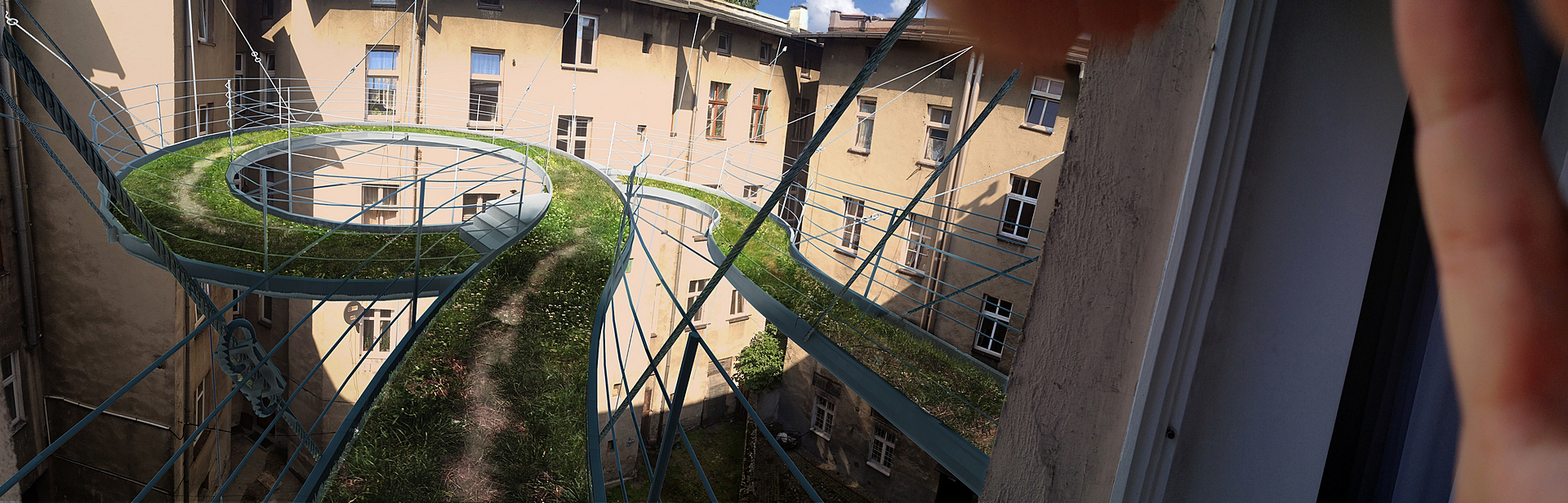
There are ideas that arise from the need of a particular moment. Such a need – another hot day of summer spent in the office and a thought “if only I could go for a walk” – became inspiration for a project of a path suspended in the air, a balcony Walk-on. It is also one of the ideas to change a sad courtyard, that we overlook every day out of the office windows on the 3rd floor, to give the courtyard a bit of magic. A normal path is tortuous, winds, does not lead directly to the goal, surprises, relaxes, gives contact with nature. Therefore our path should also flow freely in space – giving you a moment of relaxation, rest, allowing you to change the perspective. This influenced its shape – it winds freely and intertwines with itself – it allows for a relaxing walk “from office to office.” Longing for a bit of greenery made us treat the path as a large pot. We filled it with grass that can grow as it wants – after all it’s just a path.

A dark courtyard – a well, that was the nucleus of the problem – became in fact an inspiration for solutions. Mounting method imposed itself. Supports – the walls of houses – had just to be reached from all sides. Shading the neighbors was reduced by reaching to the very idea of a path – which in addition to the fact that is winding, it is also very narrow. It is therefore 80cm wide strip of greenery suspended in the air. From the bottom it seems even narrower because of the palate made of polished metal. The sheet, thanks to bending the bows, mirrors the surroundings and blurs the edges of the path.

Usually “the form follows function” but sometimes “the form follows fun” – and our balcony follows this path.

Design: ZALEWSKI ARCHITECTURE GROUP Read the rest of this entry »
Urban Infiltration Skyscraper For Houston

By:  | February - 20 - 2015

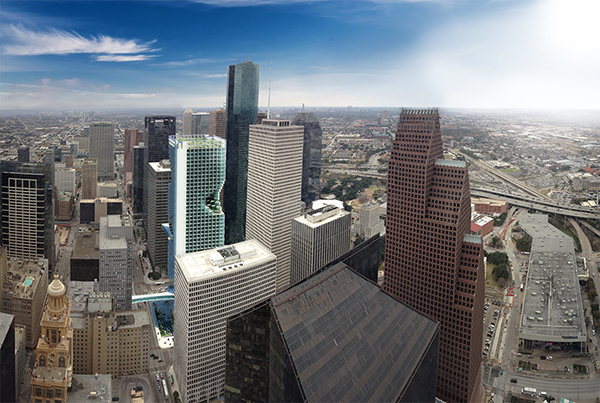
This undergraduate thesis project by Camden Wade titled Urban Infiltration is a visionary and innovative tower that challenges the typical approach to the high rise typology in Downtown Houston by using “collective design.” In a downtown that lacks formal zoning regulations which creates an exaggerated autonomous mindset for high rise development and their primarily office programs, this design takes a paradigm shift through a more holistic approach to the typology. This is explored by investigating how a high rise can be more beneficial to its environment from the large urban scale, architectural scale, and most importantly, the intimate human scale. This project approaches this design issue by creating a hybrid high rise that encourages a more sustainable and localized lifestyle through a delicate balance of programs, both public and private, that relate to one another in a more 3-dimensional and integrated way.

Rather than the typical tower that is primarily privatized and shut off from the public, this thesis proposes a built environment that encourages and nurtures this interaction by extending the public realm’s street level experience skyward through the use of the “urban ramp” and ending it in a public sky park 300 feet in the air. This design concept creates a social hub for the area while also allowing the public realm to stitch together Houston’s stratified urban fabric from its heavily trafficked underground tunnels, to almost non-existent street life, and ultimately up to its floating sky bridges all through a “vertical promenade”.

Urban Infiltration re-evaluates the role of the high rise within an urban setting by using a building typology which is infamous for segregating user groups and isolating its occupants from the surrounding context, to in fact do the opposite by unifying and uniting Downtown Houston’s urban environment. Read the rest of this entry »