2025 Skyscraper Competition
Honorable Mention
Maria Murokh, Daria Bondarchuk
Russia
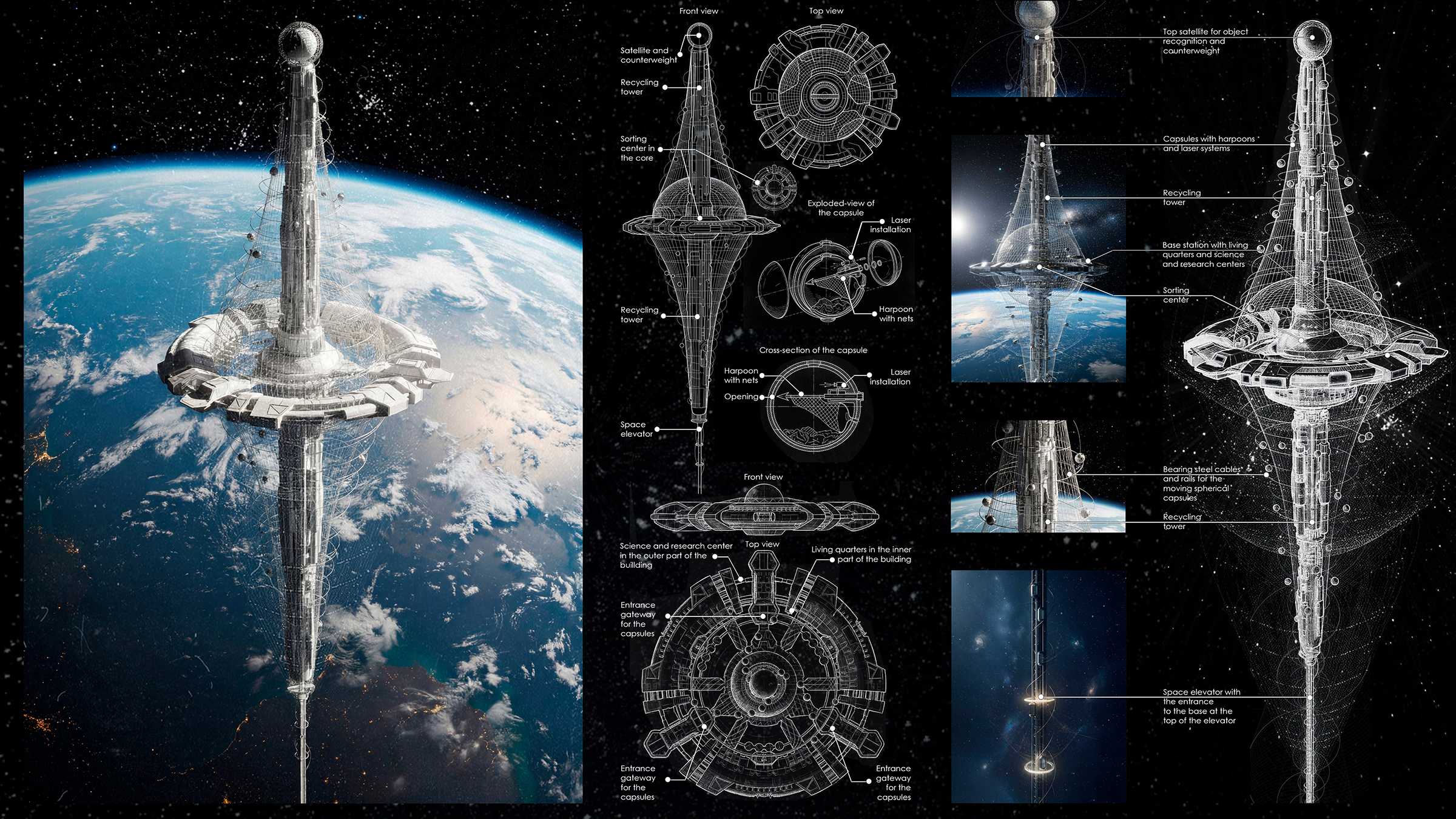
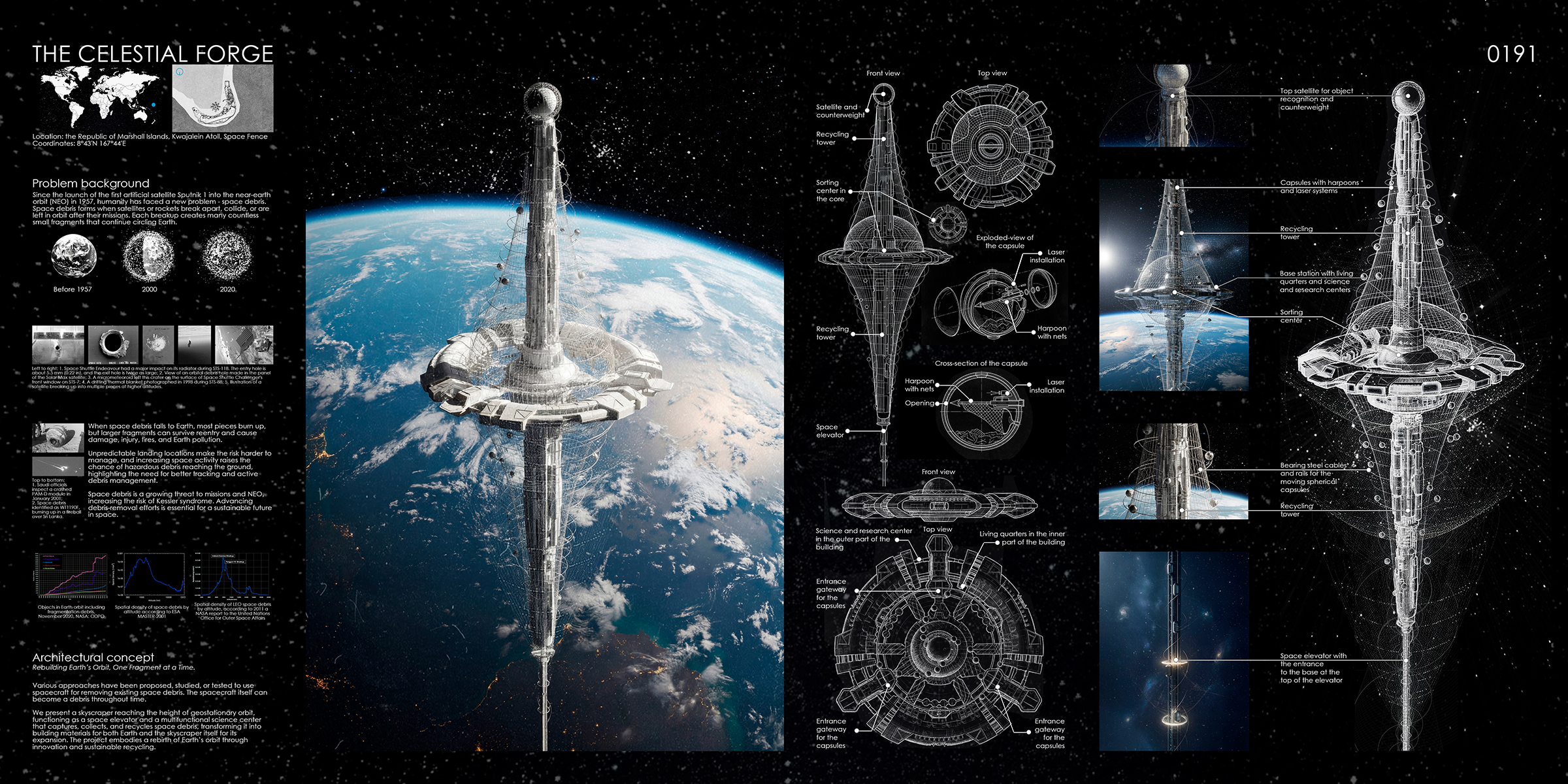
Humanity has entered an era in which its presence extends far beyond the boundaries of the atmosphere — yet our expansion into orbit has created an unintended and rapidly escalating crisis. Millions of fragments of old satellites and collision-generated debris now encircle the planet, forming a hazardous shell that threatens spacecraft, space stations, and future missions. The Celestial Forge proposes a radical architectural response to this planetary challenge: a vertical orbital infrastructure-skyscraper that captures, sorts, and recycles space debris while establishing a new typology of inhabitable architecture stretching from ocean to orbit. The project imagines a new architectural typology: a hybrid between a skyscraper, a space elevator, a scientific outpost, and a planetary-scale recycling facility.
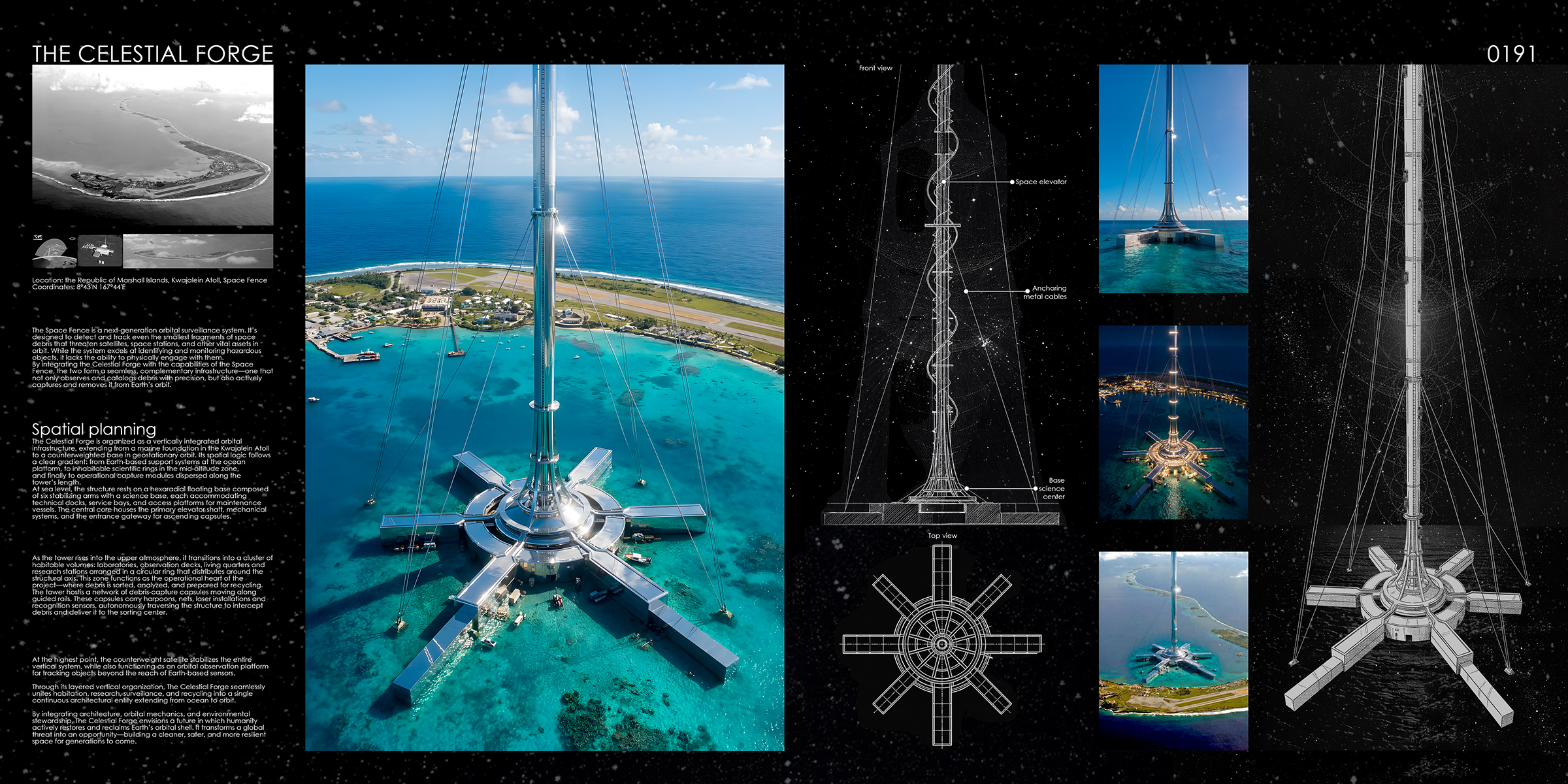
Anchored within the lagoon of Kwajalein Atoll in the Marshall Islands, the structure rises from a radial ocean platform engineered to stabilize the vertical load of the tower and serve as the terrestrial gateway to the system. The base building has maintenance docks, energy systems, a science center, and the entrance to the space elevator. From this point, the tower ascends continuously through the atmosphere, reaching geostationary altitude, where a counterweight satellite and base station maintain tension and structural equilibrium.
The Celestial Forge is conceived as a hybrid of space infrastructure, environmental remediation system, and research habitat. Its core function is debris management: intercepting hazardous fragments before they can collide and produce further scattering. Autonomous capsules equipped with harpoons, nets, laser-based recognition systems, and real-time navigation algorithms travel along the tower’s exterior by metal cables. Captured debris is transported to a sorting center housed in the center of the ring of laboratories and living quarters. Here, objects are analyzed, categorized by material, and either recycled on-site or transferred to Earth-based facilities for further re-use. Metals, composites, and rare elements — once considered waste — become valuable resources for future orbital manufacturing.
The project integrates closely with the Space Fence, a next-generation surveillance system capable of detecting even the smallest pieces of orbital debris. While the Space Fence excels in identifying and tracking hazardous objects, it cannot physically interact with them. The Celestial Forge transforms these digital observations into tangible action. Together, the systems form an interconnected, planetary-scale skyscraper infrastructure.
Beyond its industrial function, the tower incorporates zones for habitation, research, and long-term orbital living. At high altitudes, where gravity begins to decrease and the curvature of Earth becomes fully visible, a ring of scientific and residential modules forms a new liminal environment—neither Earth nor outer space, but an architectural threshold between the two. These modules house scientists, engineers, and researchers who oversee the system’s operation and study atmospheric and orbital phenomena in real time.
The Celestial Forge imagines architecture not as a static object but as an evolving instrument embedded within planetary processes. It transforms Earth’s orbit from a hazardous wasteland into a cyclical material ecosystem, where waste becomes raw material and surveillance becomes stewardship. As humanity moves deeper into the space age, the project argues that our responsibility extends beyond the ground we build on.
In addressing the growing threat of the Kessler Syndrome, The Celestial Forge positions architecture as a mediator between human ambition and environmental necessity. It proposes a future in which technological advancement and ecological responsibility coexist, and where architectural innovation becomes a foundation for planetary repair.
The Celestial Forge envisions a future in which humanity actively restores and reclaims Earth’s orbital shell. It transforms a global threat into an opportunity—building a cleaner, safer, and more resilient space for generations to come.