Honorable Mention
2025 Skyscraper Competition
Seonggeon Lee, Inseo Park, Yuran Jo, Beomseok Go, Seungeon Kim, Wonsup Lim
South Korea
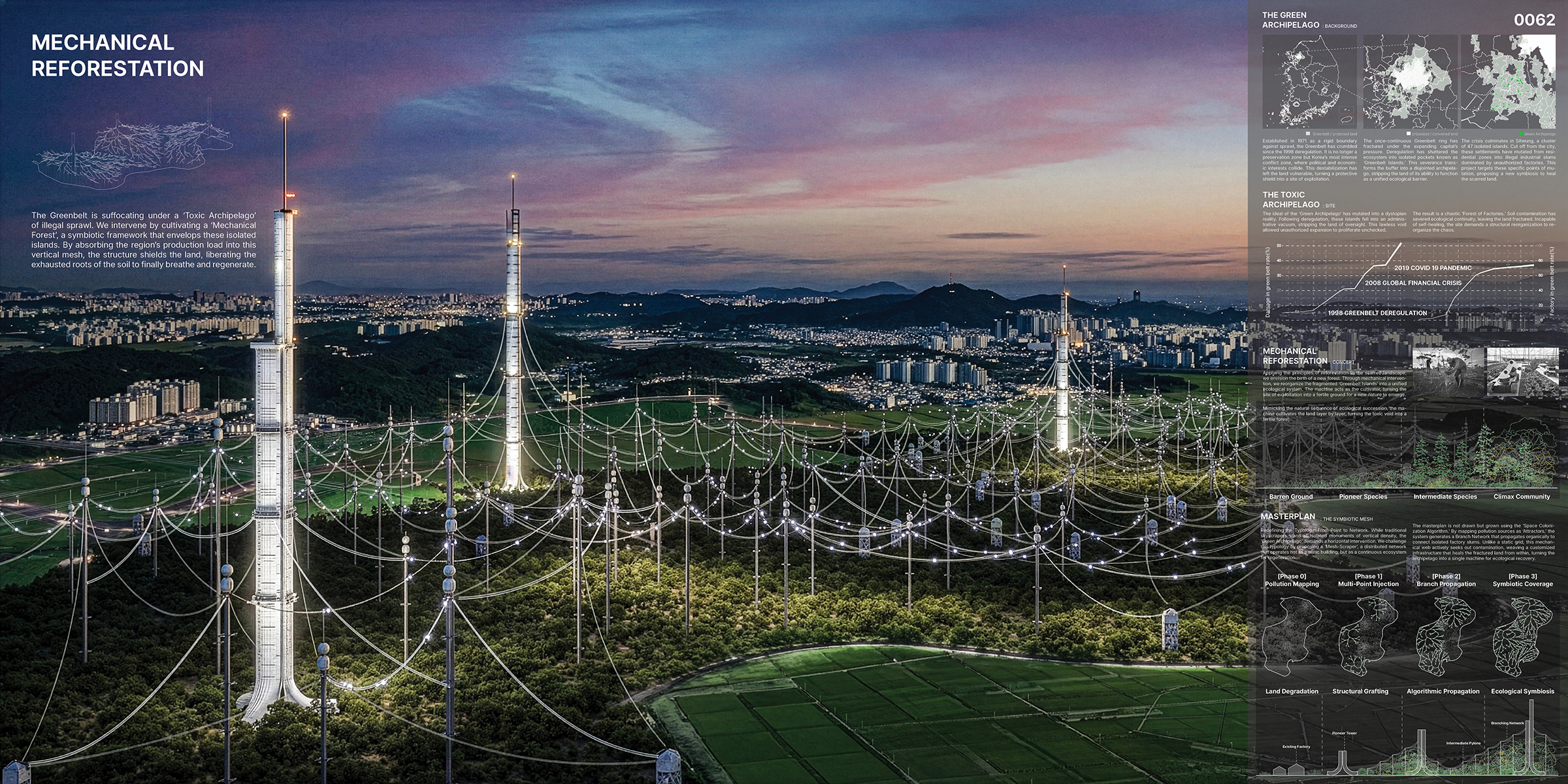
In the rapid urbanization of South Korea, the tension between metropolitan expansion and natural preservation has reached a critical tipping point. The Seoul Metropolitan Greenbelt, established in 1971 as a rigid boundary to contain urban sprawl, has paradoxically created a physical disconnection between the city and wilderness. This contradiction culminated in the 1998 Deregulation, a pivotal policy shift that fractured the continuous ecosystem into isolated pockets of development. To resolve this intense conflict, we propose ‘Mechanical Reforestation,’ a strategy of active ecological intervention that utilizes advanced technology to reconstruct a lost wilderness.
Nowhere is this crisis more evident than in Siheung, where 47 isolated settlements float within the green buffer. Far from the theoretical ideal of a ‘Green Archipelago,’ these islands have mutated into a ‘Toxic Archipelago.’ In the absence of proper administrative management, these settlements have transformed into illegal industrial slums dominated by unauthorized factories and plastic greenhouses. The land, trapped in a deadlock between conservation laws and economic exploitation, has lost its self-healing capacity. We recognize that this soil is too contaminated for natural recovery; therefore, nature requires a prosthetic.
The design emphasizes a paradigm shift from preservation to construction. Rather than displacing the existing industrial footprint, we transplant this activity into a hyper-efficient vertical infrastructure. By lifting the burden of human production into the sky, the scarred ground is finally liberated. This allows the soil to be mechanically treated and regenerated, turning a site of exploitation into a fertile foundation for a new forest.
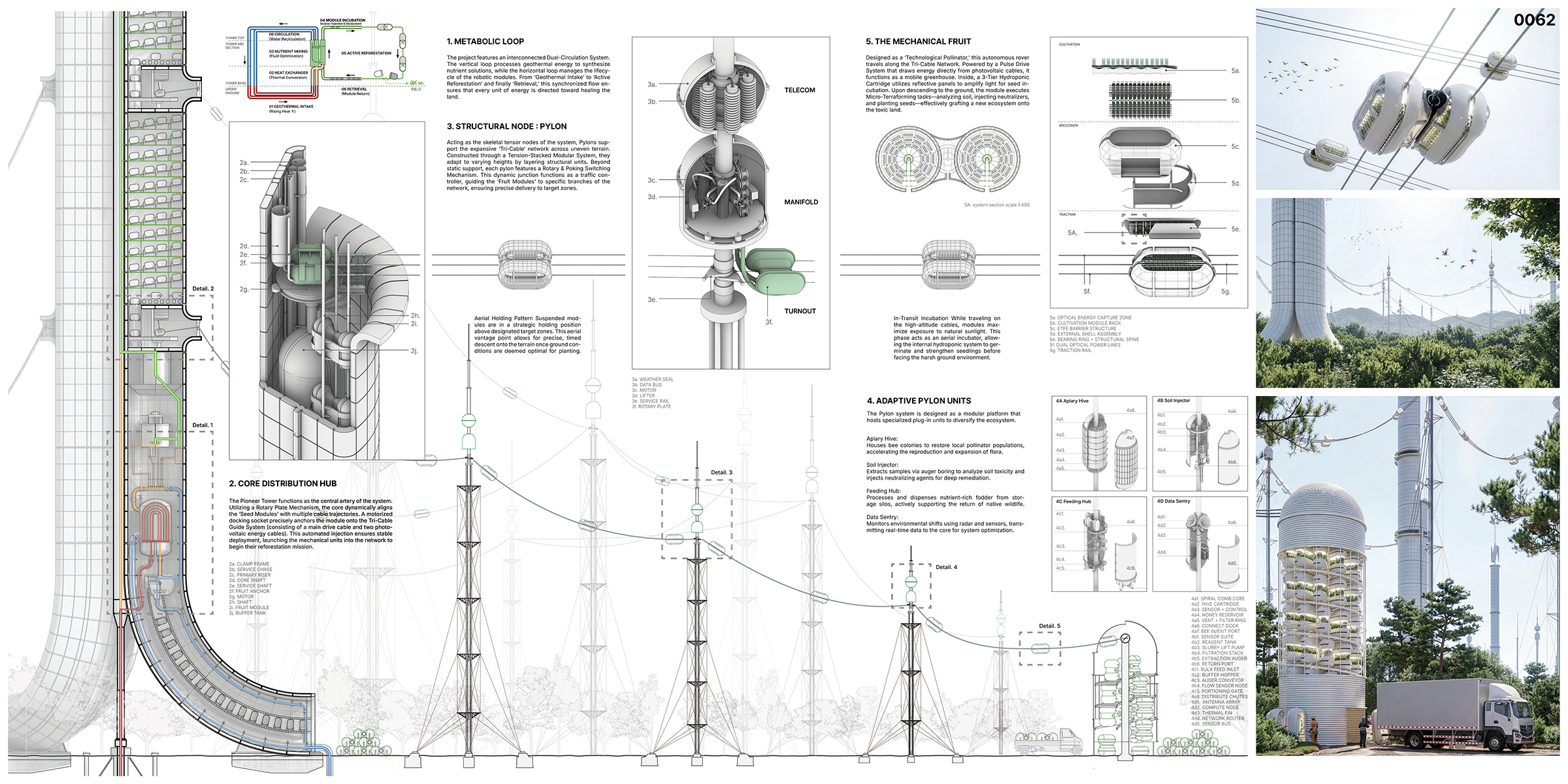
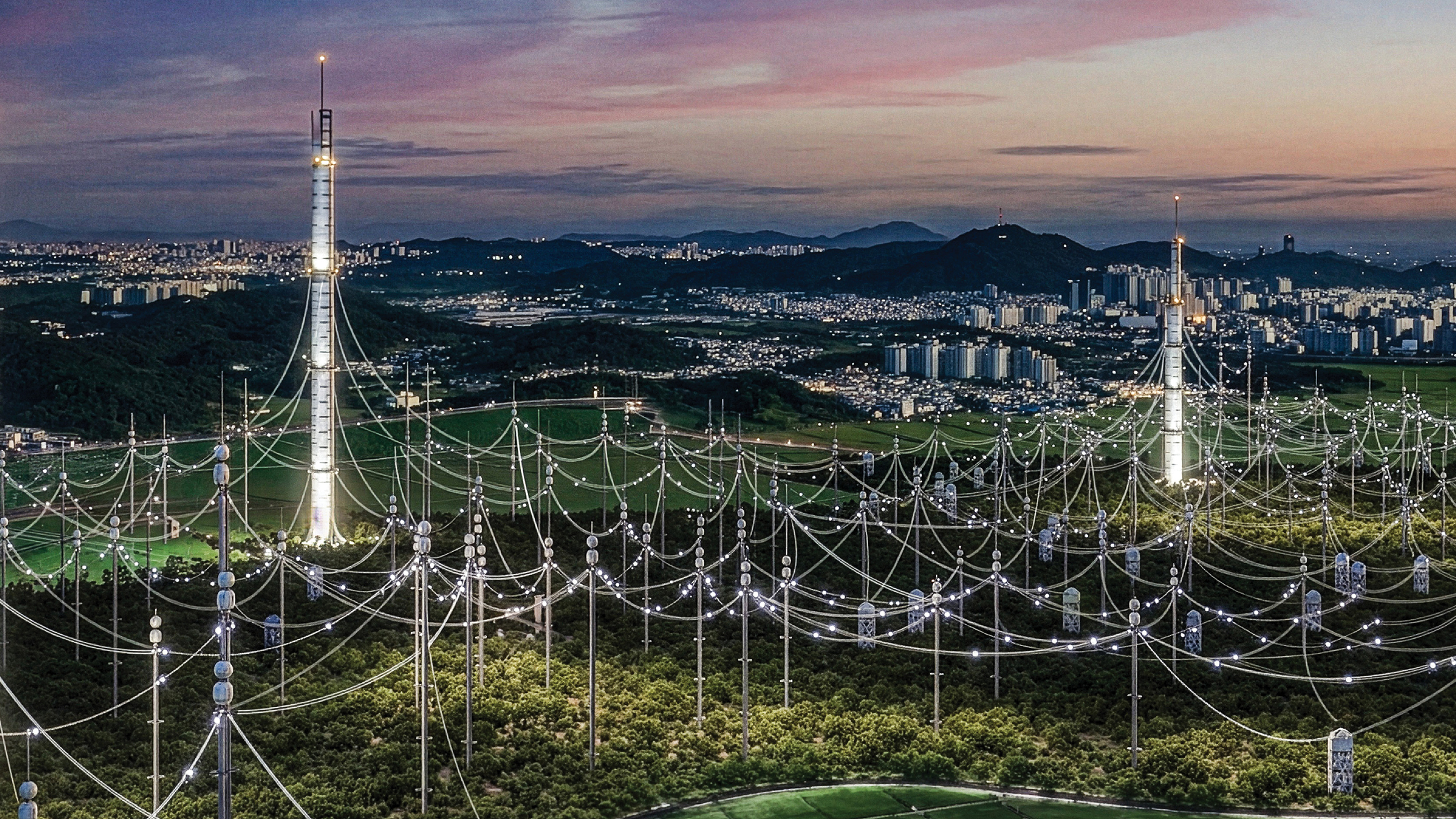
The masterplan redefines the skyscraper typology from a singular point to a distributed network, termed the ‘Mesh-Scraper.’ The form is not designed but grown using the ‘Space Colonization Algorithm.’ By mapping pollution sources as ‘Attractors,’ the system generates a Branch Network that propagates organically toward high-risk areas. This creates a rhizomatic infrastructure that physically adapts to the contamination map, ensuring optimized coverage for purification.
The system is composed of Pioneer Towers that anchor the structure and autonomous ‘Mechanical Fruits’ that travel along the Tri-Cable network. These mobile modules facilitate a cycle of production and recovery: analyzing soil, injecting neutralizers, and planting seeds. Powered by a self-sustaining ‘Metabolic Loop’ utilizing geothermal energy, the system operates as a closed circuit of regeneration. As the network expands, it transforms the fragmented ‘Greenbelt Islands’ into a cohesive, breathing organism. Ultimately, Mechanical Reforestation provides a sustainable model for the urban fringe, proving that advanced technology can serve as the most effective engine for constructing a new wilderness.