2025 Skyscraper Competition
Honorable Mention
Yuyi Shen, Ingrid Liu
United States
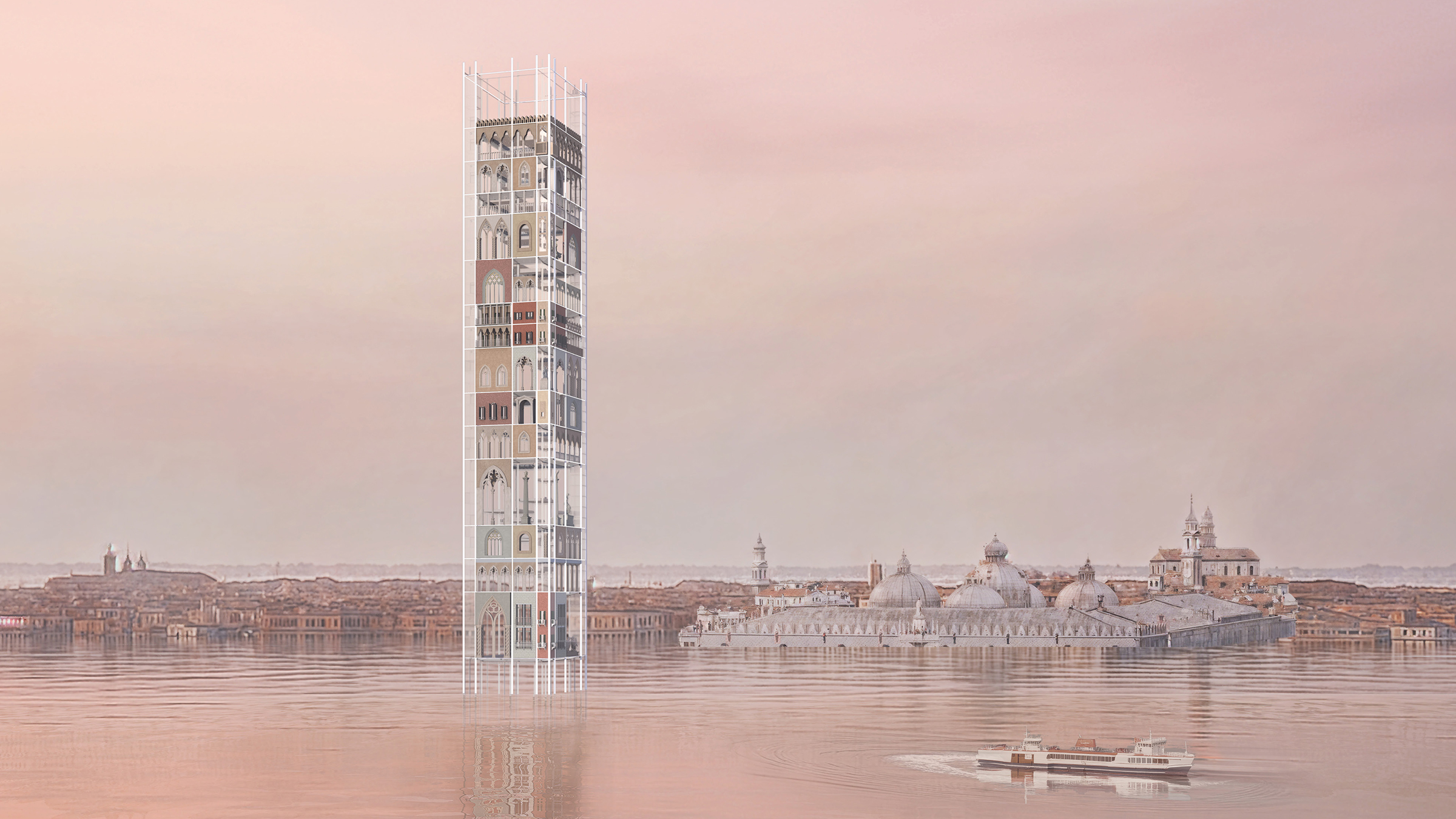
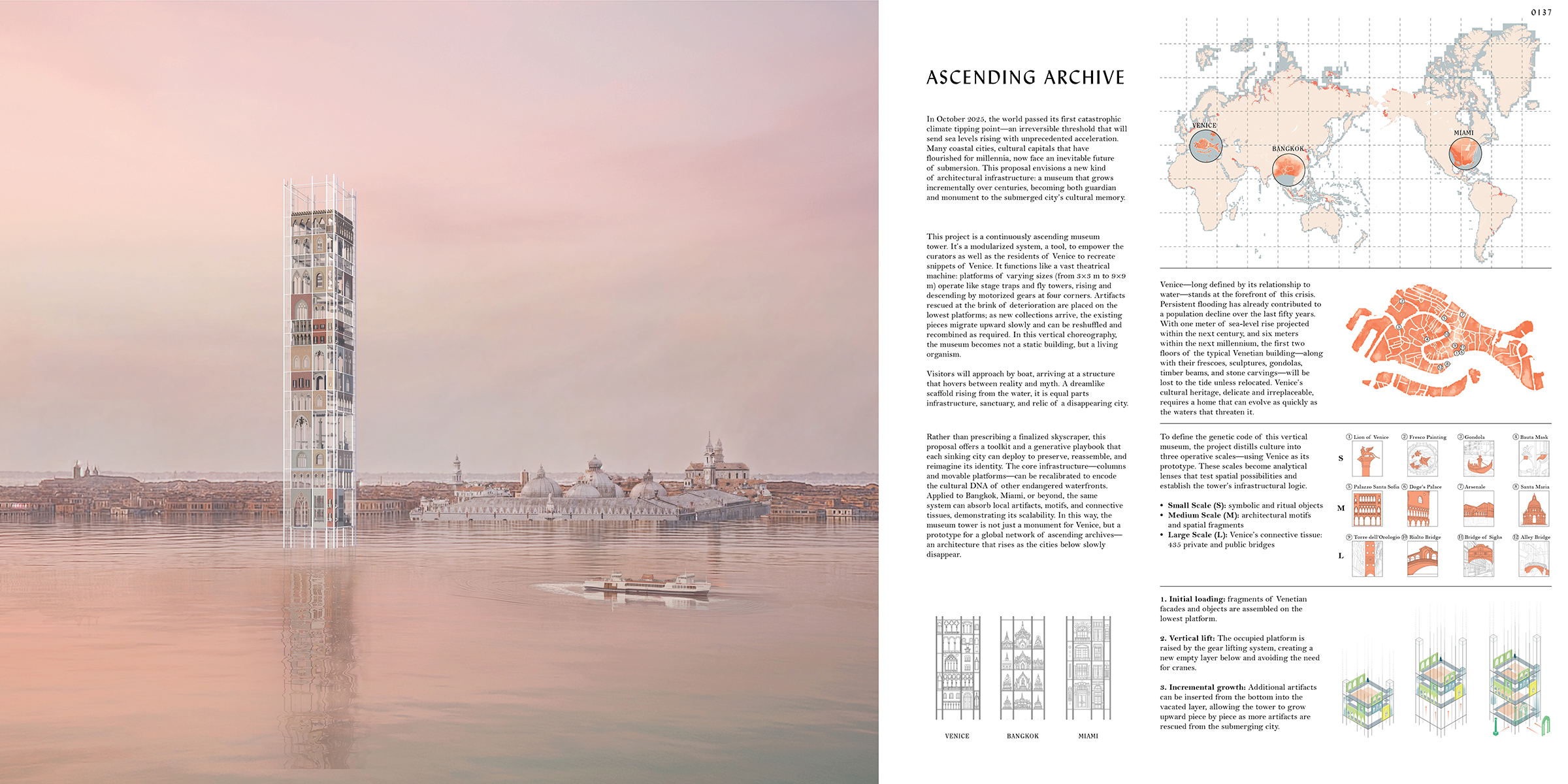
In October 2025, the world passed its first catastrophic climate tipping point—an irreversible threshold that will send sea levels rising with unprecedented acceleration. Many coastal cities, cultural capitals that have flourished for millennia, now face an inevitable future of submersion. Venice—long defined by its relationship to water—stands at the forefront of this crisis. Persistent flooding has already contributed to a population decline over the last fifty years. With one meter of sea-level rise projected within the next century and six meters within the next millennium, the first two floors of the typical Venetian building—along with their frescoes, sculptures, gondolas, timber beams, and stone carvings—will be lost to the tide unless relocated. Venice’s cultural heritage, delicate and irreplaceable, requires a home that can evolve as quickly as the waters that threaten it.
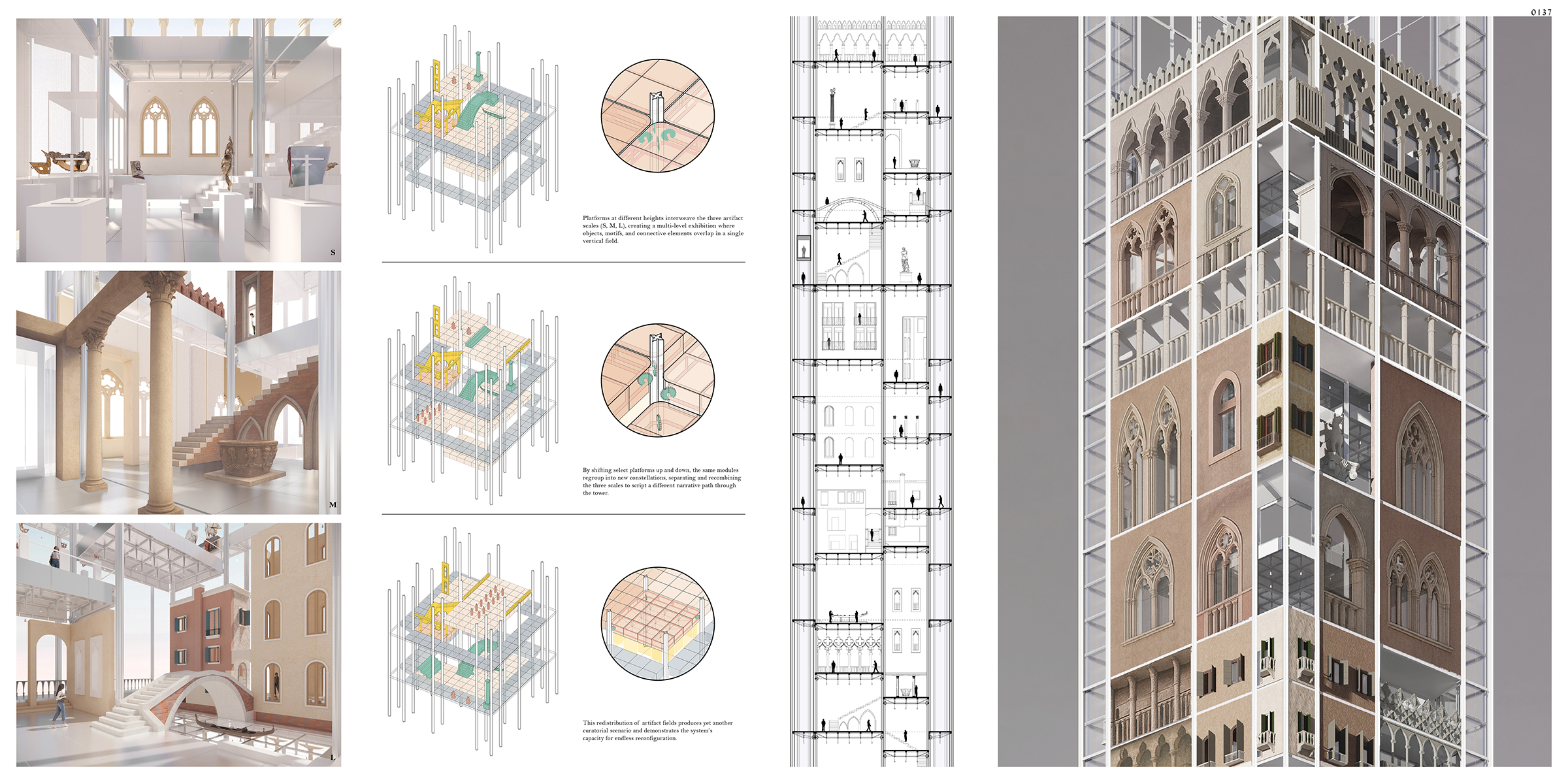
This proposal envisions a new kind of architectural infrastructure: a continuously ascending museum tower that grows incrementally over centuries, becoming both guardian and monument to the submerged city’s cultural memory. The project is a modularized system—a tool—to empower the curators as well as the residents of Venice to recreate snippets of the city. It functions like a vast theatrical machine: platforms of varying sizes (from 3×3 m to 9×9 m) operate like stage traps and fly towers, rising and descending by motorized gears at the four corners. Artifacts rescued at the brink of deterioration are placed on the lowest platforms; as new collections arrive, the existing pieces migrate upward slowly and can be reshuffled and recombined as required. Through this vertical choreography, the museum becomes not a static building, but a living organism.
To define the genetic code of this vertical museum, the project distills culture into three operative scales—using Venice as its prototype. These scales become analytical lenses that test spatial possibilities and establish the tower’s infrastructural logic:
Small Scale (S): symbolic and ritual objects
Medium Scale (M): architectural motifs and spatial fragments
Large Scale (L): Venice’s connective tissue, including its 435 private and public bridges
The three scales of cultural artifacts guide the tower’s infrastructural logic and shape countless possible curatorial scenarios. Platforms can recombine vertically and horizontally, creating unexpected spatial adjacencies that reinterpret cultural elements in new contexts. A gondola fragment might hover beside a reconstructed arcade; a bridge segment might frame a cluster of devotional objects. Over time, the tower becomes an ever-changing archive, continuously editing and re-staging the city’s memory as it sinks below the waterline.
Visitors will approach by boat, arriving at a structure that hovers between reality and myth. A dreamlike scaffold rising from the water, it is equal parts infrastructure, sanctuary, and relic of a disappearing city. Columns and movable platforms define a precise yet open framework: an architecture of mechanisms rather than fixed rooms, where the city’s remnants can be lifted, reassembled, and seen anew.
Rather than prescribing a finalized skyscraper, this proposal offers a toolkit and a generative playbook that each sinking city can deploy to preserve, reassemble, and reimagine its identity. The core infrastructure—columns and movable platforms—can be recalibrated to encode the cultural DNA of other endangered waterfronts. Applied to Bangkok, Miami, or beyond, the same system can absorb local artifacts, motifs, and connective tissues, demonstrating its scalability. In this way, the museum tower is not just a monument for Venice, but a prototype for a global network of ascending archives—an architecture that rises as the cities below slowly disappear.