2025 Skyscraper Competition
Honorable Mention
Daeun Kang, Dongwook Han, Sign Jeong
South Korea
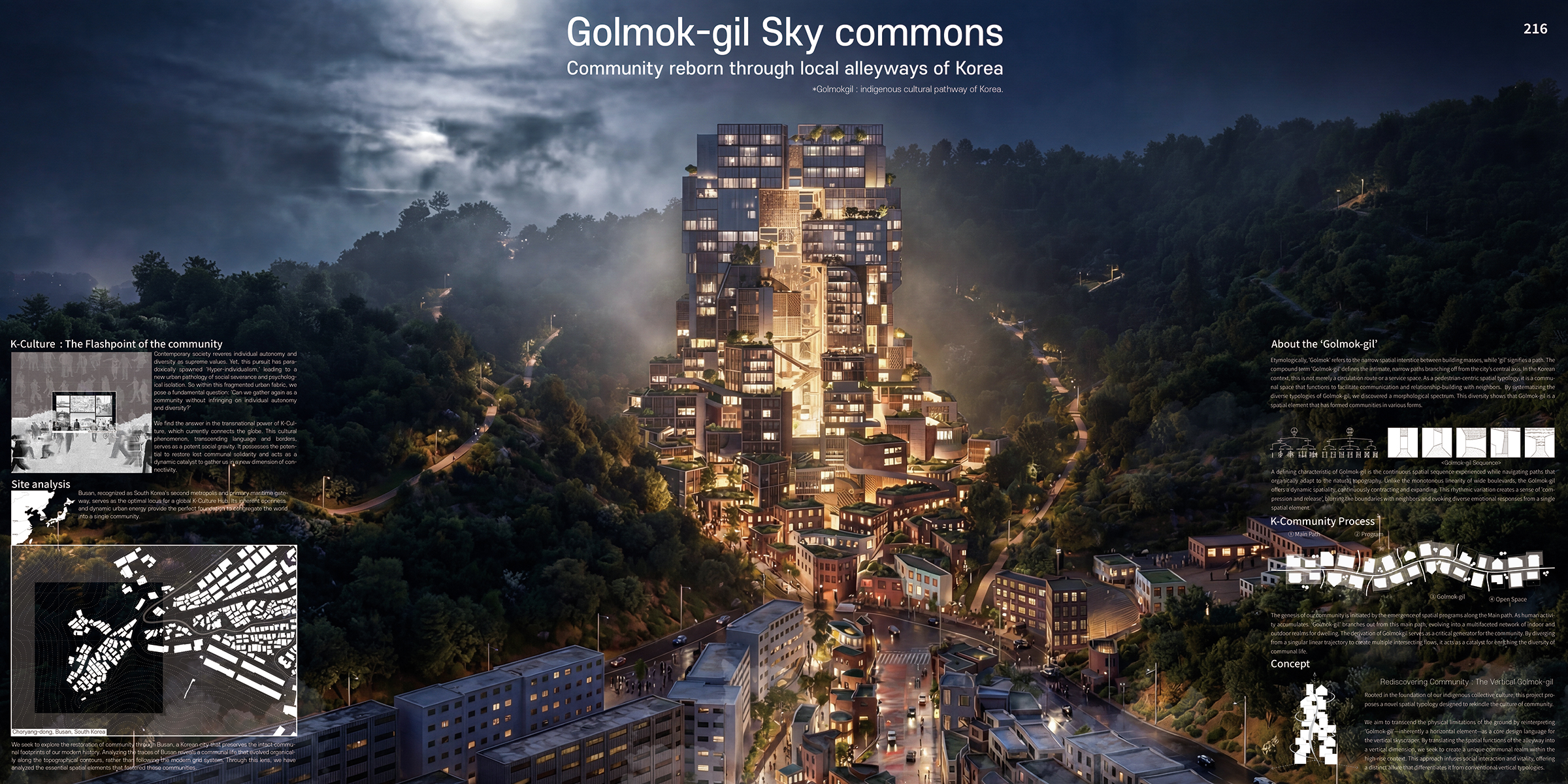
In contemporary society, individual autonomy and diversity are revered as supreme values. However, this prioritization has paradoxically given rise to the phenomenon of “Hyperindividualism,” creating a stark reality where severance from others and psychological isolation have become prevalent social pathologies. Confronted with this fragmented social landscape, we faced a critical question: “Is it possible for us to return to a sense of community without infringing upon individual autonomy and diversity?”
We found the clue to this answer in “K-Culture,” a powerful cultural force that is currently connecting the world into a single cohesive network. Just as K-Culture transcends borders to create a global consensus, our project aims to physically manifest this spirit of connection. We propose to infuse this communal culture into the typology of the skyscraper, reimagining the high-rise not as a monument to isolation, but as a vessel for social restoration.
Our architectural investigation centers on Busan, a city that serves as a living archive of Korea’s modern and contemporary history. By analyzing the urban traces of Busan, we discovered a unique form of community life. Unlike the rigid, imposed grid systems of modern urban planning, Busan’s historic settlements formed naturally, following the organic contours of the topography. In this context, the community was not forced but evolved symbiotically with the steep terrain.
Through a deep analysis of the spatial processes that fostered community life in this specific site, we identified the “Golmok-gil” (traditional alleyway) as the essential spatial archetype. The Golmok-gil was not merely a thoroughfare for passage; it was the living room of the city, the capillary of social interaction where the community was woven together. Based on this finding, we propose a radical reinterpretation: translating the spatial typology of the horizontal Golmok-gil into a vertical dimension. This project challenges the limitations of the ground plane, offering a skyscraper that generates a new form of community culture through vertical expansion.
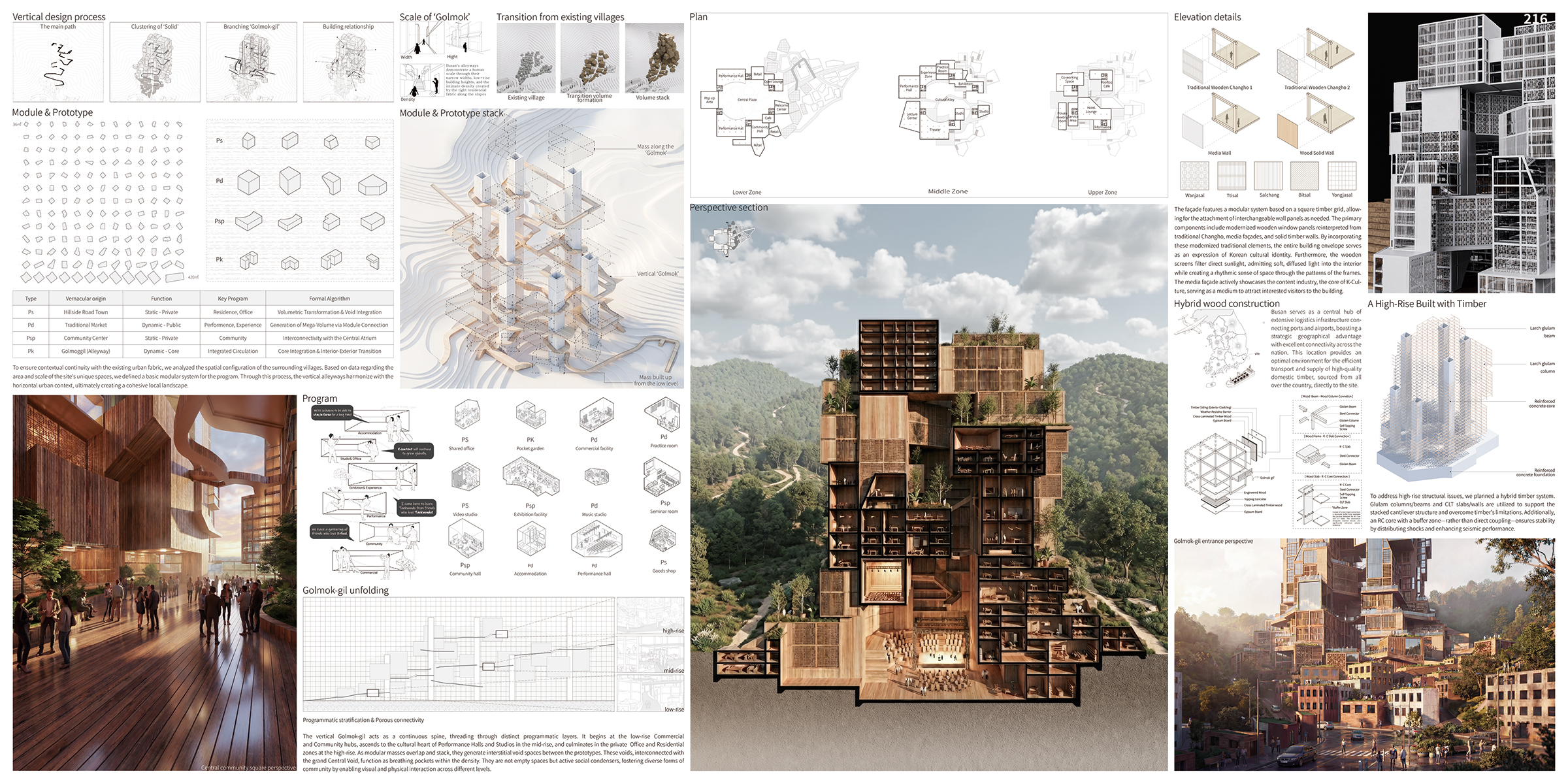
The core of our design is the construction of a continuous “Vertical Golmok-gil.” This pathway serves as the spine of the project, seamlessly connecting a diverse range of programs. The journey begins at the lower levels, designed as a commercial and community hub that invites public inflow. It ascends through the mid-levels, which house cultural facilities such as performance halls and studios, and culminates in the upper levels dedicated to offices and residential units. This zoning strategy ensures that the vitality of the street is maintained throughout the vertical ascent.
Furthermore, to materialize these programmatic spaces, we derived “modular masses” based on an analysis of Busan’s vernacular housing types. These modules are not stacked monotonously; instead, they are overlapped, shifted, and piled to create natural voids between them. These interstitial spaces are designed as three-dimensional “Madangs” (courtyards). These voids are not empty; they are connected to a massive central void, facilitating visual and physical exchanges between floors. This design strategy transforms the skyscraper from a sealed tower into a porous, breathable entity where interaction is inevitable.
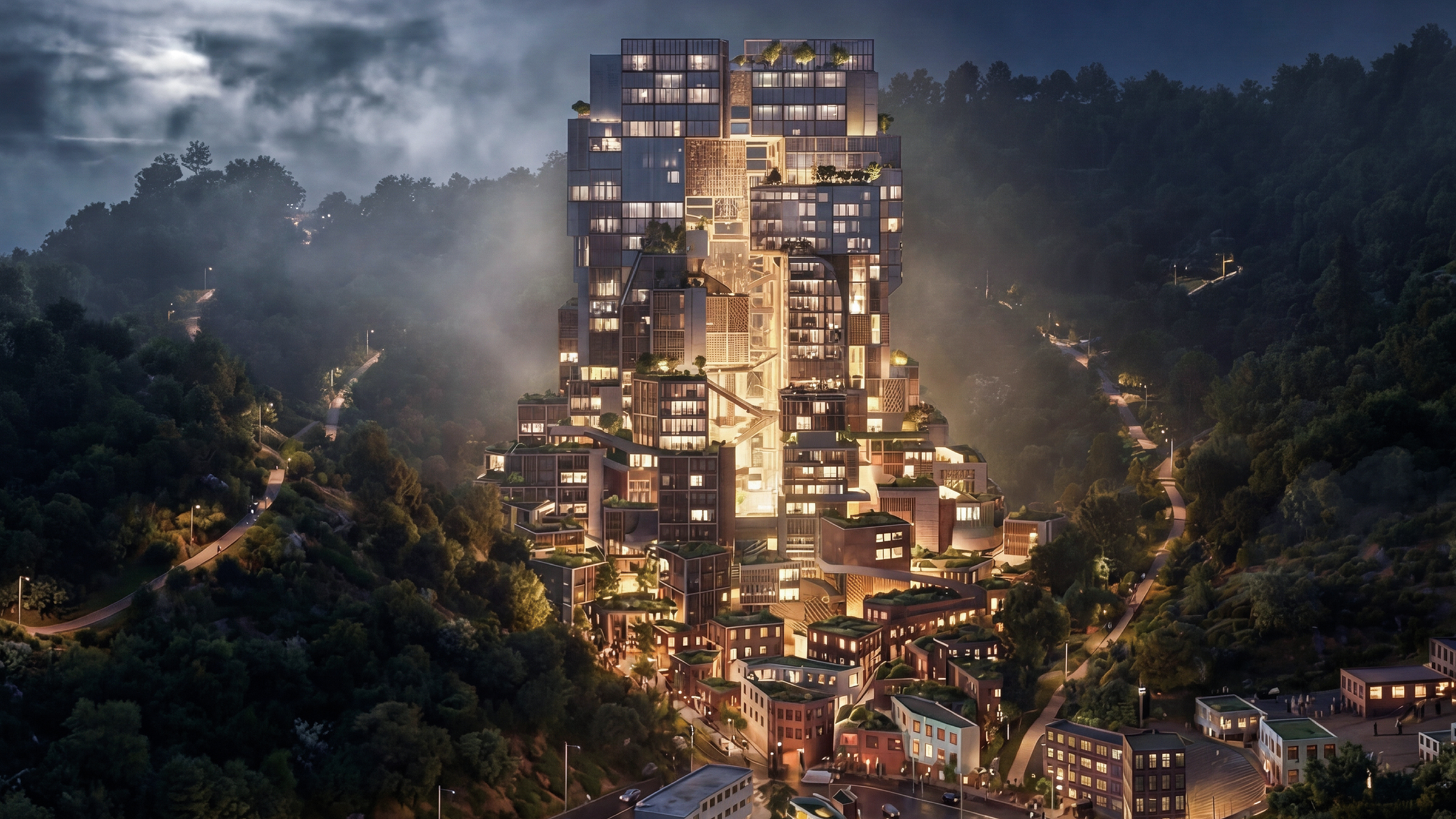
Ultimately, the “Golmok-gil Sky Commons” is more than a building. It is a manifesto for the future of urban living. By reinterpreting the horizontal heritage of the past into a future-oriented vertical architecture, this project provides a spatial solution to the problem of hyperindividualism. It demonstrates that even in a high-density vertical environment, we can restore the intimate community relationships that once defined our collective existence.