2025 Skyscraper Competition
Honorable Mention
Golnoosh Darziramandi, Alireza Agah, Ali Jamali, Hosein Amery, Hosein Mosavi, Mohsen Bokaei
Canada, Germany, United Arab Emirates, United States

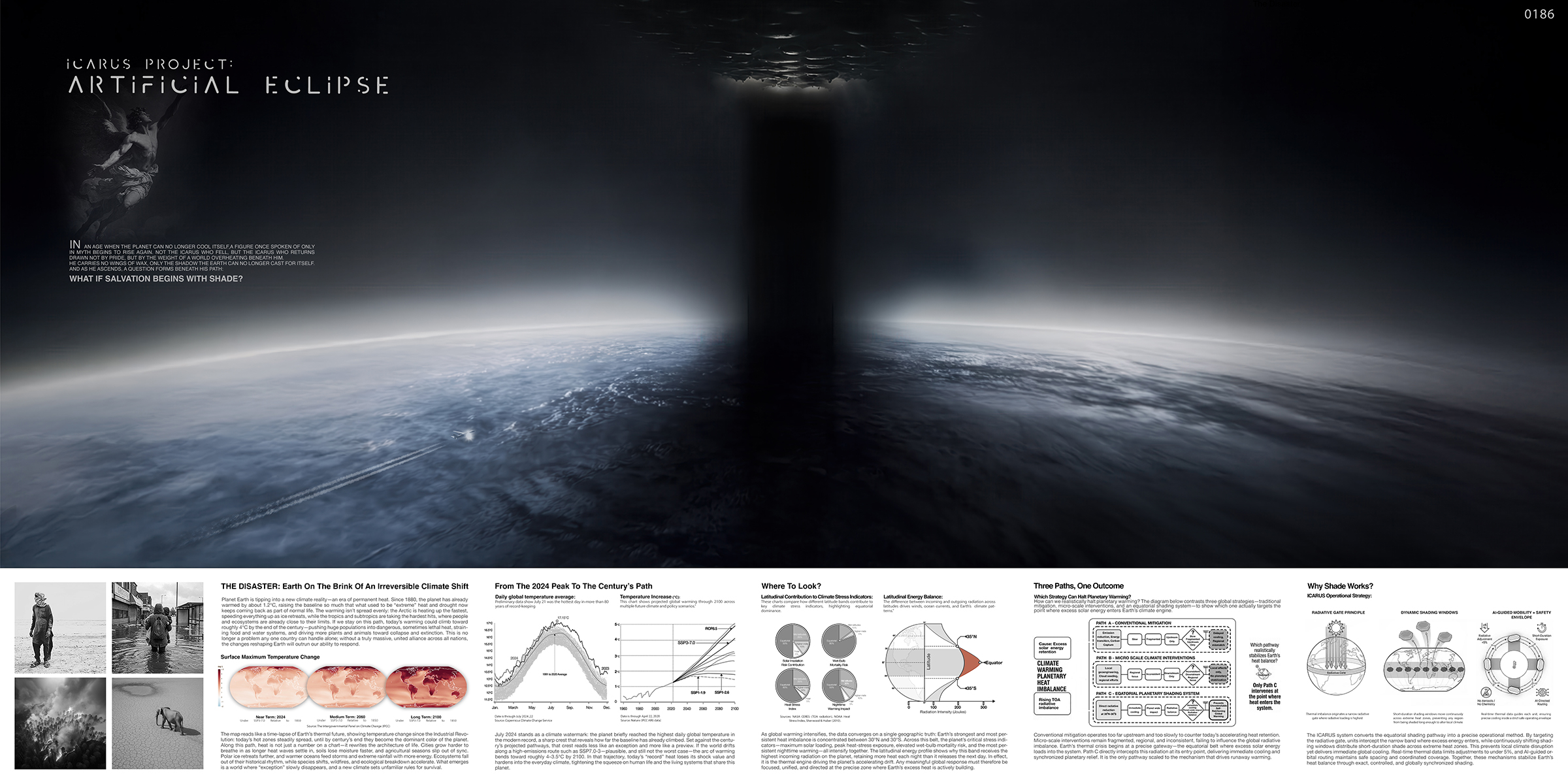
As rising temperatures, prolonged heat waves, and overstressed urban energy systems push cities beyond their limits, Icarus proposes a new kind of vertical intervention. It reimagines the skyscraper not as a fixed object but as a functional atmospheric column made of hundreds of lightweight autonomous units that operate 18 to 20 kilometers above the ground. Together they create a drifting, cloud like shading field moving across the sky.
This project introduces a new architectural typology: Skyscraper as Atmospheric Infrastructure. Icarus does not occupy land in the traditional sense. Instead, it inhabits the thermal layer between the Earth and the upper atmosphere where solar influence is strongest and climate impact is most effective.
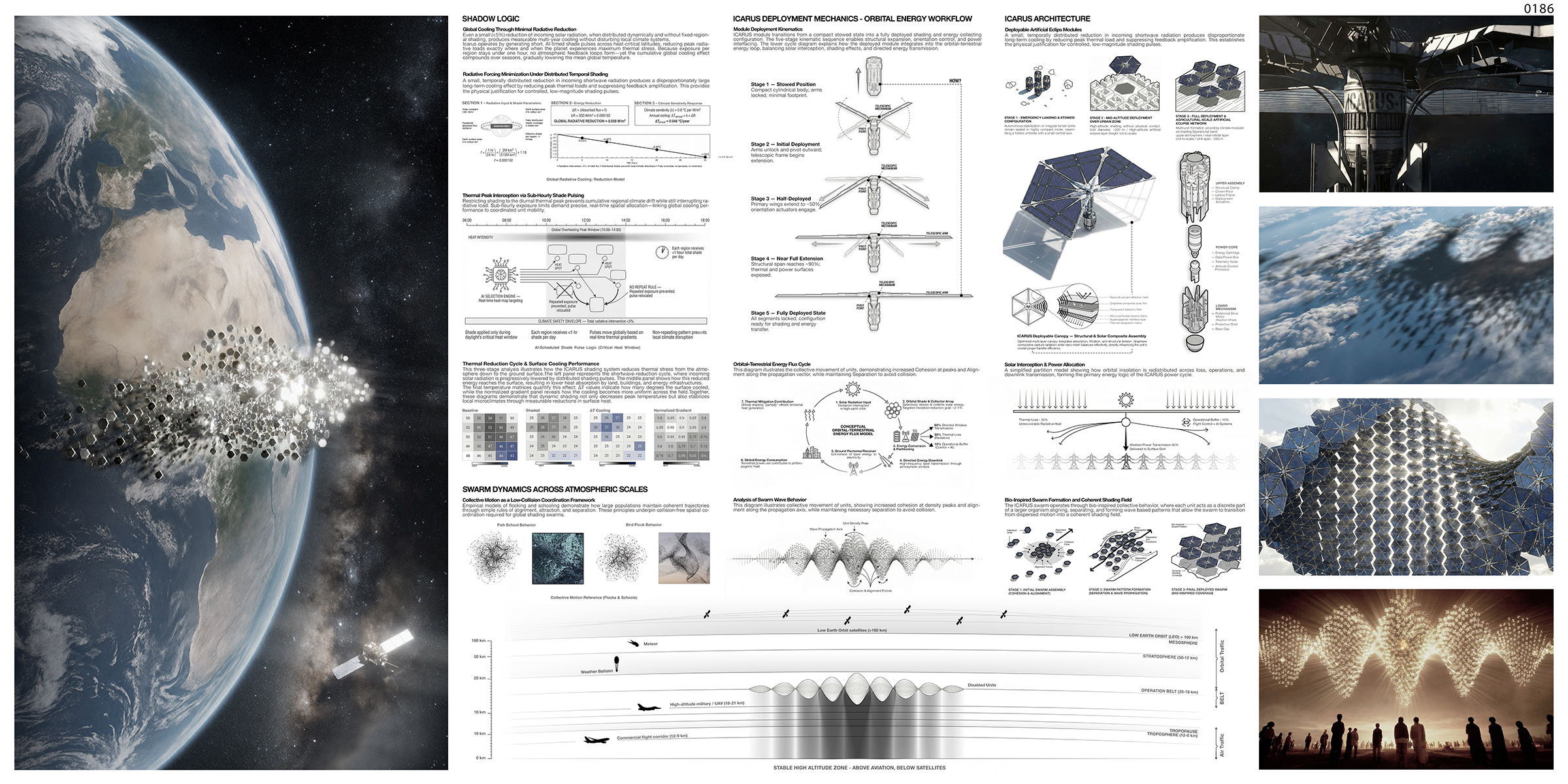
Each Icarus unit is an intelligent module guided by AI assisted coordination. Simple behavioral rules like alignment, cohesion, and separation combine with distributed learning, allowing the units to behave as one adaptive organism. They generate a vertical shading system that constantly reconfigures itself in response to solar intensity, energy demand, and atmospheric conditions. These are actions beyond the ability of any ground based structure.
Icarus performs two primary functions:
1. Solar flux reduction through dynamic high altitude shading.
2. Wireless transmission of captured solar energy, turning atmospheric presence into a distributed power network.
In this model the vertical column, usually an energy consumer, becomes both a producer and a moderator of climate. Reflective membranes and ultra light mesh structures create a field condition architecture whose identity comes from movement rather than mass. Icarus is not a static tower. It is a pattern of coordinated behavior shaped by drift, accumulation, and collective response.
Thermal simulations indicate that rhythmic shading at 18 to 20 kilometers can lower surface temperature, soften thermal gradients, and create pockets of microclimatic stability in dense cities. This intervention acts above the skyline, outside the limits of conventional architecture, yet capable of influencing the climate where it matters most.
The skyscraper of the future is not a shape. It is a climate instrument. It moderates heat, directs energy, and interacts with planetary dynamics.
Icarus lifts architecture off the ground and places it in the atmospheric thermal column where it can engage directly with radiation, temperature, and global warming. It becomes a floating adaptive vertical field responding to the overheating of cities and the limits of terrestrial infrastructure.
Icarus transforms the skyscraper from an object into a function.
Architecture of shade. Architecture of energy. Architecture of swarm.