Second Place
2025 Skyscraper Competition
Nasim Bakhshinejad, Sheida Ghelichkhany, Alireza Agah, Negar Hashemol Hosseini, Fatemeh Peysepar, Fatemeh Malemir
Canada, Italy, United Arab Emirates
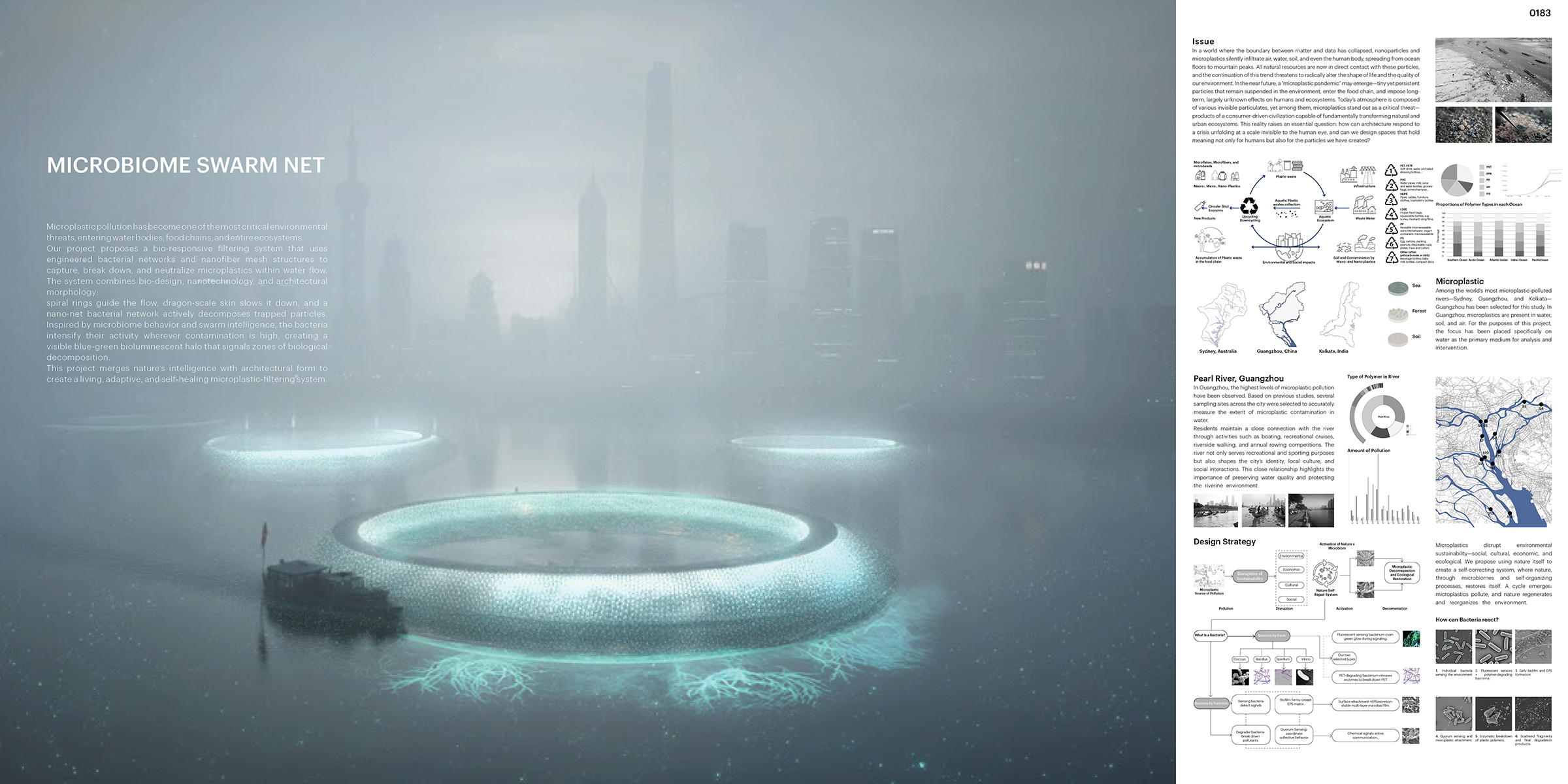
In an era when the boundary between matter and data has blurred, particles smaller than our imagination can conceive are quietly shaping and eroding the future. Nanoparticles, resulting from the coexistence of humans and machines, now permeate every layer of life: in the air, water, soil, and even within the human body. This crisis does not arise from scarcity but rather from an excess of artificial presence. Urban rivers are currently facing a growing environmental crisis. Microplastic pollution, once too small to see and easy to overlook, has infiltrated every part of aquatic life, damaging ecosystems in ways that modern cities are unprepared to address. Guangzhou, home to one of the most polluted rivers in Asia, now stands at a critical intersection of urban expansion, industrial history, and ecological decline. Here, microscopic plastic fragments travel freely through the water, evading conventional filtering systems. These particles do not decompose, and with every rainfall wave and river flow, they infiltrate deeper into the ecosystems that sustain both human and non-human life.
The project begins with a fundamental question: Can architecture function like a living organism, capable of sensing, responding to, and actively combating microplastic pollution? To explore this idea, we studied microbiomes, biofilms, and the collective behavior of Bacteria. In nature, bacteria have remarkable swarm-like intelligence. They move toward polluted areas, gather together, multiply rapidly, and enhance their metabolic degradation of these pollutants. This adaptive intelligence became the conceptual foundation for our proposal: an architecture that acts not as a mechanical machine, but as a living filter.
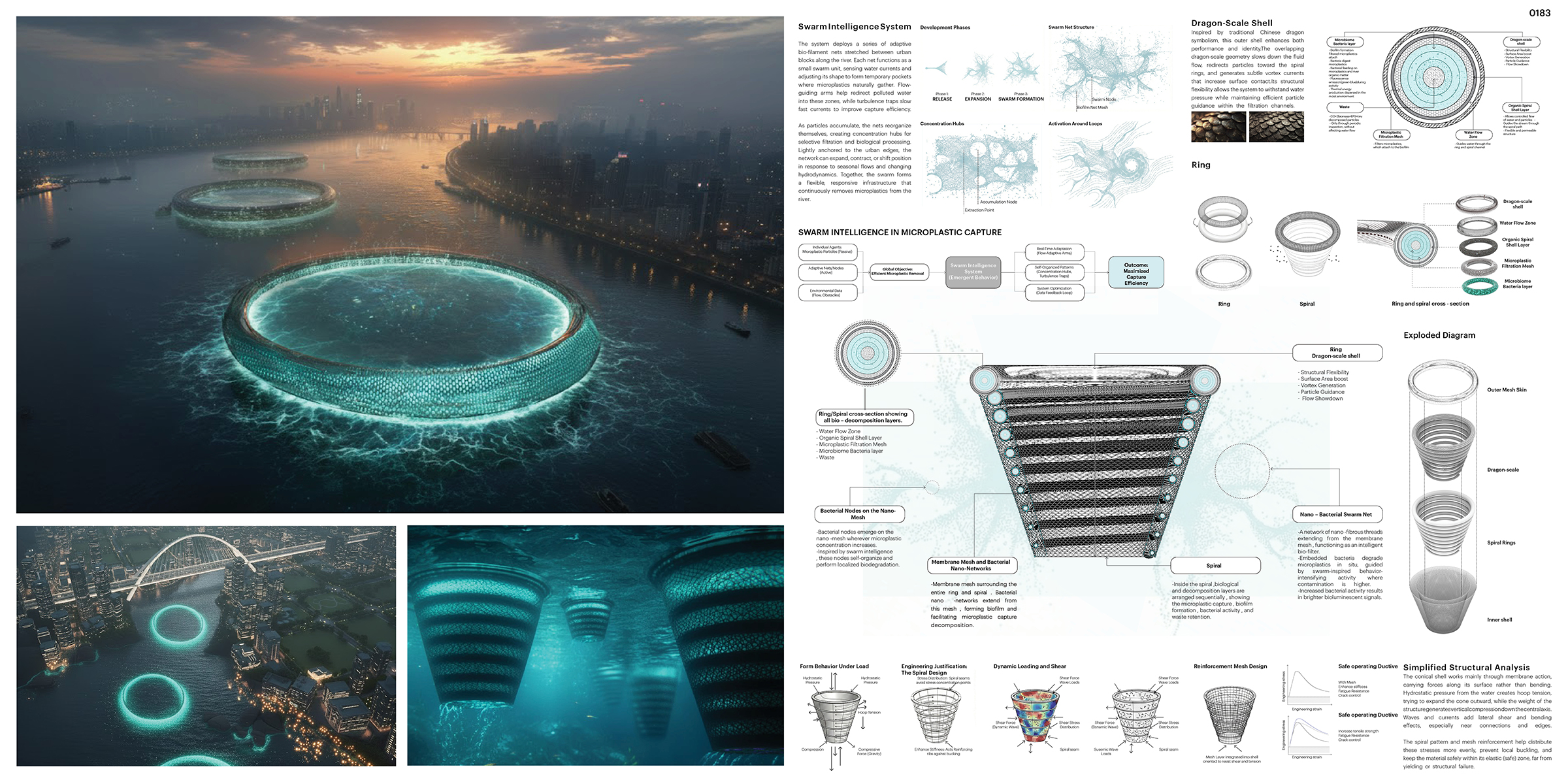
The system consists of three main architectural and biological concepts. The first is an external layer resembling dragon scales, inspired by Chinese symbolism and natural protective surfaces. This textured layer slows the river’s flow, creating soft whirlpools, directing particles toward the interior, and increasing contact between the water and the filtration layers. It functions like a sensitive outer membrane that feels alive.
Inside its protective shells, spiral rings create a complex pathway for water. This unique geometry increases the time the water spends in contact with microplastic particles and the system’s active layers. The spiral motion emulates natural filtration processes seen in shells, ocean currents, and vortex patterns, transforming the chaotic movement of the river into a more organized and efficient cleaning cycle.
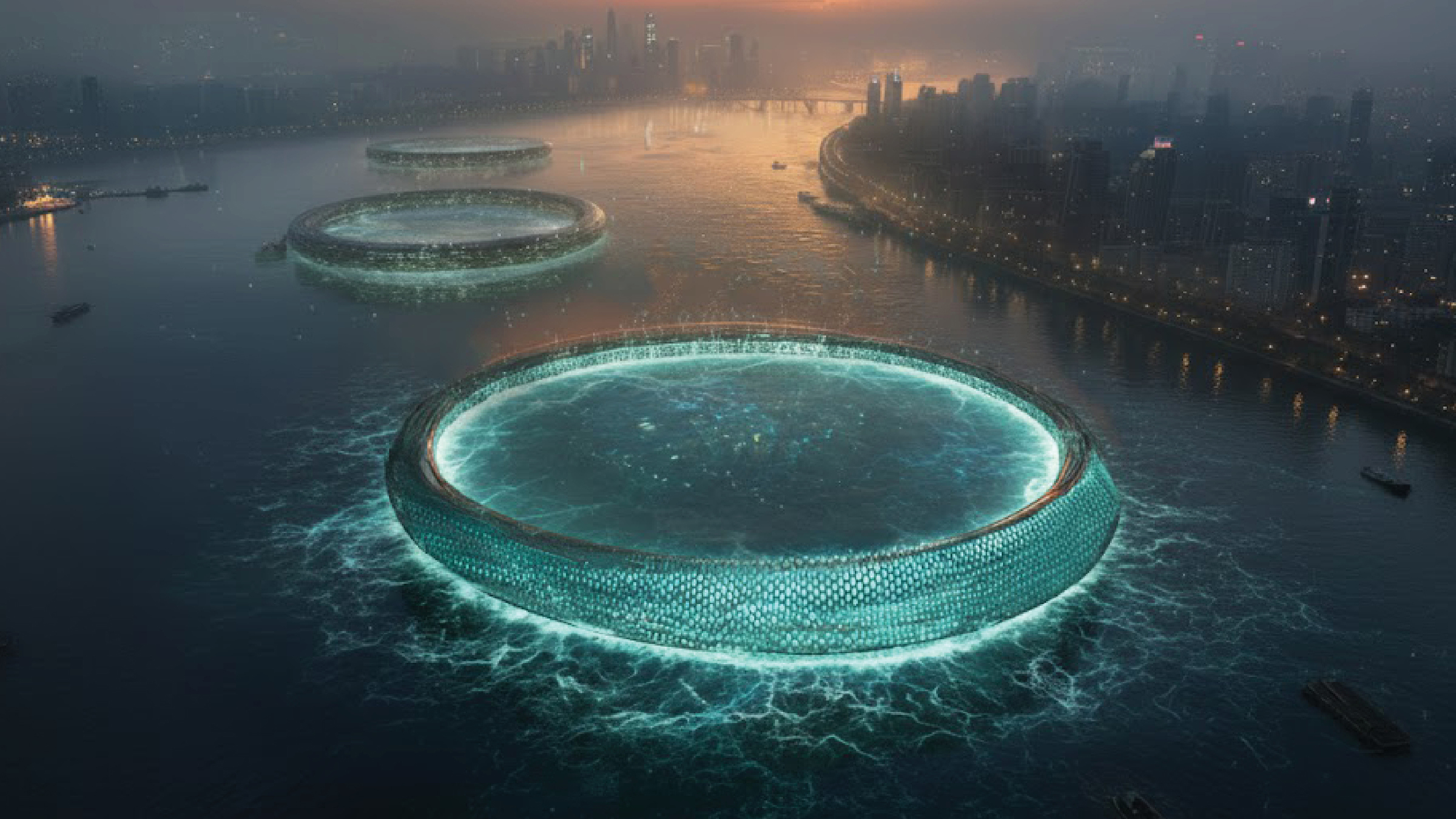
At the center of the system lies an intelligent bacterial nano-net: a fine, adaptable mesh woven between the spiral rings. Acting like a living fabric, it traps microplastics that pass through it while hosting colonies of degradative bacteria that form biofilms over time. These colonies amplify their activity in areas with the highest pollution concentration, following the logic of swarm behavior. As they metabolize plastic particles, their biochemical processes produce a soft green-blue bioluminescence, an organic signal indicating the zones where the architecture is actively purifying the water.
Overall, the project does not represent a skyscraper in the traditional sense; it is an underwater organ of purification, a structure that breathes in rhythm with the river. Drawing from microbiome science, biomimicry, Chinese cultural motifs, and material innovation, it addresses one of the most urgent yet overlooked environmental threats of our time. More than a singular intervention, it provides a replicable model for global cities facing similar crises, an architecture that adapts, senses, and collaborates with nature in the ongoing battle against microplastic pollution.