Honorable Mention
2025 Skyscraper Competition
Amirsadra Seddighigildeh, Aria Kakavand, Iman Haji Abolghasemi, Isun Ranjpourazarian, Navid Kakavand, Sahar Safardoost
Italy
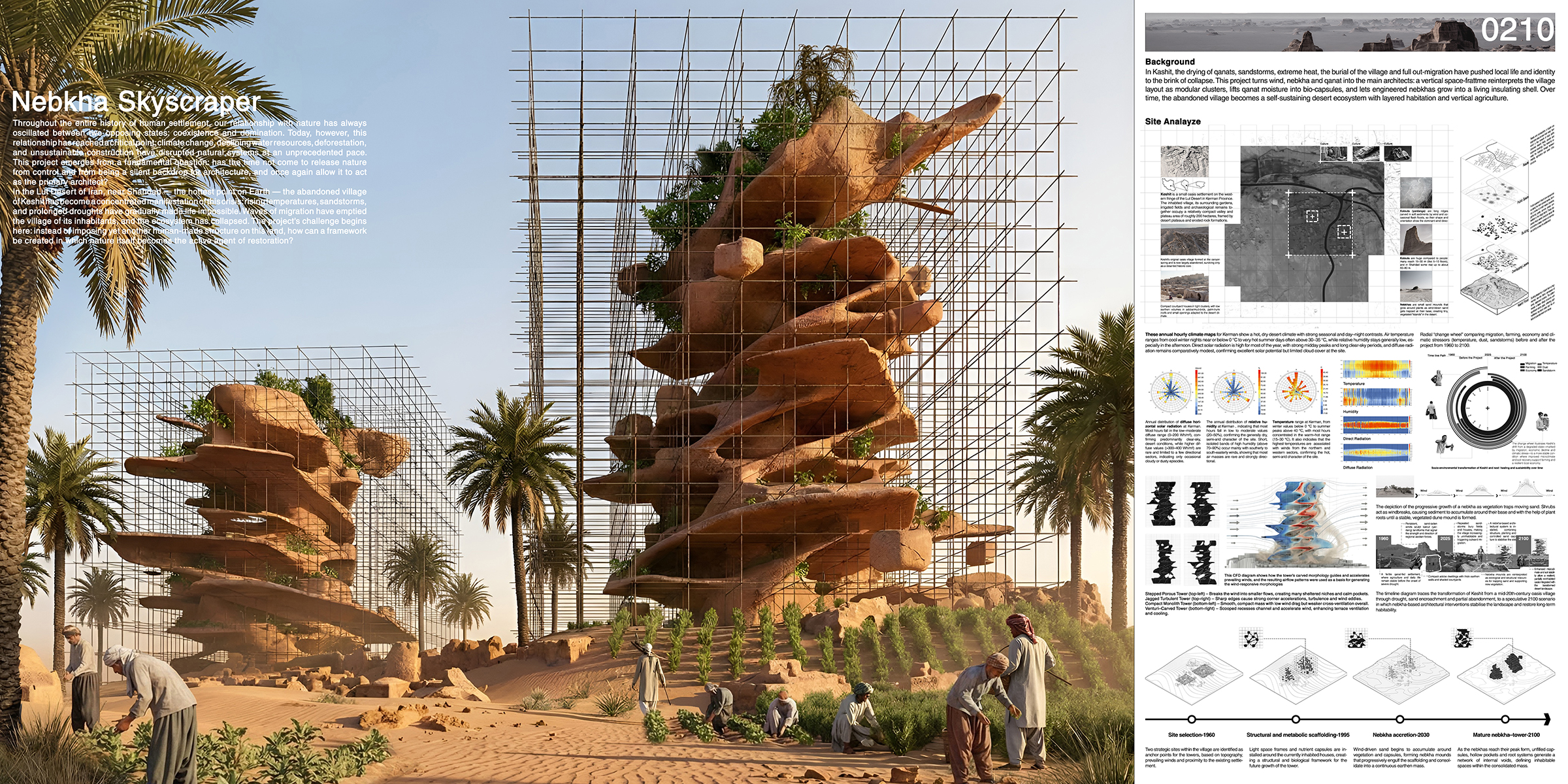
Throughout the entire history of human settlement, our relationship with nature has always oscillated between two opposing states: coexistence and domination. Today, however, this relationship has reached a critical point; climate change, declining water resources, deforestation, and unsustainable construction have disrupted natural systems at an unprecedented pace. This project emerges from a fundamental question: has the time not come to release nature from control and from being a silent backdrop for architecture, and once again allow it to act as the primary architect?
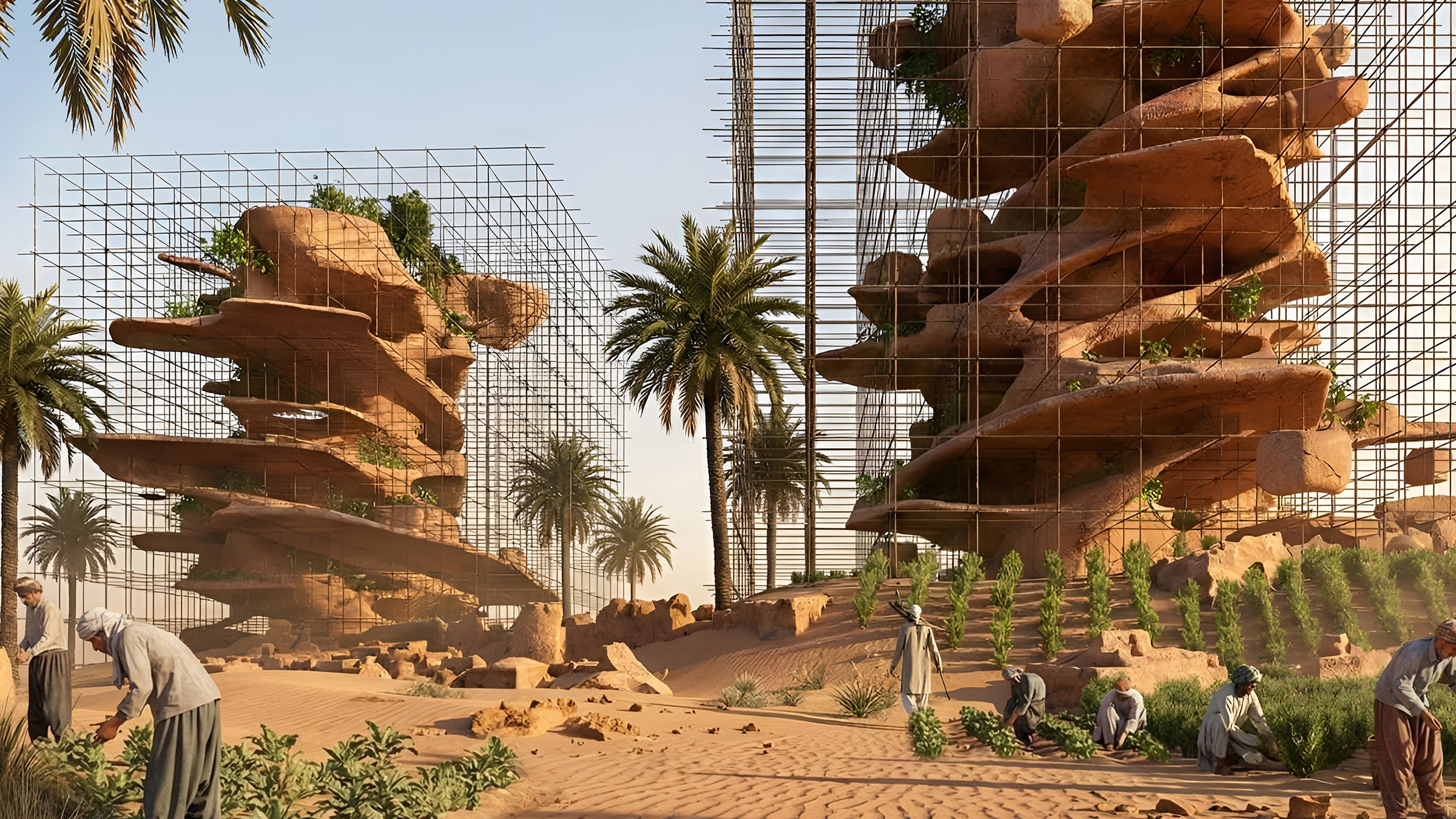
In the Lut Desert of Iran, near Shahdad — the hottest point on Earth — the abandoned village of Keshit has become a concentrated manifestation of this crisis: rising temperatures, sandstorms, and prolonged droughts have gradually made life impossible. Waves of migration have emptied the village of its inhabitants, and the ecosystem has collapsed. The project’s challenge begins here: instead of imposing yet another human-made structure on this land, how can a framework be created in which nature itself becomes the active agent of restoration? Here, the wind, the sand, and the tamarisk trees are the principal architects. The project reinterprets the desert phenomenon of nebkha — a vegetated sand mound formed by the accumulation of wind-borne sand around a plant —as a living architectural material, aided by qanat systems. What was once erosion becomes construction; the aim is not to build against the desert, but to build from within its own mechanisms.
The form of the project is entirely dependent on the wind; just as the kaluts (yardangs) of the Lut have been shaped over time by wind erosion, in this project too the wind and the sand gradually build the living masses, then carve them into habitable space. Human intervention is consciously limited to the first ten years, defined as a minimal booster system composed of three elements: the frame, mutated capsules, and pathways, which are organized according to the historical zoning of the village.
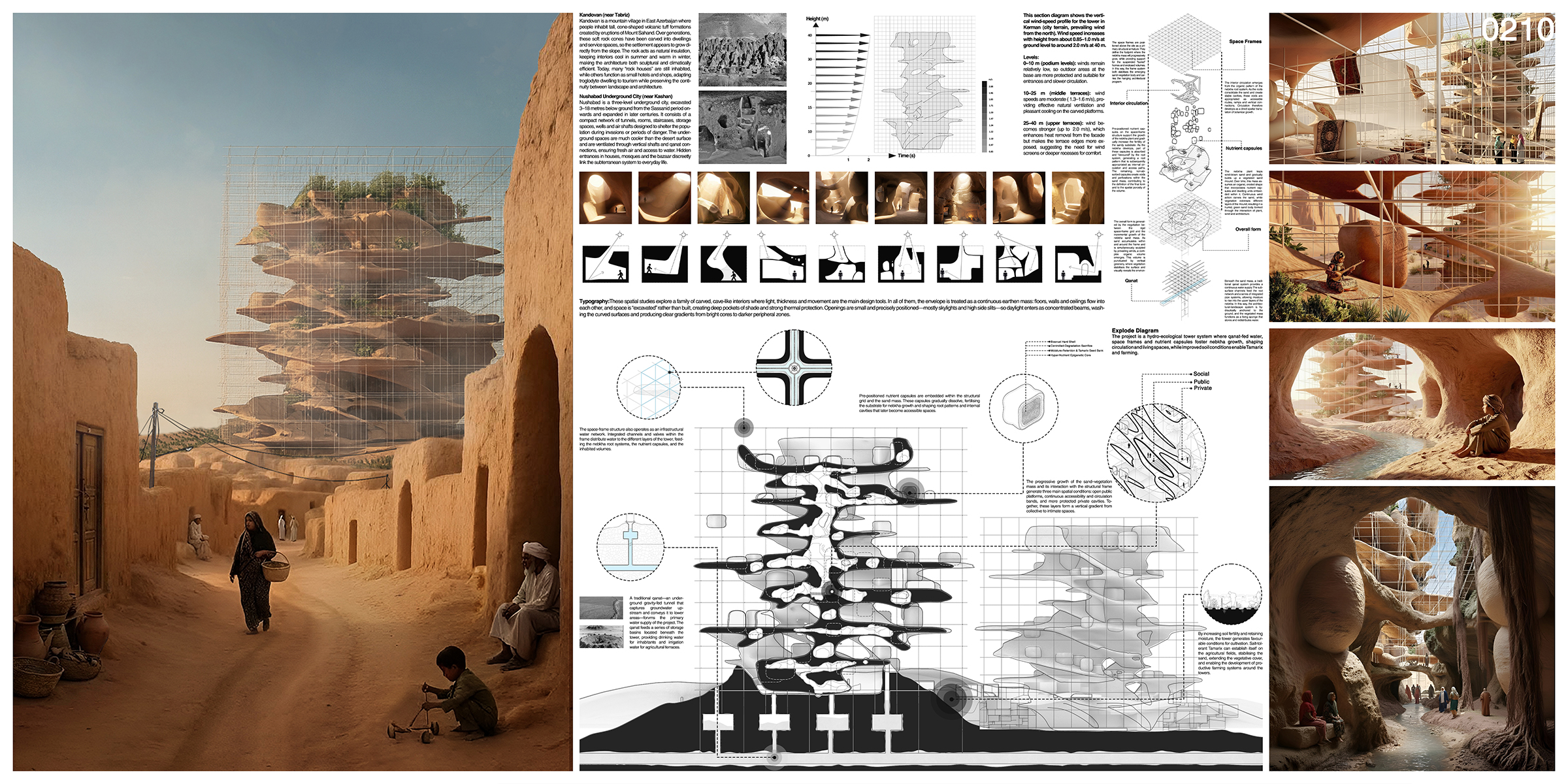
The frame is a lightweight, modular megastructure based on a simple space-frame grid, functioning as a dual holder:the inner holder suspends the primary living masses at various heights, and the outer holder provides the bed for the growth of the nabkha. Integrated channels transfer water and moisture from the restored qanats to higher elevations, enabling vertical life in the heart of the desert. The mutated capsules are temporary spatial cores arranged according to the public zones and the existing alley structure of Keshit; in this way, the horizontal plan of Keshit is vertically reconstructed.
Over 75 years, nebkha gradually grows over and into these capsules. Through a designed process of material absorption and erosion, the capsules are slowly consumed, emptied, and transformed into breathable, shaded, and habitable cavities.
Meanwhile, nebkha undergoes accelerated adaptive mutation, organically spreading across the structure and gradually engulfing the village. Architecture and ecology merge into a single evolving organism.
The project unfolds across several temporal phases: from the initial phase of site zoning and limited qanat revival, to the short-term phase of planting and the installation of capsules, to the mid-term phase in which the nabkha, guided by the wind, spreads across the grid and blankets the village layer by layer, and finally reaching a long-term phase where fertile cavities emerge for habitation, agriculture, and self-sufficiency.Over time, this system extends toward Shahdad, forming a continuous ecological network at the scale of the desert. Ultimately, the project reverses decay— abandonment becomes life, and a harsh climate becomes a generative force.Keshit is no longer a dead village; it becomes a resilient, self-sustaining, vertical desert ecosystem.