2025 Skyscraper Competition
Honorable Mention
Zheyi Yang, Zhao Zhou, Jieying Luo, Yuxin Gu, Jinglei Xu
China
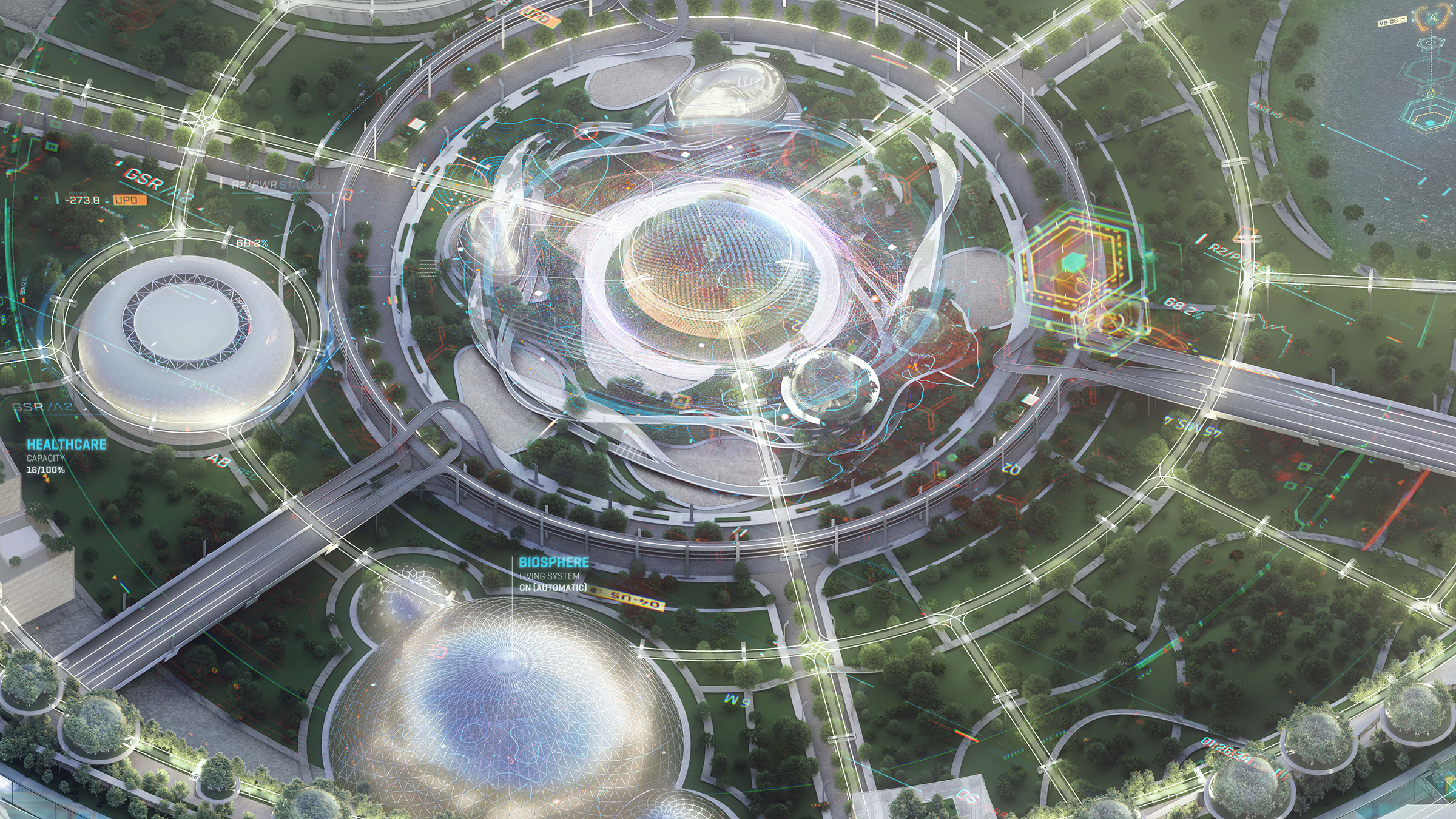
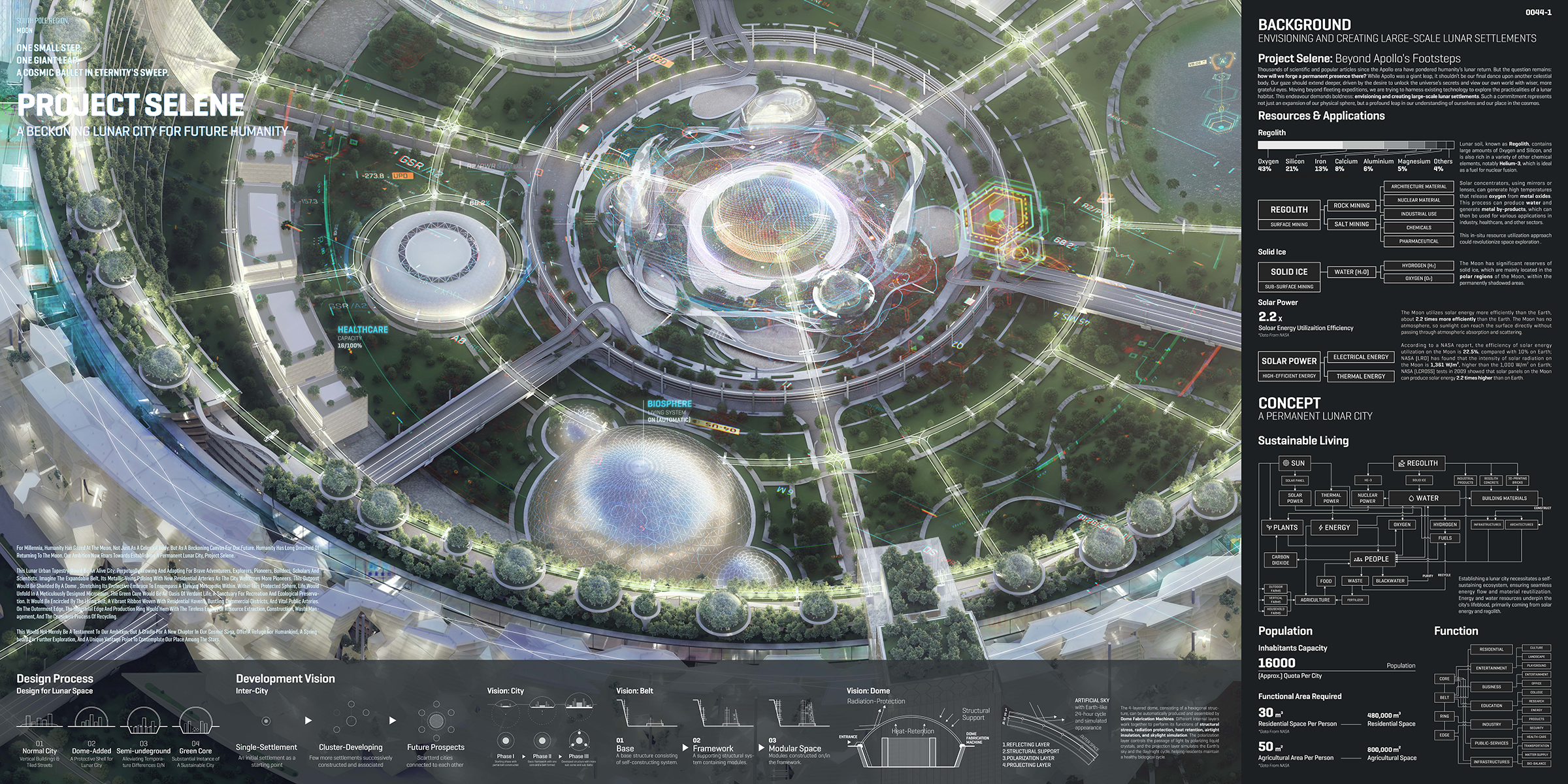
For millennia, humanity has gazed at the Moon, not merely as a distant celestial body but as a beckoning canvas for our future. Poets, astronomers, sailors, and dreamers have all found meaning in its pale light. Yet beyond romance and mythology lies a persistent, practical longing: to return, to learn, and to stay. Today, that ancient desire has sharpened into a clear ambition. Our momentum now roars toward establishing a permanent lunar city: Project Selene.
Project Selene envisions a lunar urban tapestry that is not a static base but an alive city, perpetually growing and adapting for brave adventurers, explorers, pioneers, builders, scholars, and scientists. It would welcome newcomers not as temporary visitors, but as citizens shaping a shared experiment in living beyond Earth. The city’s form would be legible and resilient, designed to expand in stages without losing coherence, dignity, or identity.
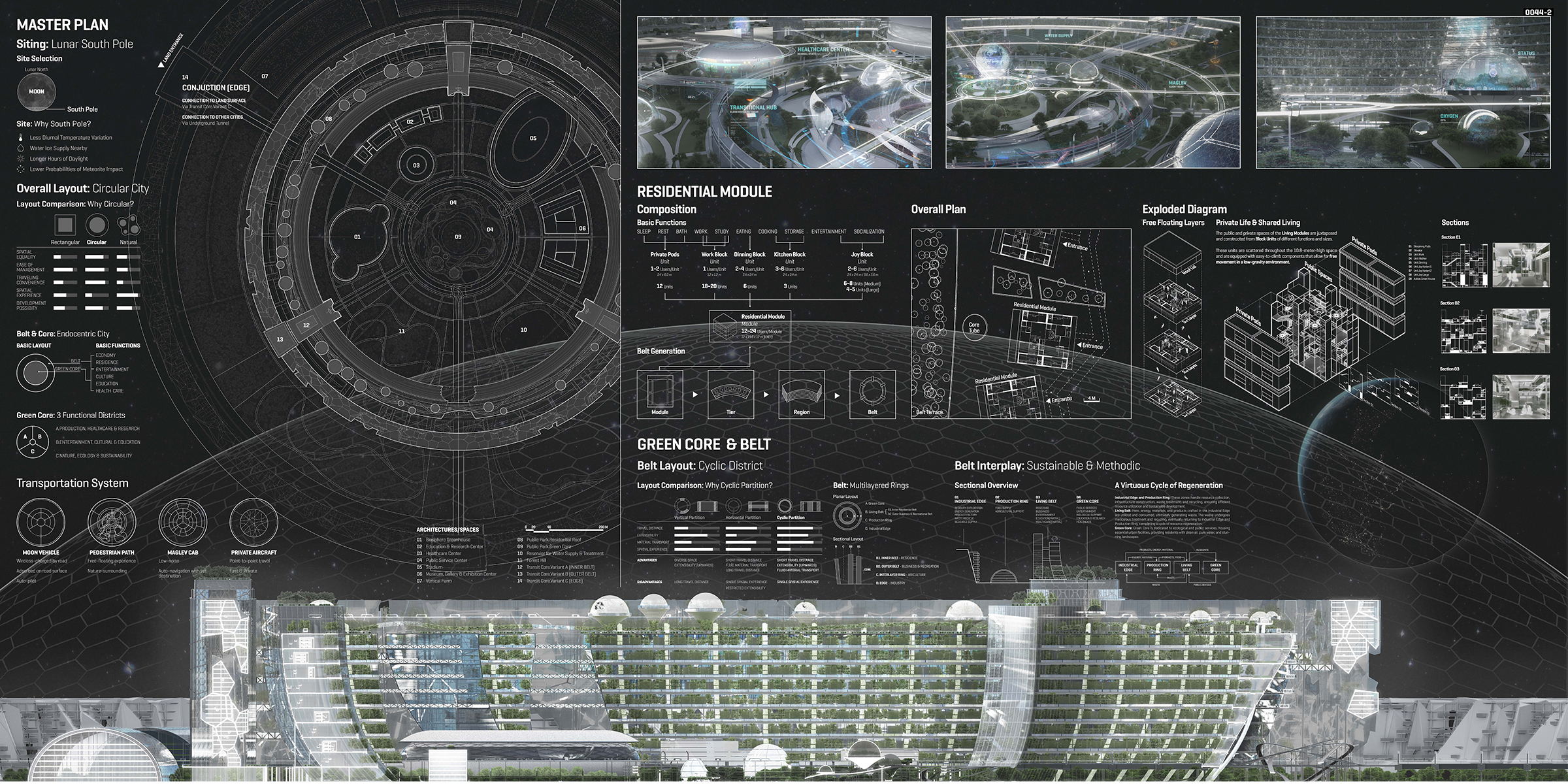
At the heart of this vision sits the expandable belt, a flexible urban spine. Imagine its metallic veins pulsing with new residential arteries as the city welcomes more pioneers and additional modules lock into place. This belt would not simply supply housing; it would also host clinics, schools, laboratories, workshops, libraries, and cultural spaces, along with the everyday services that turn survival into belonging. Transit lines, data links, power distribution, water recovery, and air management would be embedded in the belt’s structure, allowing the city to grow with minimal disruption and maximum continuity.
Above and around this outpost, a protective dome would stretch its embrace to encompass a thriving metropolis within. Engineered to mitigate radiation, micrometeoroids, and extreme thermal swings, the dome would create a stable envelope for life, agriculture, and delicate equipment. Within this protected sphere, daily routines could flourish in a meticulously designed microcosm where safety is integrated with beauty and comfort. Carefully calibrated light cycles, acoustic treatments, and interior landscapes would support mental health and social vitality, enabling residents to sustain not only bodies but also communities over long lunar seasons.
The green core would be an oasis of verdant life. More than a garden, it would be a sanctuary for recreation, ecological preservation, and food resilience. Residents might walk under cultivated canopies, rest by water features that recycle precious moisture, and participate in community farming that knits society together. The green core would also serve as a living laboratory, refining closed-loop ecological systems that can later benefit Earth’s cities and future deep-space missions.
Encircling this heart, the living belt would form a vibrant ribbon of civic life, weaving residential havens with bustling commercial districts and vital public arteries. Markets, maker spaces, research incubators, and event halls would give the settlement a rhythm of work, exchange, learning, and celebration. Local governance, emergency response, and education would be embedded throughout, enabling neighborhood-scale agency within a unified metropolitan framework.
On the outermost edge, the industrial edge and production ring would hum with tireless energy. Resource extraction, construction, waste management, and the ceaseless process of recycling would be conducted with discipline and care. By utilizing local regolith and available ice where feasible, this ring would reduce dependence on Earth, turning scarcity into innovation.
Project Selene would not merely be a testament to our ambition. It would be a cradle for a new chapter in our cosmic saga: a refuge for humankind, a springboard for further exploration, and a unique vantage point from which to contemplate our place among the stars. In building a city on the Moon, we would also be building a mirror—one that reflects the values we choose to carry into the wider universe.