2025 Skyscraper Competition
Honorable Mention
Nam Anh Nguyen, Gia Linh Pham, Cat Tuong Tran
Australia
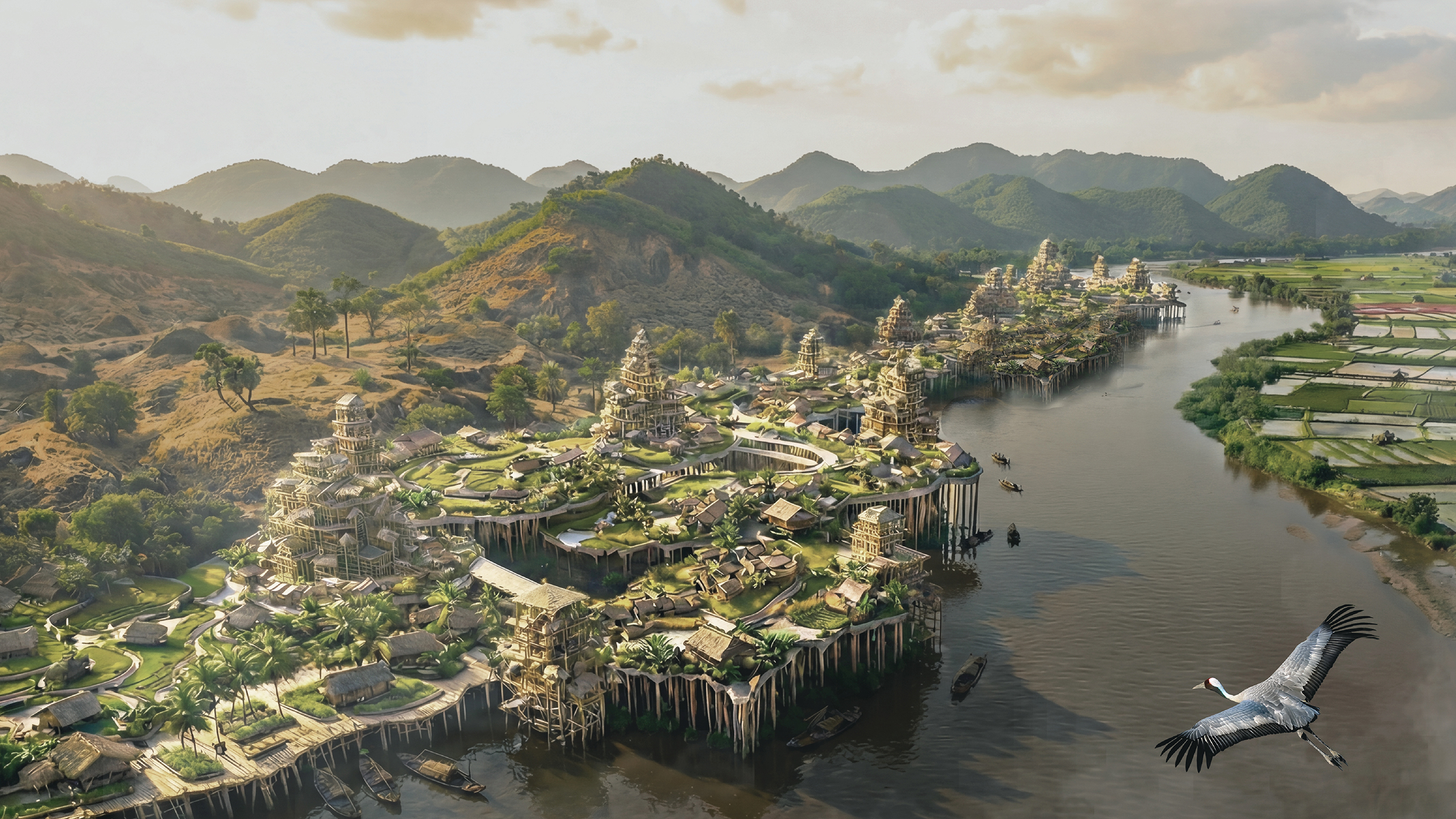
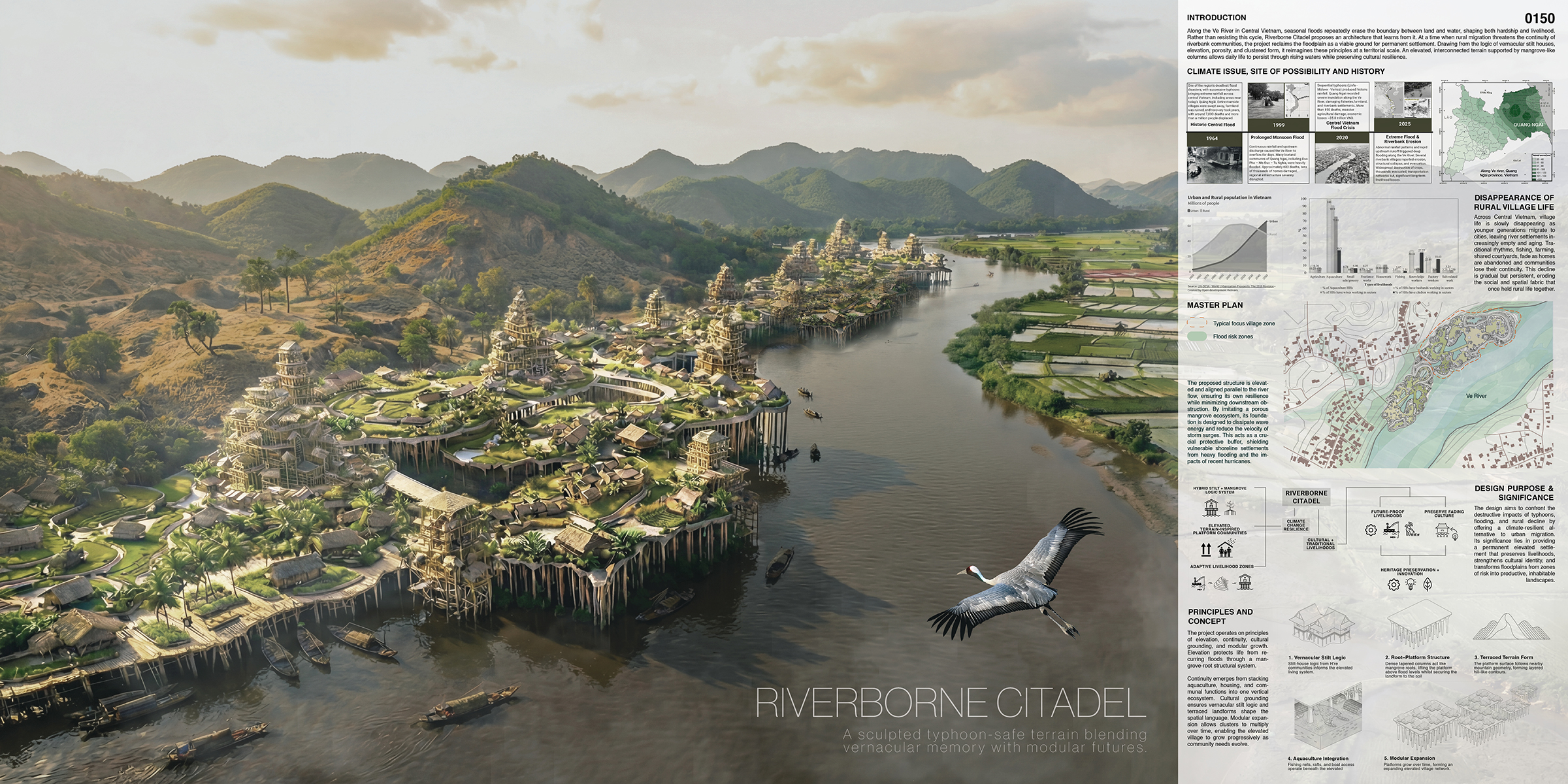
Positioned along the Ve River in Quang Ngai, the project responds directly to the region’s annual cycle of monsoon flooding. Each year, riverbanks transform into wide floodplains as rains, upstream runoff, and tidal backflow converge. These waters repeatedly damage settlements yet also enrich the land, supporting long-standing agricultural and aquaculture practices. Riverborne Citadel avoids the binary choice between abandonment and constant rebuilding, instead, it positions architecture as a mediator, allowing life to continue in both dry and inundated seasons by lifting essential habitats above water while preserving livelihoods that depend on the river below.
Riverborne Citadel then proposes a new architectural organism for the floodplains of Central Vietnam, an elevated, continuous terrain rising above the Ve River while remaining inseparably linked to the ground and water systems that sustain local life. Neither tower, bridge, nor conventional megastructure, it operates as an inhabited canopy: a suspended landscape shaped by climate, culture, hydrology, and ecology functioning as one.
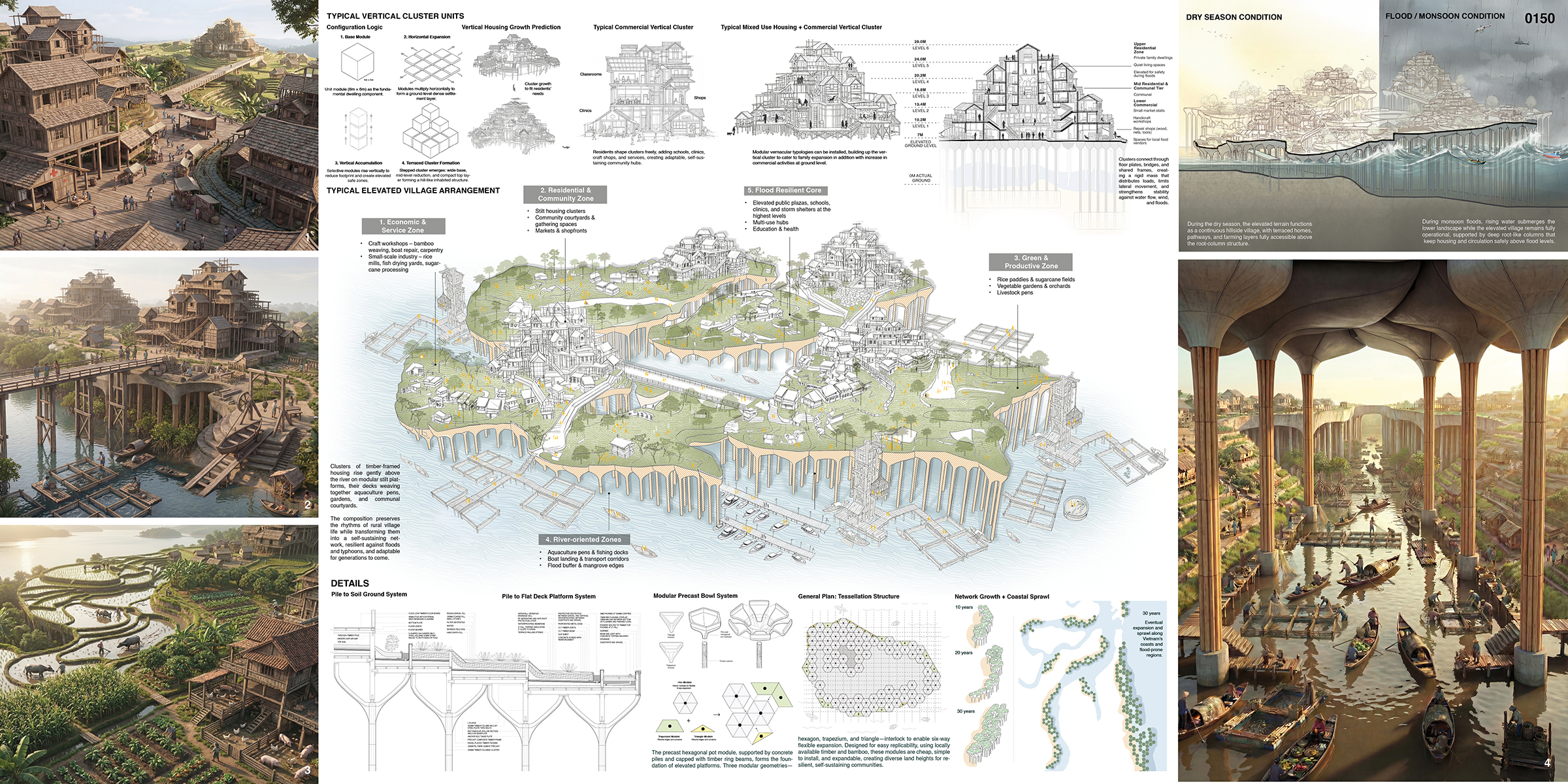
The design draws from vernacular intelligence found across highland and riverine cultures of Central Vietnam, especially the elevated living traditions of the H’re communities in Son Ha, Ba To, and Minh Long. Their stilt houses and longhouses, raised above damp soil and sudden valley floods, reveal a logic of resilience grounded in elevation, porosity, and adaptability. Lightweight timber frames, ventilated platforms, flexible roofs, and clustered communal layouts provide principles that are reinterpreted here at an expanded territorial scale.
Above the riverbank, the project forms a gently undulating sky-ground whose profile echoes the nearby mountain ranges. This elevated terrain rests on a dense field of stilt columns inspired by mangrove root systems. The root-like supports combine durable shafts for flood resistance with lighter branching structures for permeability and low-maintenance repair. Integrated vertical access cores allow fishermen, farmers, and residents to move directly from water or land to the elevated village. At water level, aquaculture zones, fish rafts, and docking platforms strengthen existing river economies without obstructing natural flows.
On the platform, clusters of modular timber-frame dwellings accumulate like small hills. Their composition draws directly from the silhouettes of surrounding mountains: platforms rise and fall in terraced layers, creating an inhabited topography that feels grown from the land rather than placed upon it. Homes step upward like miniature peaks, forming stratified neighbourhoods that mirror the logic of mountainous terrain. Roofs are oriented to catch breezes, shed monsoon rain, and cast deep shade. Terraces support small-scale farming, while shaded paths weave across the surface to form a continuous, walkable village shaped by both landscape memory and climatic necessity.
Crucially, Riverborne Citadel is not an emergency refuge. It is a permanent, evolving settlement designed for coexistence with a dynamic river system. In dry months, it functions as a productive elevated community, during flood seasons, it becomes a seamless safe haven that protects daily life without displacement. By merging vernacular wisdom, biomimetic structure, and climate-adaptive spatial systems, Riverborne Citadel reframes the skyscraper as a vertical ecological organism, an architecture that grows from the river, anchors into the landscape, and defines resilience as an integrated, everyday condition for Vietnam’s communities.