2025 Skyscraper Competition
Honorable Mention
Calvin Ho Sze Yin
Hong Kong
Overview
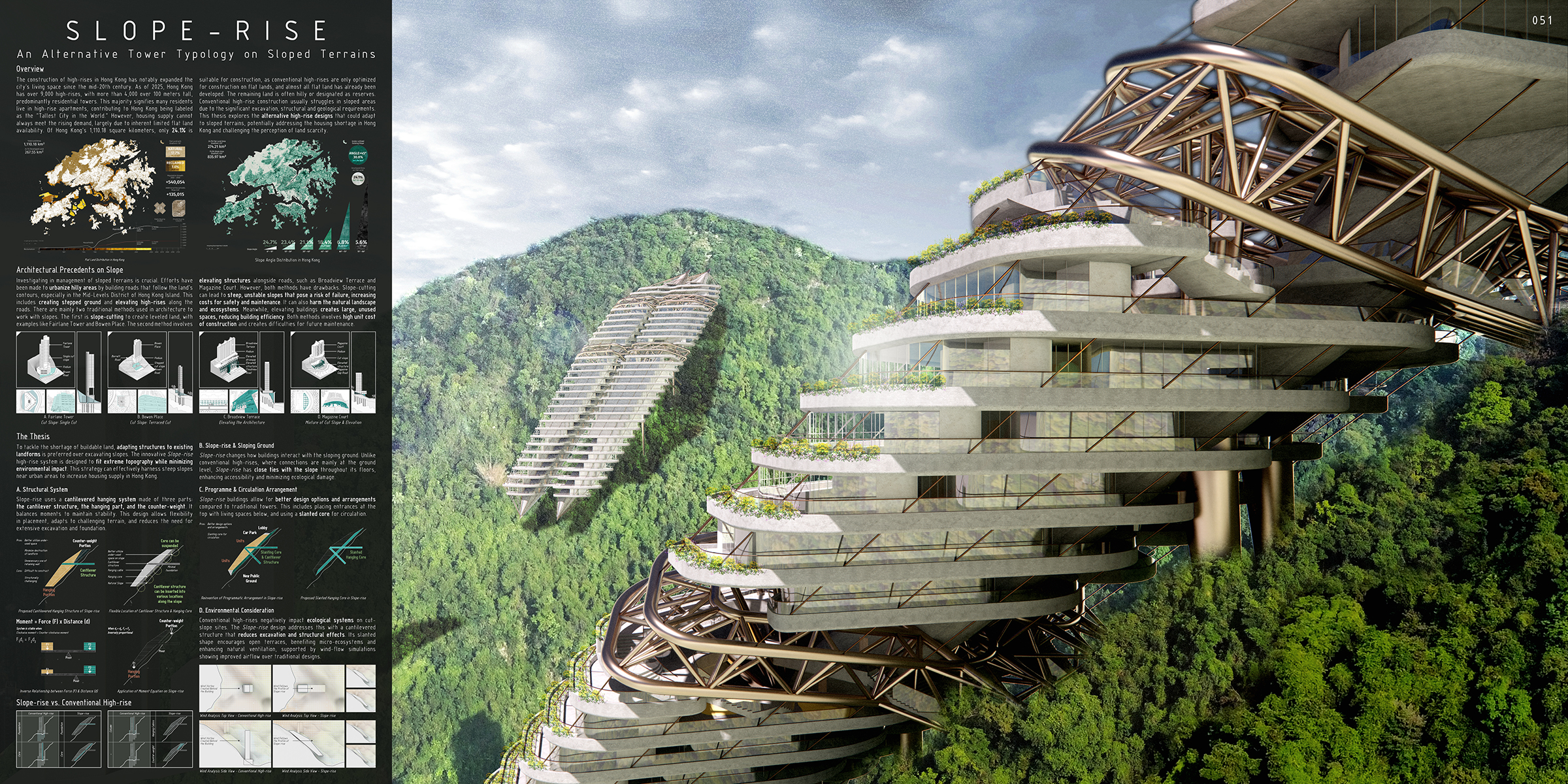
The construction of high-rises in Hong Kong has greatly increased the city’s living space since the mid-20th century. As of 2025, there are over 9,000 high-rises, with more than 4,000 of them taller than 100 meters, predominantly for residential use. However, the housing supply often cannot match demand since only 24.1% of Hong Kong’s land is suitable for construction. Much of the remaining land is hilly or designated as natural reserves. Conventional high-rise construction usually struggles in sloped areas due to the significant excavation, structural and geological requirements. This thesis explores the alternative high-rise designs that could adapt to sloped terrains, potentially addressing the housing shortage in Hong Kong and challenging the perception of land scarcity.
Architectural Precedents on Slope
Investigating the management of sloped terrains is important, especially for urbanizing hilly areas like the Mid-Levels District of Hong Kong Island. Roads are built to follow land contours, with high-rises along these routes. Two traditional methods are slope-cutting, which levels land but can create unstable slopes and harm ecosystems; and elevating structures alongside roads, which leads to unused spaces and reduces efficiency. Both methods have high construction costs and maintenance challenges.
The Thesis
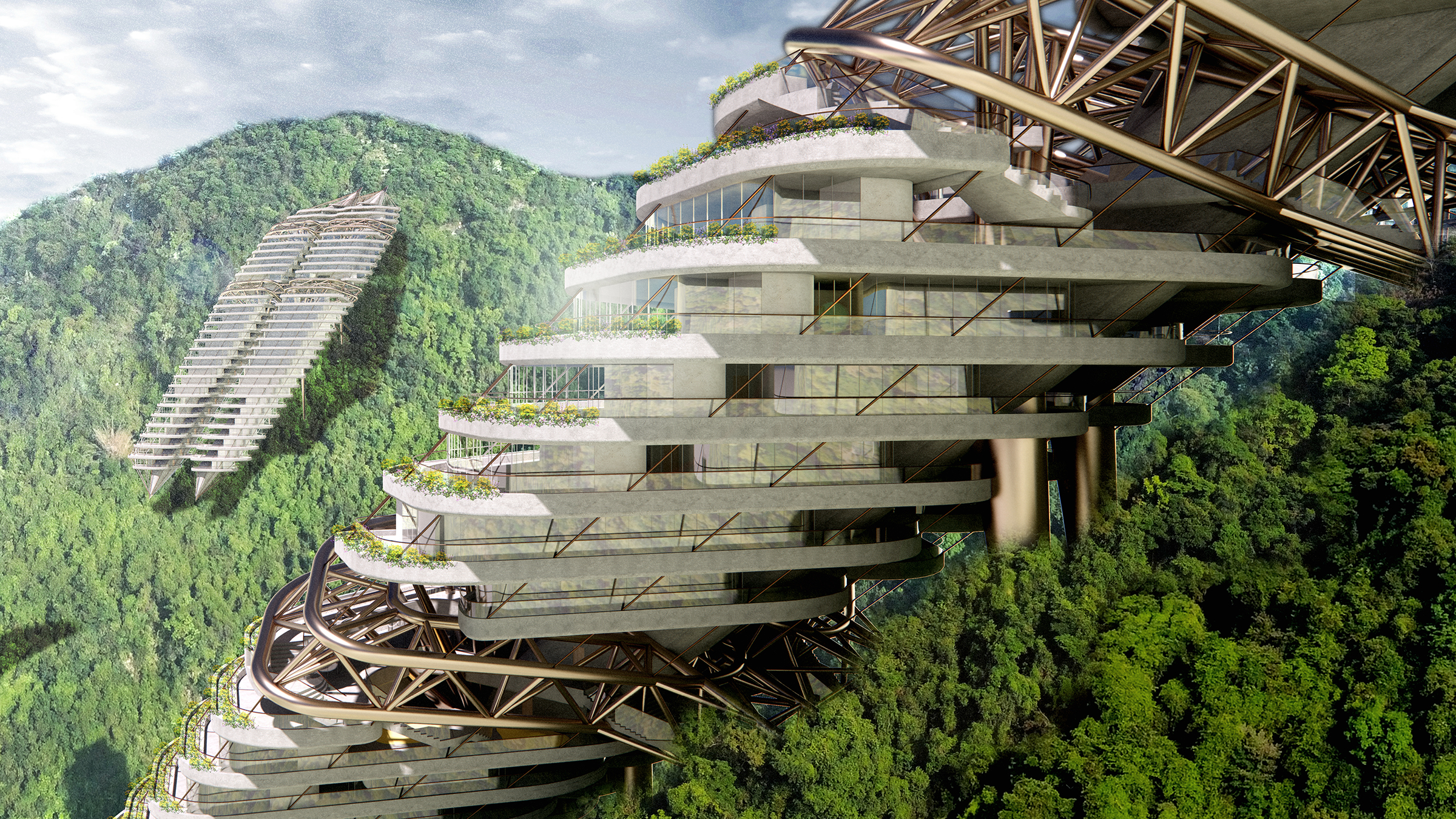
To tackle the shortage of buildable land, adapting structures to existing landforms is preferred over excavating slopes. This thesis proposed an innovative Slope-rise high-rise system, which is designed to fit extreme topography while minimizing environmental impact. This strategy can effectively harness steep slopes near urban areas to increase housing supply in Hong Kong. The design considerations are as follows: –
A. Structural System
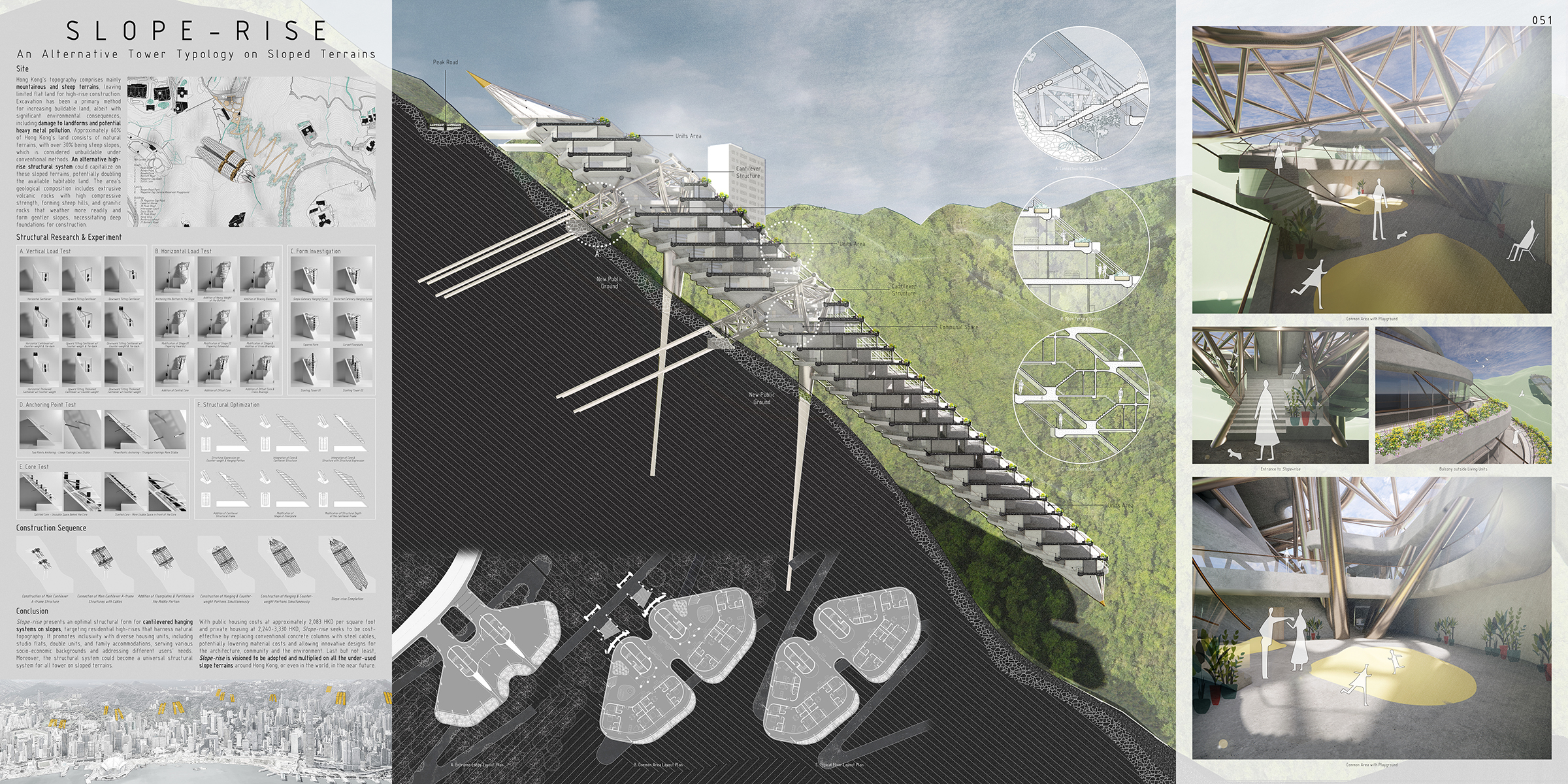
Slope-rise uses a cantilevered hanging system made of three parts: the cantilever structure, the hanging part, and the counter-weight. It balances moments to maintain stability. This design allows flexibility in placement, adapts to challenging terrain, and reduces the need for extensive excavation and foundation.
B. Slope-rise & Sloping Ground
Slope-rise changes how buildings interact with the sloping ground. Unlike conventional high-rises, where connections are mainly at ground level, Slope-rise has close ties with the slope throughout its floors, enhancing accessibility and minimizing ecological damage.
C. Programme & Circulation Arrangement
Slope-rise allow for better design options and arrangements compared to traditional towers. This includes placing entrances at the top with living spaces below, and using a slanted core for circulation.
D. Environmental Consideration
Conventional high-rises negatively impact ecological systems on cut-slope sites. Slope-rise design addresses this with a cantilevered structure that reduces excavation and structural effects. Its slanted shape encourages open terraces, benefiting micro-ecosystems and enhancing natural ventilation, supported by wind-flow simulations showing improved airflow over traditional designs.
Conclusion
Slope-rise presents an optimal structural form for cantilevered hanging systems on slopes, targeting residential high-rises that harness natural topography. It promotes inclusivity with diverse housing units, including studio flats, double units, and family accommodations, serving various socio-economic backgrounds and addressing different users’ needs. Moreover, the structural system could become a universal structural system for all tower on sloped terrains.
With public housing costs at approximately 2,083 HKD per square foot and private housing at 2,240-3,330 HKD, Slope-rise seeks to be cost-effective by replacing conventional concrete columns with steel cables, potentially lowering material costs and allowing innovative designs for the architecture, community and the environment. Last but not least, Slope-rise is vision to be adopted and multiplied on all the under-used slope terrains around Hong Kong, or even in the world, in the near future.