Honorable Mention
2025 Skyscraper Competition
Kim Kyungmin, Hong Yewon, Lee Byeonghyeon
South Korea
1. The Landfill as a Forgotten Ground
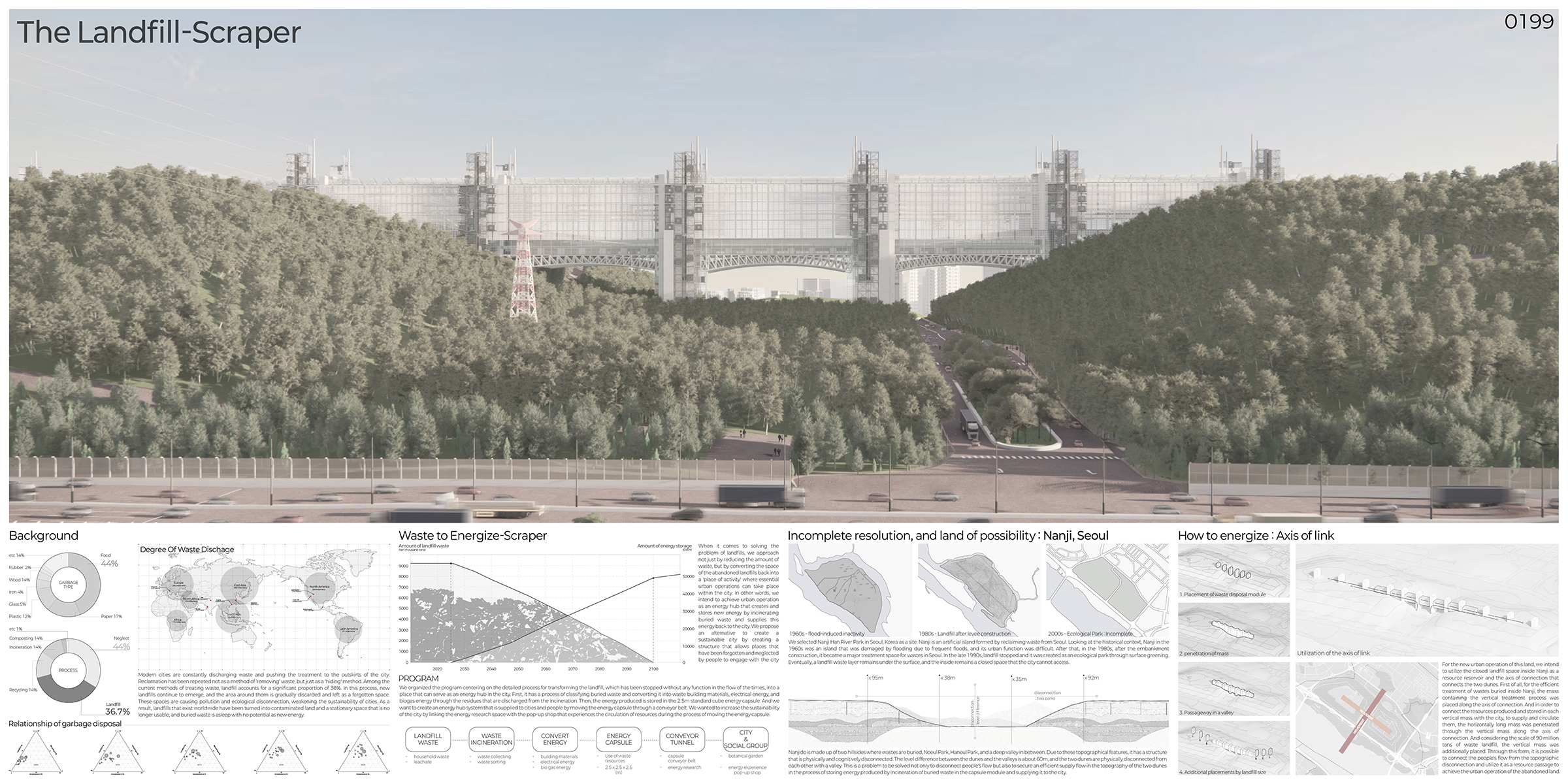
Cities continue to landfill nearly 36% of their waste, generating territories that remain polluted, ecologically severed, and functionally suspended. Although these sites hold latent energy potential, they exist as “frozen ground” detached from the urban system. The issue is not only the volume of waste but the inability of landfill land to return as active urban ground. This project reframes the landfill as an energy infrastructure: buried waste is incinerated, purified, converted, stored, and ultimately supplied back to the city. Through this transformation, the landfill shifts from a concealed burden to a productive urban engine.
2. Nanji: An Incomplete Resolution
Nanji in Seoul embodies unresolved layers—historic flooding, two decades of landfilling in the 1980–90s, and a later superficial ecological makeover. Despite its green surface, nearly 90 million tons of waste remain sealed beneath, preventing real ecological or urban recovery.
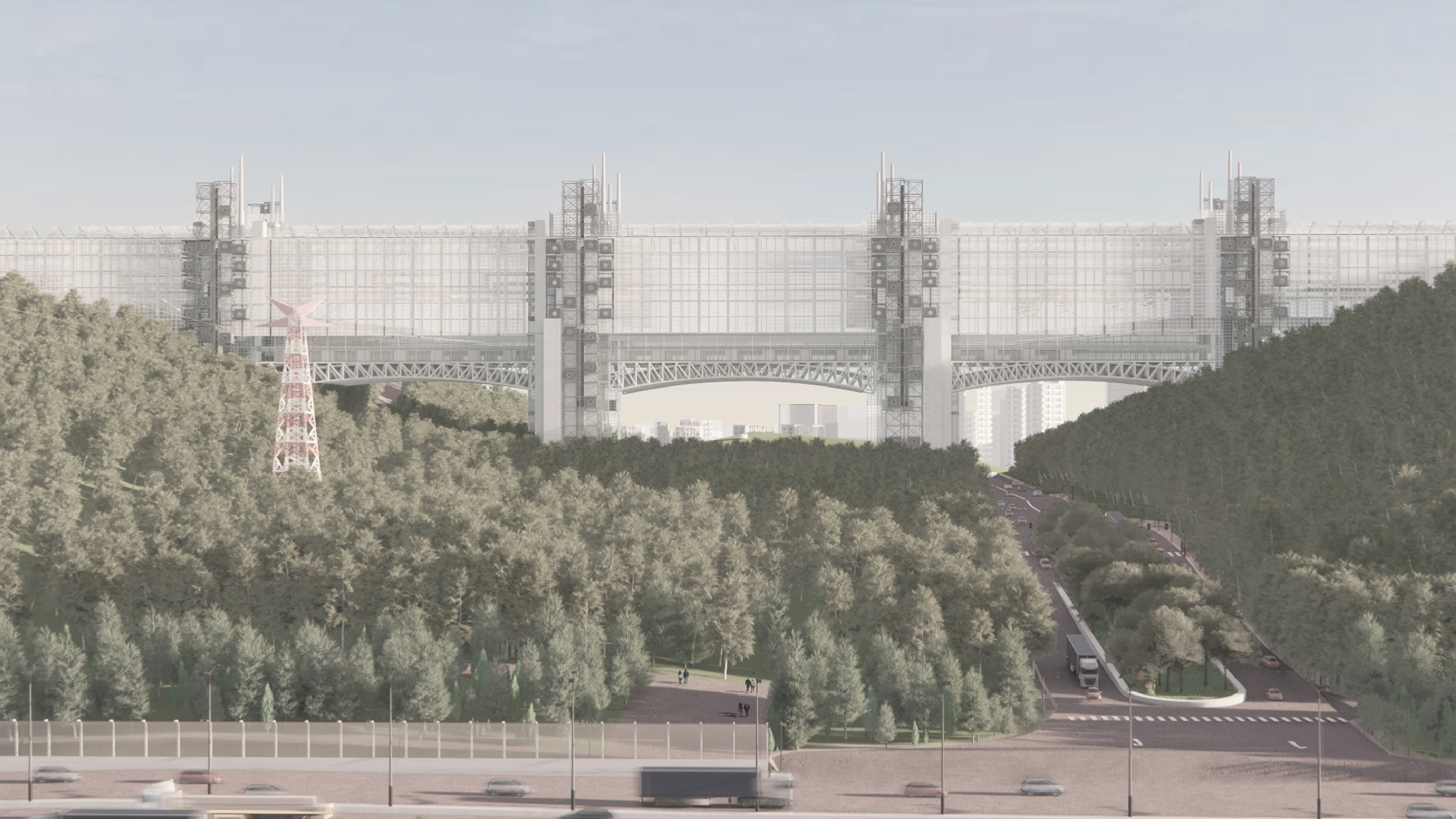
Two landfill mounds, Noeul park and Haneul park, are separated by a 60-meter height difference, producing a strong physical and perceptual rupture. This split disrupts pedestrian movement and blocks the formation of a continuous energy-processing and distribution system. The site demands a framework capable of binding fractured ground into a functional ecosystem.
3. The Axis of Link: A Framework for Reactivation
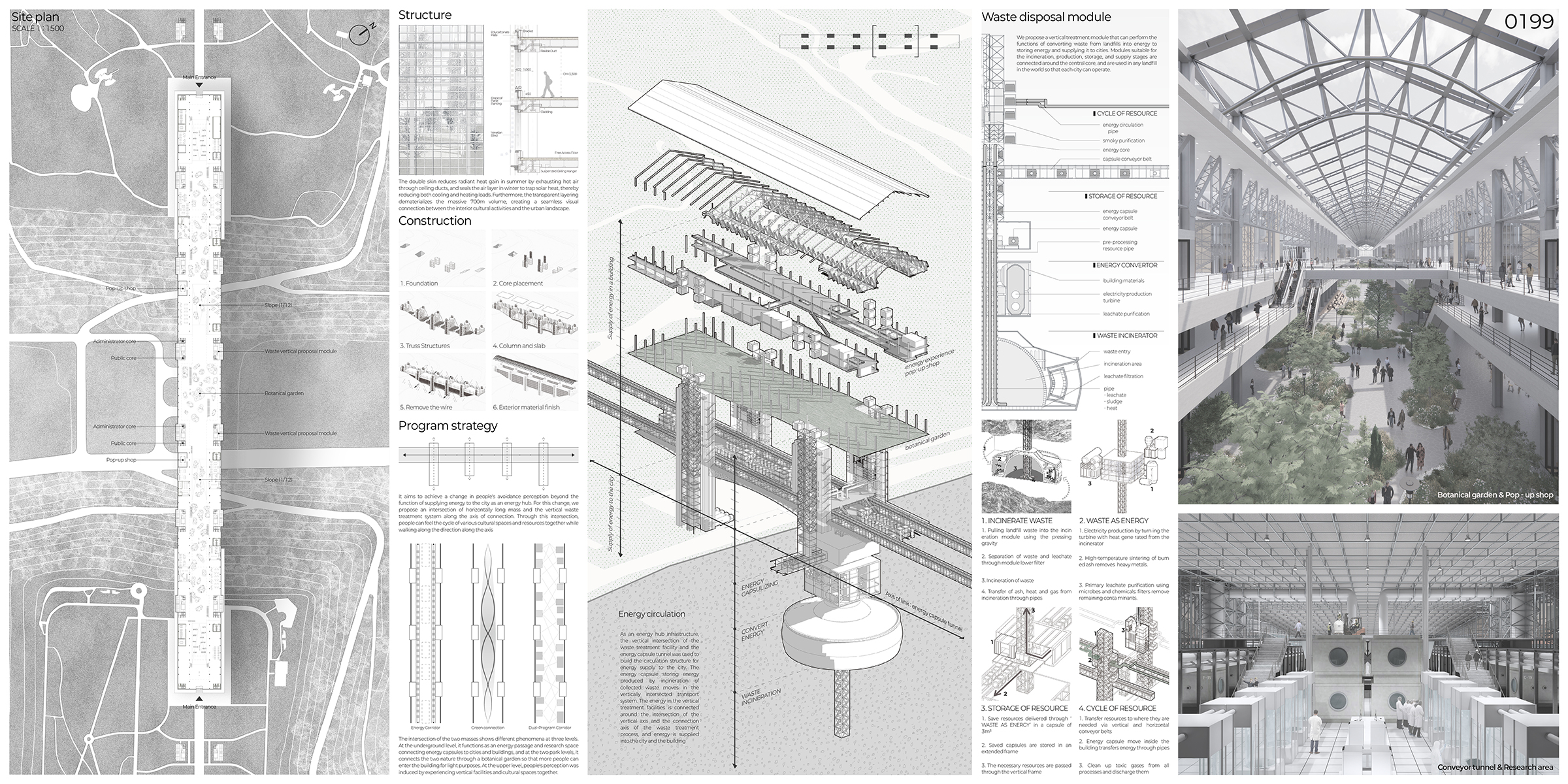
A linear Axis of Link is established along the crest lines of the two mounds. This axis reframes the sealed landfill interior as a reservoir of resources and organizes waste-to-energy operations into a continuous infrastructural spine.
Along this axis, a sequence of Vertical Waste Processing Modules is deployed. A long Horizontal Mass penetrates these modules, bridging the mounds and merging resource circulation with human movement into a single integrated system.
4. Vertical Waste Processing Modules
4.1 Incineration Module
Lower levels extract buried waste and leachate, then sort, crush, and feed them into high-temperature incineration chambers, exposing the first stage of the hidden cycle.
4.2 Energy Conversion Module
Middle zones contain boilers, heat-recovery devices, and purification systems that convert thermal energy into electricity, heat, and gas.
4.3 Energy Capsule Module
Upper levels store generated energy in standardized 2.5-meter cubic capsules. Automated carriers transfer these capsules toward the horizontal distribution spine.
4.4 Purification & Recirculation Module
Residual byproducts, gases, and leachate undergo additional filtration, with portions recirculated as secondary resources. The modules serve not only as processing devices but as exposed infrastructural towers that can be replicated at other landfill sites.
5. The Horizontal Mass: Three Layers of Integration
5.1 Underground Layer — Resource Convergence
This layer receives energy capsules from the vertical modules and distributes them through automated conveyors. It forms the infrastructural node where vertical production merges with horizontal urban supply.
5.2 Park Layer — Ecological Bridging
A linear botanical landscape reconnects the severed ecologies of the two mounds. Visitors enter with light, everyday purposes while moving along the same axis that carries energy, merging public experience with infrastructural performance.
5.3 Upper Layer — Cultural Perception Shift
Cultural and educational programs intersect with exposed capsules, structural systems, and parts of the machinery. Visitors repeatedly cross the flows of energy and infrastructure, encouraging a shift from fear and avoidance toward an informed understanding of resource cycles.
6. Conclusion: A Reactivated Urban Ground
By intersecting human programs with resource flows through vertical modules and a horizontal linking mass, the project transforms a forgotten landfill into an active energy-producing infrastructure. Physical fracture and social distance are repaired simultaneously, and Nanji emerges not as buried residue but as a functional landscape that strengthens urban sustainability and provides a model for future infrastructural architecture.