First Place
2025 Skyscraper Competition
Changsi Wang
United States
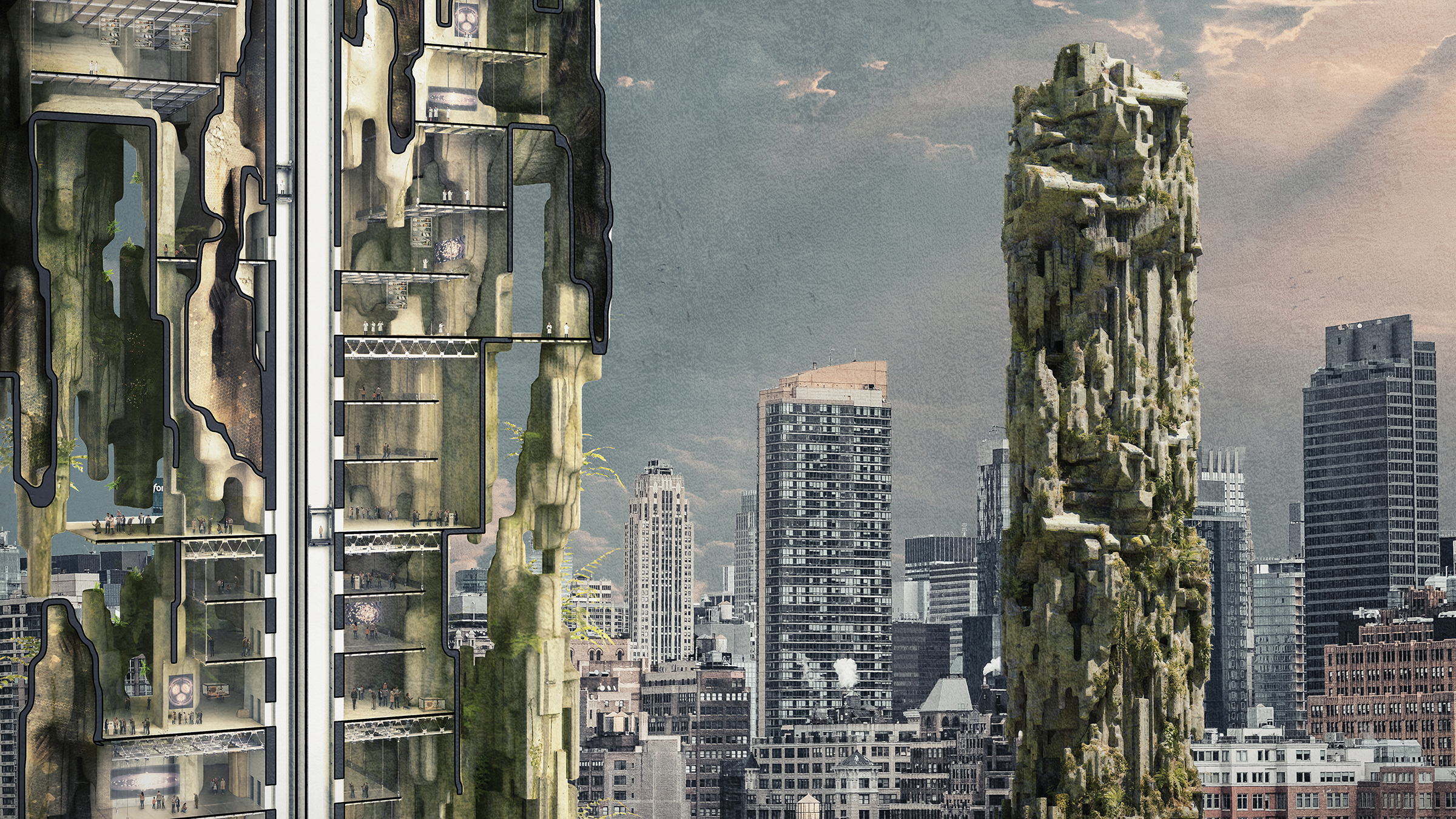
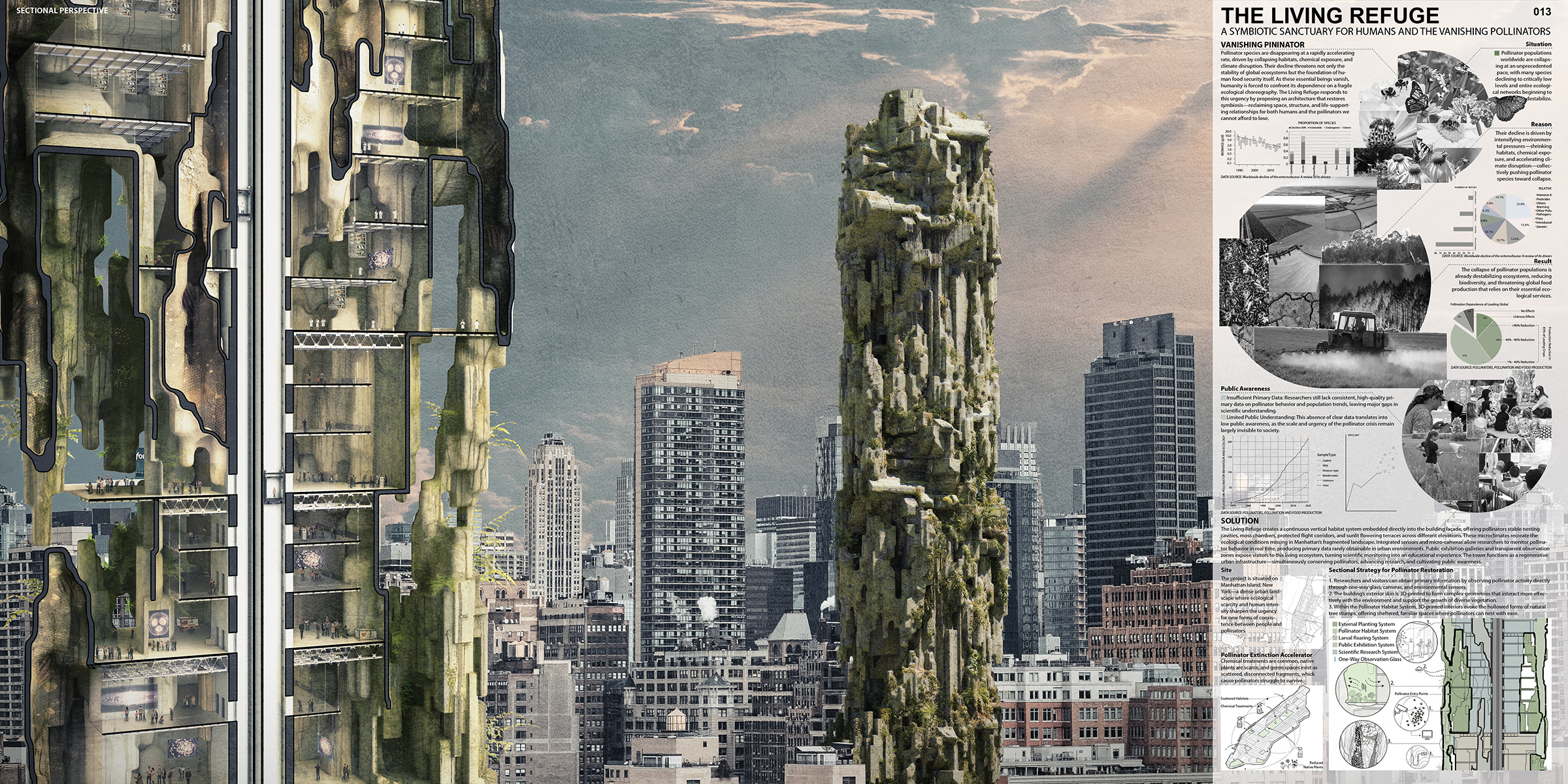
The Living Refuge addresses one of the most urgent ecological crises in dense urban environments: the accelerating endangerment of pollinator species. In Manhattan—where habitat fragmentation, chemical exposure, and extreme urbanization sharply amplify this decline—the project reframes the skyscraper as a vertical ecological, scientific, and educational infrastructure. The proposal operates through three integrated strategies: restoring habitat, advancing scientific knowledge, and raising public awareness.
REGENERATIVE POLLINATOR HABITAT SYSTEM
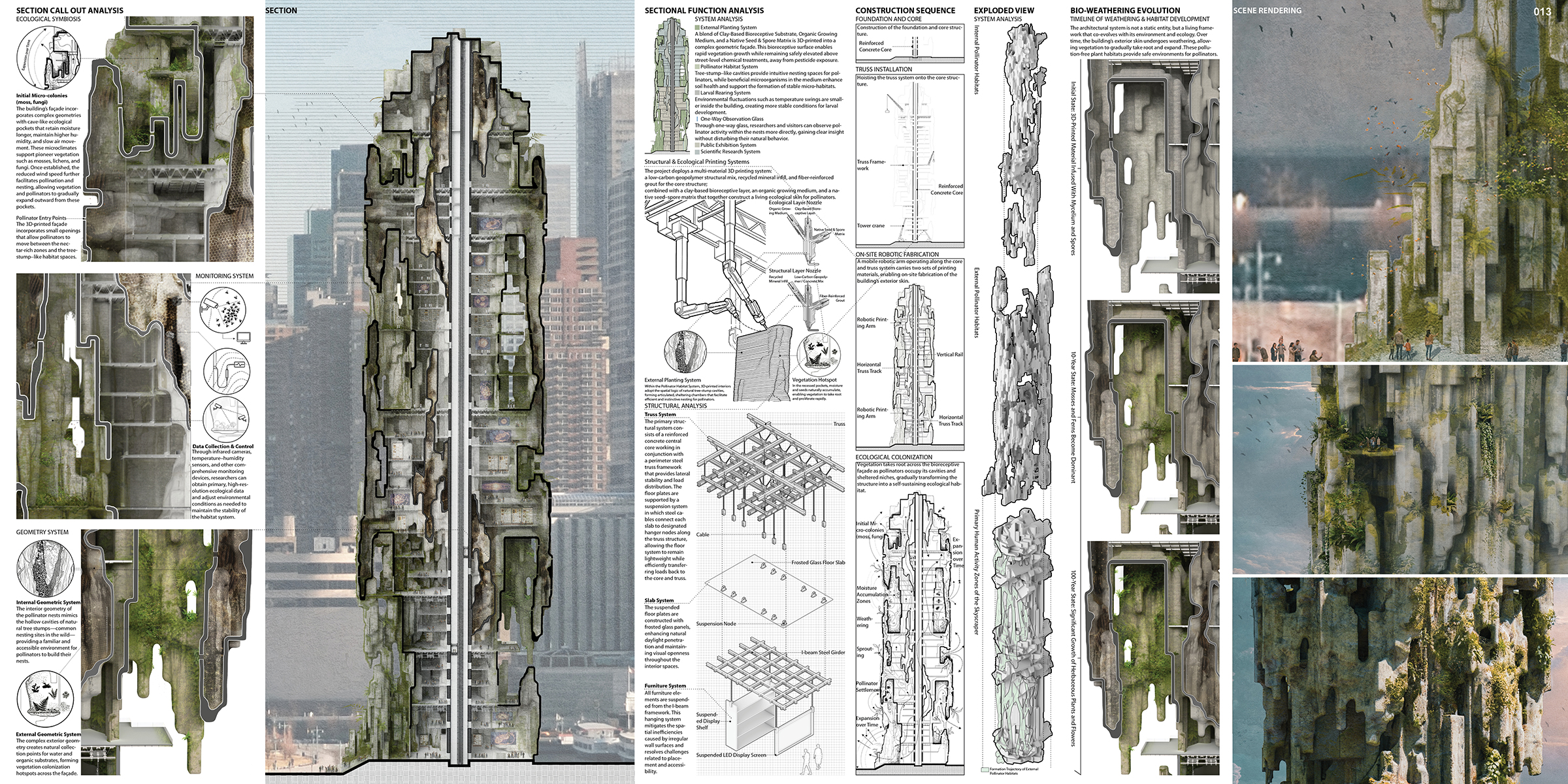
The first goal of The Living Refuge is to reconstruct stable, continuous habitats for pollinators high above the chemical-treated and fragmented ground plane of Manhattan. The 3D-printed façade becomes a vertical ecological landscape. A dual-material system—composed of a structural mix and an ecological mix—is deposited by a mobile robotic printing arm operating along vertical rails and horizontal truss tracks.
The complex façade geometry forms ecological pockets that retain moisture, accumulate organic matter, and slow air movement. These microclimates become vegetation colonization hotspots, allowing pioneer species such as mosses, lichens, and fungi to establish. As vegetation grows, reduced wind speeds support pollinator landing, foraging, and nesting. Small façade openings allow pollinators to move freely between nectar-rich exterior vegetation zones and the tree-stump–like interior cavities of the pollinator habitat system, whose 3D-printed geometries replicate natural hollow stump nests ideal for larval development.
Separated from chemical pollutants and supported by stable microclimates, the skyscraper transforms into a protected vertical sanctuary where plants, microorganisms, and pollinators can gradually colonize and co-evolve.
SCIENTIFIC OBSERVATION & DATA COLLECTION SYSTEM
A second core objective is to address the global shortage of primary scientific data on pollinators. Compared to mammals or birds, pollinator species remain understudied largely because reliable, real-time field observations are extremely difficult to obtain.
To counter this, the tower integrates an internal scientific observation and data collection system. Infrared cameras, temperature–humidity sensors, and other monitoring devices allow researchers to study pollinators directly within the ecological façade. One-way observation glass enables non-intrusive viewing of nesting behavior, foraging cycles, and larval development. Environmental conditions can be adjusted based on collected data, allowing scientists to actively maintain ecological stability while generating unprecedented, high-resolution records of urban pollinator life.
The building thus operates as a research institution embedded within a living ecosystem, turning the skyscraper into a continuous generator of primary ecological knowledge.
PUBLIC EXHIBITION & AWARENESS SYSTEM
A third critical issue is the lack of public awareness surrounding the pollinator crisis. Most urban residents have limited understanding of pollinators, their ecological roles, and the severity of their decline. This knowledge gap contributes directly to the worsening crisis.
To confront this, the tower incorporates a public exhibition system, functioning as a vertical natural history museum. Visitors experience live pollinator activity through observation chambers, transparent ecological corridors, and curated displays explaining how extinction risks threaten global food systems and biodiversity. By providing real-time, visceral encounters with pollinators, the building fosters public empathy, awareness, and long-term engagement in conservation efforts.
Through education, transparency, and immersive ecological storytelling, the skyscraper becomes a civic platform for environmental literacy.
ECOLOGICAL COLONIZATION & SYMBIOSIS
In its mature state, The Living Refuge becomes a site of ecological colonization and symbiosis. Vegetation takes root across the façade, microorganisms enrich the substrate, and pollinators occupy the interior cavities—forming a dynamic, evolving network of habitats. Positioned far above pesticide exposure and insulated from ground-level habitat fragmentation, the skyscraper operates as a regenerative ecological engine for Manhattan.
By merging construction technology, habitat formation, scientific research, and public education, The Living Refuge imagines a future where architecture actively repairs, supports, and regenerates the ecological systems.