2025 Skyscraper Competition
Honorable Mention
Mohamed Noeman, AbdelRahman Badawy, Toka Hassan, Pierre Atef Ghattas Saweris, Mariam Ahmed Hassan Elkashatt, Toqa Mahmoud Lotfy Elkhazragi, Haneen Ali Sobhi Ali, Habiba Kamal Mahmoud, Salma Shehab Mohey El-din, Sama Hazem Ragab
Egypt
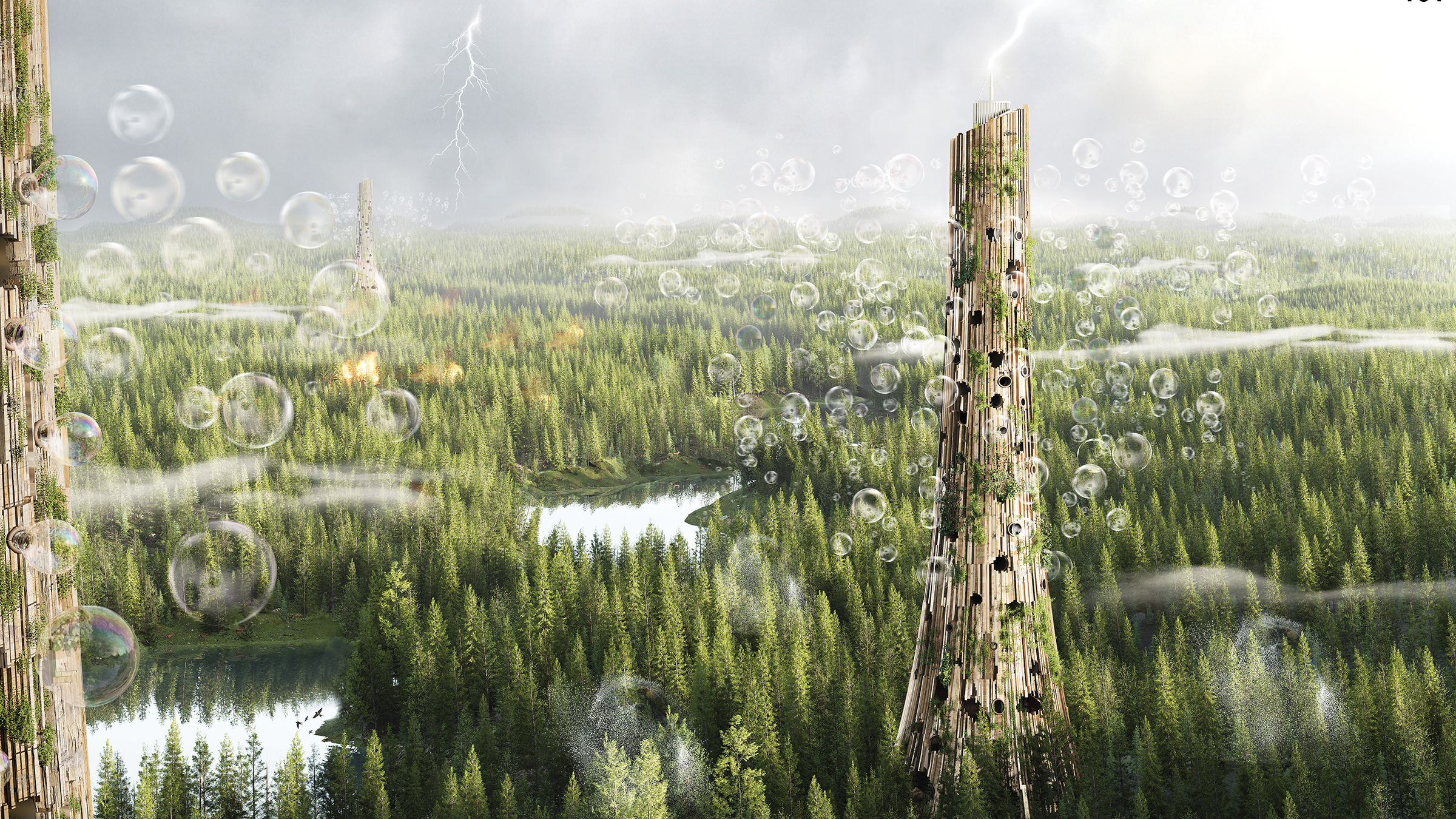
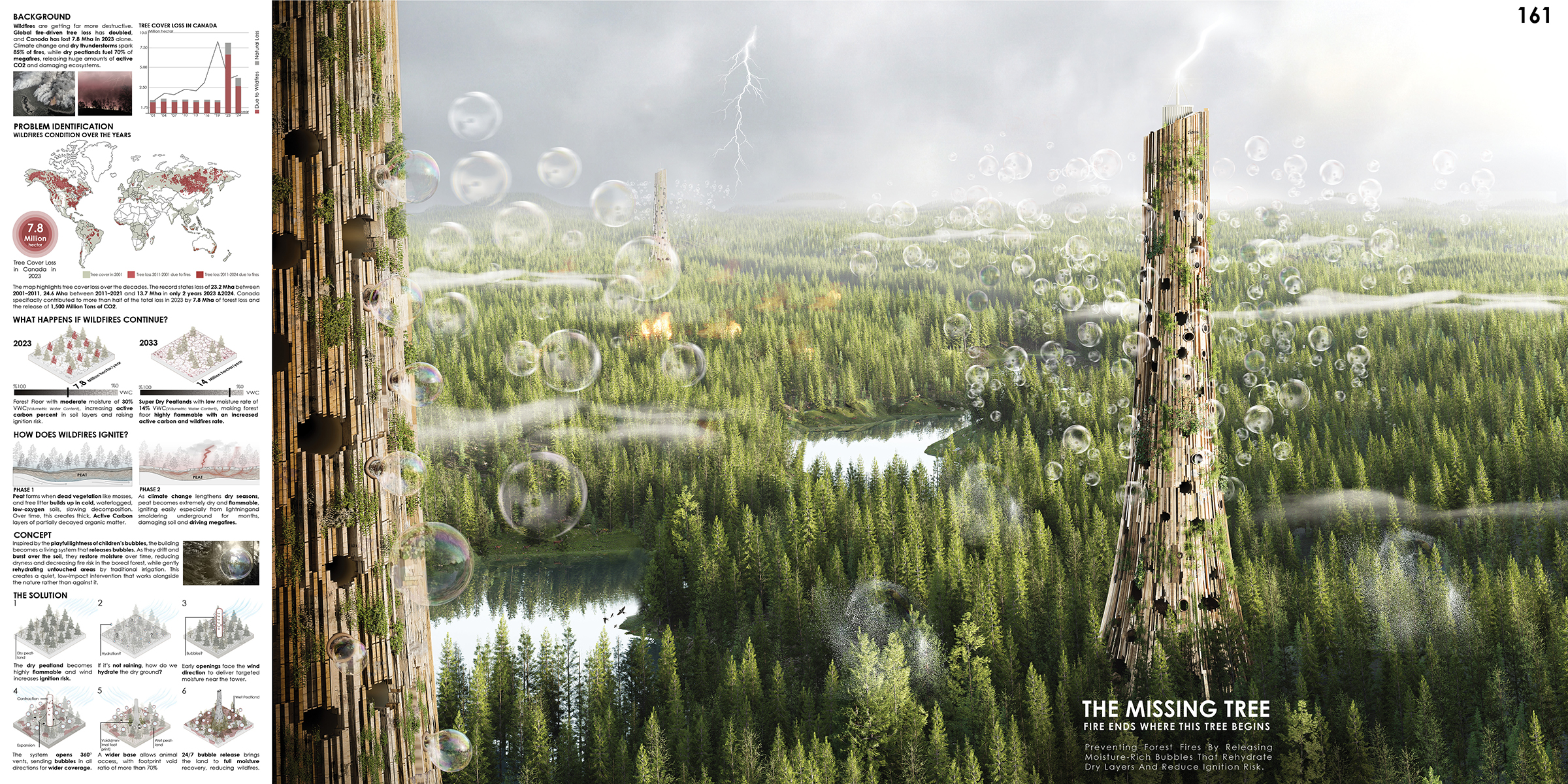
Wildfires have become one of the most destructive forces reshaping the planet. Boreal forests hold immense quantities of carbon not only in their dense vegetation but in the deep, peat-rich soils beneath them. Climate change has dried these peatlands at alarming rates, transforming them into vast reservoirs of carbon waiting for ignition. A single spark—often nothing more than lightning—can trigger runaway fires that tear across landscapes, destroy habitats, erase species, and destabilize entire ecosystems. Over the past two decades, such fires have doubled global tree loss. In 2023 alone, Canada lost 7.8 million hectares of boreal forest, releasing more than 1,500 million tons of CO₂.
In this context, The Missing Tree emerges as an architectural presence that embodies what the forest has lost—a “tree” restored not in form but in function. Rather than occupying land or adding ecological burden, it introduces the minimum footprint needed to directly confront the root causes of megafires: desiccated peat soils and lightning-induced ignition.
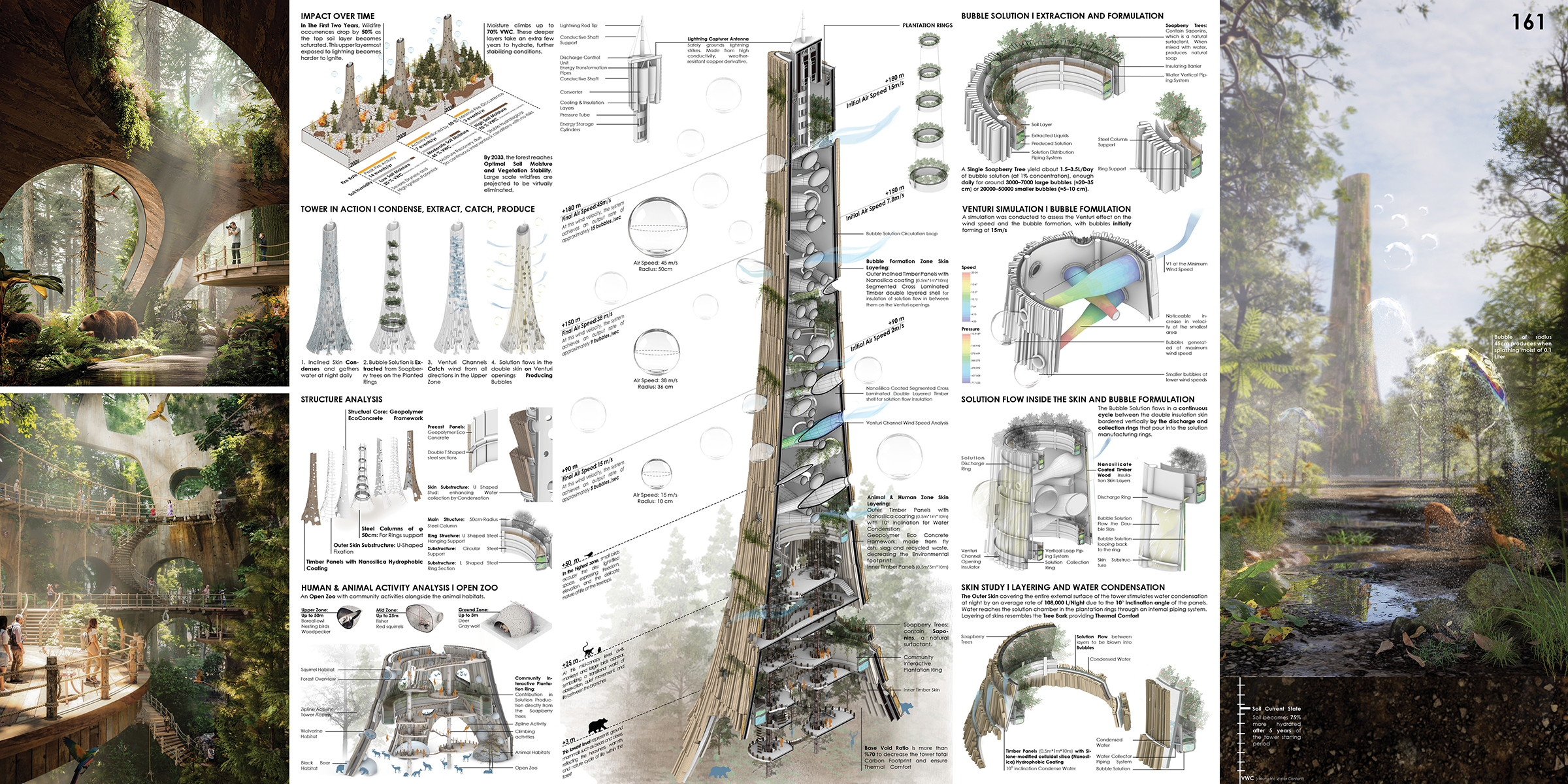
The tower draws from Venturi principles of pressure and speed to transform natural wind into a restorative force. Its conical geometry accelerates airflow, enabling the formation of moisture-rich bubbles that drift across the ground and gradually rehydrate the soil. Simultaneously, its conductive structural spine absorbs lightning energy before it reaches the forest floor, preventing natural ignition triggers from ever occurring. Within the tower, functions merge seamlessly: the upper regions orchestrate bubble formation and environmental repair, while the lower levels open as a public forest observatory—an immersive realm where communities witness and participate in the healing process.
Scientifically, the tower operates as a continuous environmental engine. A nano-silicate-coated timber skin catalyzes nightly condensation at a rate of up to 108,000 liters of water. This collected moisture flows into circular plantation rings surrounding the structure, with the help of soapberry trees, which produce natural saponins that mix with the water to create an ecological soap solution. As wind moves through the Venturi chambers, the tower generates 20,000 to 50,000 biodegradable bubbles daily. Each bubble bursts across the forest floor, releasing micro-droplets that moisten the peat layer. When winds intensify—a force that once spread fire uncontrollably—the system responds by producing more bubbles, turning a destructive natural element into an active agent of renewal.
Over time, The Missing Tree becomes long-term restorative infrastructure. During the first two years, upper peat layers regain enough moisture to significantly reduce ignition risks and support vegetative regrowth. Across seven years, deeper layers rehydrate and stabilize, restoring carbon absorption and strengthening the ecosystem’s resilience. When deployed as a network, the towers create microclimate stability across the region, reducing both the likelihood and severity of future megafires. Beyond restoration, they maintain soil health by distributing natural supplements that reinforce the forest floor.
While the upper mechanisms work continuously to repair the land, the lower levels remain an enduring public realm—a reminder that environmental recovery is inseparable from human participation. Elevated walkways, observation decks, research platforms, and zipline routes weave through the interior, enabling communities to engage with the slow regeneration of the forest. The tower becomes a space where ecological science, education, and human experience merge into a unified architectural ecosystem.
More than a structure, The Missing Tree redefines architecture as a living restorative mechanism—one that breathes moisture back into the earth and transforms destructive natural dynamics into regenerative forces. It stands as a reborn tree, protecting its forest while offering a vision for how architecture can evolve into an active agent that heals the planet.