Third Place
2025 Skyscraper Competition
Danny Elachi Elsaadi, Dima Elachi Elsaadi
Saudi Arabia
For centuries, Bedouin communities shaped their lives through a deliberate rhythm of movement. Seasonal routes, shared stopping points, and portable dwellings formed a refined spatial system grounded in environmental knowledge and reinforced through oral tradition and craft. Mobility organized social life around cooperation, hospitality, and mutual responsibility, an intentional and adaptive way of inhabiting the land, never a product of limitation.
Today, the spatial conditions that once sustained this worldview have been largely erased. Fixed borders, land ownership, and permanent settlement have rendered nomadic routes almost invisible and stripped historic stopping points of recognition. Yet the Bedouin ethos persists in poetry, hospitality, craftsmanship, and tents still raised during gatherings and seasonal rituals. What threatens is not cultural irrelevance, but the spatial framework that once allowed it to be lived.
What stands to be lost is not only a dwelling tradition, but a knowledge system, ecological intelligence, resource-light construction, oral memory, and a social ethic rooted in dignity and hospitality. These rely on cycles of gathering and returning; without spatial conditions that support them, a living culture risks becoming static heritage.
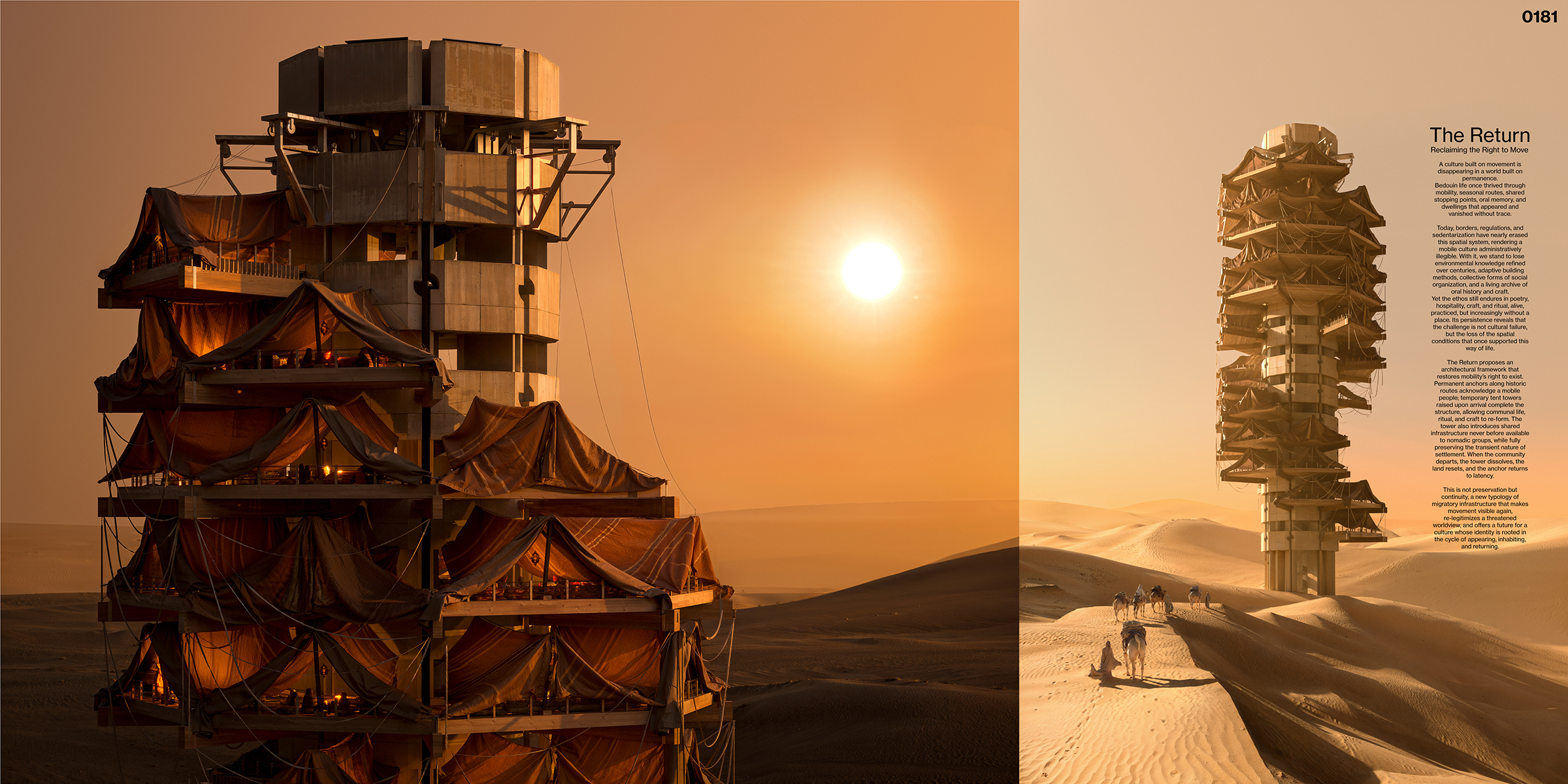
The Return proposes a territorial system that restores mobility’s place within the contemporary landscape. Permanent anchors placed along historic routes acknowledge a mobile people, reinstating a network long absent from contemporary mapping. When families arrive, temporary tent towers rise around these anchors, enabling communal life, ritual, and craft to reassemble before dissolving as the community departs. The tower consolidates shared services, energy, water routing, and essential support, introducing a level of mobile infrastructure never before available to nomadic communities while preserving the transient character of settlement. It sustains a culture that appears, gathers, and returns.
The spatial logic unfolds through four states of activation.
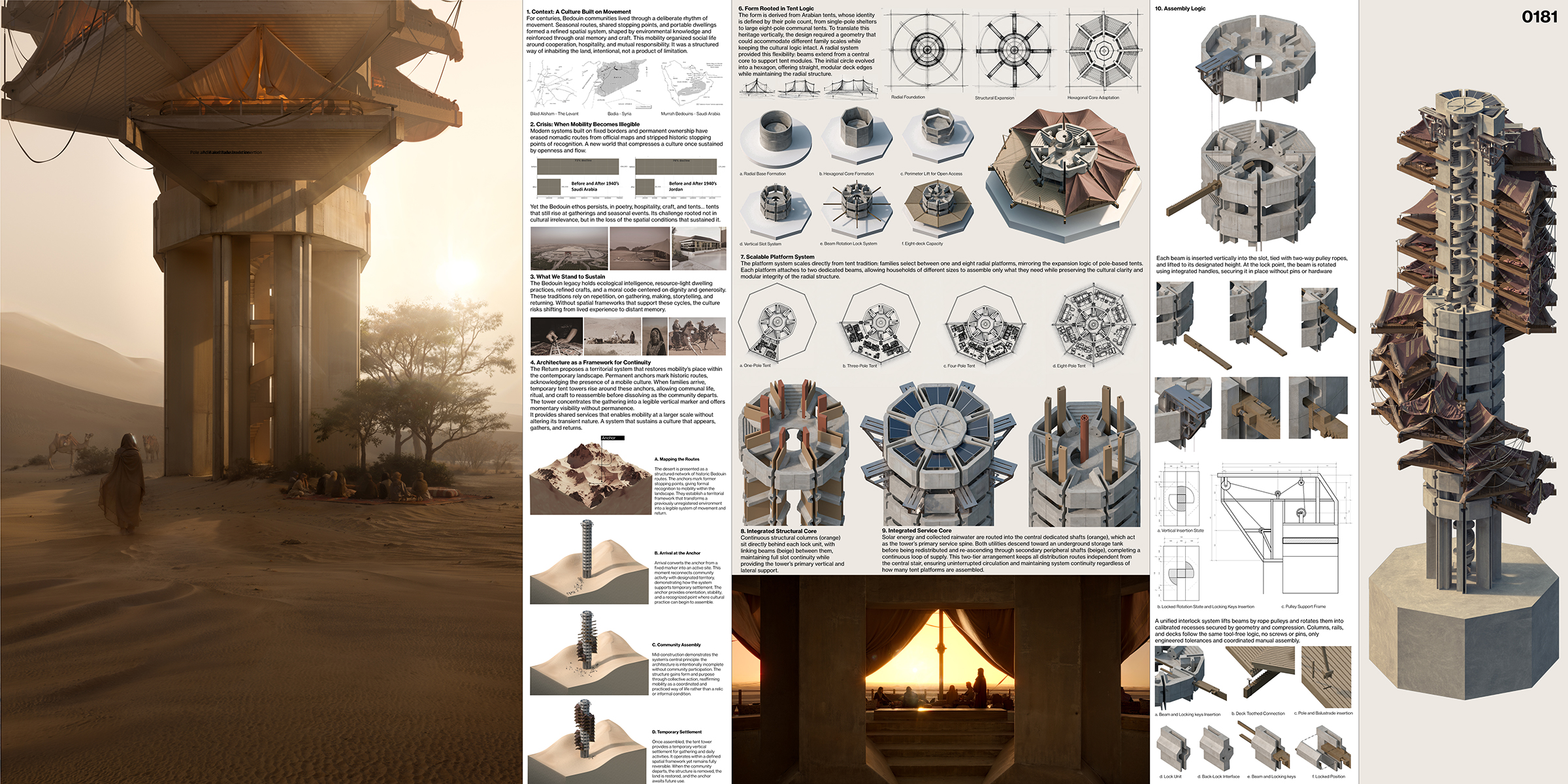
First, “Mapping the Routes” presents the desert as a network defined by historic movement, with anchors re-establishing former stopping points as recognized elements of the landscape.
Second, “Arrival at the Anchor” activates each site for temporary use, providing orientation and initiating community assembly.
Third, “Community Assembly” expresses the proposal’s core principle: the architecture is intentionally incomplete without the people who activate it. Through coordinated construction, the tower gains form and meaning.
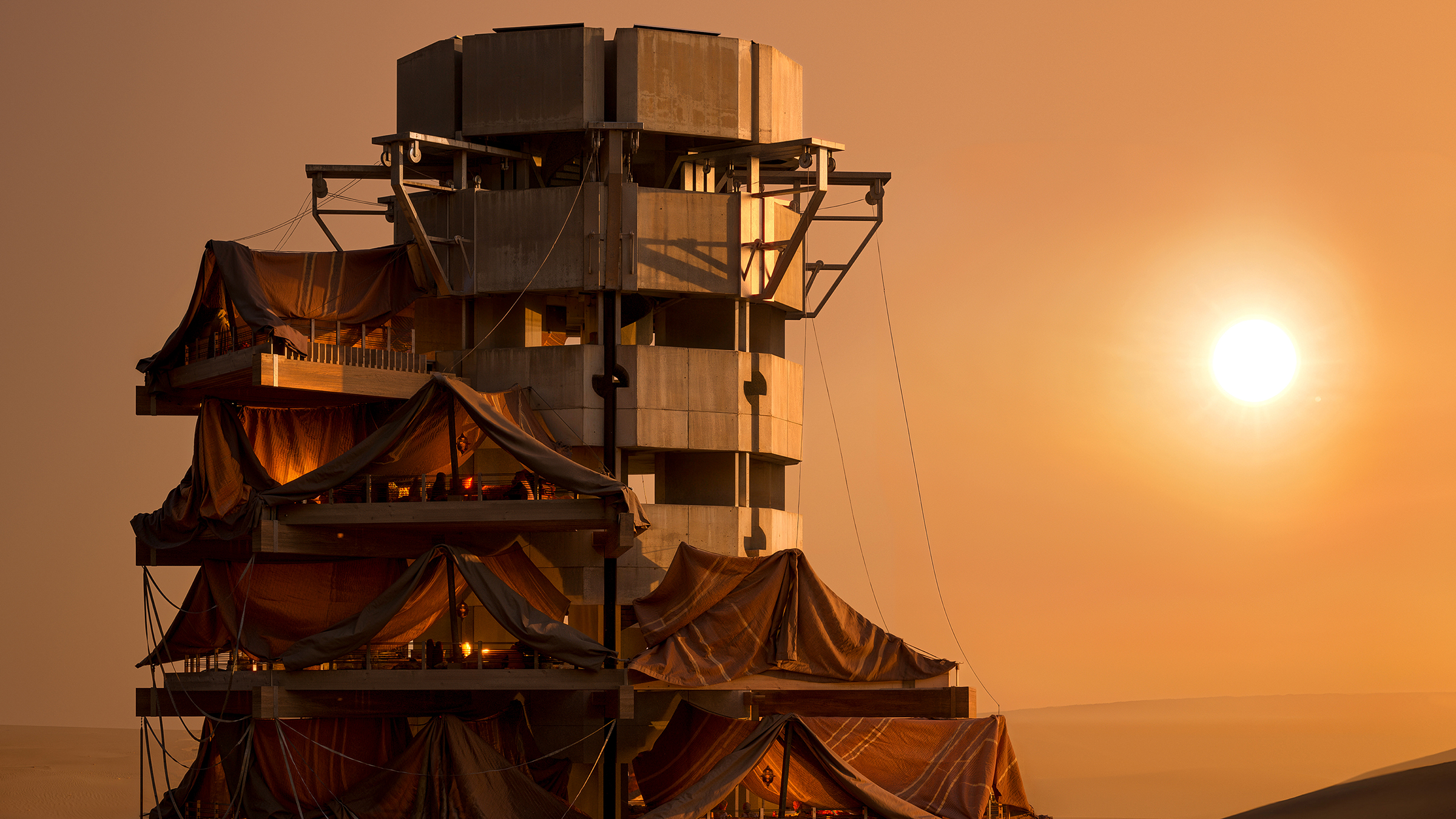
Finally, “Temporary Settlement” describes the tower in its inhabited state, a reversible vertical camp for gathering, activity, and ritual. When the community departs, the structures are removed, the land resets, and the anchor returns to latency.
The architectural form draws directly from Arabian Bedouin tent typologies defined by pole count, from single-pole shelters to eight-pole communal structures. Translating this heritage vertically required a geometry capable of accommodating different family scales while preserving cultural clarity. A radial system provided this adaptability: beams extend from a central core to support tent modules. The initial circular geometry evolved into a hexagon to align with straight modular platforms while retaining the radial logic. Families select between one and eight platforms, mirroring the expansion logic of pole-based tents; each platform attaches to two dedicated beams, allowing households to assemble only what they need while maintaining modular integrity.
The tower is built entirely by hand through a passive mechanical system: carefully engineered slots receive the beams, pulleys lift them, and each beam rotates into a specially designed geometric lock that secures it without hardware. Platforms and rails follow the same tool-free logic, allowing the tower to be erected, inhabited, and dismantled without machinery.
The Return offers an architectural framework through which Bedouin culture can remain legible and enduring, an infrastructure that restores mobility to visibility and supports a people whose identity is rooted in the cycle of appearing, inhabiting, and returning.