Header Image
  • Home
  • news
  • magazine
  • competition
  • About
  • Shop
  • Jobs
  • News
  • architecture
  • design
  • art
  • 2022
  • 2023

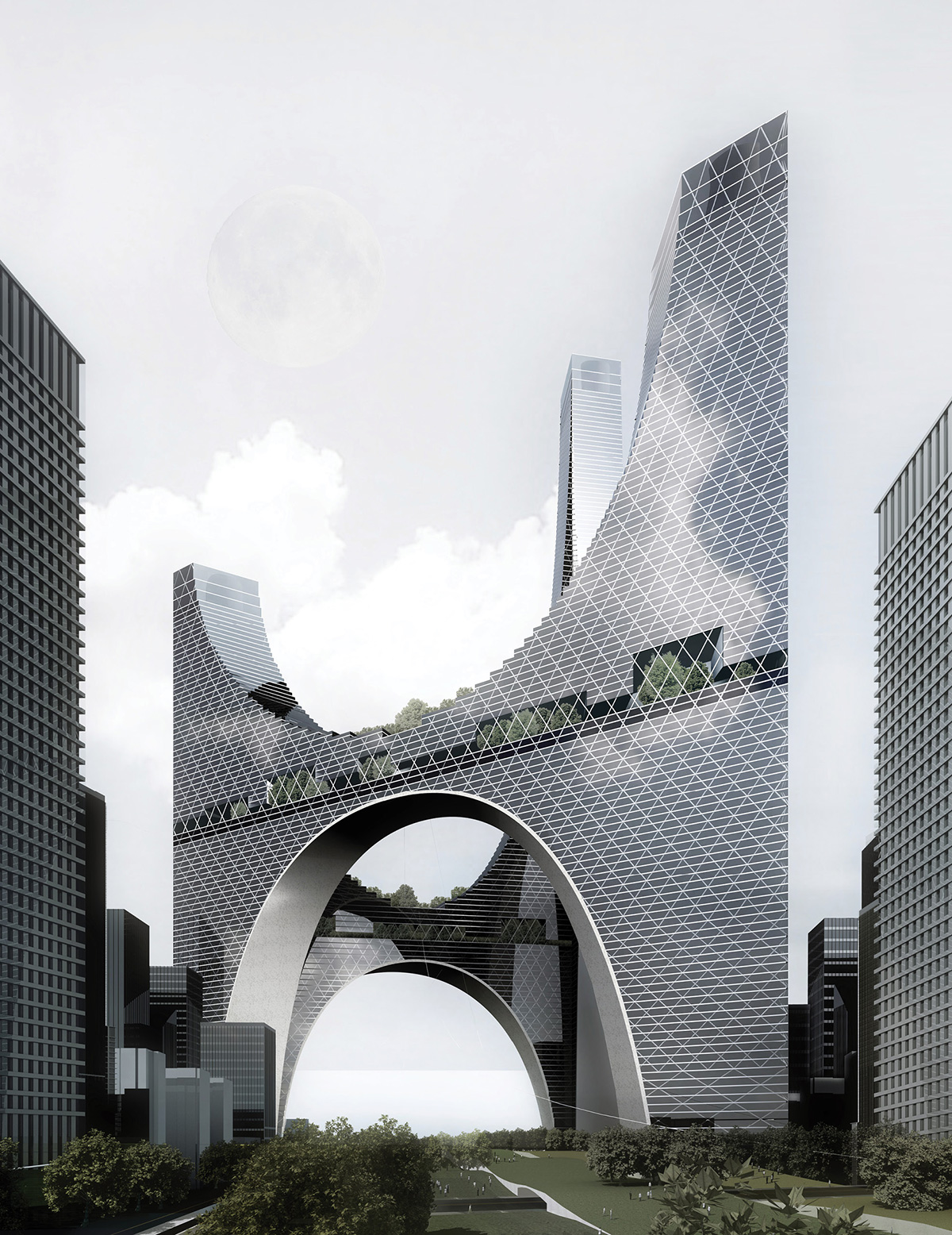
Cloucity

By: admin | April - 17 - 2015

Editor’s Choice
2015 Skyscraper Competition

Juerg Burger, Ge Men, Qingchuan Yang, Yin Li, Wei Hou
Switzerland

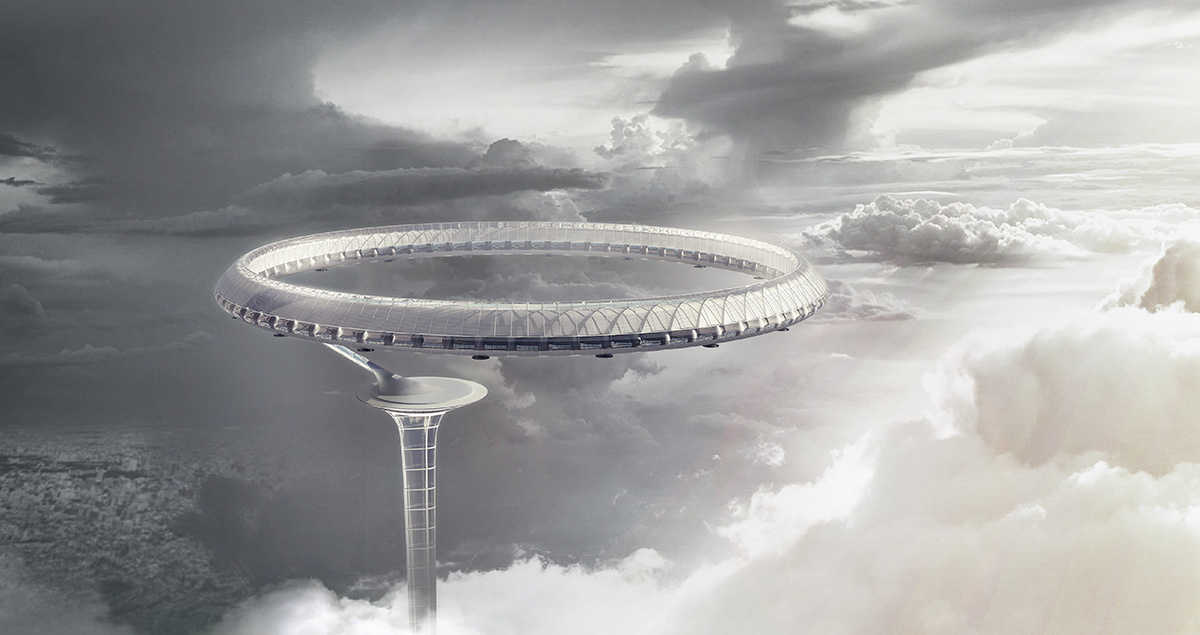
Skyscrapers are controversial buildings. Conventional sksycrapers suffer from a series of programmatic and spatial problems including: homogeneous spaces, inefficient vertical/ horizontal connections, and isolation from urban fabric. Cloucity proposes a vertical city connected to the existing city at three different points. The void generated will serve as a recreational space for the city and will be  Read the rest of this entry »

architecture, featured, news

Re2iffel Equalizer Skyscraper

By: admin | April - 17 - 2015

Editor’s Choice
2015 Skyscraper Competition

Teemu Holopainen, Tomi Jaskari, Tuomas Vuorinen, Simon Ornberg
Finland

Societies around the world call for equity. Political structures and values create base for land use and build environment which in turn should equilibrate the contradictions embodied to democracy. Goal of development can no longer be based on economic values alone. Continuing growth by numbers (GDP,ROI,FAR etc.) is ecologically impossible and has already started to diminish wellbeing of man. Growth of culture is needed instead of growth of capital. Can high rise contribute for equity of culture in society? Originally high rise building was just a building on the block with more floors. Relationship with the city was organic and the door, the lobby, of the high rise was part of the public street life between buildings. With the modern movement and zoning via traffic planning for the goals of industrial capitalism, high rise isolated from the city. 20th century high rise lacked to provide more public city life but instead it strengthened the negative effects of the privatization of space. High rise architects ended up being like fashion designers trying to dress the body with trendy clothes to make just another sexy model for portfolio shoots. Relationship between the world outside and the high rise inside was only “traffical”. This arrogant ignorance and denial of the public realm has made a 20th century high rise a symbol for decadence/triumph of capitalism of time. Future society calls for openness for public space in internet and in physical city to enhance proximity to produce culture of dignity and caring as much as concrete innovations and business for better world. From this perspective 21th century high rise building should be universal and permanent construction for multiple uses. It is more about concept of construction than the concept of use. It is more about architecture.

Concept

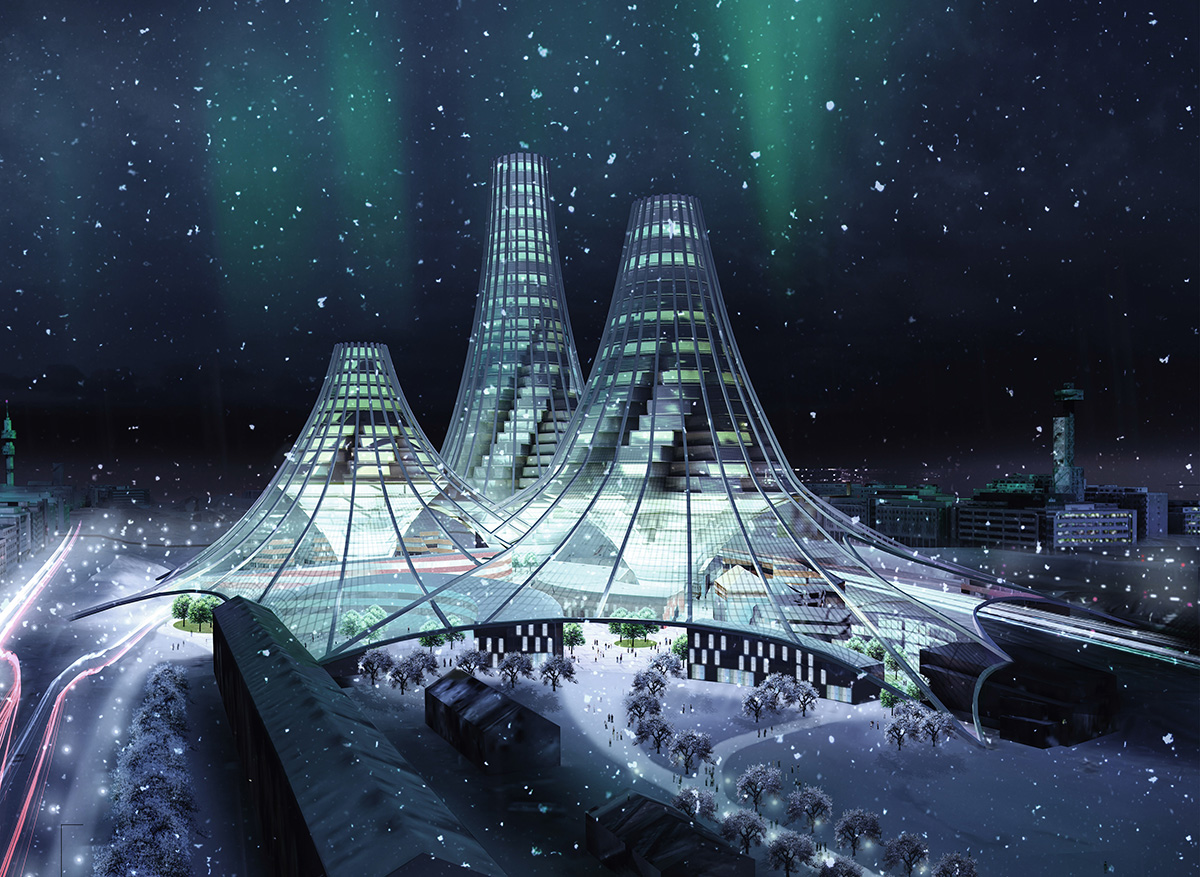
Re²iffel seeks the concept of structure, the body, not the concept of functions, for high rise to fulfill equity goals while providing comfort and shelter for future threats of climate change where extreme ends of whether conditions will vary more and more often. The concept is based on traditional combination of load bearing facade and rigid elevator shaft which together in a form of thin-shell structure in the shape of tent creates very stable and enduring skeleton for high rise use. This kind of primary structure contributes the image of the city and landscape with landmark effect while, from near, forms human scale environment. At the same time it allows functional flexibility and openness of public space to flow through it. The greater the volume of the public space the greater the privately used floor space on the very same place. Scaled enough the structure can work also as a bandage which repair the accessibility of pedestrians or cyclists. Foot of structure can be treated same way as a giant Eiffel tower pad, which spreads the “tent” over the existing infrastructure to form pedestrian access. The surface of the facade can be dressed with the newest ubiquity intelligence finish to provide electricity out of sun (photovoltaics) and wind (piezoelectric). Tent shaped facade creates optimal angle for both zenith sun and polar sun in positions of different latitude and compass point. Inner partition walls form the tertiary structures which need to be flexible for changing use. Ground level with small scale buildings creates facilitations for events with public space as a venue around. The whole contributes the urban sustainability and history of the city. Read the rest of this entry »

architecture, featured, news

Diffused Boundaries Skyscraper

By: admin | April - 17 - 2015

Editor’s Choice
2015 Skyscraper Competition

Satavee Kijsanayotin, Ben Novacinski, Hannah Mayer, Haydar Baydoun, Mingxi Ye, Zhifei Chen
Thailand, United States

One’s identity within the city is determined by a relationship to public and private space. Where a person can go, what they can see, and what experiences a person has access to shapes the identity of the individual. Architectural language plays a crucial role in this identity. Diffused Boundaries aims to break down previously known thresholds in the city and affect change in the way people perceive, use, and experience space.

Hong Kong, like many metropolitan cities of the world, experiences the rapid rise in urban population in limited build-able land, creating a need for the city to grow vertically.  This method of architectural urbanization have humans pushing the boundaries of our existence into the sky. Yet the existing model for vertical existence have produced an urban landscape of tall, monotonous, and isolating structures that pushes the population to become socially disconnected.

The rigid separation of the programmatic functions between the public and private realm shapes and limits human social interaction.  As cities continue to grow skyward, leaving behind the socially and culturally rich public functions that exists at street level for the private realm higher up, the more private and isolated our lives becomes. Thus, as we look skyward, the question that Diffused Boundaries seeks to answer is not only how do we begin to blur the boundaries that create separations between public and private spaces, but also how to bring the rich civic and communal lifestyle that currently exits on the ground up into the sky.

The twenty-four-block site chosen for the project exists within the main concentration of the commercial district of Sham Shui Po.  Made of up nearly identical buildings,the shop house typology dominates. Public/Semi-public use of each building exists on street level, while the next couple floors up serves as residences.  More recently, however, towers of residential living and / or commercial use have been situated atop the shop house typology, creating an ever-distant relationship between ground and sky, public and private.  
The concept of Diffused Boundaries ,then, seek to blur this rigid division between the public and private programmatic function that exists due to the existing architectural language in all three axis of urbanization through the vertical and horizontal diffusion and dispersion gradient of form and functions.

Each building block of shop-houses are diffused vertically to redefine both its public and private space.  By opening up each floor, there create more opportunities for not only more available commercial space, but also an opportunity to extend the rich street life from the ground up into the air.  The void space that are created as a result of this strategy create allows for a mixed used circulation design that acts as both modes of navigation through the structure, but also public spaces and the lively street life style that initially inspires the project.

Vertical cores provide direct point A to point B routes and horizontal planes provide lateral circulation within a new dissolved reality. Large public spaces with storefronts allow street life and public life to merge in the sky. Vertically aligned public spaces offer more space for gathering, talking, and moving through spaces. Public and private functions exist within and without each other in a new dissolved way. This system of circulation, program separation, and public space, creates a new type of community where the experience of those passing through, working, or living within it becomes integrated. Social interaction increases as a result of dissolving the public and private. The experience of Sham Shui Po no longer exists solely in black or white, but also tones of gray. Read the rest of this entry »

architecture, featured, news

Winners 2015 eVolo Skyscraper Competition

By: admin | March - 26 - 2015

2016 Skyscraper Competition is open for registration


eVolo Magazine is pleased to announce the winners of the 2015 Skyscraper Competition. The award was established in 2006 to recognize outstanding ideas for vertical living. Since then, the publication has received more than 6,000 projects that envision the future of building high. These ideas, through the novel use of technology, materials, programs, aesthetics, and spatial organizations, challenge the way we understand vertical architecture and its relationship with the natural and built environments.

In 2015, the Jury, formed by leaders of the architecture and design fields selected 3 winners and 15 honorable mentions. eVolo Magazine received 480 projects from all continents. The winners were selected for their creativity, ingenuity, and understanding of dynamic and adaptive vertical communities.

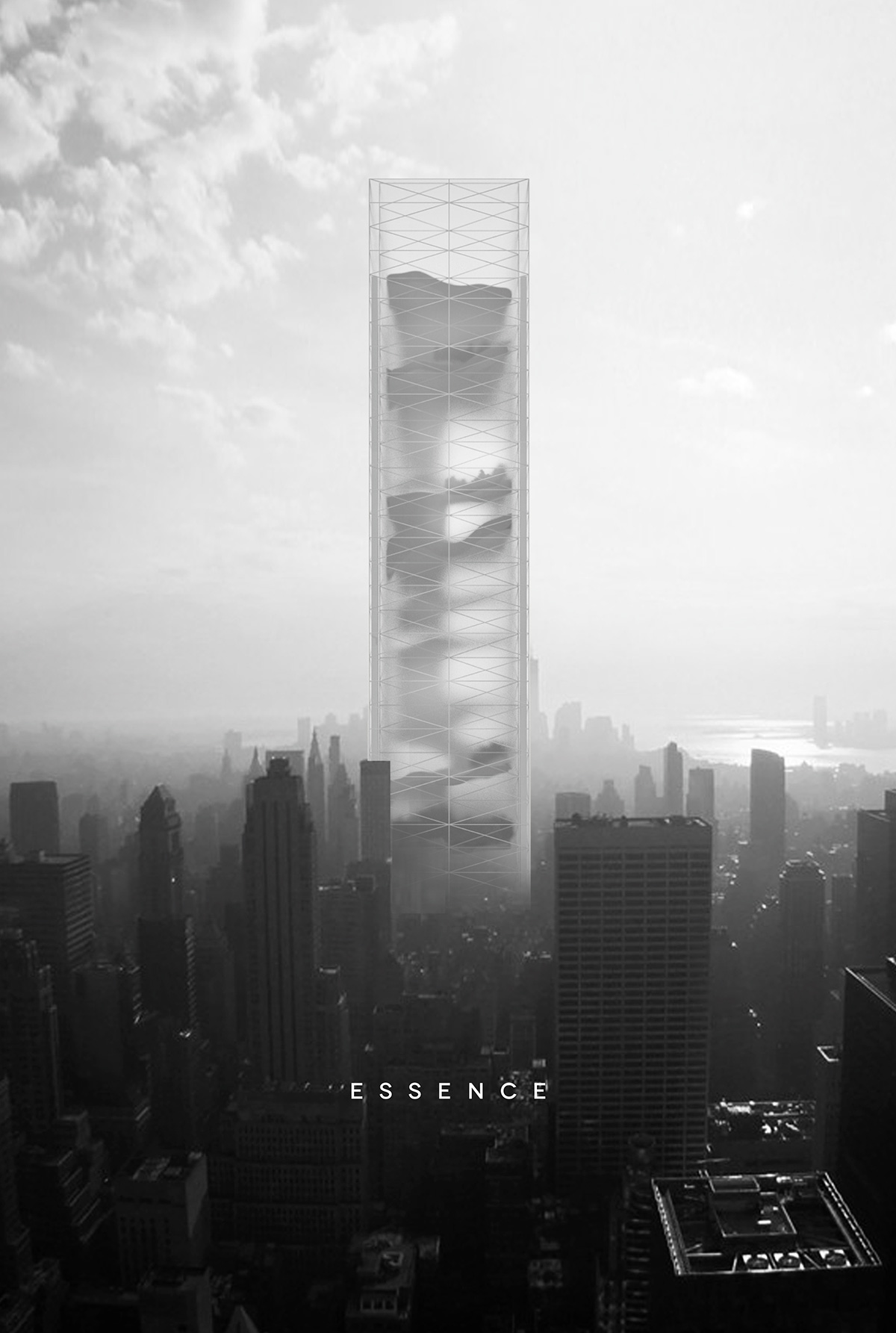
The first place was awarded to BOMP (Ewa Odyjas, Agnieszka Morga, Konrad Basan, and Jakub Pudo) from Poland for their project Essence Skyscraper. The proposal is an urban mega-structure that contains diverse natural habitats. The skyscraper would serve as a place to briefly escape urban life  and stimulate diverse and complex experiences.

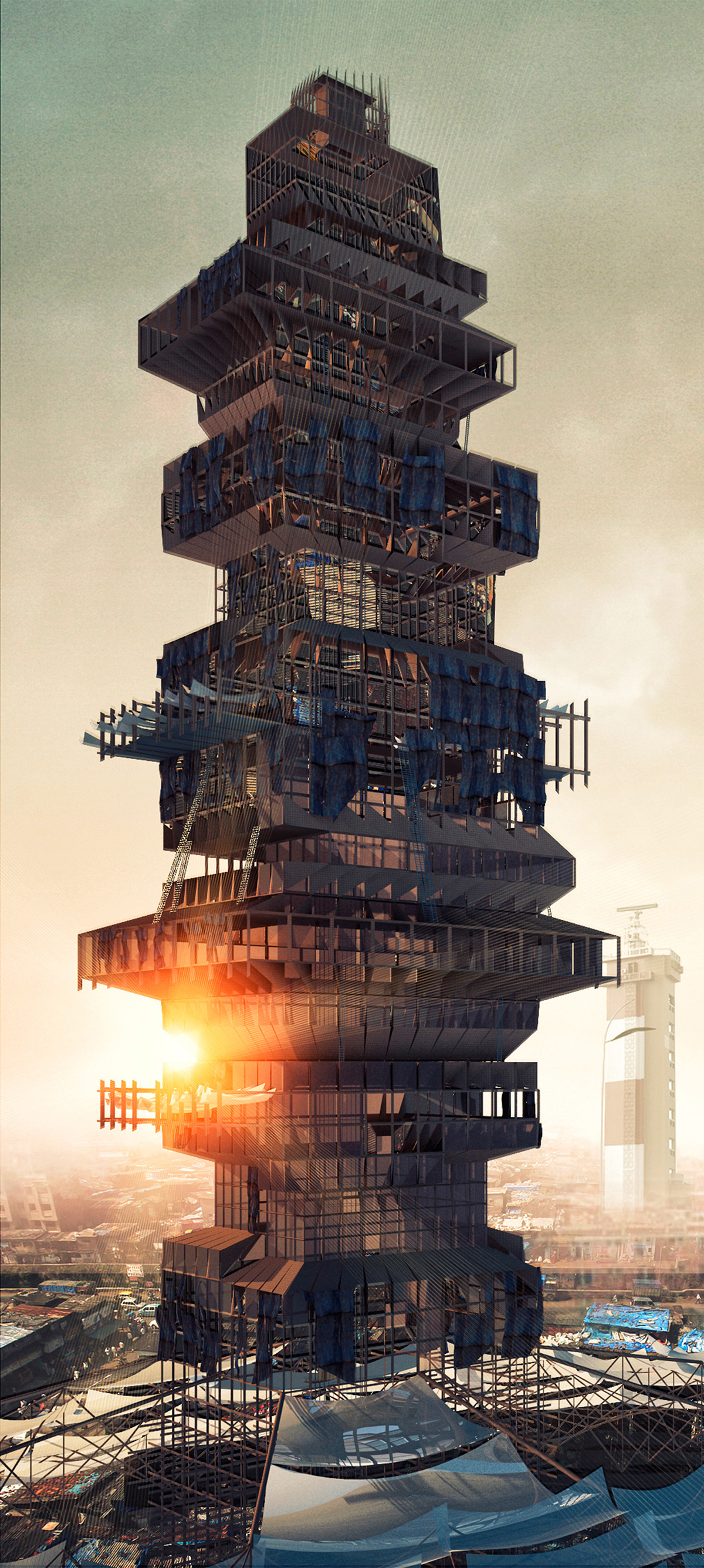
The recipients of the second place are Suraksha Bhatla and Sharan Sundar from India for their Shanty-Scaper. The project seeks to provide housing, work and recreational spaces to the inhabitants of Chennai city’s slum in India. The skyscraper is designed to reutilize the city’s post-construction debris including pipes, corrugated metal sheets, timber, etc.

The third place was awarded to Egor Orlov from Russia for the project Cybertopia which reimagines the city of the future as the combination of digital and physical worlds – a city that grows and morphs instantly according to our needs.

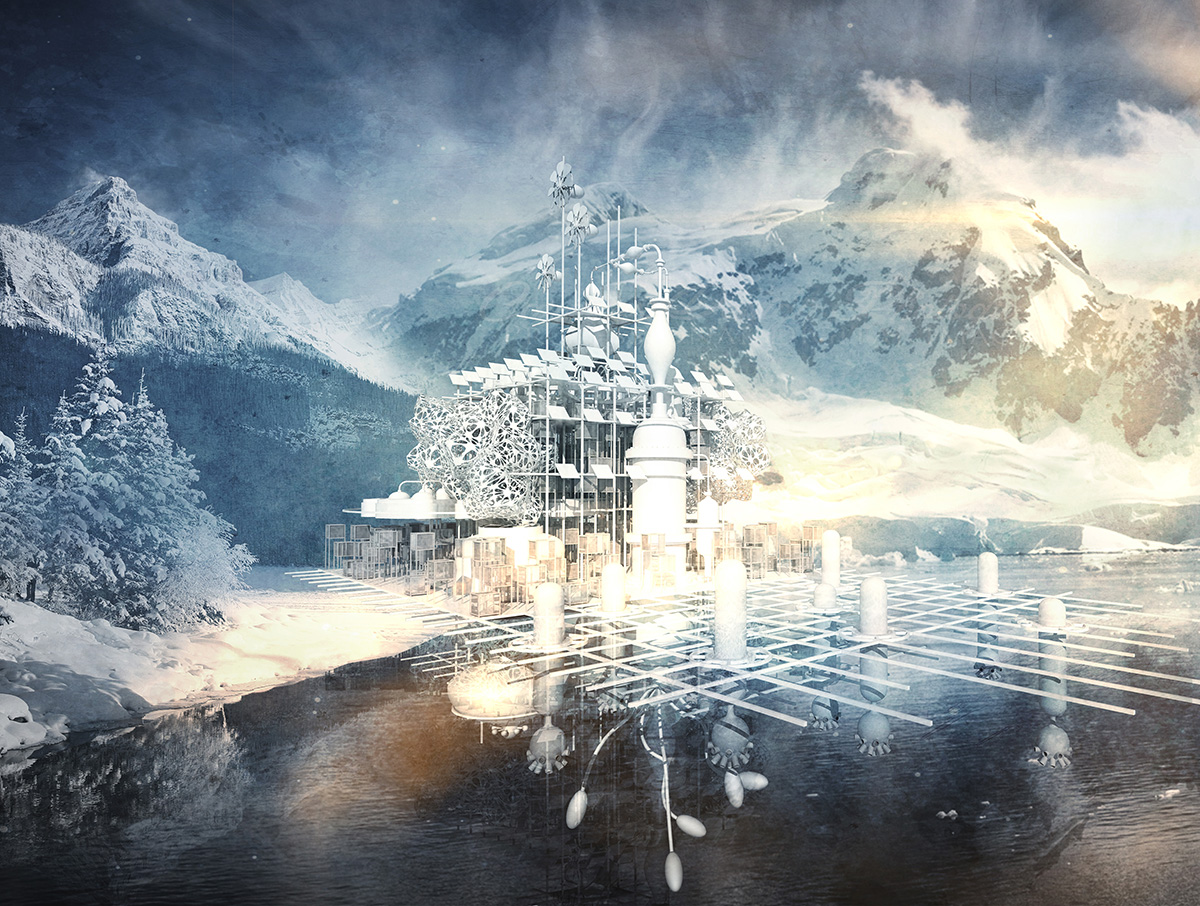
The 15 honorable mentions include skyscrapers designed for the arctic, structures that intend to reverse desertification, abandoned oil rigs transformed into bio-habitats, and atmosphere laboratories among others.

The members of the Jury are: Massimiliano Fuksas [principal Studio Fuksas], Michael Hansmeyer [CAAD group at Swiss Federal Institute of Technology], Richard Hassell [principal WOHA], Alvin Huang [principal Synthesis Design + Architecture], Yong Ju Lee [winner 2014 eVolo Skyscraper Competition], Wenchian Shi [project manager MVRDV], Wong Mun Summ [principal WOHA], and Benedetta Tagliabue [principal EMBT Miralles Tagliabue].

The 2015 Skyscraper Competition was made possible with the sponsorship of Autodesk, real5D, and v2com.

2015, competition

Essence Skyscraper

By: admin | March - 26 - 2015

First Place
2015 Skyscraper Competition

Ewa Odyjas, Agnieszka Morga, Konrad Basan, Jakub Pudo
Poland

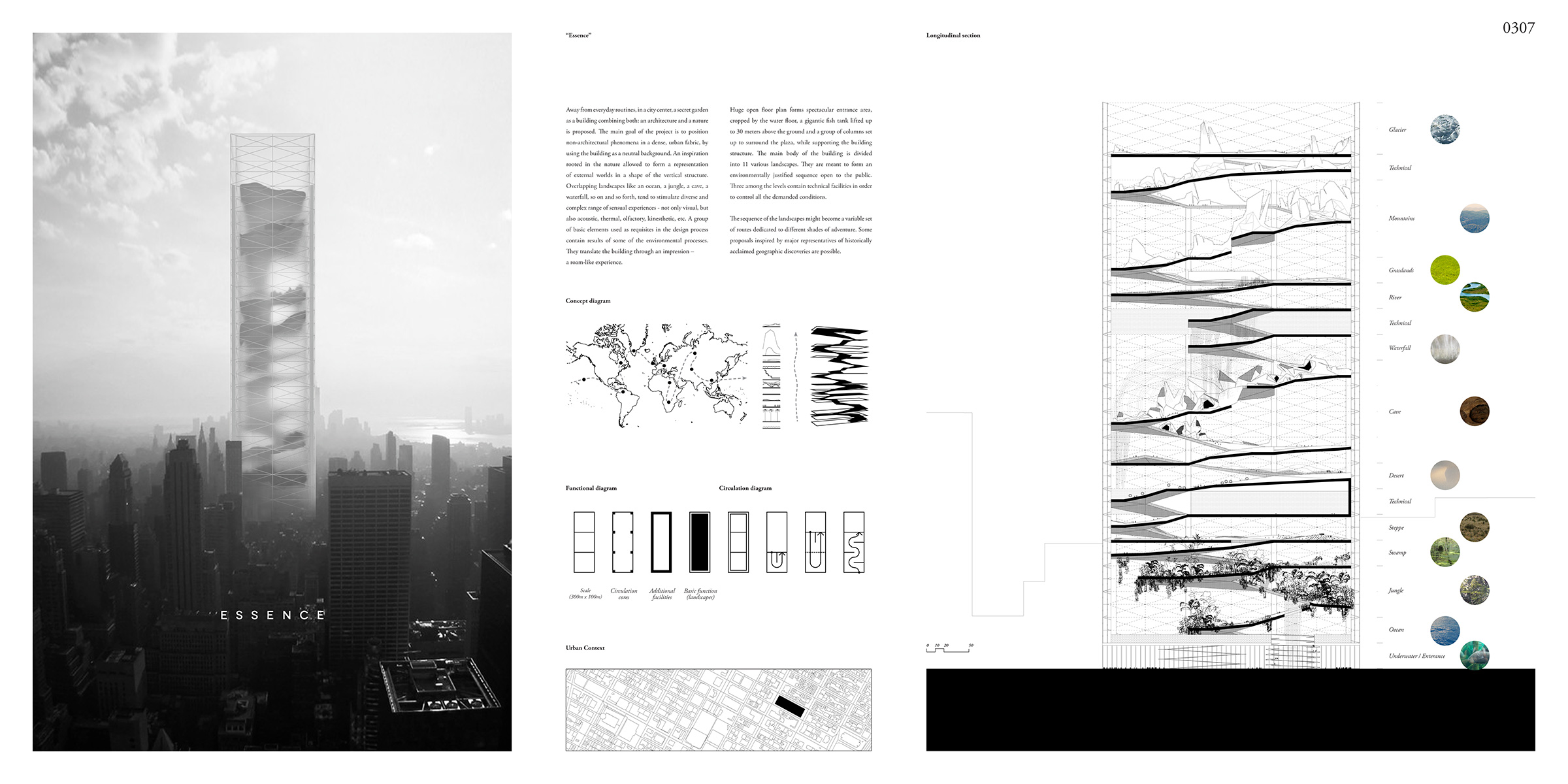
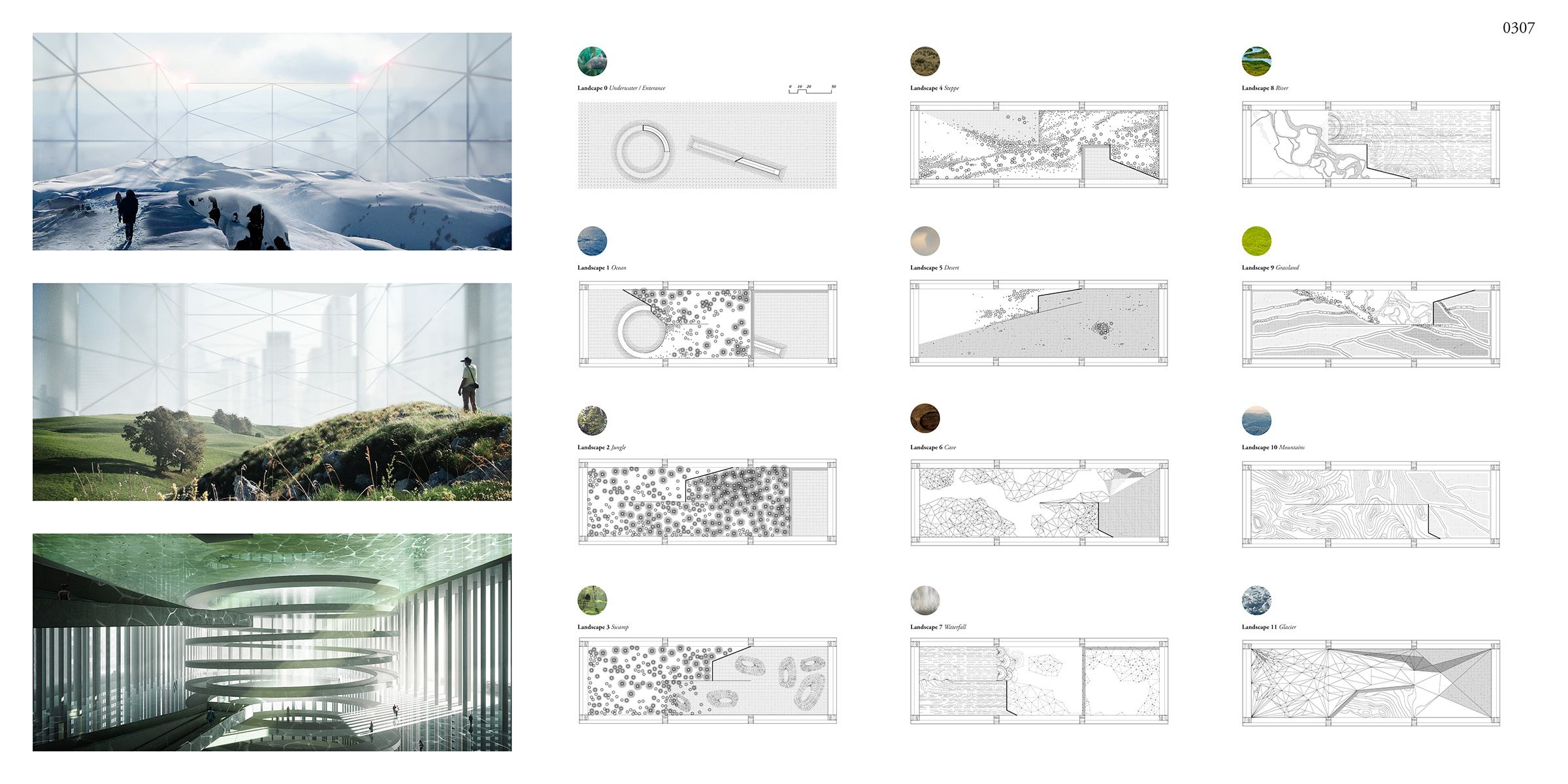
Away from everyday routines, in a dense city center, a secret garden that combines architecture and a nature is born. The main goal of this project is to position non-architectural phenomena in an urban fabric.  An inspiration rooted in nature allowed to form a representation of external worlds in the shape of a vertical structure. Overlapping landscapes like an ocean, a jungle, a cave or a waterfall will stimulate a diverse and complex range of visual, acoustic, thermal, olfactory, and kinesthetic experiences.

The main body of the building is divided into 11 natural landscapes. They are meant to form an environmentally justified sequence open to the public that includes extensive open floor plans that form spectacular spaces with water floors, fish tanks lifted up to 30 meters above ground, and jungle areas among others natural scenarios. The sequence landscapes might become a variable set of routes dedicated to different shades of adventure.


2015, competition

Invisible Perception: Shanty-Scaper

By: admin | March - 26 - 2015

Second Place
2015 Skyscraper Competition

Suraksha Bhatla, Sharan Sundar
India

India’s Slum population is expected to surge to 104 million (9% of the national population) by 2017*. As the nation’s disparity between the rich and poor deepens, the number of people living below poverty line (<1$ per day) has doubled over the last decade. Chennai city’s Nochikuppam slum is home to 5,000 fishermen families living in less than 1,500 shanties making it the third largest slum dwelling amongst the Indian metropolises. The rise of city’s squatters over the past decade indicated the struggle to cope with rapid urbanisation and the lack of political will, resulting in the failure of the government to regularise and successfully build resettlement tenements. The government’s only indirect response to such slums has been the construction of large-scale resettlement colonies on the outskirts of the city rather than recognising improving residents’ access to services.

Pragmatically, building adequate amounts of resettlement housing to house all slum-dwellers will simply take too long, require vast amounts of land and cost the city 1 billion rupees. Moreover, many residents do not necessarily desire such housing: reports indicate that nearly 20 % of allotted homes are vacant and 50 per cent of the original beneficiaries are no longer living in them, subletting them instead. Clearly, this was due to the fact that slum dwellers were transplanted 30 kms away from city centre where they found no jobs and no social infrastructure and thus were forced to move back to the city.

A far more reasonable strategy would be to implement the Tamil Nadu Slum Clearance Act (1971) in the spirit that it was written, and start to recognise slums and improve them in situ. The sky-high rentals in Chennai’s downtown and the fight for survival in India’s slums such as Nochikuppam are increasingly blurring the lines between centre and periphery. Urban planners face escalating challenges as these slums will mostly proliferate in semi-rural and downtown areas, a consequence of scarcity of urban land and accelerating rural to urban shift across the nation.

Unrecognised slums have effectively become akin to an invisible Chennai, largely ignored by the service provision agencies. As urban planners and architects we must make a conscious decision to improve the quality of life of squatters (shelter, services & livelihood) by applying principles of sustainable urbanism. The need of the hour is a reimagination of the existing land parcels, growth and infrastructural burden squatters place on the city’s civic supplies. This begs the question – Will the cities of the future be filled with vertical slums? Informal settlements and the paucity of land parcels can no longer be ignored & the complexities of resettlement will force slum dwellers themselves to build higher using locally available, structurally sound, recyclable materials accommodating themselves into organised communities.

Shanty-Scraper aspires to provide a unique solution for the fishermen of Nochikuppam located at Marina bay beach. The vertical squatter structure predominately is comprised of post-construction debris such as pipes and reinforcement bars that crucially articulate the structural stability. Recycled corrugated metal sheets, regionally sourced timber & thatch mould the enclosure of each dwelling profile and lend to their vernacular language. The double height semi enclosures serve as utility yards & social gathering spaces. The vertical transportation is fragmented into multiple plank lifts that are constructed from a simple mechanically driven lever & pulley contraption. The rhythmic timber lattice membrane structure at the ground level, houses the public sea food market, & forms the first level of defence against future tsunamis. The high rise typology serves as a vantage point for the fishermen to gauge high risk waters & during emergencies. Read the rest of this entry »

2015, competition

Cybertopia: Future of an Architecture Space, Death of Analogous Cities

By: admin | March - 26 - 2015

Third Place
2015 Skyscraper Competition

Egor Orlov
Russia

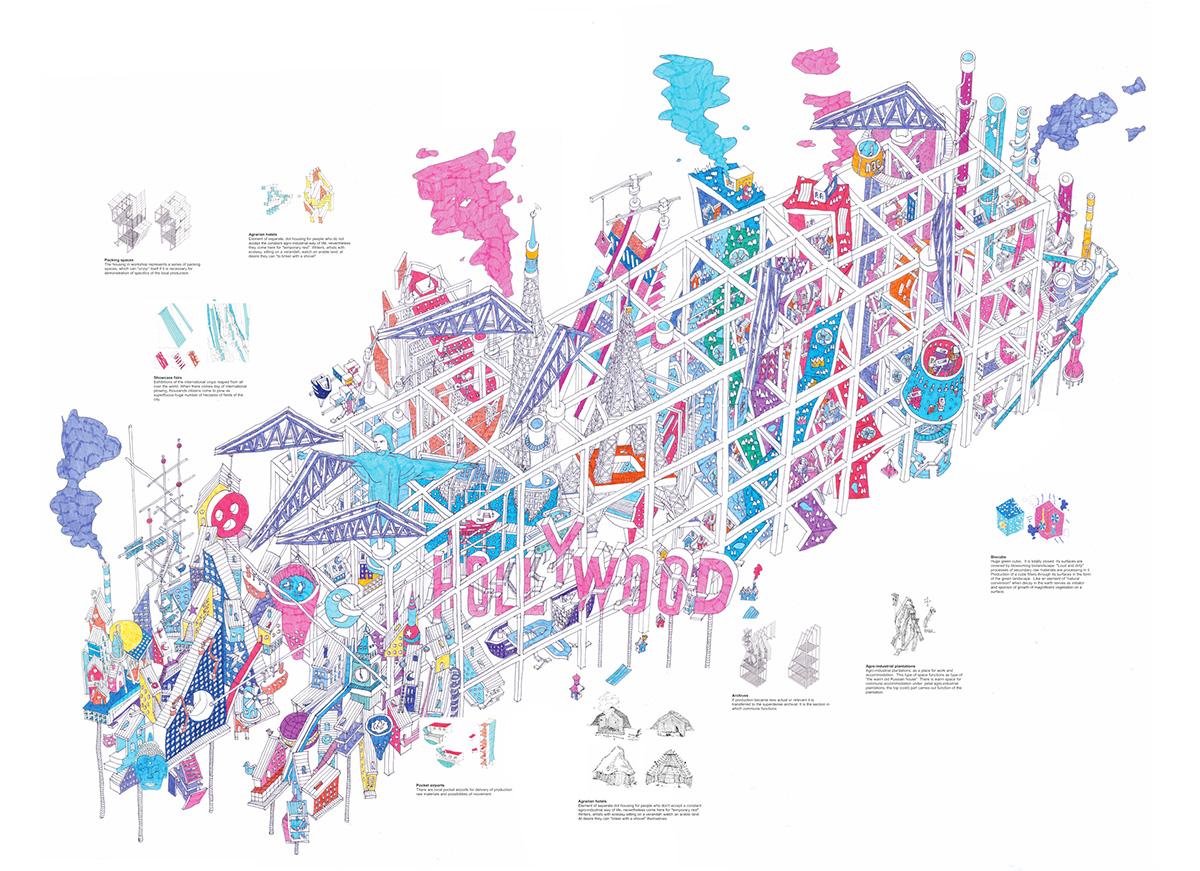
For the last few years mankind has accumulated more knowledge than in all its previous history. This factor enables us to say that in the next few decades there will be fundamental breakthroughs in science and engineering which will result in changing society and the architectural design of cities. The degree of its influence could be compared to the age of Great Geographical discoveries. A complex space structure of the future megapolis combines the physical and digital worlds. Spaces of these digital areas have a large number of physical and mechanical laws alien to real space. An ability to fly over or move from one planet to another one, to pass through the walls during system bugs makes the city more complicated. Cyberspace full of hallucination and bugs, components of its own habitat has moved into a real megapolis which is being formed and organized simultaneously in the digital and physical space. “Tomorrow” we expect a completely different topography of the city. It will be a map which includes cyber worlds with intrinsic geography, laws of physics, qualities and even its own residents. It is as though landscapes of computer games have woven into the city space becoming its integral part.

The spatial structure of a skyscraper is also flexible and mobile. All complex is formed round frame structure on which cranes move, completing and moving whole blocks of a complex. The part of frame structure can be sorted at once after completion of the region of a housing estate or intentionally to remain invested with a framework for potential possibility of further transformation and change in the future. The whole completed regions of a housing estate can move to the separate sector that “not to disturb” and “not to constrain” further building or to be interspersed directly in frame structure for transformation of a program palette or its intended consolidation.

Huge ships that at once become part of this block of the skyscraper, its organic communication and spatial cell. Its decks are temporary squares of the city, and construction woods of its street. On them inhabitants move. Having sated, the ship “sails” in the next swimming, and on arrival in the new port city, not become dusty indefinitely in megalopolis port, and joins new structure, as the spatial block. Main decks of the ships are covered with numerous weaving installations, reaching top level immigrant-workers start weaving goods for the city. Other ships serve as suppliers of a material for housing that is constructed here. It is a new format of the city street, new public space in a superdense and dynamic urban environment.

The residential area of the skyscraper represents constantly growing and developing spatial complex. Series of frame and spatial elements that are printed by 3D printer or by drone construction, carry out a role of structures for the subsequent local consolidation and change. The central axis of a complex that unites a series of the inhabited quarters, comprises a monorail on which moves the printer which is printing out, and in some cases erasing spatial structures. In this extended communication the intra quarter train settled down that with a huge speed moves citizens from one part of the city to another. Technologies became so safe and exact that are interfaced with everyday life of citizens. For example, if in a family got a child, it can order the press of new room, having expanded the living area. While the room is printed, it grows roots residents, and everyday life flows the turn. Way of life on a building site. Read the rest of this entry »

2015, competition

Limestone Skyscrapers

By: admin | March - 26 - 2015

Honorable Mention
2015 Skyscraper Competition

Jethro Koi Lik Wai, Quah Zheng Wei
Malaysia

Limestone hills that are mined are doomed to suffer total annihilation, or become remnance of a souless terrain. This design approach seeks to intervene the process of mining, turning it into a mere “site clearance and earthwork” phase to allow buildings to be erected within, adapting to the sophisticated and ever so beautiful terrain of the karsk topography. These towering natural monuments withstood the tests of time, until humans begin to mine their substances. Mining of these substances not only creates an eye sore, it also increases calamities such as flash floods and landslides. Therefore, it is vital that proper treatment has to be applied upon mining of the natural resources.

Limestone materials have numerous uses: mainly as building materials, as aggregate for the base of roads, as white pigment or filler in products such as toothpaste or paints, and as a chemical feedstock. This in turn, creates a building within a mountain, harnessing the natural resources of existing stones and minerals on site to be used as the construction materials eg. marble, travertine.

The Architecture serves as a compliment to the monolithic beauty in its original state, bringing a different life and purpose to the mining hill sites. Read the rest of this entry »

2015, competition

Tower of Refuge

By: admin | March - 26 - 2015

Honorable Mention
2015 Skyscraper Competition

Qidan Chen
China

Because of facing threat from alternation of the natural growth pattern, deterioration of the global environment and excessive harvesting of the living creatures, more and more species of animals and plants are now endangered on the Earth. How to maintain species diversity has become a crucial issue.

Endless reports of deforestation, city sandstorms, unpredictable death of elephants and brutal hunting of whales keep coming into the public eyes, while human beings are focusing on constructing their survival fortress and exploring potential habitat outer space. However, could we slow down the pace and ensure our future generations could have the same experience about this blue planet, and even the blue sky before industrial era?

Before rehabilitating successfully the livable environment and climate, or finding out artificial reproduction methods of all species, human have to build up a Noah’s ark, which guarantees the provision of three elements of life: sunlight, ] air and water. Meanwhile, enough soil and food are essential for growth and reproduction.

According to the IUCN Red List of Threatened Species, species are classified into nine groups: extinct, extinct in the wild, critically endangered, endangered, vulnerable, near threatened, least concern, data deficient, not evaluated.

Based on these basic concepts, scheme about Tower of Refuge has come out. Tower as a huge refuge, likes a self-operating machine serving all survival conditions. It can obtain and filter water and air, reallocate sunlight and transform solar energy for tower using. Read the rest of this entry »

2015, competition

Air Monument: Atmosphere Database

By: admin | March - 26 - 2015

Honorable Mention
2015 Skyscraper Competition

Shi Yuqing, Hu Yifei, Zhang Juntong, Sheng Zifeng, He Yanan
China
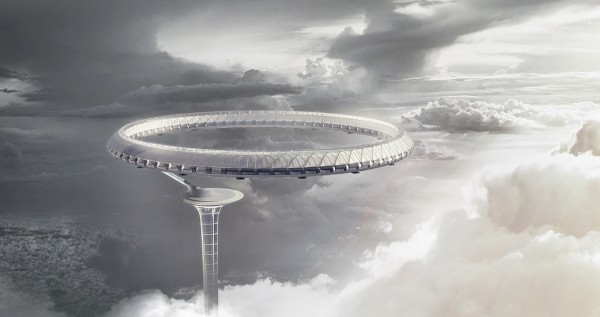
Nowadays, there is growing problem in global climate. Studies on atmosphere components provide possibilities for people to learn the law of climate changing. However, detected datum don’t include all the components of the atmosphere. We hope in this memorial building, it can get atmosphere samples automatically every year, and store the samples with reasonable system.

With time passing, the building will become a library to study atmosphere components changing with the most resources. In the meantime, future techniques will allow more thoroughly studying atmosphere, providing better ways to respond to climate change.

Background

1. Atmosphere components study

Since the industrial revolution, with more fuel use, more biomass burning, more motor vehicle exhaust, the concentration and distribution of both regional and global atmosphere have changed observably. And that leads to problems like global warming, ozone depletion, acid deposition, air quality going down and so on, which have much effect on earth environment and ecosystems, and put huge threat to human development. Therefore, the observation and study of atmosphere components is quite important. Carrying on long-term steady observation of atmosphere components and its relevant qualities is essential for learning atmosphere components and its changing process. Such based studies on atmosphere components changing law, and responding to climate change and disasters, is one of the essential issues of achieving the unity of man and nature both nowadays and in the future.

2. Air samples are more important than datum

It’s not enough for studies on atmosphere components to only rely on clearly recording and studying datum. Earth atmosphere components are really complex, including solidities, fluids, and gas, with complicated physicochemical properties. There are limited datum from detecting existing air samples. And there is possibility that some unknown substances make much difference during climate changing process but could not be detected for now. Therefore, air samples are the most comprehensive data resources. Today’s scientific researches often need early air samples. Nowadays these samples usually come from polar deposits. Although these samples are precious few and hard to define a particular year, they still help scientists study greenhouse gas concentration changes for the past 200 years. Modern advanced techniques also helped discover atmosphere component like hydro fluorocarbon, which were not paid attention to before.

3. Caution of scientific management should be called to the public

Human behaviors have large impacts on atmosphere components and global climate change. There were many serious air pollution events all around the world in history, such as Meuse River Valley smog event in Belgium in 1930, which has caused 63 deaths. And in 1952, the photochemical smog in London has cause 4000 people to death within four days. In recent decades, there is constant drought, flood, high temperature, rainstorm and sand storm happening, which is closely related to atmosphere components changes due to human activities. In the 21st century, even if governments and scientific institutes have shown growing concern on environmental problems, without public consciousness of protecting the environment, it’s still not so optimistic of improving atmosphere pollution. There is reason that scientific approaches of improving the environment is too far away from everyday life. Thus, to show scientific work to the public in a better way, is essential to alarm them. Read the rest of this entry »

2015, competition
Page 12 of 15« First«...89101112131415»
  • Skyscraper Competition

    • 2025 Skyscraper Competition
  • BUY EBOOKS ON GOOGLE

    • EVOLO SKSYCRAPERS 3
  • BUY EBOOKS ON APPLE

    • EVOLO SKYSCRAPERS
  • Retractable Fountain Pen

    • RETRACTABLE FOUNTAIN PEN
  • Follow On Instagram

    • Instagram
  • Competition Sponsors

    • Archinect
    • architecture.competitions.yearbook
    • bustler
    • competitions.archi
    • e-architect
    • Skyscrapercity
    • YoungBirdPlan
  • Subscribe to Newsletter

© 2006-2021 This work is licensed under a Creative Commons License permitting non-commercial sharing with attribution. eVolo is a trademark of EVOLO, INC. in the United States and other countries.

Webdesign by: SOFTlab
Header Image