Header Image
  • Home
  • news
  • magazine
  • competition
  • About
  • Shop
  • Jobs
  • News
  • architecture
  • design
  • art

BIG Wins Competition to Design Greenland’s New National Gallery

By: admin | February - 10 - 2011

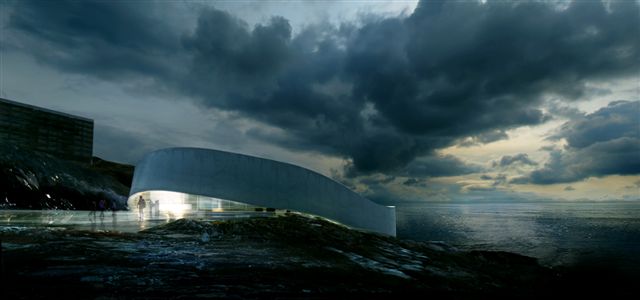
BIG + TNT Nuuk + Ramboll Nuuk + Arkitekti is the winning team to design the new National Gallery of Greenland in the country’s capital Nuuk, among invited proposals totaling 6 Nordic architects.

Located on a steep slope overlooking the most beautiful of Greenland’s fjords, the 3000 m2 National Gallery will serve as a cultural and architectural icon for the people of Greenland. The new museum will combine historical and contemporary art of the country in one dynamic institution The winning proposal was selected by a unanimous museum board among 6 proposals, including Norwegian Snøhetta, Finnish Heikkinen‐Komonen, Islandic Studio Granda and Greenlandic Tegnestuen Nuuk.

“The Board has a clear vision: to work for the establishment of an internationally oriented highly professional institution that communicates the continuous project of documenting and developing the Greenlandic national identity through art and culture. Our dream is a national gallery where historic and contemporary art meets circumpolar pieces, Nordic and world art in general. Our dream is an institution that stimulates our curiosity, awake our excitement with its thought‐provoking design and where we all feel at home. Selecting a prominent architect as BIG, I am sure that our chances of realizing that dream are good”, Tuusi Josef Motzfeldt, Greenland’s National Gallery of Art.

As a projection of a geometrically perfect circle on to the steep slope, the new gallery is conceived as a courtyard building that combines a pure geometrical layout with a sensitive adaption to the landscape. The three‐dimensional imprint of the landscape creates a protective ring around the museum’s focal point, the sculpture garden where visitors, personnel, exhibition merge with culture and nature, inside and outside. Read the rest of this entry »
architecture, featured, news

Golf and SPA Concept Villas in Dubrovnik, Croatia / Zaha Hadid

By: admin | February - 9 - 2011

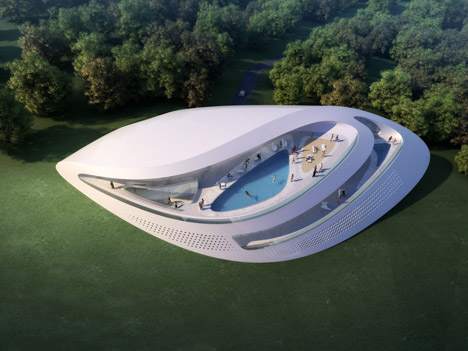
The brief called for the design of two prototype Villas for a new Golf and Spa Resort in Croatia overlooking the old town of Dubrovnik. The total development comprises 400 villas, two 5* hotels, luxury apartments, retail facilities, a spa and an 18 hole golf course including a golf resort club house. A recently developed master plan determines the perimeter and size of the parcels, which range from 12,000m2 to 20,000m2. The site of the prototype villas is located at the edge of the plateau with picturesque views. The prototype villas shall define the overall architectural design of the resort.

The area of development is located north of Dubrovnik, a Unesco World Heritage Site. The land comprises 430 hectare and is located on a high plateau approximately 300m to 400m above sea level, north of the old town of Dubrovnik. At the southern edge of the project site, the terrain slopes steeply towards the sea. The terrain also slightly slopes from west to east. The elevated level of the site allows for magnificent views in all directions. Towards south the owner will enjoy sea views and views of the old town of Dubrovnik. In north direction one can enjoy picturesque mountain and landscape views. Zaha Hadid Architects architectural proposal is a distinct and unique structure with a strong sense of identity and character. It has a highly expressive, sculptural quality, infused with a sense of light and space. Light and views are the driving forces of the house. The design is inspired by the Croatian karst topography. Read the rest of this entry »

architecture, featured, news

Zundel and Cristea’s Urban Farms

By: Dennis Lynch | February - 9 - 2011

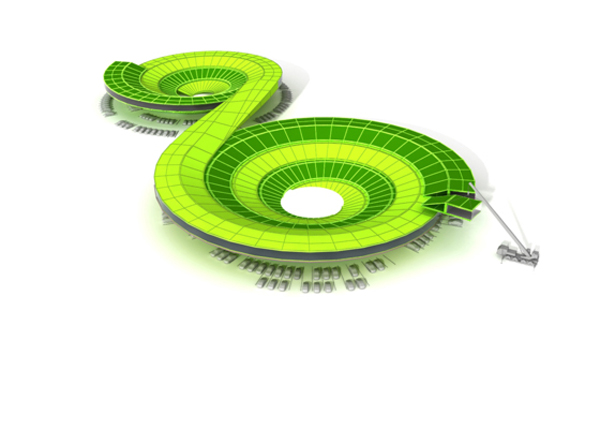
Urban food production is not a new concept. We’ve seen countless designs here on eVolo for vertical farms, urban ecosystems, and arcologies, but French firm Zundel and Cristea has taken the urban farm concept in an entirely different direction. Instead of proposing a monumental project like a vertical farm, they put together a design for smaller urban farm centers planted throughout a city.

The centers are designed to grow food, process it, and some to even serve it in on site restaurants. On the inside bowls of the spiraling structures is the green space where various types of food and greenery is grown. Visitors and urban farmers would go out to the spirals to harvest and enjoy the green space. Food would then be taken into the superstructure and processed where it could be served or packaged and brought to market.

The small scale of each of the double spiral structures allow for Zundel and Cristea’s urban farms to be regional centers for the districts they individually serve, a sort of park and bazaar in one. Placing them in urban landscapes also reduces the green house emissions that would normally be needed to transport produce from rural farms to city centers. Centers would be topped with wind turbines as well, to create an energy sustainable landmark that is economically, socially, and agriculturally productive. Read the rest of this entry »
architecture, featured, news

Artificial Matters: New Sensations through Texture, Geometry, Coloration, and Finish

By: admin | February - 9 - 2011

Rather than taking the “true” or literal approach to materials, this project designed by Dave Bantz and Michael Gross attempts to adopt techniques mastered by artists and apply them at an architectural scale. Material in art is used as a representational device for effects and a gateway to sensation. The”Artificial Matters” studio, run by SCI-arc professor Elena Manferdini, aims to provoke new sensations through texture, geometry, coloration, and finish. The studio began by 3D scanning literal materials (in this case a sliced peach) and modifying the raw data to produce a synthetic material with the potential to create new sensations. Read the rest of this entry »
architecture, featured, news

A cactus sprouts as a new office tower in Qatar

By: Danielle Del Sol | February - 9 - 2011

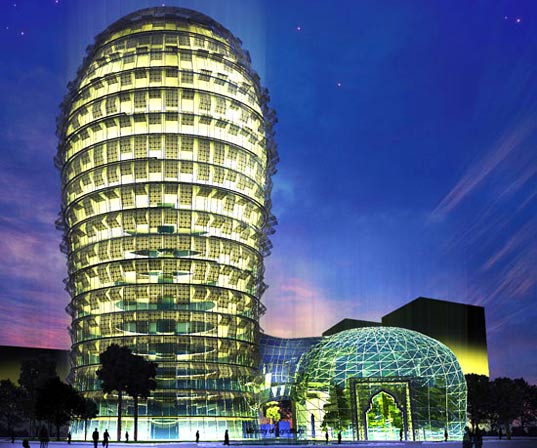
The new office for the Qatar Minister of Municipal Affairs & Agriculture (MMAA) is one that speaks creatively and directly to the location and the office’s subject matter: it’s shaped like a giant cactus.

Bangkok firm Aesthetics Architecture has designed a modern, glass succulent for the MMAA, using the cactus as design inspiration both in how the building looks and functions. Qatar is a scorching desert country that averages only 3.2 inches of rainfall per year; as such, buildings could potentially waste enormous amounts of energy in attempts to cool the people inside. While any building in Qatar has its work cut out for it in terms of keeping cool, energy efficient elements in the design of the MMAA building, such as moveable sun shades that will adjust to respond to the sun’s strength, will aid the building in that task. The dome attached to the main cactus form will also bring an environmental offering, in the form of a botanical green house. Read the rest of this entry »
architecture, featured, news

Egg-shaped office building in Mumbai blends natural shape with innovative technology

By: Danielle Del Sol | February - 9 - 2011

Here’s another entry in the “architecture as a natural but inanimate object” category: The new “Cybertecture Egg” has been designed as a poultry-inspired office building for Mumbai, India.

The 32,000 square meter building was designed by James Law Cybertecture International, a firm based in Hong Kong, UAE and India that has coined the term “cybertecture” to mean a meeting of architecture, technology and innovative engineering to sculpt the urban environment. One way in which the firm has used technology in a new way for the design of the Egg is by electronically monitoring workers’ health: vital signs and statistics such as blood pressure are accessible to workers electronically in restrooms, and the stats can be signaled to doctors if deemed necessary.

The building’s design attempts to decrease energy demands through passive solar design, the construction of an elevated garden to help cool the building (through a process called thermolysis), the implementation of photovoltaic panels and wind turbines on the roof, and infrastructure to recycle gray water for landscaping. Read the rest of this entry »

architecture, featured, news

Interactive Parametrics Workshop / modeLab

By: admin | February - 8 - 2011


AetherSCS.02 - Alan Tansey


Studio Mode/modeLab is pleased to announce the fourth installment of the coLab workshop series: Interactive Parametrics – a two-day processing workshop (with an optional third day) focusing on dynamic sketches and prototyping. The workshop will be held in New York City during the weekend of February 19, 2011.

The paradigm of scripting within ubiquitous modeling platforms such as Rhino or Maya allows users to generate complex form by accessing an underlying geometry engine and performing iterative functions. This paradigm is typically based on run-once execution, making it unsuitable for designing interactive or time-based behaviors. By implementing workflows that utilize Processing to create real-time software sketches, we can design dynamic systems that can act as standalone tools for parametric design, input mechanisms to feed other platforms, or processors of existing or sensor-based data sets. Read the rest of this entry »
architecture, art, design, featured, news

Library of Birmingham, England / Mecanoo

By: Dennis Lynch | February - 8 - 2011

Mecanoo designed the Library of Birmingham, England with the goal of solidifying Centenary Square as a center for arts, culture, and entertainment. The quite loud design and edutainment intentions of the Library has garnered it the name “super library” by the press.

The library is better described as a cultural center than simply a library. It will attach to the Repertory Theatre next door and share a box office and reception desk as well as shared programs and events. The Repertory Theatre will run shows in the 600 person theatre inside the Library. The Library will also feature a unique outdoor amphitheatre for performances that is sunk into the ground and attached on an underground level to the main structure.

To pay tribute to the industrial artisan history of Birmingham, Mecanoo added the ornamental circle/star shaped design that adorns each exterior wall. The façade masks an interior designed around eight cylindrical rotundas that house various collections and let in natural light. To engage visitors to the surrounding Centenary Square, Mecanoo added a cantilevered balcony to overhang the square. Read the rest of this entry »
architecture, featured, news

Patkau’s Fallingwater Cottages

By: Dennis Lynch | February - 8 - 2011

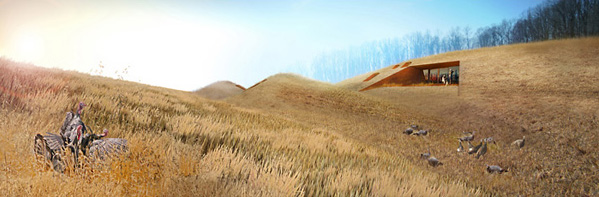
Recently picked as the winning design for an addition to the Fallingwater grounds, Patkau’s design implements a bold design with striking subtlety to create a serene community of cottages sunk into the Pennsylvania hills. The award was the first ever to be given out by Fallingwater for new construction on the grounds.

The design for the cottages explore the synergy of environment and architecture so well realized by Frank Lloyd Wright in the Fallingwater house 75 years ago. The Patkau cottages take Wright’s design principles to the 21st century and shed all conventionalism both inside and out. Non-angular interior walls create a comforting cocoon space within the hills and the choice of bare wood visually blurs the line between the interior and the rolling hills the cottages are set in and around. Outside, the cottages nearly disappear in the hills, engaging guests with the surrounding hills. The cottages are laid out in a proximity that encourages interaction between guests yet still respects privacy.

Patkau designed the cottages to be sustainable as well, further solidifying the unification between the built and nature. The built-in-hill design embraces the energy saving benefits of the natural heat retaining qualities of earth and all incorporate kitchen and grey water recycling. Read the rest of this entry »

architecture, featured, news

The Boston Arcology / Schopfer Associates

By: Dennis Lynch | February - 8 - 2011

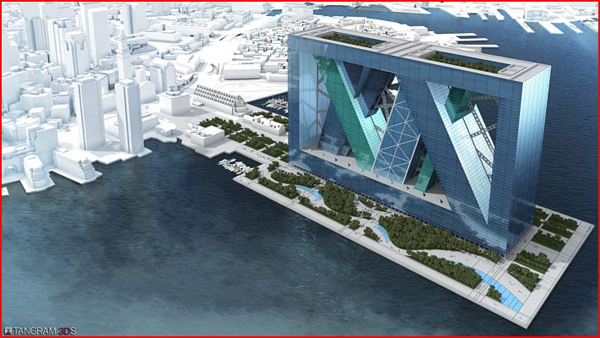
The Boston Arcology is a proposal by Schopfer Associates that seeks to “create a visionary and iconic structure predicated on this principle of Arcology…”. The BOA as it is referred to by its designers is a more realistic take on the concept of arcology design that they claim is entirely realistic with the techniques of today.

The BOA was designed to answer a number of concerns that coastal cities like Boston will be facing over the next 50 years. Schopfer took environmental change in particular as a major design platform and designed the BOA to “float” in a 105ft retaining pool that it would be housed in, in which water from Boston Harbor would freely flow. The buoyant element is made out of all things, concrete.

The BOA, like many other arcology models is modeled as a re-concentration of urban development away from the urban sprawl that has characterized metropolitan growth over the last 60 years. It has the residential capacity to house 15,000 occupants between hotels, offices, retail, museums, condos and a new city hall. Schopfer drew inspiration from Boston’s modern and postmodern built environment for architectural inspiration and incorporated the styles into the contemporary design of the BOA. Read the rest of this entry »

architecture, featured, news
Page 193 of 250« First«...190191192193194195196197...»Last »
  • Skyscraper Competition

    • 2025 Skyscraper Competition
  • BUY EBOOKS ON GOOGLE

    • EVOLO SKSYCRAPERS 3
  • BUY EBOOKS ON APPLE

    • EVOLO SKYSCRAPERS
  • Retractable Fountain Pen

    • RETRACTABLE FOUNTAIN PEN
  • Follow On Instagram

    • Instagram
  • Competition Sponsors

    • Archinect
    • architecture.competitions.yearbook
    • bustler
    • competitions.archi
    • e-architect
    • Skyscrapercity
    • YoungBirdPlan
  • Subscribe to Newsletter

© 2006-2021 This work is licensed under a Creative Commons License permitting non-commercial sharing with attribution. eVolo is a trademark of EVOLO, INC. in the United States and other countries.

Webdesign by: SOFTlab
Header Image