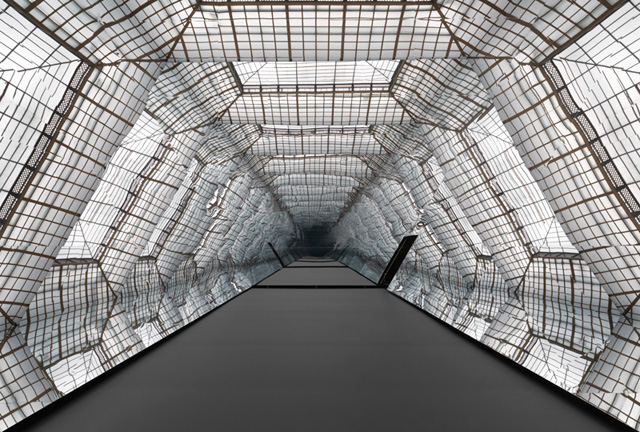

New York City’s Watershed is in crisis. Not only is there a larger demand for water due to the growth of the population, but due to further suburban development in upland areas, water catchment sites are not as hygienic as before. Within the Croton Watershed lies Carmel, a suburban town in Putnam County with large basins for water catchment integrated into a developed suburban community. The distributed system currently in place for the dispersal of sewage, though, has a very high risk of contaminating the watershed.
Based on a topological study using sand and cavities to represent the density and area of groundwater contamination risk, a landscape was generated by Carla Lores and Michael Yarisnky. The areas that are highest upland have the highest ground water capacity and lowest contamination risk, and the areas downland have the lowest capacity and highest risk. This relationship is key to the remediation strategy, by creating a topography that channels effluent water to these specific sites. The exo-landscape is then populated with components that not only allow the material flow relationship but can also be modulated to allow for varying lighting conditions and the ability to contain soil and plants. This passive system is then activated by integrated pumps that draw sewage to biogas processing sites. Read the rest of this entry »