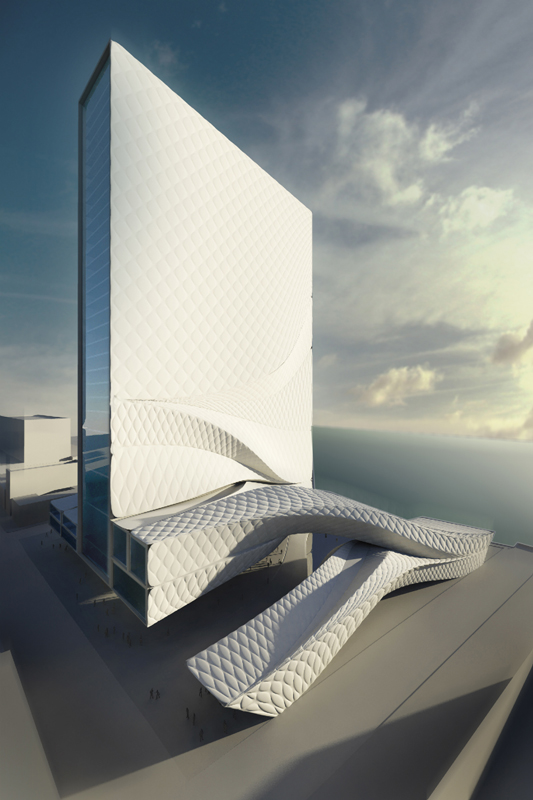
‘Gator Boots’ was designed by Dominic Peternel and Stephen Coorlas in Paul Preissner’s studio “High Contrast” at the University of Illinois-Chicago spring semester 2010. The studio focused its efforts on blending shape and form in order to create a newly identifiable visual type and also looked to rearrange visual expectations resulting in the growth and creation of new audiences.

Transitions and uniformities are explored in this characterized architecture. ‘Gator Boots’ strives to achieve the perfect blend of typical building-shape and atypical geometric-form. These gestures respond to sequenced interior programming, which follow a Ground/Public/Extend versus Vertical/Private/Contract format. A uniform façade pattern was used to envelop its morphing and contrastive personalities. Read the rest of this entry »

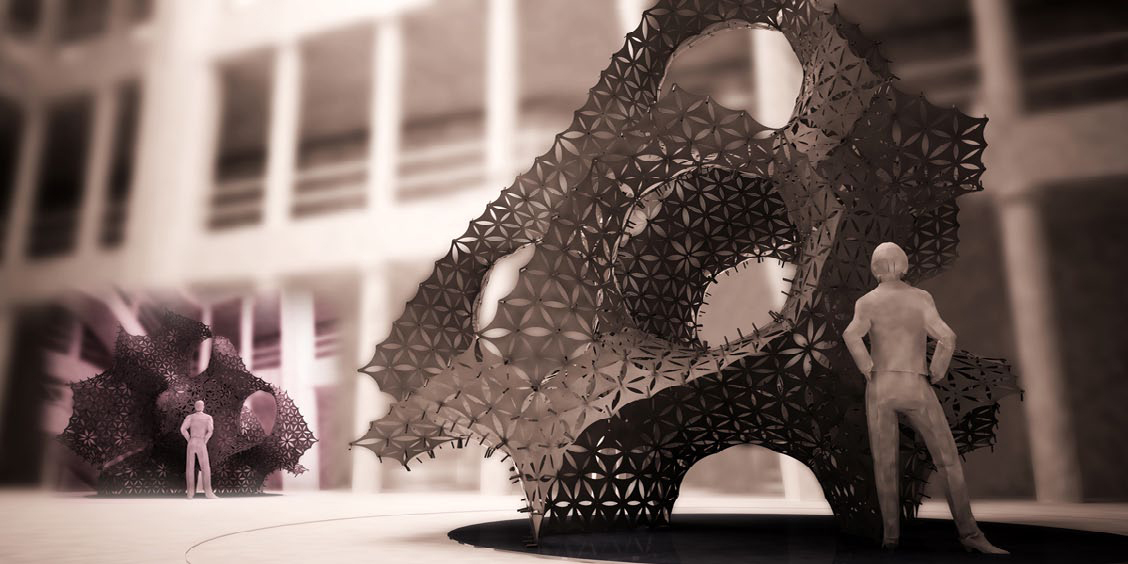
Romanian architect Vlad Tenu was  awarded the first price in the Tex-Fab Repeat Competition for his project ‘Minimal Complexity’ which along with its aesthetic beauty, technical superiority and elegance of detailing, the proposal was chosen because it employs structural robustness, material efficiency and an inherent logic of assembly. A minimal periodic surface structure is created with the repetition of only 16 different components. A macro-scaled modular cellular pattern emerges through symmetry that is infinitely expandable and open-ended while becoming differentiated at its edges. Ornament functions as a simultaneous expression of the whole and the part working in dynamic equilibrium. Read the rest of this entry »

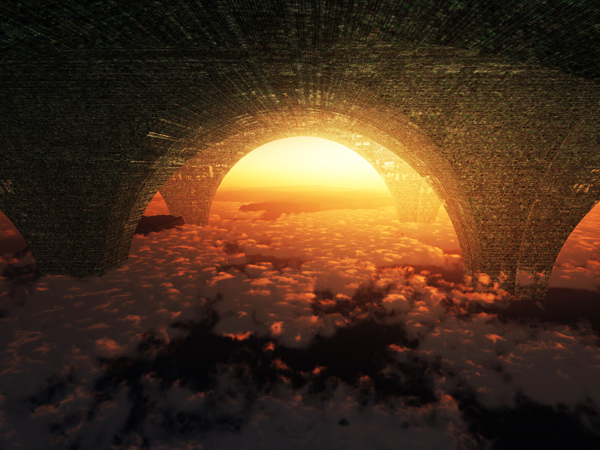
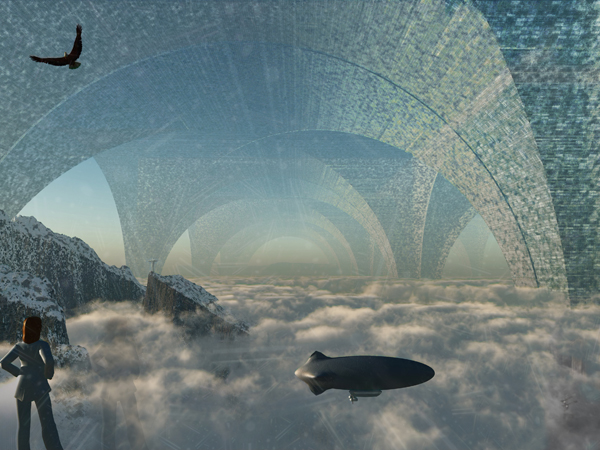
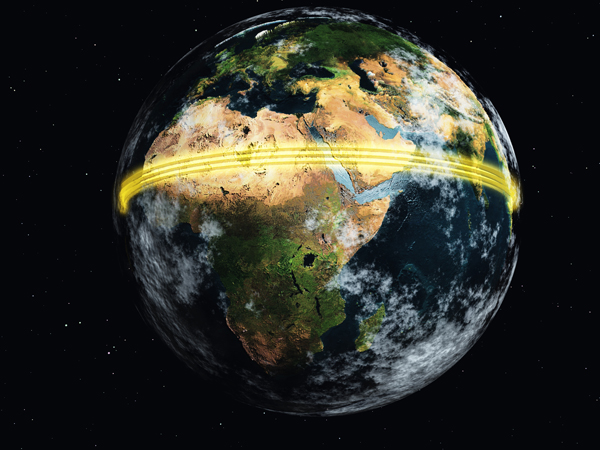
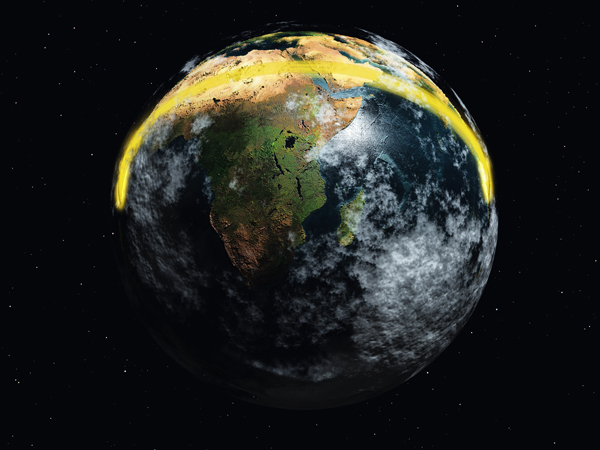
Geotectura Studio unveiled a proposal for a futuristic city comprised of multiple green belts around the equator which could hold the entire human population in a democratic, social, and self-sufficient manner. A series of high-scale arches are developed as sustainable mega-structures in which the whole roof will be a gigantic solar and wind generator with photovoltaic cells and wind turbines. The inhabitants will be able to cross the world in just 5 days with green public transportation while layers of dwelling, agriculture, industries, and recreational areas will be contained inside the “cloud”.

Skidmore, Owings and Merrill (SOM), the New York-based architectural firm, has recently completed The Park Hotel Hyderabad, the flagship hotel for The Park Hotel Group. This 531,550-square-foot, 270-room hotel infuses a modern, sustainable design with the local craft traditions, and is influenced by the region’s reputation as a center for the design and production of gemstones and textiles.

Roger Duffy, SOM’s Partner in Charge of the project, says, “This building signals our commitment to creating a design that simultaneously felt at home among the exuberant vernacular architecture of Hyderabad, while simultaneously incorporating the latest sustainable strategies and technologies.”

The project is distinctive for its profound implementation of sustainable design strategies, with special attention paid to the building’s relationship to its site, daylighting and views. Solar studies influenced the site orientation and building massing, with program spaces concentrated in the north and south facades, and service circulation on the west to reduce heat gain. The hotel rooms are raised to allow more expansive views, situated on top of a podium comprised of retail spaces, art galleries, and banquet halls open to guests and visitors. Read the rest of this entry »

The winners of the TEX-FAB Repeat Digital Fabrication Competition has been announced. The jury consisting of Patrik Schumacher, Marc Fornes, Lisa Iwamoto, Chris Lasch,  and Blair Satterfield decided that the winning project that will be built for the TEX-FAB Event in Houston in February 2011 was “Minimal Complexity” designed by Vlad Tenu. The Jury selected 1 Winner, 4 Runners-Up and 7 Honorable Mentions which will be exhibited along  the winner.

Minimal Complexity – Winner
Vlad Tenu

Along with its aesthetic beauty, technical superiority and elegance of detailing, the proposal was chosen because it employs structural robustness, material efficiency and an inherent logic of assembly.  A minimal periodic surface structure is created with the repetition of only 16 different components.  A macro-scaled modular cellular pattern emerges through symmetry that is infinitely expandable and open-ended while becoming differentiated at its edges.  Ornament functions as a simultaneous expression of the whole and the part working in dynamic equilibrium. Read the rest of this entry »

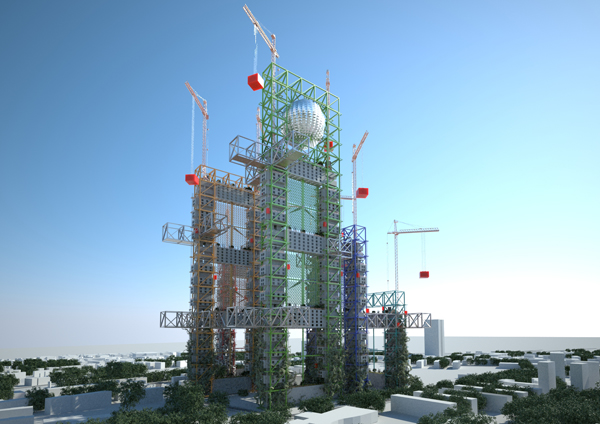
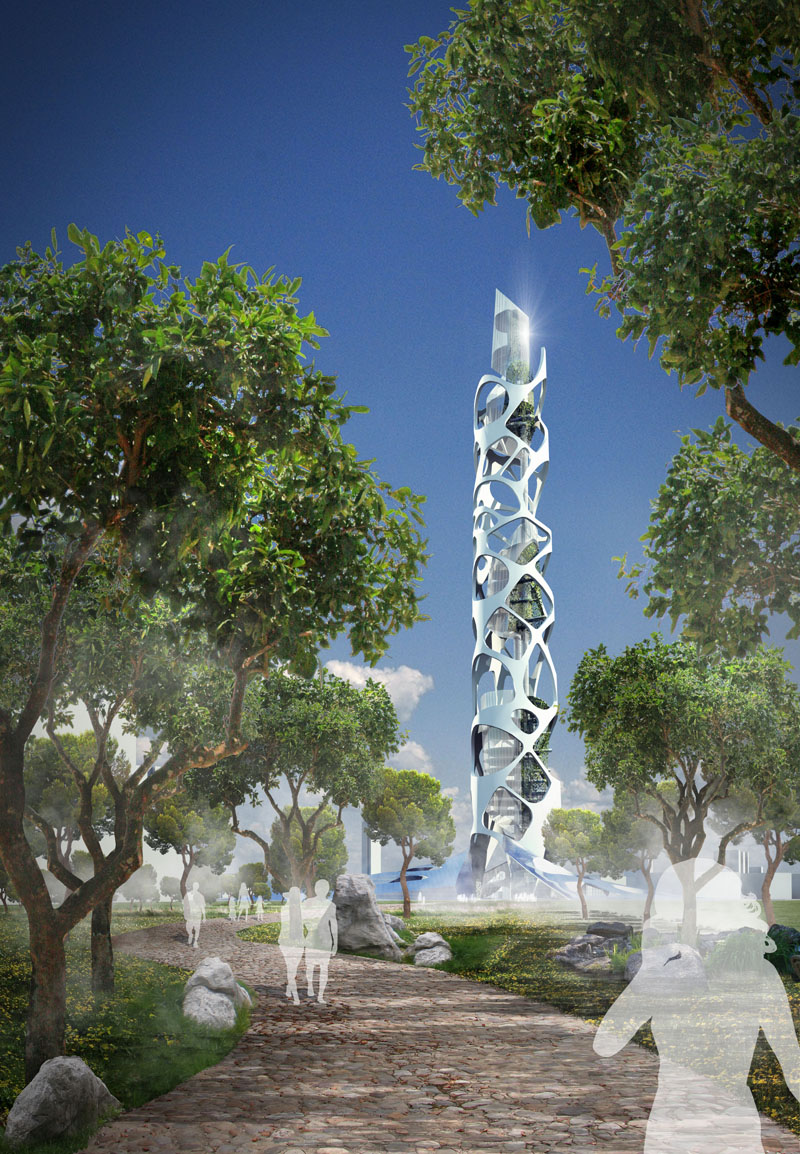
The flexible character of Additional Hope’s plan is based on the use of original neighborhood’s building blocks, which determine the buildings’ orientation and demarcate the green spaces around them. This prototype project defines the towers as additions to existing buildings in any city around the world. The gigantic frames created by the buildings will contain sun sails, various-sized wind turbines, dew traps and a plethora of vegetation. In addition to framing the sea and the mountain, they will also harness natural elements — water, light and wind — in the service of man, while calling man’s attention to natural elements and raising awareness to ecological concerns.

The towers branch out into increasingly thinner beams, cranes that will never be dismantled and a dense net of numerous details. Each building’s weight is reduced without detracting from its overall strength. This is a model of continuity that appears in fractal forms which create living additions at every given moment. The ability of these skyscrapers to support various kinds of additions results in a flexible planning platform, which is oriented towards the future. Read the rest of this entry »

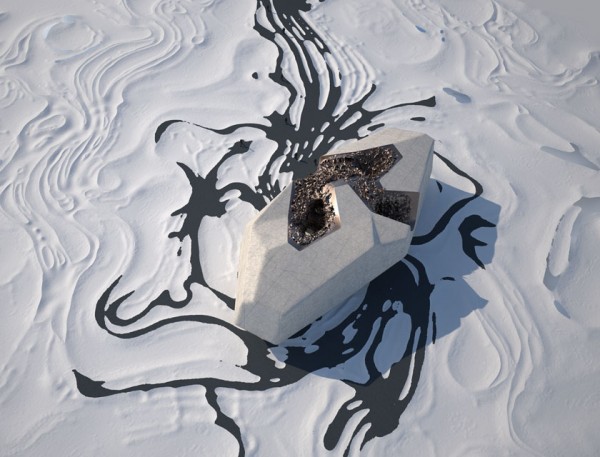
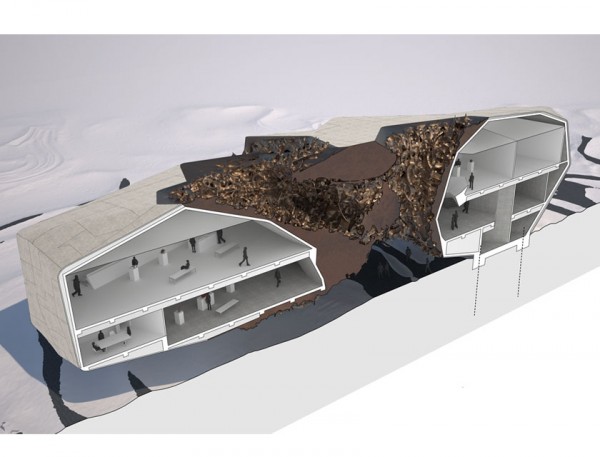
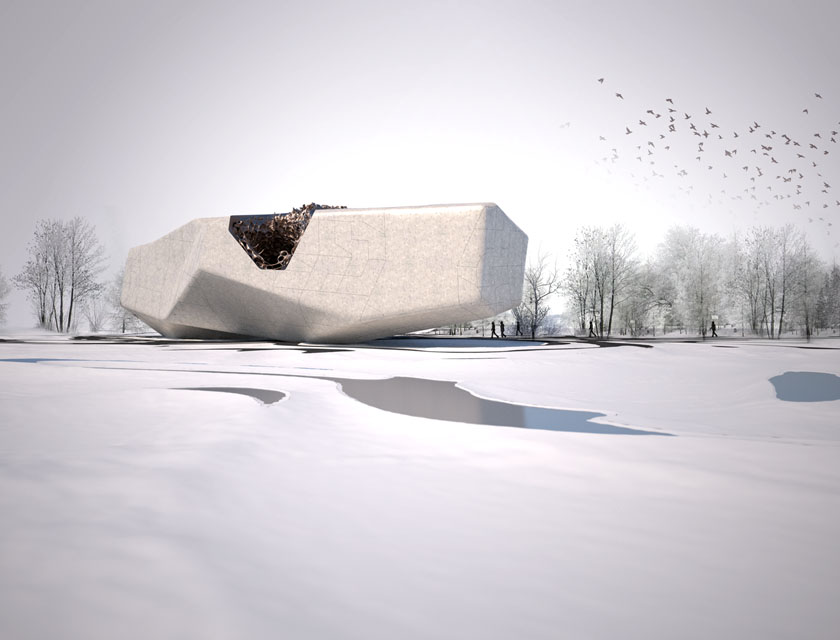
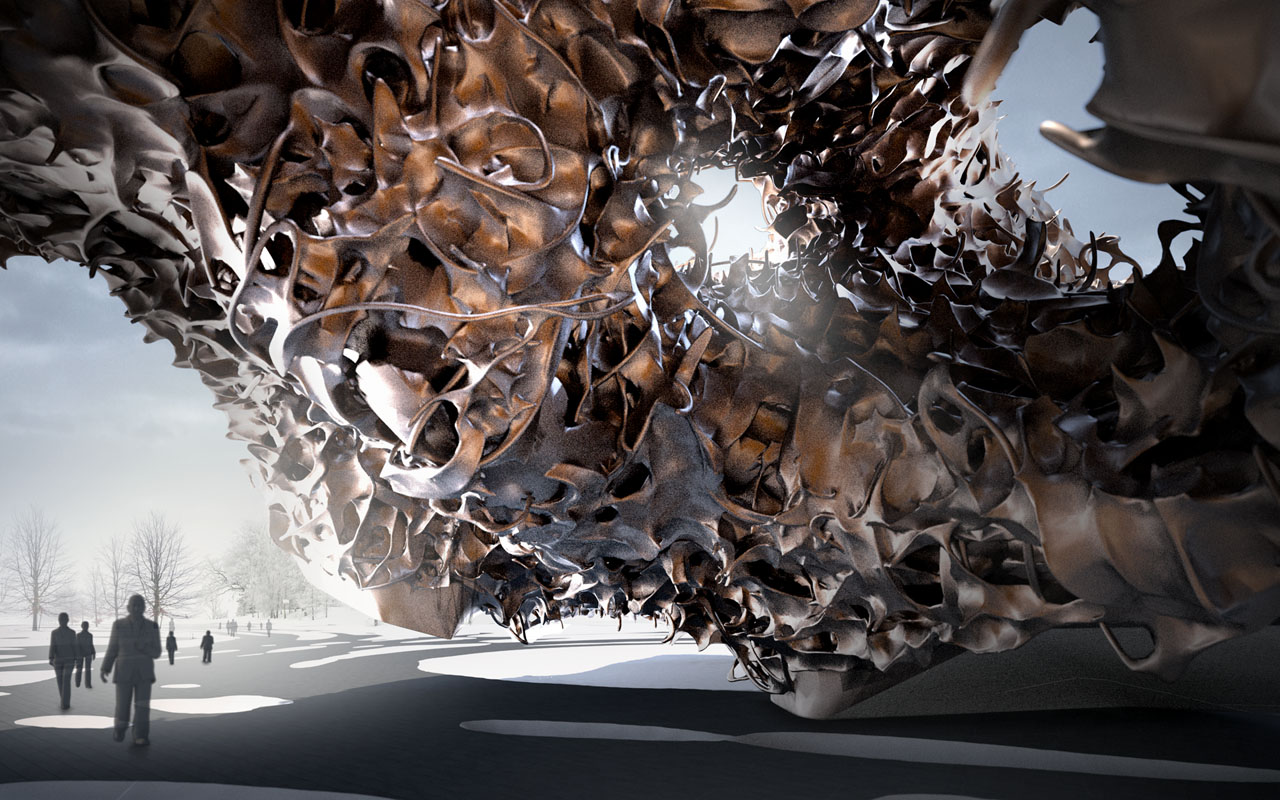
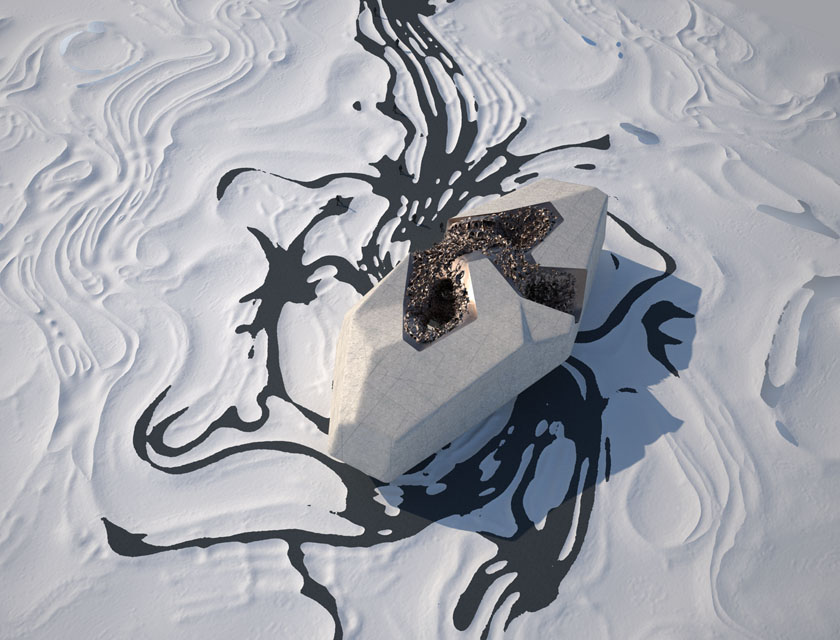
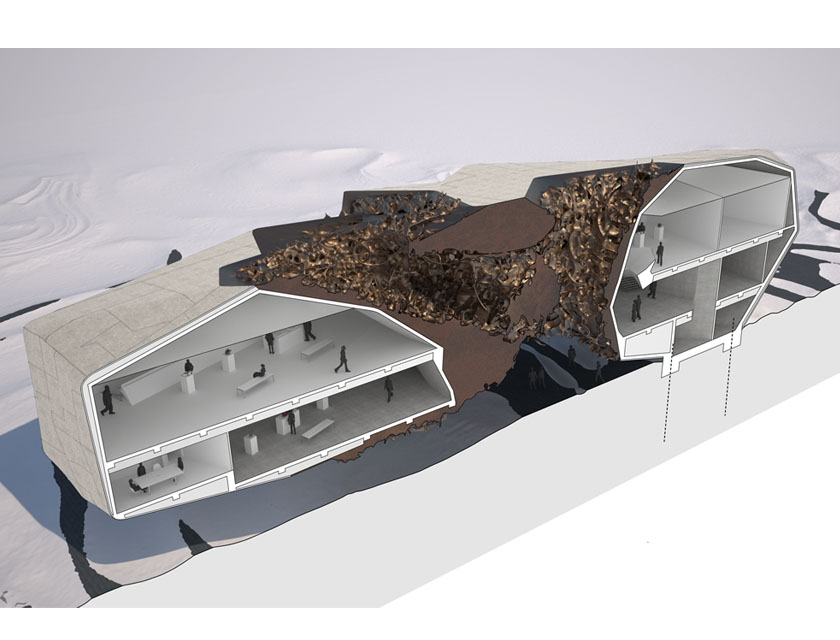
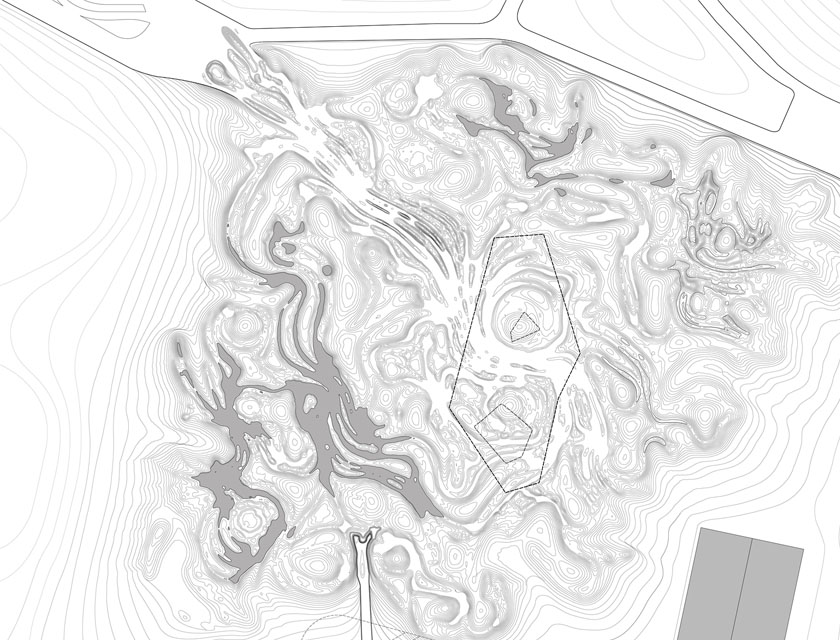
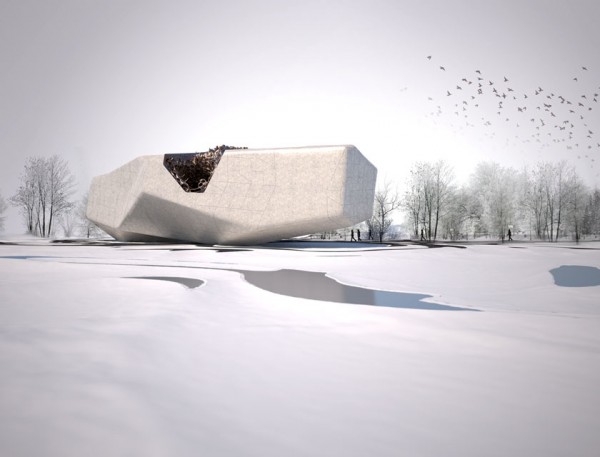
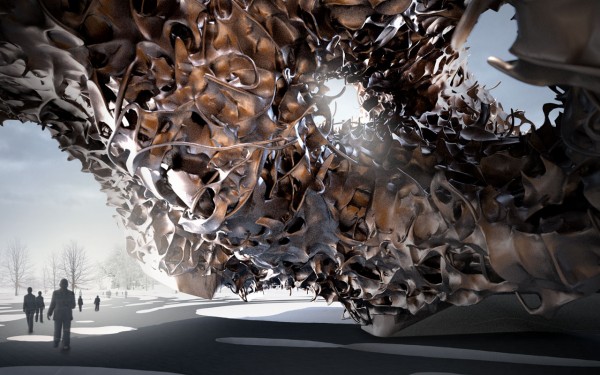
This project conceived by New York-based architectural firm Kokkugia reconsiders the monument as object, instead positing the formation of an immersive space of remembrance, a space that emerges from the landscape and is carved from within a somber stone monolith – an inverted monument. The project explores the emergence of a space, rich with intricate detail, reflecting the culmination of individual differences within a multitude.

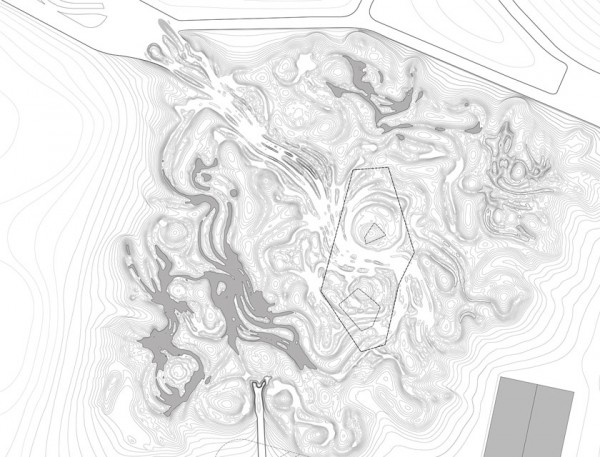
This project is part of Kokkugia’s ongoing research into Behavioral Design Methodologies. These methodologies operate through Multi-Agent algorithms to generate a landscape with a differentiated field of intensities that culminates in an intense aggregation – the inverted monument. The non-linear interaction of the agents navigate a field of varying charge, negotiating between their own swarm logic and a field of external influences.

The project is concerned both with the emergence of figure from a field as well as the dissolution of the figure into abstraction. The space of remembrance within the inverted monument is cast from bronze and generated through the interaction of agent-based components. At a local level the component has no base state, but instead adapts to its conditions. Consequently while local moments of periodicity may occur, its constant shifting of state triggered by local relationships resists a definitive reading of the component.

The component logic of this carved space is polyscalar: self-similar algorithmic agents operate across scales to form a continuous tectonic, where the legibility of discrete tectonic hierarchies diminish. Through this disintegration of hierarchy a new set of intensive affects emerge.

Design Director: Roland Snooks
Design Team: Casey Rehm, Fleet Hower, Bryant Netter
With a height of 368 meters (1,207 feet), Little’s submission for the Taiwan Tower International Design Competition symbolizes life, vibrancy and perpetual prosperity – cultural qualities indicative of the “Taiwan Spirit” and important to the people of Taichung as well as the visitors of this civic icon. The self-sustaining tower includes a history/cultural museum, offices for the Department of Urban Development of the Taichung City Government and a public observation/monitoring component that gives visitors a view of the city and local landscape.

Serving as a model for green building in the 21st century, the tower also serves as a metaphorical rain forest that offers life and revitalization to the local community and greater Taiwan. In addition to an exoskeleton that provides maximum stability to the structure, the tower incorporates three “floating mountains” that mimic the nearby Dadu mountain range. The “mountains” are linked by elements of vegetation and include habitable vertical rain forests and sky gardens that work toward cleansing the air of Taichung. A photovoltaic canopy that stretches up from the base of the building provides a place of human exploration and contributes vital energy to sustain this net zero development. Read the rest of this entry »

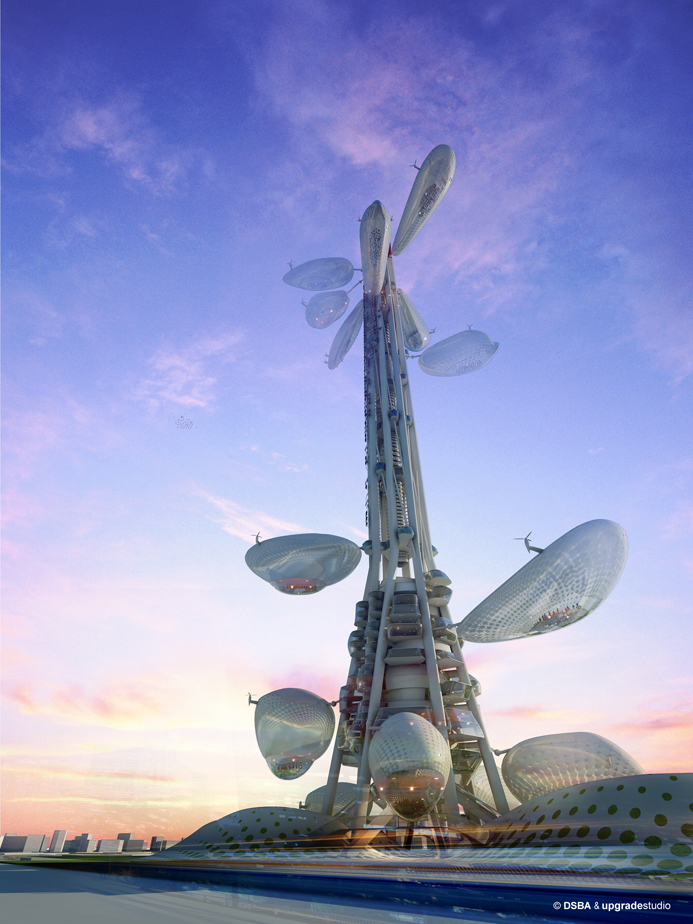
The Floating  Observatories proposal by Dorin Stefan’s DSBA, Mihai Carciun, and upgrade.studio wins the Taiwan Tower Conceptual International Competition

“Starting from the ‘geographical’ visual of Taiwan ‐ which is an island resembling a leaf ‐ we have developed the concept of the technological tree: we have designed 8 spatial leaves (with eight being a propitious number in the local culture) in the form of zeppelin‐like elevators which glide up and down the ‘tree trunk” and which serve the purpose of observation decks / belvedere. I have called these elevators floating observatories because each has a nacelle which can take 50 to 80 people; they are self‐sustained by helium balloons and are built from lightweight materials (borrowed from the spacecraft industry) and are wrapped in a last‐generation type of membrane (PTFE) and they glide vertically on a track positioned vertically in a strong electro‐magnetic field” ‐ Dorin STEFAN, Principal, DSBA

The tower layers underground and ground level spaces as well as in its vertical reach, the functions required by the conceptual theme: information center, museum, office and conference space, restaurants, fixed observation desks. Apart from the fact that we aim to design a tower whose silhouetted out of line echoes the local symbolism and has great impact in terms of visual identity, our solution is at the same time a model of green architecture: minimum footprint at land level; maximum green area surface; all circulations are vertically integrated (main and secondary functions for both services and tourists). The “chimney” effect is used for the natural ventilation of various functional areas. The office and services areas in the tower have a 360° orientation, which offers the possibility to minimize the green‐house effect through the use of cross‐ventilation. The electrical energy is produced by: a system of axial turbines located along the vertical central core, an adjustable photovoltaic panels on the whole height of the tower. The lighting of the basement areas and of the museum spaces under the sandwich slab (structure‐plants earth‐pedestrian traffic) is done through a fiber optics dome system. Heating of the floating observatories are done through an electromagnetic field using the electrical power created by the new generation membrane which wraps the helium tanks and captures through photovoltaic transmission. The rain water is collected from all platforms into a tank situated in the basement. Read the rest of this entry »

Life Will Kill You is an installation designed by Molly Hunker and Greg Corso for the Revolve Clothing showroom in West Hollywood. To stand in contrast to the high-fashion clothing of the boutique, an everyday industrial material – the zip tie – is aggregated to create a floating volume that nestles below an existing soffit. The design is intended to explore the edge between aggression and elegance through material sensibility, overall form, and visual effect. The cloud-like volume is created by a double-sided surface composed of over 100,000 zip ties. The exterior surface of the volume is an aggregation of longer, wider white zip ties while the interior is comprised of shorter and finer colored zip ties. The resulting bulging form offers ever-changing glimpses of blurred yet vivid color combinations as the zip ties layer on top of one another in the predominantly black and white store interior. Read the rest of this entry »