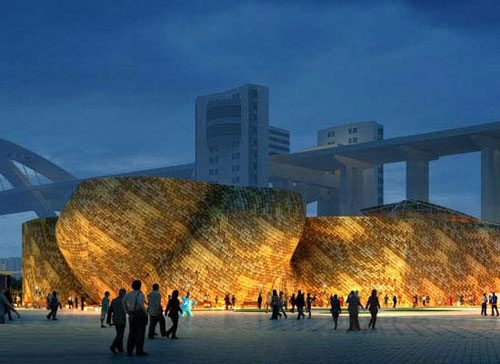
The display category at the World Architecture Festival this year was not only about displaying objects, but even more about telling stories. Many of the display nominees were more like exquisite small museums. In the category we also found two of the pavilions from the Shanghai-Expo, where architecture itself is supposed to tell the story of a country. The category winner the Spanish pavilion by Miralles Tagliabue EMBT, is as much a piece of art as it is architecture.

The idea of taking wicker, even though not solely a Spanish material, shows what architecture can do when Expos like this send architects off doing the unthinkable. It stands out as a building, and a story, that the visitors to the event will remember. The container of the exhibition becomes an ephemeral poetic and strongly memorable image of the creativity of Spain. The connection of the Chinese visitors to the craft of wicker making encourages a level of sympathy with Spanish craftspeople of past times. Read the rest of this entry »
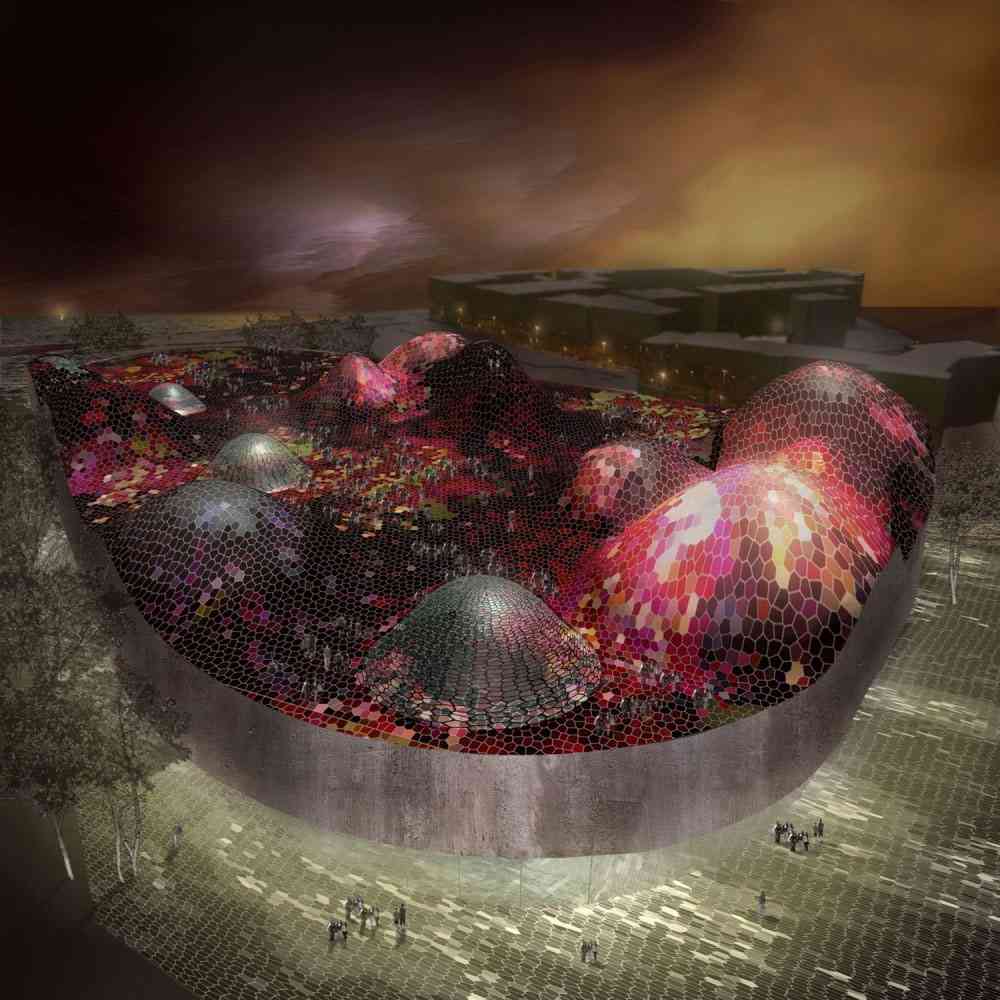
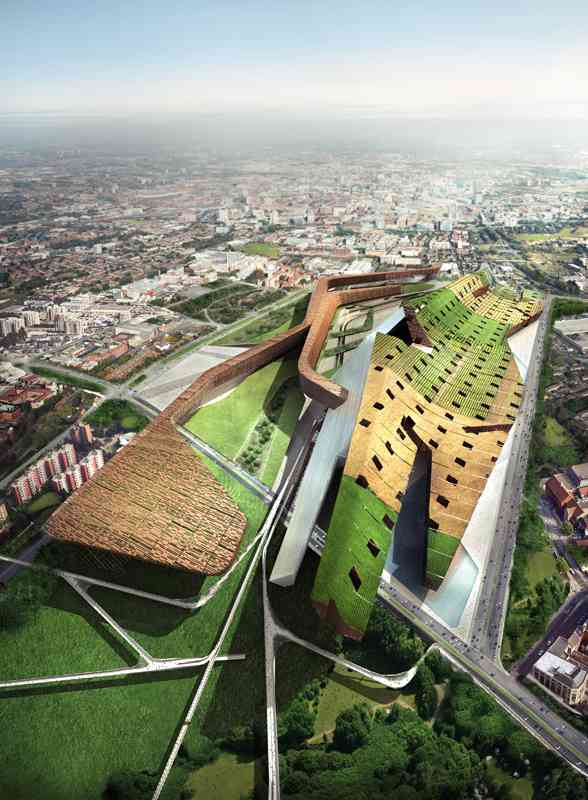
The project for the World War Museum in Gdansk designed by Chicago-based architect Sean Lally is organized around two straightforward principles. The first is to create a central exhibition core, a “jewel box” that contains the permanent and temporary exhibition space, continuously accessible from all sides along a “loop lobby” that encircles it: the second is the location of the public programs associated with the museum’s urban context–conference, restaurant, hotel, library, and education facilites as well as an urban park–on the upper level rooftop, initiating a “new city floor” with views to the surrounding city, accessible year-round. Making these outdoor public spaces attractive to visitors regardless of season requires the design of a “climatic wash’ that can produce artificial micro-climates and extend seasonal activities throughout the year.

This wash is made possible by harnessing the energy dumps that inevitably occur in a building of this scale (36,000 m²), which requires 900 m² of mechanical space and 11,000 m² of parking garage, both of which vent large amounts of heat and moisture, as well as the combined body heat of several thousand visitors a day. This climatically elastic and unique ‘new city floor’ is the resource for the museum and the city of Gdansk as a whole. Read the rest of this entry »
Award-winning firm Studio SHIFT unveiled their proposal for mixed-use housing in the periphery of Milan, Italy. Mario Cipresso is the founder of the Santa Monica-based studio and commented on the project: “The project is one of twelve proposals located on the periphery of the historic city center offering conceptual solutions for the densification of Milano. Each proposal injects 25,000 inhabitants into the existing fabric of Milano for a total population increase of 300,000.

The radical nature of this undertaking, specifically the insertion of twenty-five thousand new inhabitants at the site, on the periphery of the cultural and economic center of the city, requires an equally radical response. The population increase will most certainly impose enormous demands on existing infrastructure and the social and economic well-being of the population will face new strains.

In order to address this situation, our proposal employs a comprehensive strategy that simultaneously establishes a self-sustaining community and one that seeks to integrate programmatically and physically with the existing city. Read the rest of this entry »

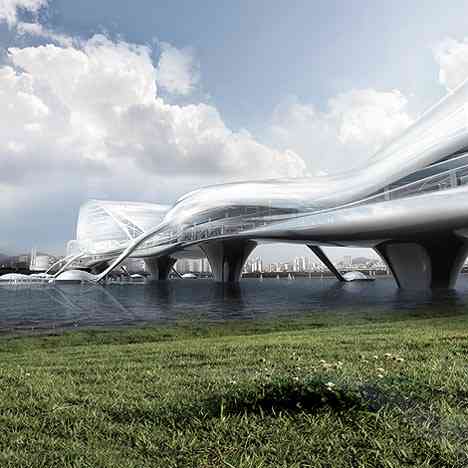
Creative director Byung Ju Lee of Planning Korea announced a new paradigm in bridge called ‘Paik Nam June Media Bridge’ in Seoul, Korea. Connecting Dangi-li Power Plant (which has a plan to be redeveloped into public cultural space) in the north and The National Assembly Building in the south, this bridge shows the first example of ‘a city expanded to the river’.

As a futuristic and aesthetic sculptor over the Han River, Paik Nam June Media Bridge shows how to use spaces over the bridge efficiently and eco-friendly. Inspired by the water strider, the overall shape is organic with sleek, streamlined outline. With the total length of 1080m, this mega structure bridge is covered with solar panel to generate energy by itself. Read the rest of this entry »

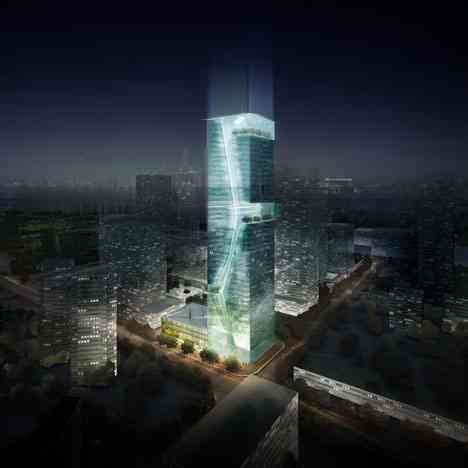
Massimiliano and Doriana Fuksas won the “International Schematic Design Competition of Shenzhen Guosen Securities Tower” After the Shenzhen Bao’an International Airport Terminal 3 won by Studio Fuksas in March 2008, on October 18th 2010 Massimiliano and Doriana Fuksas won the “International Schematic Design Competition of Shenzhen Guosen Securities Tower”.

The project by Studio Fuksas is born from the intention to create a new concept of vertical public space for the tower. A three-dimensional void will be arranged along the facades giving a dynamic image to the building and creating different public scenarios for the offices. The design of the void shape explores the relation between the podium and the vertical section of the tower with diagonals spaces and fluxes that create a vertical tension in the full height of the tower. Read the rest of this entry »
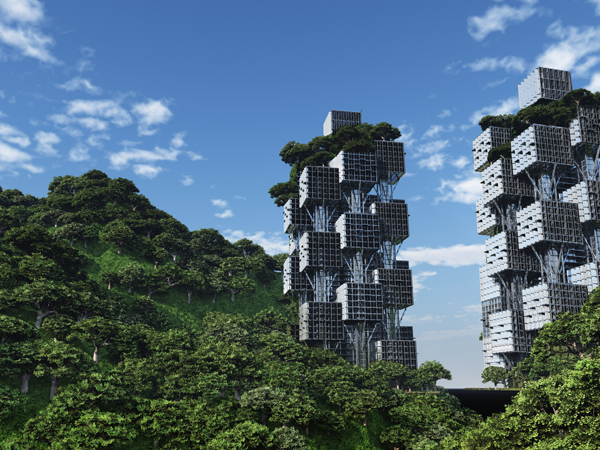
The Urban Tree project was designed by Geotectura, and award-winning architectural studio based in Israel and founded by Dr. Joseph Cory as a way to merge land and architecture with sustainable elements, cost effective technologies, and social responsability.

This urban scale structure contains greenhouse platforms on dwelling floating cubes that keeps a minimal footprint on the ground. The bioclimatic structure capsule enables space and function flexibility. Variation in size and function in each unit is preserved within each cube with panoramic viewpoints and optimal air flow. Together with the multi-dimensional absolute green environment and the terrace sky courts of this versatile self-sufficient project reflect a sustainable responsability while building high. This concept of two helicoids prefabricated infrastructure is like a growing a urban tree that improves the dwellers’ quality of life while living in the sky. These mega-cubes weave nature and communities  into a dense city. Read the rest of this entry »
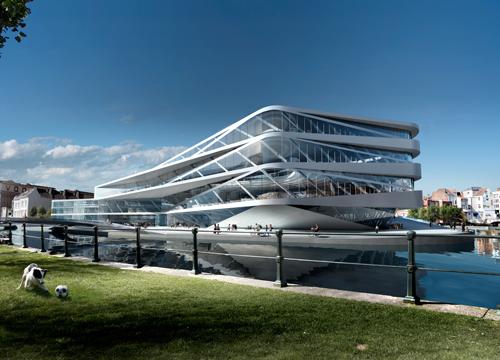
Amsterdam-based architectural firm UNStudio unveiled the design for the Urban Library of the Future and Centre for New Media in Gent, Belgium. The new complex creates a dynamic, flexible and open knowledge environment, with an open landscape, alternative circulation routes, several meeting areas and a public plaza. The building is fluid in form, accommodating to its surroundings and incorporates expansive sightlines. The internal organisation of the building is based on an open central void, around which the circulation takes place. This void enhances the spatial experience, creates clear orientation through the building and fulfills a bridging function between the city and the Municipal Library. The structure of the building makes it possible to introduce (green) roof terraces whilst also ensuring low levels of direct sunlight penetration. Read the rest of this entry »

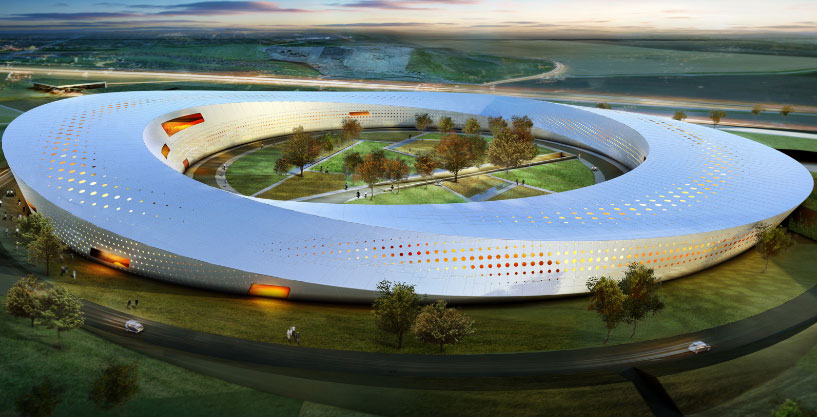
Award-winning Norwegian architectural firm, Snøhetta, unveiled an innovative proposal for the Max-Lab in Lund, Sweden. The Max-Lab is a national laboratory jointly operated by the Swedish Research Council and the Lund University.

The overall architectural idea builds on the meeting point between the strong landscape and the circular shape of a synchrotron (cyclic particle accelerator). The circular shape is twisted and raised to create a dynamic form based on a Möbius strip that becomes an actual volume, not just a ribbon.   The building is unified to the landscape through parks and cultural programs around an oval road with an iconic layout that would be independent from future developments in the surrounding area – from agricultural landscaping to urban developments.  The geometry of the twisted cylinder is generated based on functional requirements and detailed solar studies for heat gain, reducing it up to thirty percent. Read the rest of this entry »

Cities Of Tomorrow

By:  | October - 27 - 2010

Cities Of Tomorrow
Carlo Aiello
Digital copy
130 pages

-> Buy From Apple Books

eVolo_03: Cities of Tomorrow

How do we imagine the cities of tomorrow? This is one of the most difficult questions that architects, designers, and urban planners need to answer in a time where more than half of the world’s population lives in urban settlements – a mere century ago only ten percent did.

In this issue we examine innovative urban proposals that will transform the way we live; projects that preserve the natural landscape with integral architecture and urbanism with deep connections to site, culture, and environment. These are concepts of hybrid urbanism that offer a juxtaposition of programs to live, work, and play for a hyper-mobile population.

Arup Biomimetics
AS/D
BIG – Bjarke Ingels Group
LAVA – Laboratory for Visionary Architecture
MAD Architects
Matter Management
MONAD Studio
NH Architecture
Rag Urbanism
Rojkind Arquitectos
SOFTlab
Ted Givens
Terreform One
Trahan Architects
UNStudio
Vincent Callebaut
Will Alsop
WOHA Studio

2010 Skyscraper Competition
Australia in 2050
Urban Visions: 1850 – 2100

Essays and Interviews

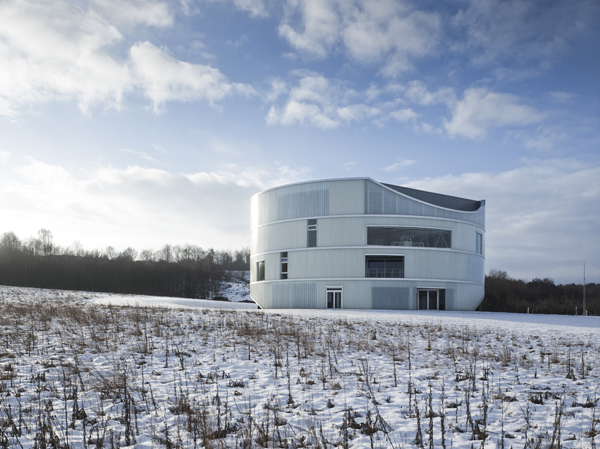
Since the concrete dried last winter the Natural Science Center has attracted a lot of attention worldwide. The Danish building situated in Bjerringbro far away from the capital Copenhagen even went as far as getting cited by the World Architecture Community Awards. Now the innovative building designed by Nord Architects Copenhagen is nominated for the Mies van der Rohe Award.

The Natural Science center is a building out of the ordinary. If you thought atriums spanning two floors were cool, think again. In the Natural Science Center all spaces are open and have views spanning several floors. The building itself is shaped as a cylinder with terraces, openings and cuts to explore and get lost in.

“The idea behind the Natural Science Center is to make young people interested in natural science and pursue a career within that field. Natural Science is about exploring and asking questions, so we wanted to design a building that made them do just that.” – Johannes Pedersen, partner Nord Architects Copenhagen Read the rest of this entry »