Russian architects Gagarinskaya Anastasiya and Gaydukova Varvara from the Moscow Institute of Architecture propose a three-hundred meter tall space station on the western side of Moscow. The strong architectural forms are inspired by the Russian Constructivists of the early 20th Century with the use of platonic forms and clean lines. It consists of a main multifunctional round platform with additional horizontal landing strips. The station is linked to the city on the other side of the Moscow River by a pedestrian bridge where a hotel and other amenities would be located. Read the rest of this entry »

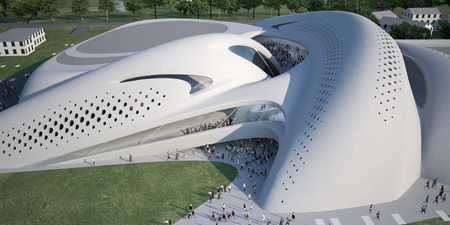
Zaha Hadid Architects unveiled a fascinating hotel and retail centre in Italy to be completed in 2014. Jesolo is one of Italy’s most established seaside resorts and the design of Jesolo Magica makes full advantage of its location near the Venice Lagoon. The project aims to be the catalyst for reinvention and regeneration – giving the of the town of Jesolo an excellent opportunity to further develop as a conference and holiday destination. The design creates a continuum of fluid space that instigates a renewed sense of possibility. The disparate elements of the Jesolo Magica complex fit together to form a coherent field of buildings, each one separate – but logically connected to the next in a continually changing ensemble. The volumes encompassing the retail centre ‘open-up’ around a central space, like the petals of a flower. The hotel building forms the final ‘petal’, framing the views over the adjacent lagoon. In addition to offices, retail spaces and restaurants, the Jesolo Magica project features a hotel with conference center, spa, nightclub and outdoor spaces for events. Read the rest of this entry »

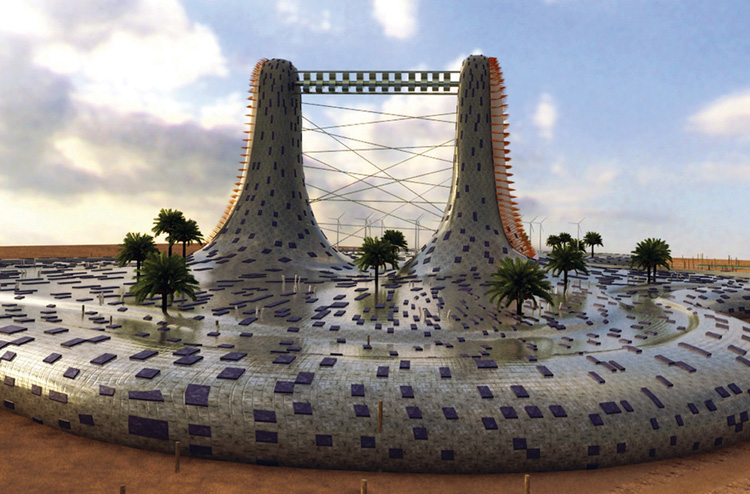
Egyptian architect Karim Elnabawy unveiled his design for a sustainable power plant in Dubai. His project was designed as part of the Land Art Generator Initiative which goal is to design and construct a series of public art installations that combine avant-garde aesthetics with clean energy generation. Karim’s project takes advantage of the harsh weather conditions in Dubai with a project that harness wind and solar energy through different methods.

The design consists of a large metallic surface with two towers that emerge from it. The intention is to use the sun to heat the air underneath the surface. Hot air will later ascend through the towers (chimneys) while powering wind turbines.  At the same time, the entire surface is covered with photovoltaic panels that will provide enough power for the adjacent neighborhoods.  Another interesting aspect of the design is the filaments that cover the wind exposed façades of the towers. These filaments oscillate with the wind and produce energy in a similar way as tidal waves are used at sea. Read the rest of this entry »

Vertical Plug-in City

By:  | October - 26 - 2010

The Hive is a vertical city proposal by Hungarian architect Gergeley Gaal. The project consists of a steel exoskeleton where residential and workings “cells” plug-in according to density requirements. Gergeley’s vision includes open areas at different levels for leisure activities. Some of these spaces are organized as a vertical park that includes running tracks, picnic areas, and small “pockets” or sports fields.

The project is designed to be located outside big cities and support its expansion in a sustainable way. Among its green technologies, The Hive is a water treatment plant and reservoir. The façade is covered with solar panels and wind turbines are located between cells. In addition, each residential unit will have an orchard for local produce. Although the project is on conceptual stages, Gergeley plans to offer the design to the Hungarian government to further develop it. Read the rest of this entry »

Vincent Callebaut Architectures in association with Frederic Magnien Architect unveiled their project for a mobilization swimming pool in Royat, France.

Architects’ statement:

In the heart of the water city of Royat and its green mall in the confluence of the Tiretaine and Liaboux rivers, our extension project is a dynamic response to the ambition of Royat city to build a mobilization swimming pool represented by a very attractive and contemporary architecture researched by the patients of spas.

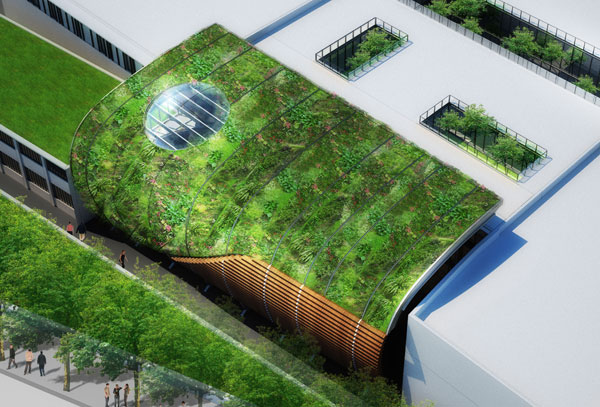
By increasing also the choice of cardio-arterial and rheumatologic cares, our architecture proposes the construction of a “planted wave” that covers the pool hall under its curve. The ecological wave projects thus its curve towards the avenue de Royat such as a new green setting, true urban signal dedicated to the welfare and laid out in the urban Northern façade of the spa site. By meeting the needs of the programme as precisely as possible, our project emphasizes three major themes as detailed below: the urban signal, the welfare of the patients and the high environment quality.

From the avenue de Royat our project expresses thus itself clearly as a strong architectural signal leading the slightly austere line of the mineral façade laid out in bar codes of extensions dating of the sixties to the eighties. Our “green wave” takes into account all the constraints of the site and presents a compact made-to-measure volumetric on stilts of the scratched surrounding frame. Actually, the arched architecture of the pool hall sets up against the bank of the main building, lining up along the firemen lane to the laundry and the workshops located below. Read the rest of this entry »

Self-Sufficient Vertical City

By:  | October - 23 - 2010

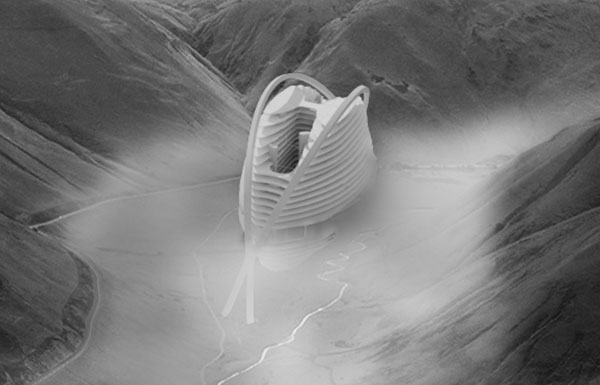
Czech architect Jiri Richter recently unveiled his proposal for a self-sufficient vertical city to be located in pristine landscapes. Richter’s project investigates the possibility of creating a building that will support an entire community without a nation’s help. The structure is designed as two 150-meter tall arches with hanging floors. The central core is an open space aligned to wind currents where two wind turbines, along with photovoltaic cells will generate the required energy for the community.

The program is distributed throughout the building with crops fields in the higher levels in direct contact with sunlight while residences, educational, cultural, and recreational areas will occupy the lower floors. An interesting aspect of the proposal is the retractable canopy between the two arches that will allow airflow during hot summer days and be closed in winter. Read the rest of this entry »
DUNEhouse / Gianluca Santosuosso

By:  | October - 23 - 2010

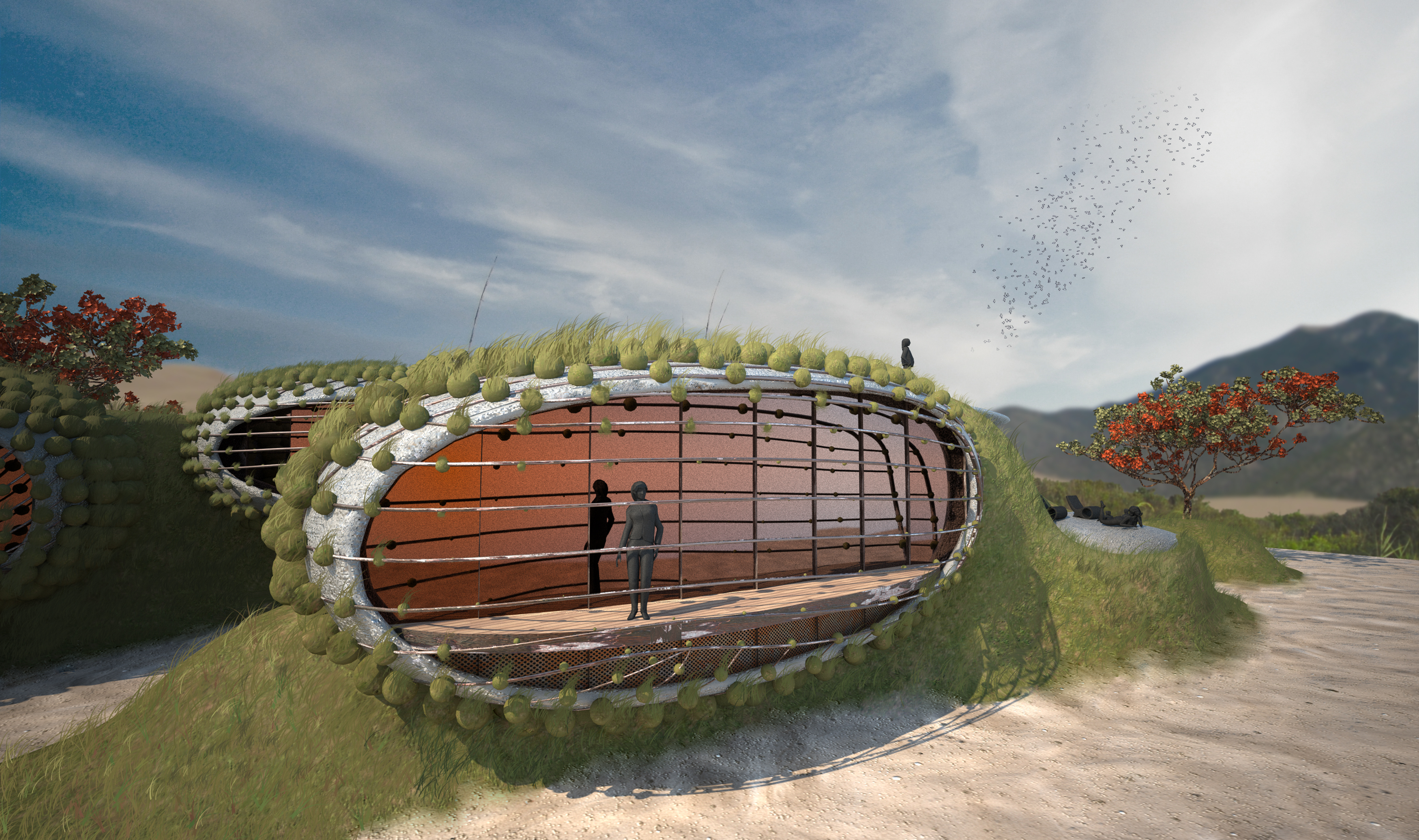
Italian architect Gianluca Santosuosso unveiled the DUNEhouse as a flexible tool where the client has the possibility to define his own house. Mainly, the idea is based on a system composed by different volumes where each of them represents a program or a cluster of it (bedroom and bathroom, kitchen, swimming poll, etc.) and the client is able to distribute them on the plot and creating every kind of space and connection that he prefers.

In the project, the most important parameter is the wind, so the base geometry of the house (the sequence of air flow analysis shows some of the wind test) is organised in order to maximise the wind flow and consequently the natural ventilation inside the building. To increase the effect of this mechanism all the house volumes (made of reinforced and insulated concrete shells) have been thought on the top of small artificial dunes working as thermal mass with the aim to regulate the income air temperature. Read the rest of this entry »
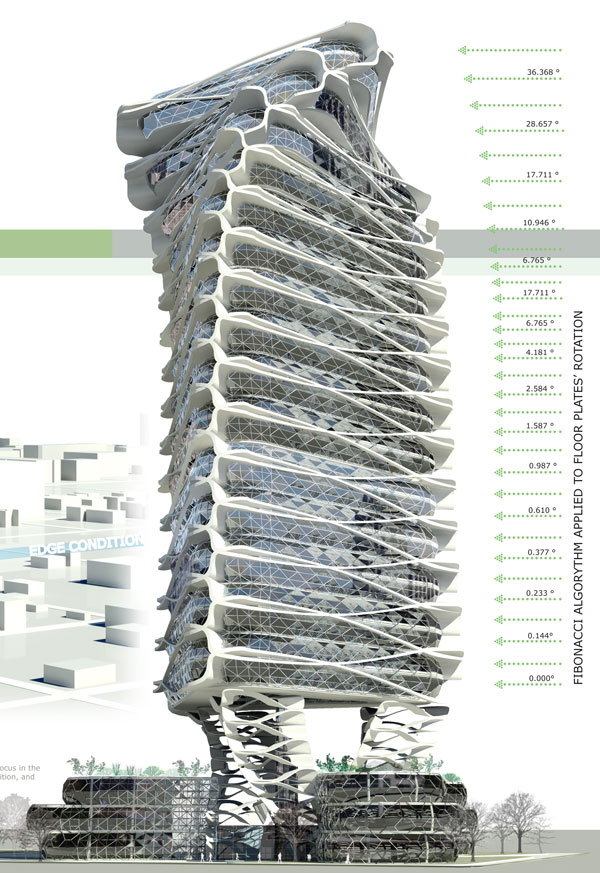
The proposed skyscraper designed by Marie-Alice Kacou and Khanh Do, students at the Savannah College of Art and Design, seeks to become iconic edifice that helps to raise the awareness of recycling and sustainable development in terms of material reuse and water efficiency in the city. Located in south-east Raleigh, the site could be perceived as an abstracted edge of the downtown landscape as well as a transitional locus in the urban context. The parti is based on the converging points of three dynamic forces that meet at the site: the urban transition, the edge condition, and the human interaction. The investigation began with the metaphor of infinity underlying the concept of sustainable recycling and the interpretation of the universal symbol of recycling. The Symbol consists of three arrows pointing back at each other, denoting an abstraction of infinite cycles. Therefore, the infinity sign is being dissected in 2 dimensional and 3 dimensional configurations to establish the structure and fabrication of the building. What is proposed is a prototype for a mix use skyscraper acting as an architectural locus where these three forces will interact and generate interaction. Read the rest of this entry »

Vertical Landscape

By:  | October - 22 - 2010

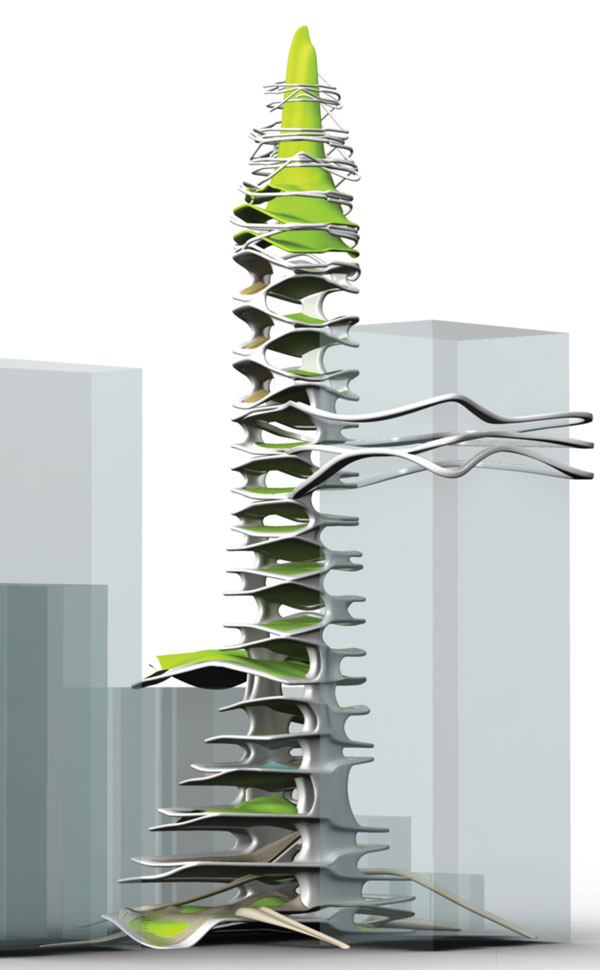
Vertical Landscape is an urban intervention proposed by Pratt Institute graduate student Sejal Bhimjiani where architecture and landscape appear as a continuous element. The project creates an exchange between rigid urban grids of metropolises such as Shanghai or New York City and “soft” landscape through a series of vertical experiences. The topological and continuous areas in a multipurpose plaza at ground level transforms into a serene vertical sculptural park, jogging trails, and camping grounds. Sejal describes the project as a new typology that activates and transforms the cityscape at different scales. The structure also defines public and private spaces through an innovative structural ribbon that expands at lower levels. Read the rest of this entry »

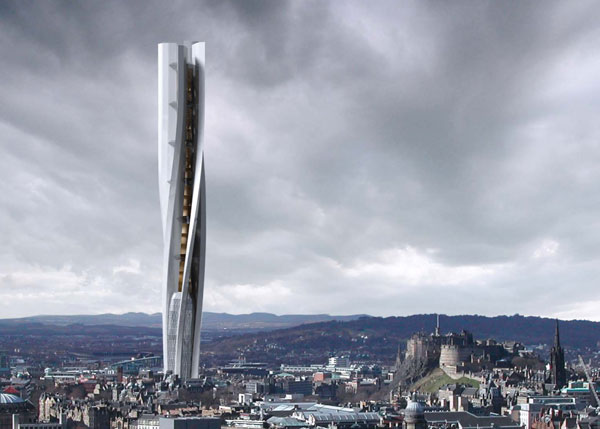
The Wind Tower is a spiraling mega-structure designed by British architects David Arnold and Alexa Ratzlaff as a twisted steel and concrete diagrid aerodynamically shaped to take advantage of the prevailing wind currents. At the center of the tower is the core which contains the main vertical circulation and storage areas. Spiraling around the core is a series of platforms that will accommodate a variety of programs including commercial, residential, institutional, and recreational facilities. Located above the program, turbines measuring 45 meters will generate enough power for 2,000 residences. Read the rest of this entry »