Vertical Theme Park

By:  | October - 18 - 2010

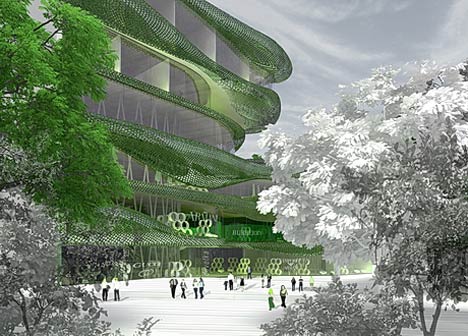
New York-based architect Ju-Hyun Kim envisions the theme parks of the future as vertical structures in large metropolises. His concept for a theme park skyscraper borrows the idea from Disneyland to create different worlds but bases the entire experience in height and the relationship with the existing city. Ju-Hyun proposes a park without automobiles, a sustainable building that harvest solar and green energy, recycles waste, and collects rainwater.

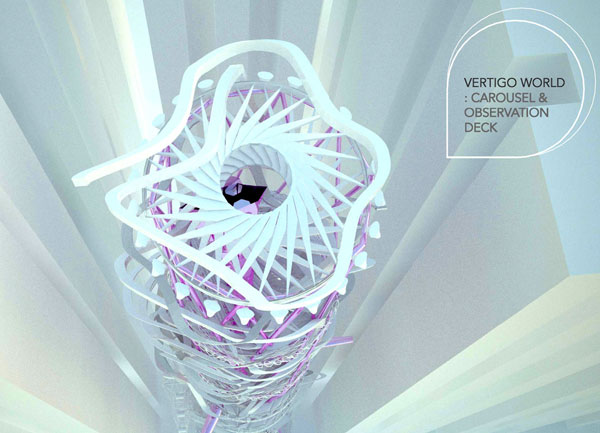
The classic rides, such as the Ferris Wheel, rollercoaster, and carousel are all re-imagined for a vertical experience. Ju-Hyun’s vertical theme park has five major areas: Vertigo World (carousel and observation deck), Fast Land (flume ride, rollercoaster), 360 World (Ferris Wheel, sky promenade), Abyss City (deep city diver), and the Elsewhere Universe (space exploration, science center).

We hope this concept becomes a reality to transform and inject new life to a century-old invention. Read the rest of this entry »
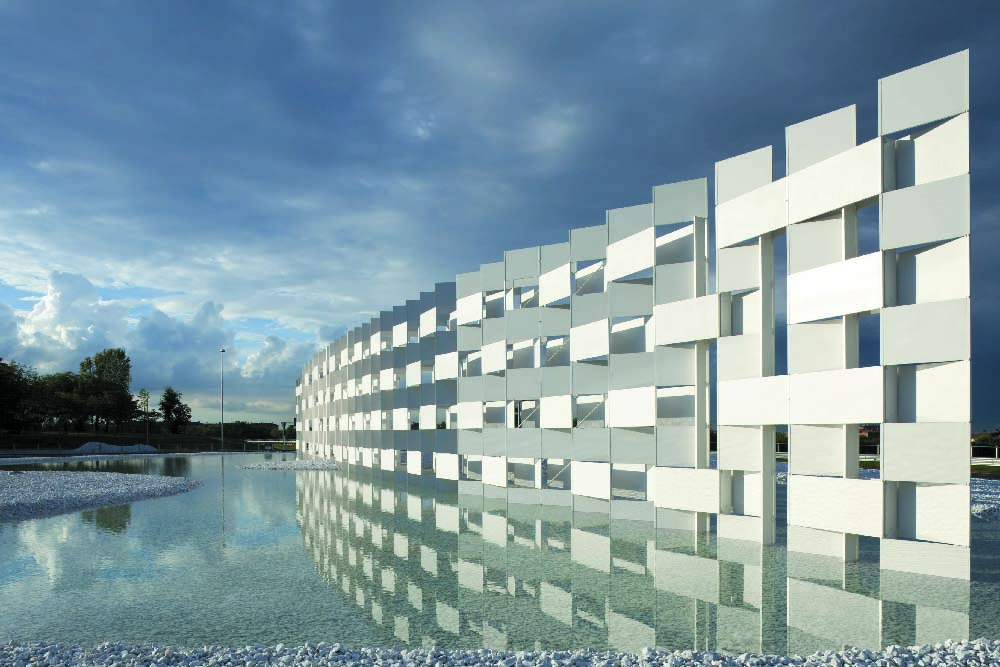
The Casalgrande Ceramic Cloud, the first work of architecture in Italy by Kengo Kuma, the Japanese master, and a new symbolic gate of the ceramics district of Emilia Romagna, is located in the municipality of Casalgrande, in the province of Reggio Emilia. The work is located near the production works of Casalgrande Padana, the leading company in the production of unglazed stoneware and the buyer of the work itself.

The CCCloud transversally divides the space of a roundabout like a thin diaphragm curtain dynamically attracting the viewers’ sight. The layout plan of the work is oblong and streamlined at the ends and the central section reaches a maximum width of 1.7 metres. It is almost 12 metre tall.

For the first time, ceramic material is tested for structural purposes. Its 3D structure is composed of nine layers of large technical porcelain stoneware slabs – standard production items by Casalgrande Padana – placed one onto the others and interconnected by means of thin hidden threaded bars. Read the rest of this entry »
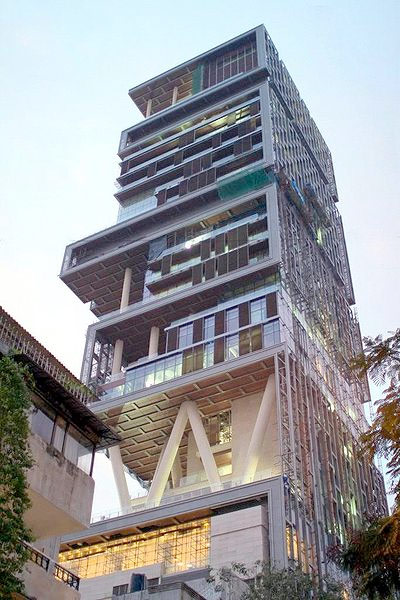
Time Magazine has reported that the most expensive home in the world has been completed. The owner, Mukesh Ambani is the fourth richest man in the world according to Forbes. Mr. Ambani is Chairman of Reliance Industries which controls a large portion of oil and gas products in Asia. His new residence, Antilia, named after the mythical island in the Atlantic is a twenty-seven floor building with approximately 400,000 square feet. The tower has been designed by Chicago-based architects Perkins & Will and constructed by Leighton Holdings. Read the rest of this entry »

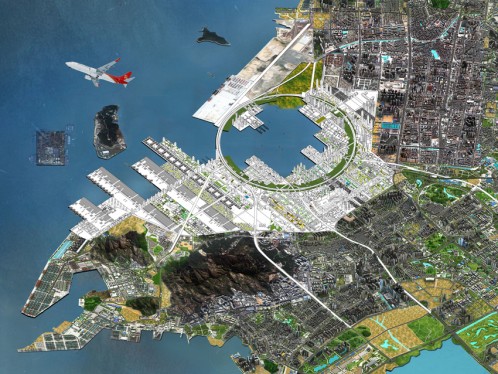
OMA recently unveiled their masterplan for Qianhai Port City. Situated at the threshold of Hong Kong and Mainland China, Qianhai occupies a position of strategic significance in the Pearl River Delta. The planned intensification of transport through the site renders inevitable its emergence as a new center. The question is not whether Qianhai will develop, but how? If successful, a new city center in Qianhai could fulfill Shenzhen’s coastal ambitions and establish a node for interaction between various components of the PRD.

The existing use of the site consists primarily of infrastructure, transportation, and logistics. The operations of the port and its related functions define the quality of much of the site and adjacent areas. What if, rather than attempting to suppress or insulate these uses from new development, they are considered as latencies capable of forming the identity of a new city? Can the introduction of new urban conditions benefit from and reinforce the existing (port) conditions of the site? The design organizes the site in a series of parallel bands running east-west. The irregular extension of these layers into the Qianhai Bay and Pearl River Estuary creates piers and increases the proximity of the city to the water. The layers form a stack of different and juxtaposed types of space, each varying in terms of architectural typology, density, and landscape. Read the rest of this entry »

A unique superblock is officially opened today in the French City of Lyon. Designed by Erick van Egeraat created the superblock, called the ‘Monolith’in collaboration with the French architects Combarel-Marrec, Manuelle Gautrand, Pierre Gautier and the Dutch Architect Winy Maas.

This superblock is part of the urban renewal project Lyon Confluence. The building with its exuberant architecture is intended to add the new values to this derelict territory which was previously a thriving industrial district. Now the area is transformed into an innovative and beautiful part of Lyon’s city center. Erick van Egeraat and his French and Dutch colleagues all contributed to this ambitious development.

The Lyon Confluence project consists of three lots: A, B and C. The project of (designed by Erick van Egeraat) is located in lot C which is also know as Le Monolithe. Lot C comprises of office, retail and residential units on a size of 32.000m2, is located in Lyon’s key – redevelopment area Lyon Confluence. It will accommodate 1.500 new residents, 15.000m2 of new office-space and 1.800 m2 of retail. This ‘superblock‘ is part of the larger inner-city redevelopment in the gastronomic center of France. Read the rest of this entry »
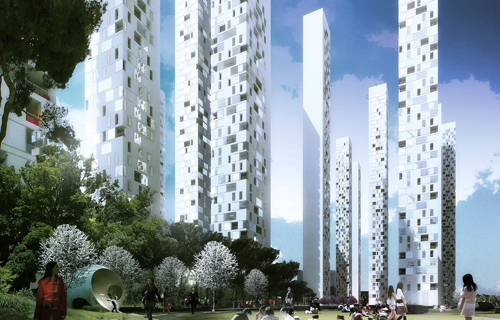
Award-winning architectural firm REX designed  a residential complex in Songdo Landmark City, Korea in which every apartment offers direct southern exposure, cross-ventilation, and views. However, Korean zoning guidelines and local building practices typically produce towers that fail to provide these three locally-prized amenities. Furthermore, prevailing site strategies carve up the open space such that the result is not the often-advertised “Towers in a Park,” but anemic “Towers in a Yard” instead.

Block A4 challenges conventional Korean development practices to provide the three key amenities within each unit and a true publicly-accessible park at grade. Korean towers typically have four or more units per floor. As a result, many apartments have limited direct light, no southern exposure and poor cross-ventilation. By splitting a single tower with four units per floor into four separate towers with only one unit per floor, the resulting super-slim building type. Read the rest of this entry »
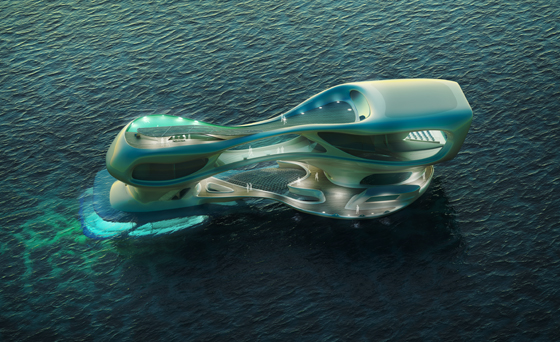
Solus4 recently unveiled  a 2,500 sm Marine Research Center Located 100 meters away, parallel to the shore of Kuta Beach, Bali, Indonesia. The program is composed of three main components: public, semipublic and private. The spaces vary from underwater labs, scientist bedrooms and aquatic garden to sea water pool, swimming pool terrace, bar and an auditorium. The spaces are located above and under water and allow the visitors and scientist to take full advantage of the amazing landscape that surrounds the project.

This project represents a new typology for stationary in-water based projects reached by boat, which in the past have been mostly relegated as merely work, non-destination platforms which do not take into account the design possibilities that the in-water sites present. Read the rest of this entry »

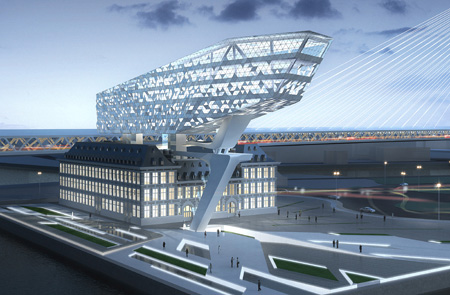
The new Antwerp Port Authority headquarters designed by Zaha Hadid Architects will house approximately 500 staff (currently working in separate buildings) in a single new location that comprises a former fire station and the new extension.

Staff and visitors arrive in the central atrium which also operates as an exhibition space, from where public counters, offices and meeting rooms in the existing building are directly accessible. The offices, meeting rooms, auditorium and panoramic restaurant in the new extension are accessible via panoramic lifts just off the central courtyard. In total the new Port House design is 12,800 m² (gross): 6,600 m² in the refurbished Fire Station, and 6,200 m² in the extension. The maximum dimensions of the new building extension are 114 m long, 24 m wide and 46 m high, providing an additional 4 floors. Read the rest of this entry »

OFIS Arhitekti unveiled a mixed-use development for Ljubljana, Slovenia to be completed in 2011. The project is located in the city’s main pedestrian street and its program is a mixture of boutique shops, café, and residences. The street and the park will be connected with a public passage perforating the building  in different levels.

The lower 4 floors are shops connected with a mall while the top three floors are reserved for apartments. The building has terraces between the low-rise historical line and the park, towards the recent extension of the Post Office on the north border of the site. These terraces offer beautiful views towards the old city and the castle. A lower terrace forms an open air café while higher terraces are designed as apartments. 
Some are enclosed with “green pillows”- an organic layered metal mesh with implanted greenery inside.

Similar to fashion, the building changes through seasons: the fall / winter appearance is  silver and sometimes covered in snow. On the other hand, during spring and summer, it is green and covered with flowers. Read the rest of this entry »

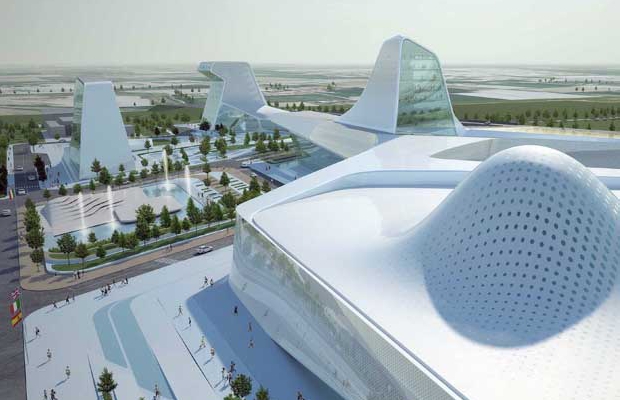
Award-winning New York studio Asymptote Architecture unveiled a proposal for a new master plan for an area south of Orio al Serio International Airport, located near the historic and majestic city of Bergamo in Northern Italy, calls for an intricate complex inspired by the rolling planar aspects of the region’s countryside. The master plan is a meandering and intriguingly articulated collection of surfaces that seem to have evolved naturally from the adjacent farmlands. The manifestation of the Italian rural landscape in built form is an elegant solution to the real and commercial need for mid- to large-scale development projects such as this one. The scheme calls for powerful, yet subtle, new architectural works placed on an urban plinth and pursues a quasi-urban notion of occupancy where the interior and exterior spaces are fluid and transitional from one another. Overall, the Azzano-San Paolo Master Plan is a signal for the possibility of such developments to be aesthetically compelling and architecturally dynamic. Read the rest of this entry »