Kyoai Gakuen University sought proposals for a new building on part of the campus’ recreation grounds. BAKOKO design response was to not to build over this existing amenity space, but to lift it to a higher level, supported by the building underneath. The site is also located adjacent to the school’s sports field which currently lacks spectator seating. By sloping the roof in this direction, the proposal could provide additional value by providing seating for sports events.

In addition to being a valuable leisure space, the green roof has numerous sustainable benefits. Soil and biomass help to insulate the building, reducing the level of mechanical heating and cooling. Rainwater runoff is reduced and biodiversity is fostered within the roof’s trees and natural vegetation.

Supporting the green roof is a grid of perforated concrete vaults. The curved form optimizes its compressive strength whilst being permeable to air and light. Similar structural strategies may be observed throughout biology – such as the intricate mineral skeletons that protect microscopic protozoa called radiolaria. Read the rest of this entry »
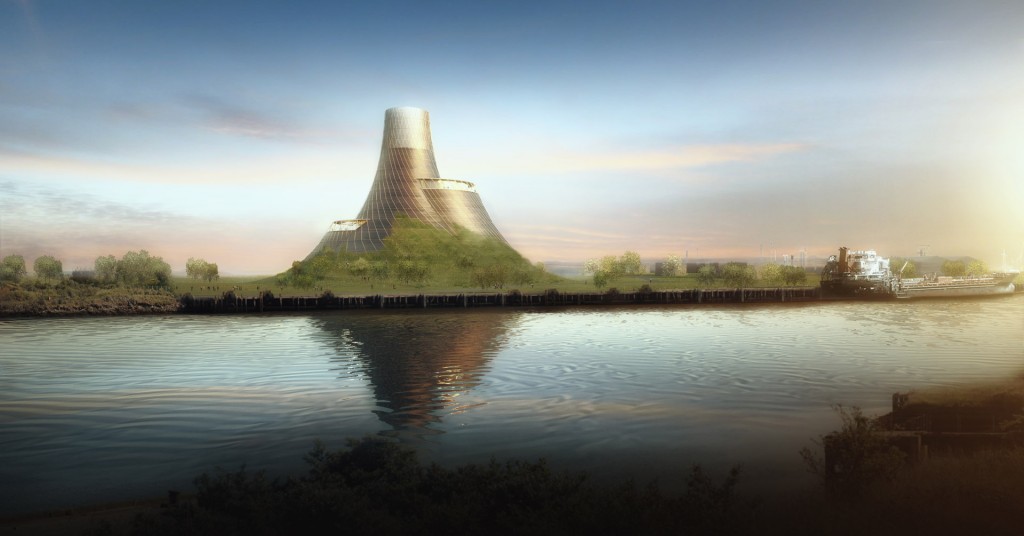

With a rising global population and increasing political focus on the future of power generation, the task of designing a 49 mega-watt, bio-mass fuelled power station in Stockton-On-Tees is an interesting design challenge.

The site at Clarence Works is on the banks of the river Tees and is classified as brownfield, being both post-industrial and ecologically sparse. On the opposite bank is Middlehaven, a major new development of 3000 new homes.

The studio’s approach has been to treat the power station as an opportunity to make a positive architectural and cultural contribution to the area. Rather than placing yet another large industrial building onto this flat landscape, the studio’s proposal is integrated into it. By reconfiguring the arrangement of the energy generation equipment permitting it to be housed within an efficient single volume, the scheme occupies only a third of the site and provides four hectares of indigenous grasslands, which are literally pulled up the façade.

The scheme includes the creation of a publicly accessible park, education facility and events venue. The riverside site enables the fuel to be delivered by ship, achieving a further reduction in carbon emissions compared to road transport. The parabolic hyperboloid form is clad with a proprietary panelised façade system supported on a steel frame, which is structurally very efficient as it also carries the load of the internal equipment, effectively making it a lean-to. Read the rest of this entry »
Hani Rashid co-founder of the award-winning, New York-based practice Asymptote Architecture recently unveiled the UBU-FUGU-ROI.MGX vases. With their metalized nickel coated surfaces, these three vases appear as tornadoes and whirlpools in constant motion. Produced using stereolithography and selective laser sintering, they possess the ability to create and reflect the atmospherics of a place, both absorbing and transmitting light. Read the rest of this entry »

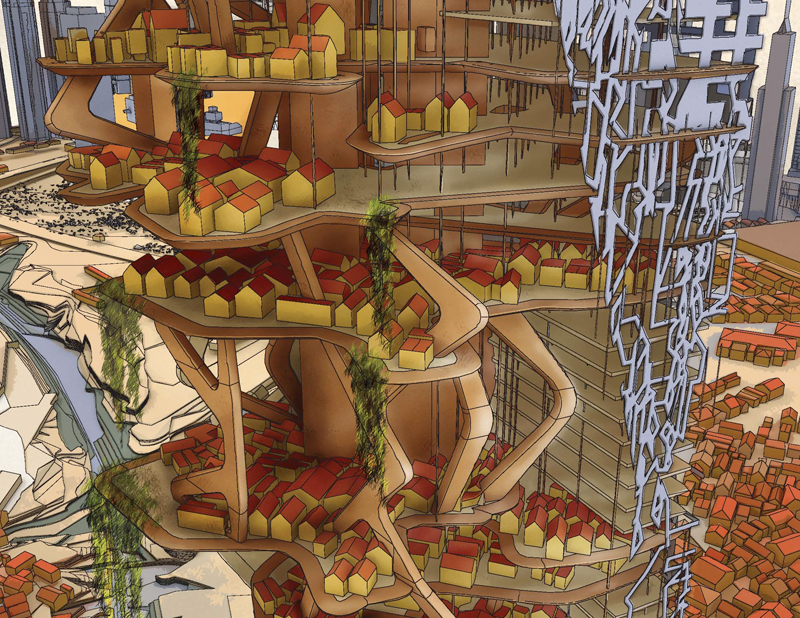
While the Kota is the center of power, a manifestation of Jakarta, as the center of the Indonesian government in all activities: social, cultural, economic, and political; the Kampung is an unstructured, informal settlement characterized by high population density, poverty, and compact community patterns.

The forced dispersal of Kampung communities disrupts social networks and forces citizens to horizontally relocate to inhabitable flood plains. A vertical Kota infrastructure for Kampung settlement condenses social relations and provides a foundation for the future of the city.

In order for Indonesia to participate globally a symbiotic relationship must exist between Kota and Kampung. Architects Robert Gilson and Catherine Caldwell proposed this project which is interested in the multiple scales of economic symbiosis within the skyscraper as an urban from. 

The ‘Kampunkota’ is a tower that seeks to engage the wider possibilities of vertical dwelling. It is a gradient of Indonesian lifestyle that challenges and respects the socioeconomic divisions within Jakarta.  The skyscraper emerges from a Kampung, blending perfectly with its urban fabric and providing new infrastructure. As it goes up, the tower slowly transforms into a Kota for more cultural and luxurious lifestyle. The idea is to create a fusion between the two with intersections, where a new type of lifestyle emerges – one that benefits from the wealthy Kota, but nurtures from the strong communal bonds and traditions of the Kampung. Read the rest of this entry »

The Transient Response System (TRS-1) is a deployable architectural base that quickly assembles a tower to provide immediate shelter for victims of natural disasters such as earthquakes and floods. This structure designed by architecture students Adrian Ariosa and Doy Laufer at SCI-Arc in Los Angeles is proposed for cities like Jakarta which could be underwater by 2025.

Once a flood subsides, the architectural base could serve as a rally point with a residential tower and a civic plinth for diverse programs including factories, refineries, and recycling plants. The residential tower is comprised of 3-story modules that adopt an open program to accommodate as many inhabitants as possible with adequate air, light, and space. Read the rest of this entry »
After the fall of the Iron Curtain, cities of the former Soviet Bloc experienced a rapid change from a central planned economy to a free-market society with similar problems to some developing nations with a rapidly increasing population and lack of adequate infrastructure, affordable housing, and urban planning.

Restituted Spaces by Piotr J. Lesniak is a skyscraper proposal for Warsaw which investigates the urban future of the site now occupied by the Palace of Culture and Science – a soviet skyscraper built by the an initiative of Joseph  Stalin in the 1950’s which completely neglected the existing urban fabric.

Restituted Spaces embraces the Palace with a map-like topography derived from the original master plan. The result is a hyper-dense high-rise structure that challenges the existing typologies of architectural form and organization. Funicular-like elevators and ramping streets act as an extension of the existing urban infrastructure – a three-dimensionally planned city with many possible urban scenarios. The program includes a new velodrome, a community centre, offices, residences, and art galleries. Read the rest of this entry »

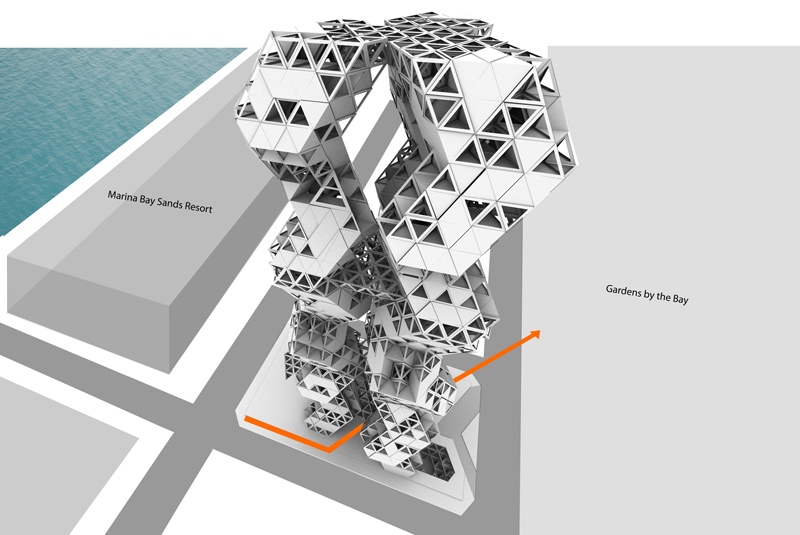
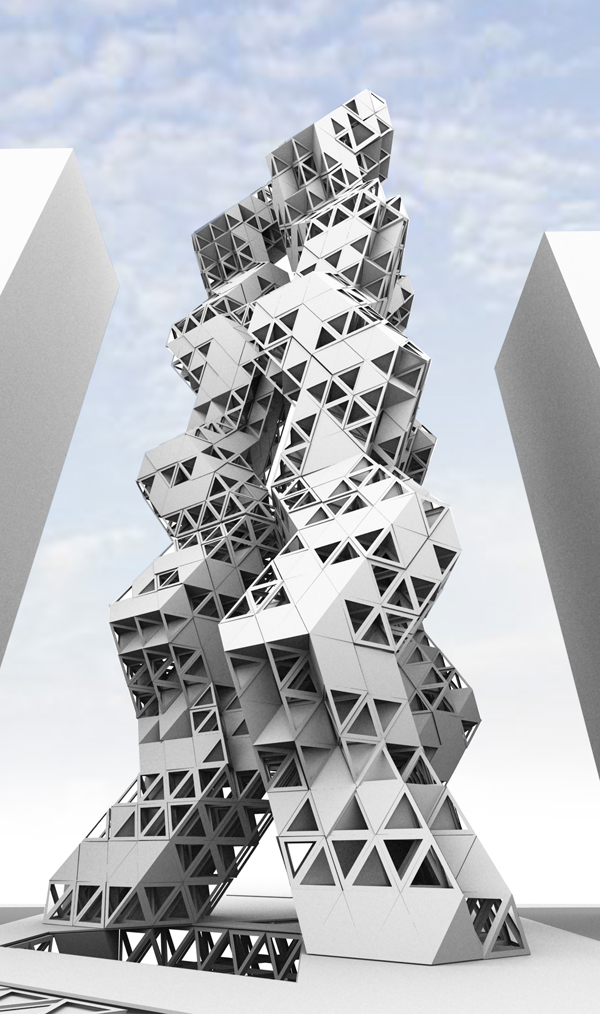
This project, conceived by Tan Bing Hui, rethinks the skyscraper beyond its architectural scale by interpreting it as a new urban community. It is located in Singapore’s Marina Bay, where modernization and densification is increasing due its proximity to the Central Business District.

The project analyses and rethinks the properties of Buckminster Fuller’s theory of ‘close-packing’. It is an investigation on the structural and spatial qualities of the octahedron and the tetrahedron. It unveils a possible methodology to aggregate patterns and modules for vertical urbanism. Read the rest of this entry »

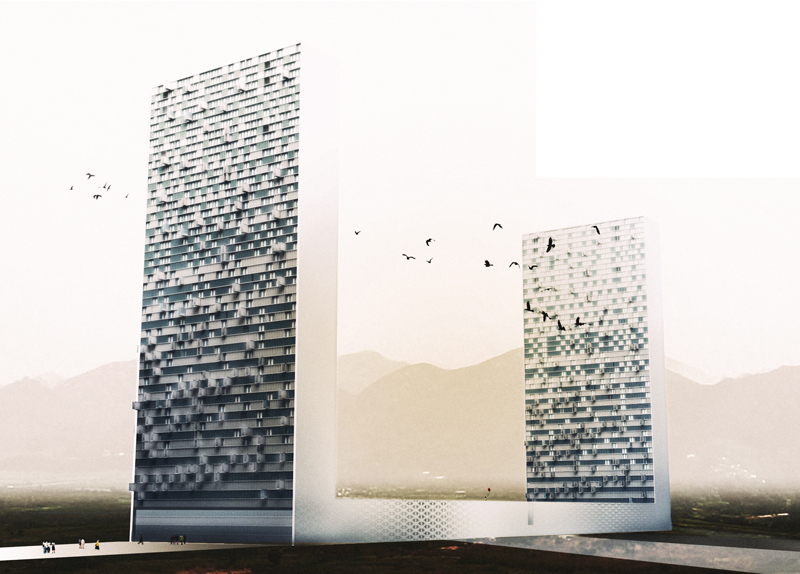
Even though China regained control of Hong Kong a decade ago, the political, social, and economic conditions between the two continue to be very different. There has been an increasing interaction between Hong Kong and the mainland’s nearest city, Shenzhen, which has prompted the construction of numerous checkpoints, factories, and the relocation of entire communities.

This project designed by architect Koren Sin proposes a single community for the two regions -a set of residential towers, one located in each city and linked by a habitable bridge. The Hong Kong tower is designed according to the residential needs of the island while the program for Shenzhen’s development is based on traditional Chinese housing. The residential portion located on the bridge is a fusion of both lifestyles – an experiment on the possibilities of a twin-city that could accommodate both political and economic systems. Read the rest of this entry »

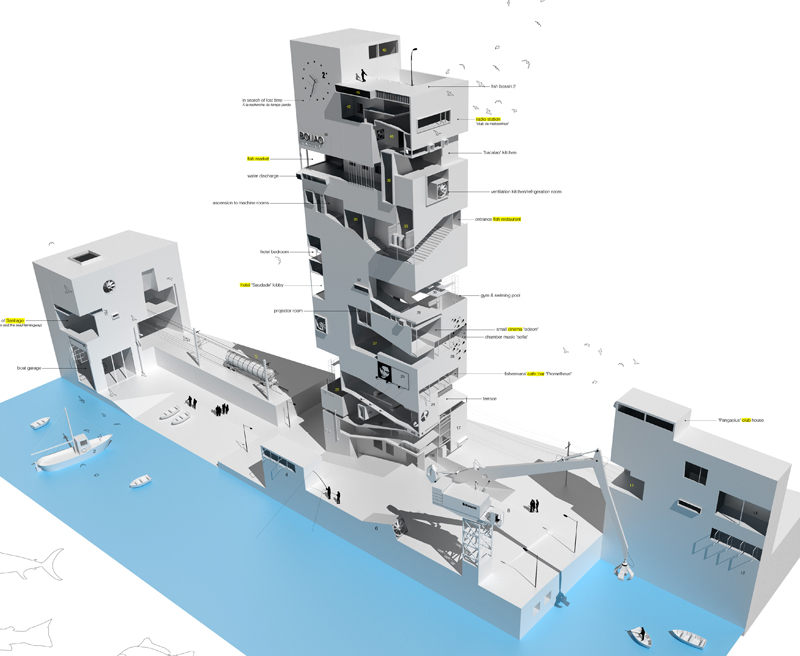
Based on Ernest Hemingway, ‘The Old Man and the Sea’, this project designed by Austrian architects Roman Agreiter and Andreas Perkmann Berger examines the integration of a skyscraper into a fishermen community. The proposal is a cluster of sculpted volumes individually shaped according to various programs; being  the most important one, a vertical fish market that is surrounded by interior pedestrian streets with satellite programs such as restaurants, radio station, cinema, bar, café, and fitness center.

Agreiter and Perkmann explore the relationship between different programs to create a vertical city. The playfulness and careful attention to light and shadow, solid and void, and the human scale are evident characteristics of a highly integrated building to its immediate urban context. Read the rest of this entry »

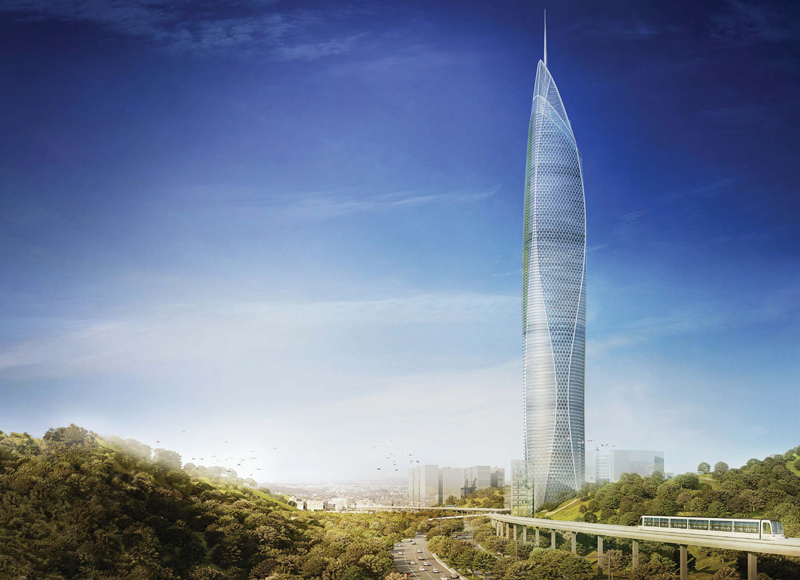
This landmark tower designed by Mustafa Abadan from Skidmore Owings and Merrill located at the heart of Seoul’s Digital Media City proposes a new paradigm in high-performance skyscraper design.

Conventional high-rise towers traditionally create a barrier between program and environment; mechanical systems consume significant amounts of energy in order to heat and cool interior spaces as well as to draw in fresh air. The Digital Media City Tower explores ways of bringing the environment within the structure to reduce energy consumption and create better interior spaces. The inspiration was taken from the marine sponge, a creature that survives by filtering nutrients from water.

Several large atria maximize daylight harvesting. The interior atria along the perimeter act as lungs for the tower, providing air circulation and filtration for the varied programmatic volumes. Within these, active phytoremediation walls temper and refresh the quality of interior air. Read the rest of this entry »