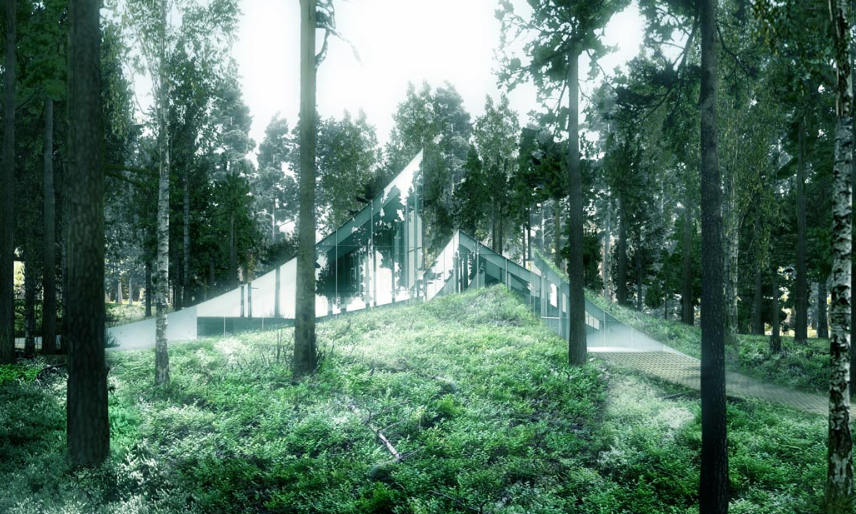
Bjarke Ingels Group (BIG) unveiled his design for a crematorium to be located in an untouched forest in Sweden. The main idea of the project is to create a utility building with a religious presence and to be integrated to the overall Woodland Cemetery composition. The main goal was to create an organizing network that would connect the new structure to the existing crematorium and chapel.

The project is composed of three paths that reach the site; two for pedestrian paths that cross each other and one for vehicles. The two intersecting paths carve through the soil and create four slopping roofs encircling an intimate clearing. Beneath the sloping roofs four interconnected spaces accommodate the four elements of the cremation process in a loop. The paths also create a small courtyard with natural daylight and fresh air. Read the rest of this entry »
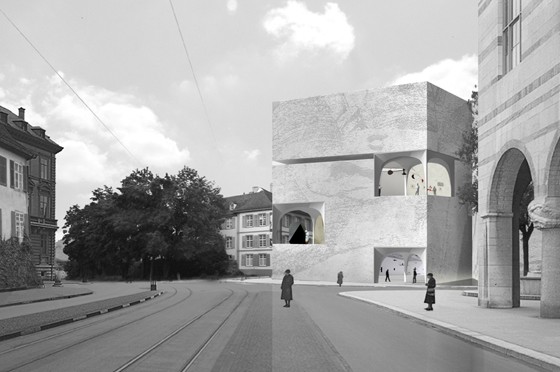
OMA proposal for the expansion to the Kunstmuseum in Basel, Switzerland.

“The cruel problem of the annex is its fundamental subservience; typically of inferior scale and compromised aesthetics, it cannot exist on its own, while its predecessor did very well without it. Although the new building clearly needs to extend and complement Basel’s Kunstmuseum, it is equally crucial that it proclaims its independence. If it is to be successful, the institution needs a new name: “Kunst Zwilling”.

The site and its context intimidate – so much history, so little time. Too careful and the project shrivels, too flamboyant and it backfires. We propose a shape that is independent, beautiful and that “accidentally” behaves well in the context. Not exactly aligned, it fits carefully in all the perspectives but is strong enough to declare its independence – both from its immediate neighbors and the older museum – like one of Ellsworth Kelly’s forms. Read the rest of this entry »
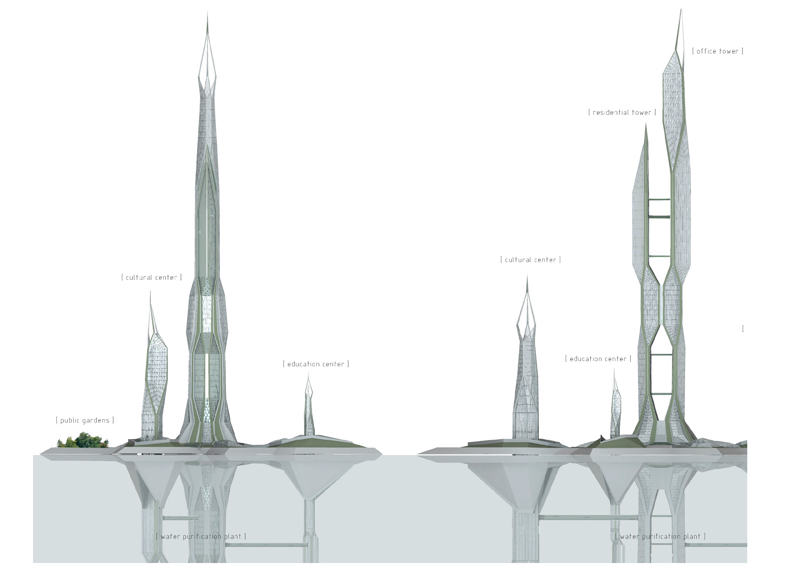
The Horti-hub is a mixed-use water purification skyscraper proposed for New York City designed by Philadelphia architect Zhongshi Liu. The complex consists of five independent towers dedicated to different programs. The taller structures will contain residences and offices while the three smaller ones will be used as research center, cultural center, and water purification plant. At the ground level, a continuous greenscape unifies all the structures and will be used as a new public park to the city.

The ingenious form derives from the development of a structural frame based on the observation of nodes and internodes in plants that creates a morphological strong structure through the union of single elements or predefined building cells. Read the rest of this entry »

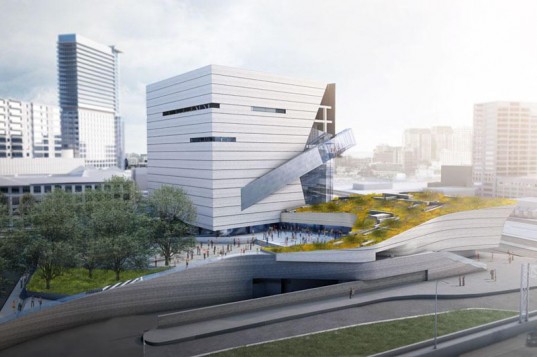
Morphosis Architects unveiled their design for the new Perot Museum in Dallas, Texas. The $185 million structure consists of a landscape plinth with a forest of native canopy trees and desert flora terrace. The xeriscaped terrace gently slopes up to connect with the museum’s iconic stone roof. The overall building mass is conceived as a large cube floating over the site’s landscaped plinth. An acre of undulating roofscape comprised of rock and native drought-resistant grasses reflects Dallas’s indigenous geology and demonstrates a living system that will evolve naturally over time.

The intersection of these two ecologies defines the main entry plaza, a gathering and event area for visitors and an outdoor public space for the city of Dallas. From the plaza, the landscaped roof lifts up to draw visitors through a compressed space into the more expansive entry lobby. The topography of the lobby’s undulating ceiling reflects the dynamism of the exterior landscape surface, blurring the distinction between inside and outside, and connecting the natural with the manmade. Read the rest of this entry »

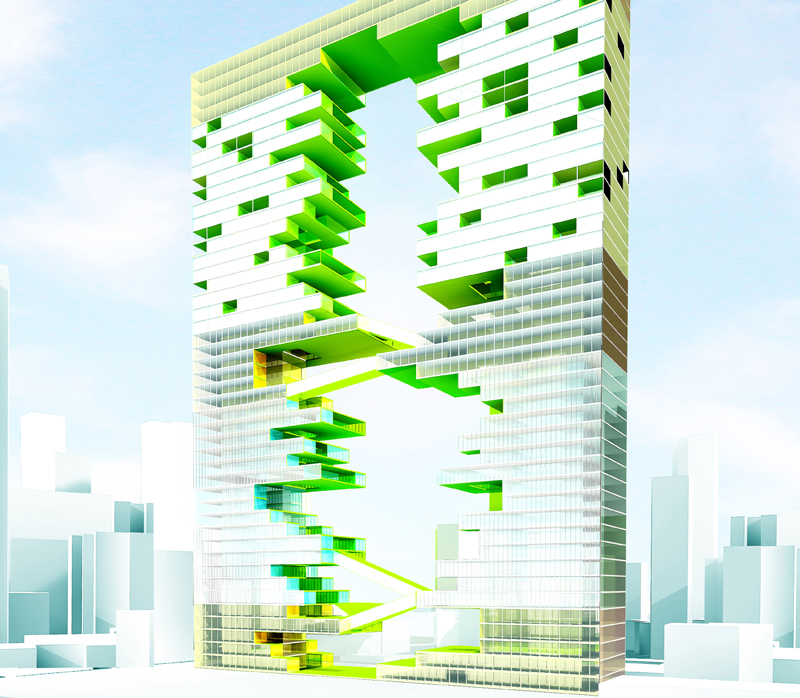
French architect Jaubert Francois proposes a new skyscraper for Paris that consists of two towers joined by a vertical park that starts at the ground plane and finishes at a soccer pitch on the rooftop. The “Hyper-Tower” is a mixed-use development with residential and sports facilities on the top levels and commercial and leisure areas in the first floors.

The structure is a reinterpretation of the Arche de La Defense but instead of creating an un-programmed void, Jaubert Francois creates a lush garden for the city. The interior spaces spill into the green void through terraces in each level. Read the rest of this entry »
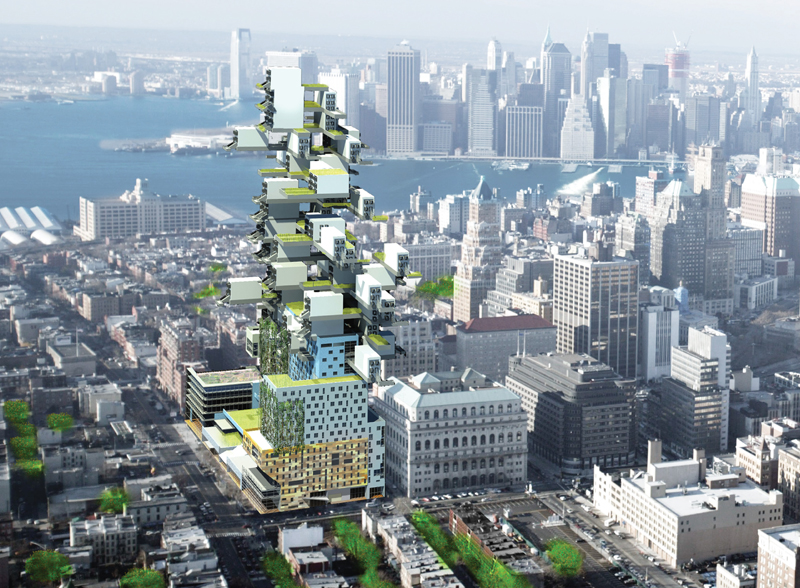
The Brooklyn Yard-Scraper designed by Rogers Marvel Architects is an innovative proposal for redevelopment of the Brooklyn House of Detention. It demonstrates how prime City-owned land can be re-imagined for broad public purpose through a design that carries the texture of Brooklyn into vertical urban form drawing directly from the character of its low-rise surroundings.

Located at Atlantic Avenue, the site is at the collision of the established brownstone neighborhoods extending to the south and the recently rezoned and rapidly changing high-rise construction of Downtown Brooklyn.

The lower portion of the Yard-Scraper is a diverse combination of social, commercial, and educational uses. Each key program element is linked to a yard, in either enclosed or open-air horizontal orientation.

The yard and program of the brownstone establishes the upper area of the building. The homes are stacked atop one another, each orienting itself for suitable light and air to support the residences and their adjacent program. No longer tied to the planar grid of streets and property boundaries, the new brownstones rise into the sky and create a vertical composition, each scraping its portion of the sun’s rays.

Among the many programs, the Yard-Scarper counts with a Green House Center, flats, brownstones, public school, institutes, library, justice center, and green public areas. Read the rest of this entry »
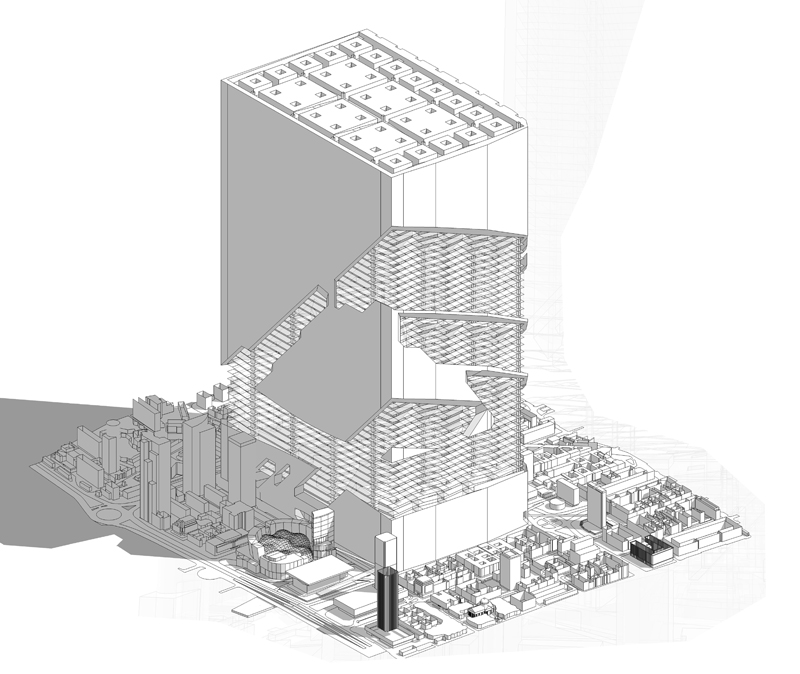
Polish architects Lukasz Wecawski, Jakub Kupikowski and Anna Wójtowicz unveiled an urban proposal to reconfigure the center of Warsaw which after World War II was completely destroyed and reconstructed according to the original plans during the following decades. Although most of the city recovered its previous charm, a large void was occupied by a massive and completely isolated building (Palace of Culture) donated by the Soviet regime.  The main idea of this proposal is to reconfigure that urban area.

The proposal departs from creating a massive volume that will occupy more than 10 city blocks in each direction. The resulting mass will later be carved to create a new urban typology according to diverse programs.  The sunlight voids resulted in the analysis of sunlight required for dwellings taking in consideration the angle of sunlight in the equinoxes.  The transportation voids consists of a spiral grid of ramps connecting all levels of the building – these will become streets with designated areas for pedestrians and bikers. The sun-fiber voids will provide sunlight from top to bottom through an ingenious group of light wells equipped with reflective materials while the green voids will be scattered throughout the entire project. Read the rest of this entry »

Sociocultural evolution is an umbrella term of theories of cultural evolution and social evolution, describing how cultures and societies have developed over time. Although such theories typically provide models for understanding the relationship between technologies, social structure, the values of society, they vary as to the extent to which they describe specific mechanisms of variation and social change.

Conceived as an iconoclastic intervention which implodes the conception of skyscraper at the global and local scale, Adamastor’s Throne exists to reveal and respond to the social fabric and cultural framework of an entire country, South Africa, but specifically Cape Town and its complex and contradictory history. The tower is an ontological experiment to provide spatial models toward recalibrating the relationship between technologies, social structure, and values of South African culture. Read the rest of this entry »

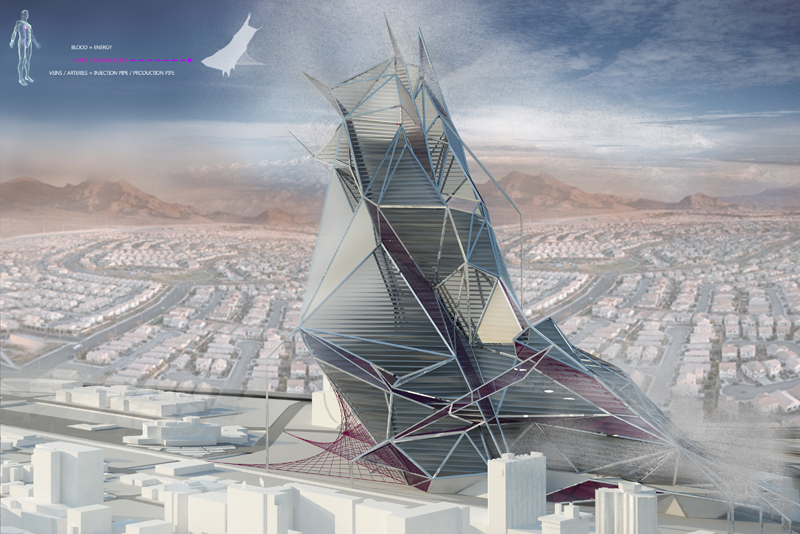
What does a geothermal plant and casino have in common? Well, a group of Korean architects are studying the possibility of creating a mixed-use skyscraper in Las Vegas that will harvest geothermic energy and pockets at the same time. According to various studies, the United States has the largest territories where geothermic energy can be extracted and it is expected that by 2015 it will produce at least 15,000 MW.

This proposal might sound a bit radical, but its main concept is to investigate in safer geothermic plants that could be mixed with other programs in the middle of a city; a right where a large amount of electricity is required. Read the rest of this entry »

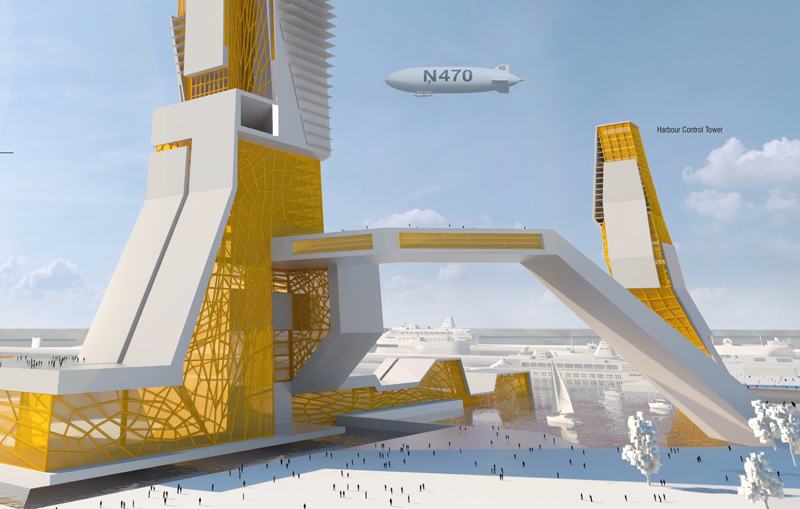
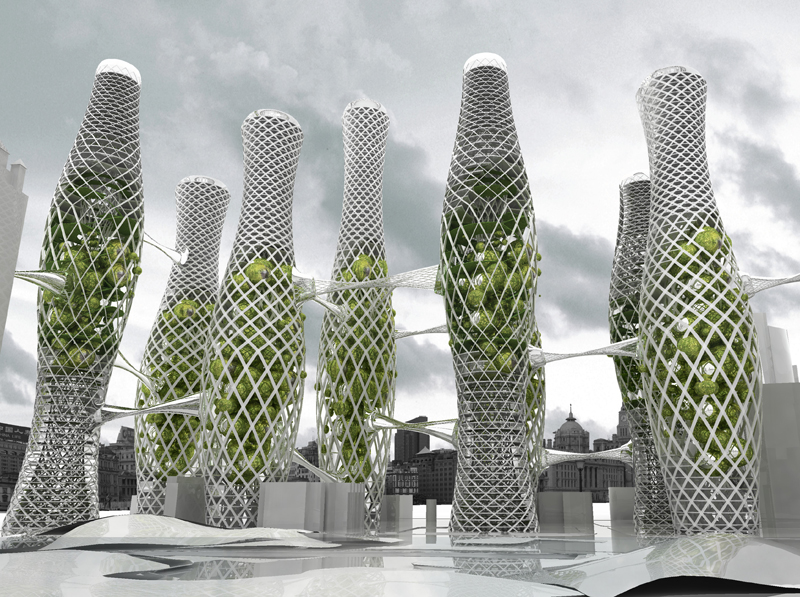
The HydraScraper is a sustainable high-rise proposal by Chinese architects Bao Kai and Zhou Yixing from the Tongji University in Shanghai. The skyscraper was inspired on the Hydra organisms which characterize for its multiple tentacles and its ability to synchronize work by creating clusters of thousands of them. The main structure of the HydraSraper is a steel mesh that opens and closes according to wind loads and solar exposure. 

The building was designed as a multi-use structure for residential, commercial, and recreational areas. One of its most innovative aspects is its green park that occupies the middle section (30 floors) of the project. Tentacles or bridges emerge from this section and connect to other HydraScrapers creating a network of more than ten skyscrapers in Shanghai’s financial district. The main concept is to create a continuous elevated greenscape that will function as an air purifier lung and as the main park for the entire city. The location of these parks originated from the analysis of solar incidence and wind currents. Read the rest of this entry »