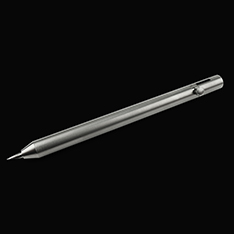
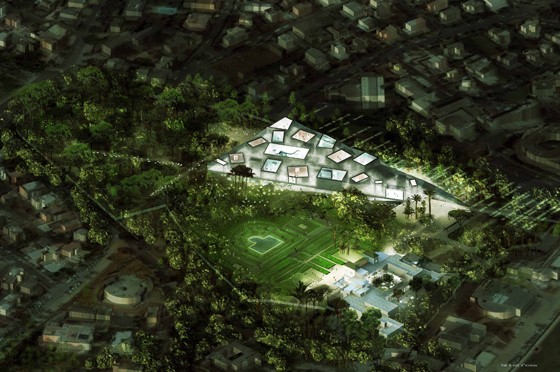
OMA unveiled their design for The National Museum of Archeology and Earth Sciences (MNAST) located on one of Rabat’s highest points: the gardens of the Lyautey Residence, which used to house Morocco’s French administrator. The MNAST will act as a catalyst for Rabat’s development, its innovative architecture reinforcing its urban and cultural attraction. The building is a long, flat isoceles triangle, resembling an ancient relic or indeed an archeologist’s tool. But the shape is primarily motivated by three axes on the site: Franklin Roosevelt Avenue, facing the city in the east; the park in the north; and the Lyautey Residence and formal gardens in the south-west. Rather than appropriating the Lyautey Residence as a part of the museum, the MNAST – with its entry is at the same level – will engage it in dialogue. Through its topographical connection with the MNAST, the Residence will be inscribed anew in the contemporary history of Morocco. Read the rest of this entry »
National Museum of Archeology in Morocco / OMA
Center for Promotion of Science in Belgrade, Serbia
This competition proposal for Center for Promotion of Science in Belgrade was designed by a team of young Serbian architects Milos Zivkovic, Nebojsa Stevanovic, Janko Tadic, Aleksandar Gusic and Slobodanka Tadic. The object itself is a place where two ages crash – a collision of modern function and retro environment. Its architecture should provoke, associates, intrigue observers as much as its users. In time, exhibits have taken on a new form, so today the requirements for new architectural concepts have also changed. The user now becomes a participant and without him an exhibition does not exist – by activating it he becomes a part of exhibition, together they form a spectacle.
The main space is formed by de-leveled staggered slabs, recessed from the facade so they can be perceived from all levels and angles. With continuous movement through space and the use of exhibits, the user creates a form of event for himself and for the observer. All elements of the facility are subordinated to this idea and so are the access ramp and conference room that form environments that look out on the exhibition areas. The highest level of the building is formed in relation to program requirements; it is compact and offers dark areas that correspond to different types of exhibitions. In the floor there are gaps through which you get a new perspective of the spectacle. The facade of the building is used as a filter for the outside observers who watch through Fresnel lenses which are located on three sides of museum. It gives them ability to see enlarged image of the inside space and giving them a whole different perception of the Center. Read the rest of this entry »
Smooth Space in the Striated Empire
This project was developed by Jungwook Lee as Design Thesis at Cornell University. The study is briefly summarized through three main topics. The first topic was to analyze the sense of smooth and striated space from Deleuze and Guattari’s philosophy book; ‘A Thousand Plateaus with Architecture Point of View’. The second part included the research of weaving structures characterized by striation that can mutate into smooth spaces. The last study was to re-define the massive grid system in Manhattan. This study proposes the alternative architectural result of the combination of smooth spaces with striated spaces. Read the rest of this entry »
Exuberant Cathedral for Vienna, Austria
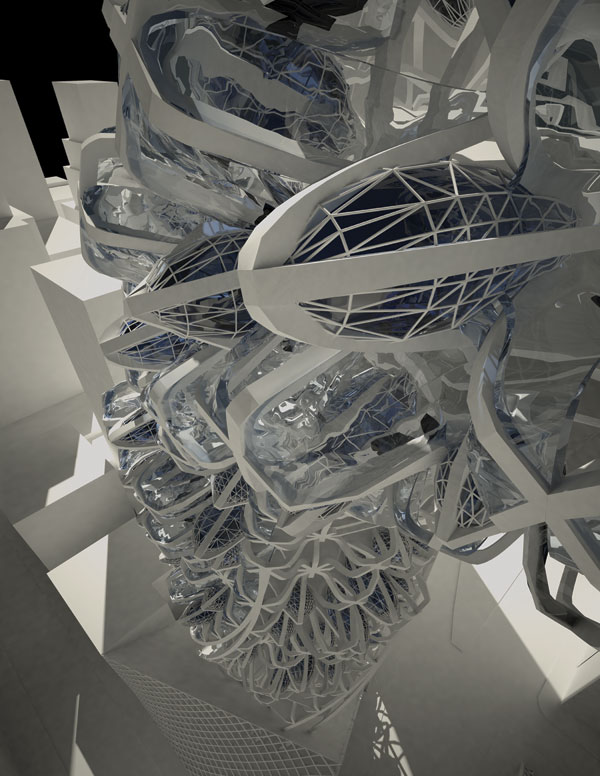
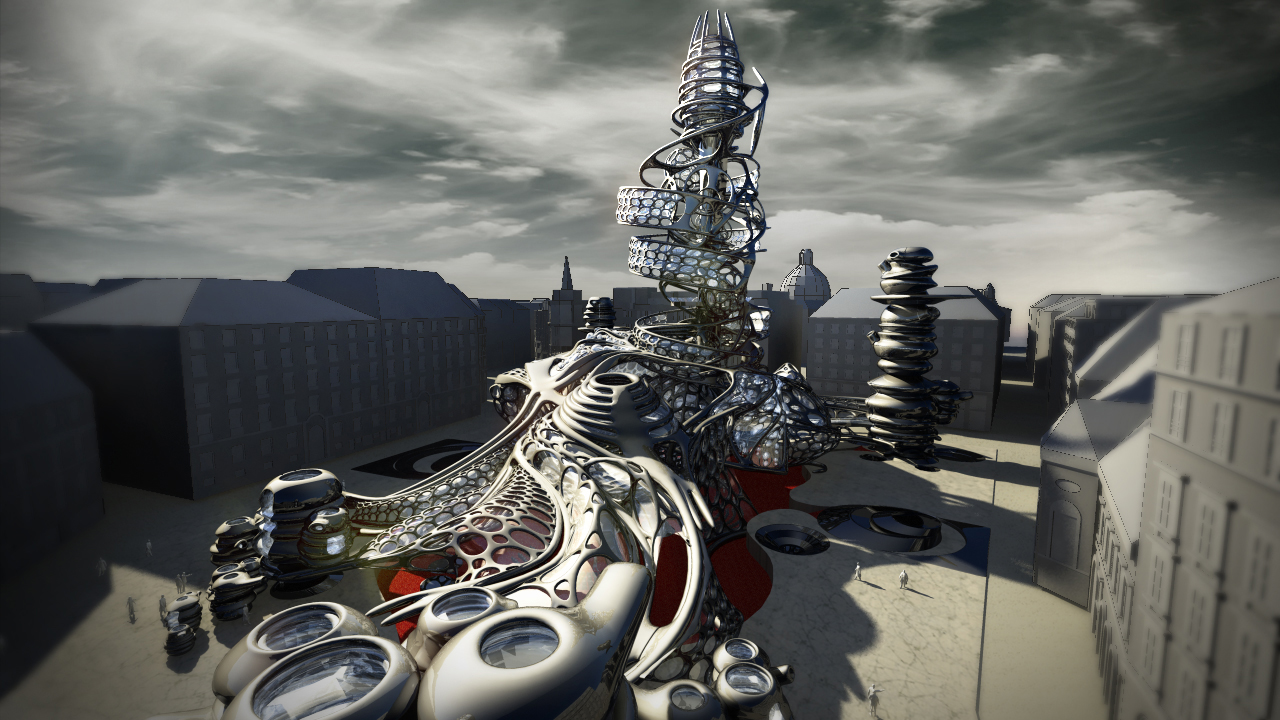
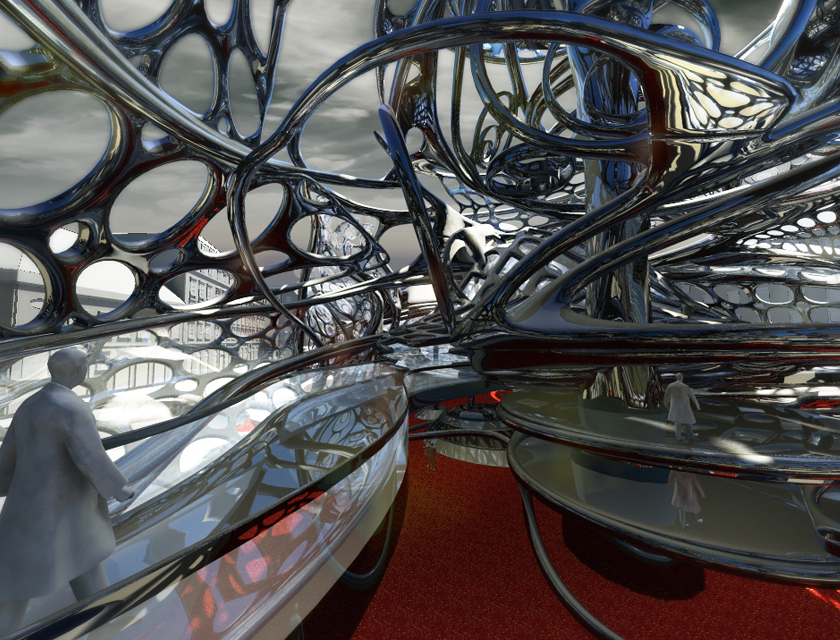
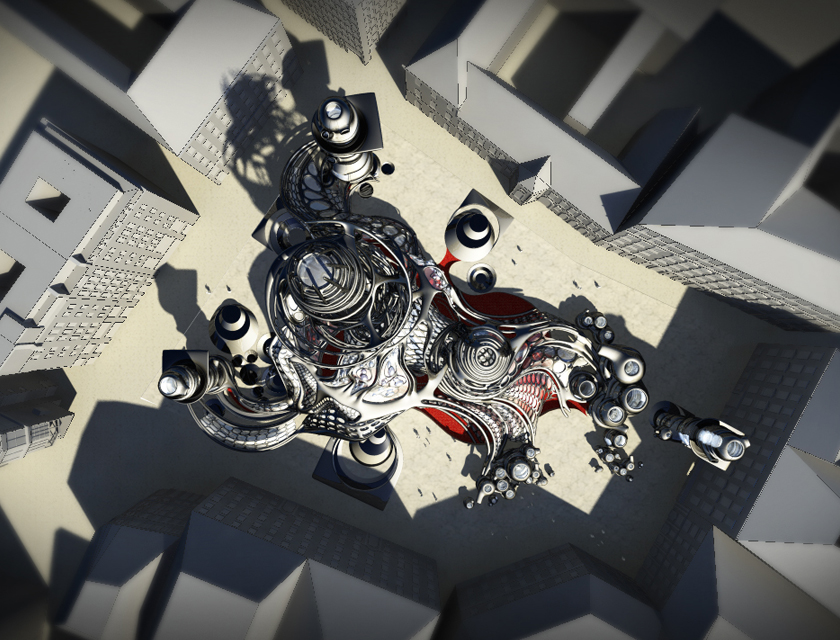
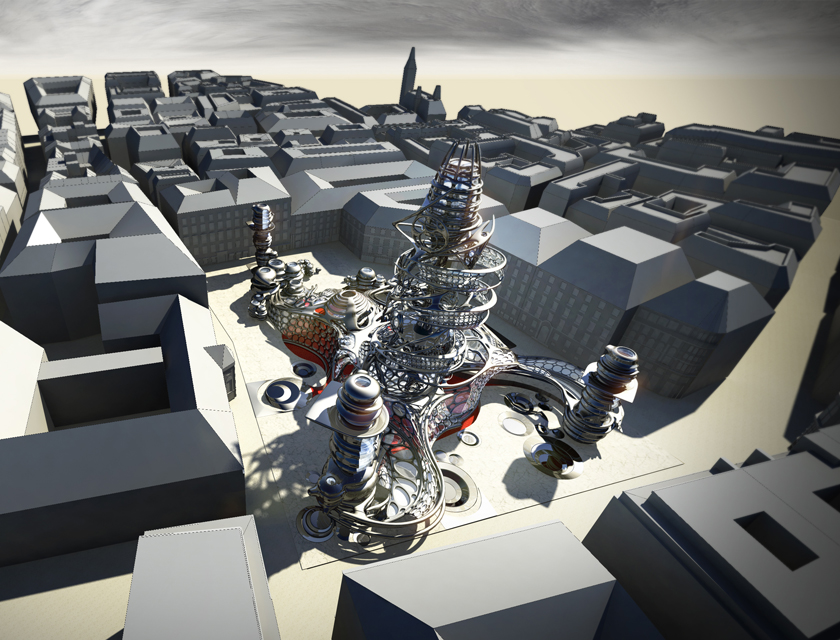
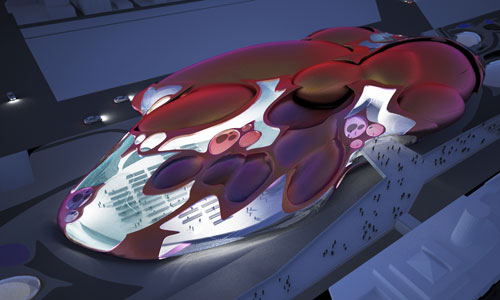
The Loop Cathedral for Vienna, Austria designed by Chi Wai Chan examines various notions and typology of a religious building bringing it closer to contemporary requirements and sensibilities. Many feel that Catholicism is just a grandiose relic on the outside without much substance on the inside. This superficiality rather than spirituality becomes the main agent for the explorations.
The project manifests the notion and affect of an ‘Exquisite Corpse’ or a skeleton of fluid lines that flow together coherently to achieve the effect of ‘part becomes whole and whole becomes part’. The language is exuberant and excessive. It is dark and sinister like a cathedral in Gotham city. The iconograpic typology of a Gothic Cathedral was disseminated with formal elements of a tower and base to remain. Animated formal attributes and surface tessellations reinstitute the ornamental and decorative affect of a Gothic Cathedral. The cathedral as an institution exists only in excess.
via suckerPUNCH
Urban Landmark in Perth, Australia / AquiliAlberg
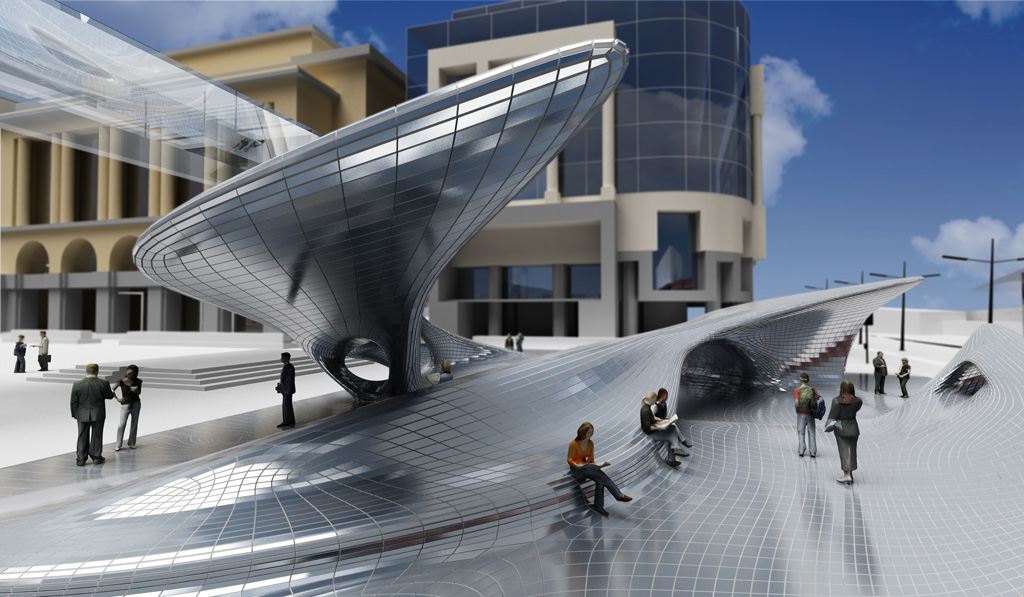
Italian architects AquiliAlberg unveiled their design for a new urban landmark in Perth, Australia. The project consists of a fluid folding surface that peels off from the ground to create three pavilions. The project is located at Forest Place, one of the most representative plazas in Perth and offers a new and exciting urban destination for the residents and visitors. The pavilions count with diverse seating and gathering areas as well as canopies and relaxation spaces. At night the project will be illuminated with multi-colored lights according to seasons, events, and celebrations. Read the rest of this entry »
Chengdu Contemporary Art Centre / Zaha Hadid
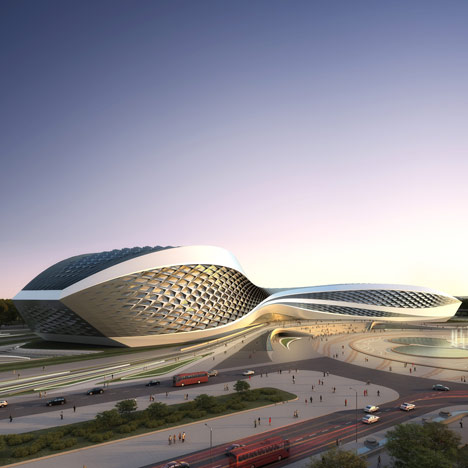
The result of an international design competition, the Chengdu Contemporary Art Centre (CCAC) designed by Zaha Hadid Architects will be a new cultural destination for Sichuan Province and will provide Chengdu with an unprecedented collection of world-class arts, performance, leisure, and congress venues. CAC will be a regional art and music centre of international standing. CCAC accommodates three auditoria, an art museum, an exhibition centre, a conference centre, a learning centre, bars, restaurants and shops.
The largest of the three halls, a multifunctional theatre, seats up to 2,000 people.The second hall caters for lyrical theatre and music events, with a seating arrangement of up to 870 people. The third auditorium will be used as a music hall. Designed for natural acoustic, this hall will provide space for an audience of up to 1,000. The conference centre comprises 8,000m2, which can be separated into 16 equal and independent accessible conference rooms. A flexible 10,000m2 exhibition centre is located at the main entrance level. The art museum comprises approximately 15,000m2 net exhibition area which is located below the roof and will take advantage of natural lit exhibition spaces. Our design aims to resolve the complexities of the programme, while combining spatial clarity with the design of a unique and iconic structure. Read the rest of this entry »
Centre for Promotion of Science in Belgrade, Serbia
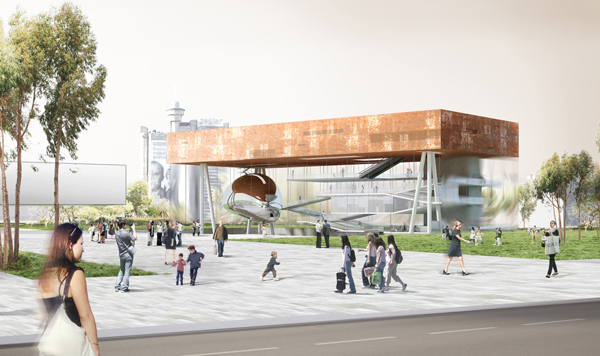
The Centre for Promotion of Science in Belgrade, Serbia designed by Austrian architect Wolfgang Tschapeller will be an institution of service and a national bank of knowledge in the field of science. It will organise innovative and educative exhibitions, and bring science closer to the people. The main goal of the Centre for Promotion of Science will be to facilitate scientific education, a continuous training as well as social and economic growth, both with direct action, and in partnership with other actors – primarily the Ministry of Science and Technological Development and the Ministry of Education.
The Centre will be floating high above the ground. It will operate in 3 main levels. On the level of the City it will be an optimistic sign positioned on one of the main routes of the capital. For the Blok 39 it will be a sign, a canopy and a portico. The building being programmed to promote sciences, it plays on visions of technology and construction. The architectural language of the centre will be one of state-of-the-art technology and the display of structural principles. A special role is given to the underside of the centre; it will have mirroring qualities, able to reflect all the movement on the ground as well as the visitors that by entering the centre are penetrating the reflections of the earth’s surface. Read the rest of this entry »
Kaohsiung Cruise Terminal / Emergent
The design for the Kaohsiung Cruise Terminal by Emergent is interior driven, biasing building section, and interior spatial effects. The goal is to create a cavernous space which will appear simultaneously massive and lightweight. The project oscillates between volume and surface, avoiding the limitations of exclusively surface-based and volume-based architectures.
The Port Services Center, made up of string of hard elliptical volumes, is pushed down into the soft bubble of the Ferry Terminal, so that exterior skin becomes interiorized. This nesting action allows for functional division between the programmatic elements while creating complex interior formations. While the Ferry Terminal is oriented towards the inside, the Port Services Center– consisting primarily of offices– is oriented towards the outside, with views out to the city and the ocean. It is a building within a building. The skin of the Ferry terminal is constructed out of transparent ETFE membrane and hard fiber-composite Armor Plates. These Armor Plates operate as both structure and ornament. They create stiff zones in the skin where the membrane can be affixed. Ultimately, the construction system is a hybrid of shell and membrane construction types– what we now call Shell-branes. Read the rest of this entry »
Kaohsiung Marine Gateway Terminal / Asymptote
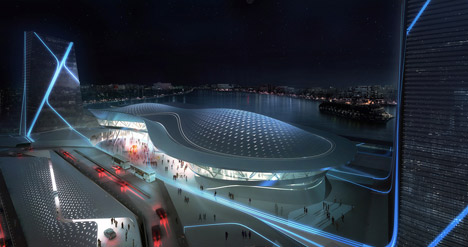
The new Kaohsiung Marine Gateway Terminal designed by Asymptote is a new state of the art transportation interchange, an urban destination with both terminal and public facilities including exhibition and event spaces for the people of Kaohsiung as well as for national and international visitors. The project transforms the site from its industrial roots into a dynamic urban hub and a global gateway that bring a powerful and electric experience to the city 24 hours a day. The port terminal as envisioned by Asymptote is designed to invigorate and activate Kaohsiung’s city edge at the water. The port terminal extends the urban realm from the center of Kaohsiung to the city’s waterfront and connects this new urban space with the vitality of the future Pop Music Center and other public recreational and commercial activities that are to be located along the planned park at water’s edge.
Key components of Asymptote’s design are two elegant towers, a sculptural terminal hall that is framed and hovers in an elevated position between them, and a plinth below that connects the towers and accommodates a new public urban space. This open plaza is an articulated yet continuous public space that is located at the very intersection of circulation paths that seamlessly draw the urban space of Kaohsiung into the heart of the project through to the water’s edge and back towards the city. These provide access to a number of important public spaces and programs as well as contribute to the dramatic entry sequence to the port facilities. This intertwining of public and private access as well as programming creates an activated public realm, providing a unique experience to ship passengers and city dwellers alike. The curved form of the terminal hall sits delicately yet majestically above the large open plaza activated by the flow of people moving back and forth between the harbor and the city. From the city, the terminal forms an urban scaled aperture that frames the harbor and water beyond. The sculpted underside of the floating building provides shelter to the urban space from the strong sun and seasonal rains while at night it provides dramatic illumination for the ongoing public activities, events and celebrations. Read the rest of this entry »
Greg Lynn’s Fountain for the Hammer Museum
Greg Lynn’s Fountain is the first architecture and design project guest-curated by architectural historian Sylvia Lavin. As part of Hammer Projects, Lavin will organize a new project approximately once a year over the next three years that will present new works by architects and designers. These projects will be sited in different locations around the Museum.
“I was influenced by an ex-assistant of mine who stayed on in my position at the ETHZ named Matthias Kohler who is using robotic arms to place standard masonry units like bricks and blocks as well as Office DA who must have inspired him by building something similar in China with intricate brick patterns using manual labor and curved templates. I was interested in an intricate approach to masonry but instead of geometries of how to place bricks I decided to start with a new kind of brick itself. A hollow plastic lightweight brick that would be cut intricately in order to achieve complexity of surface as well as rustication (a quality I admire in the baroque architecture and sculpture); all without use of mortar for tolerance. My wife, Slvia Lavin suggested that the best scale for these new hollow plastic bricks (Blobwall and Toy Furniture) was a Fountain. Once the typology that was her idea was in place I started looking at Bernini’s fountains around Rome in particular. I realized that as sculpture they were too busy (they were assembled out of many many parts including turtles, elephants, fish, dolphins, shells, human figures, serpents, etc…) whereas as architecture they were figural and made out of relatively few pieces. I was inspired by this typology of the fountains that had more discrete pieces than sculpture but fewer more figurative parts than a building.” – Greg Lynn Read the rest of this entry »