Chernobyl Skyscrapers Network

By:  | March - 7 - 2011

Honorable Mention
2011 Skyscraper Competition

Mengni Zhang
United States
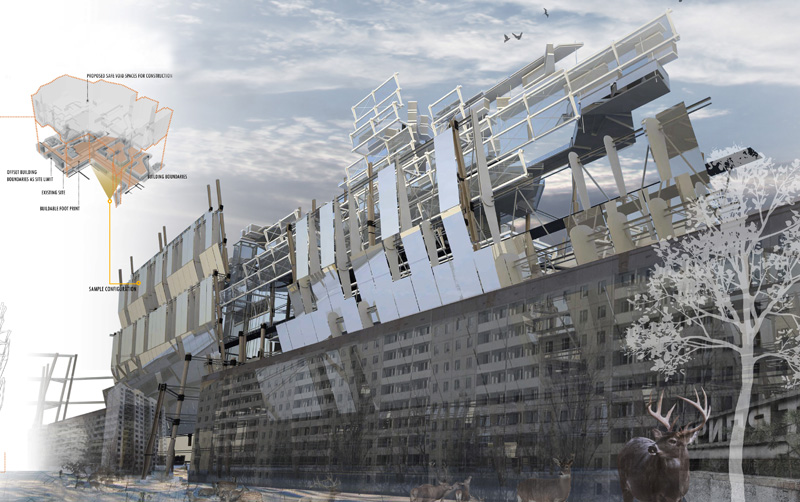
In December 2010, the Ukrainian government lifted the restriction on tourism in the zone around the Chernobyl power plant. Conceptually, this proposal deals with the reconstruction of a post apocalyptic environment. Since the accident in 1986 the site has been abandoned long enough for nature to take over, the absence of humans provides an opportunity for creating a utopian vision for a city. The proposed structure would engage the existing site and architecture as a new layer of landscape, a network of self-evolving skyscrapers that will address scientific, cultural, and historical concerns.

Due to the unpredictable distribution of fallout materials and possible radiation, the primary structure will be manufactured with light-weight fiber composite materials and fixed and transported onto the site by air. Secondary structures, such as highways and other programs, can be built above ground like cantilevered bridges. Read the rest of this entry »
White Cloud Skyscraper

By:  | March - 7 - 2011

Honorable Mention
2011 Skyscraper Competition

Adrian Vincent Kumar, Yun Kong Sung
New Zealand

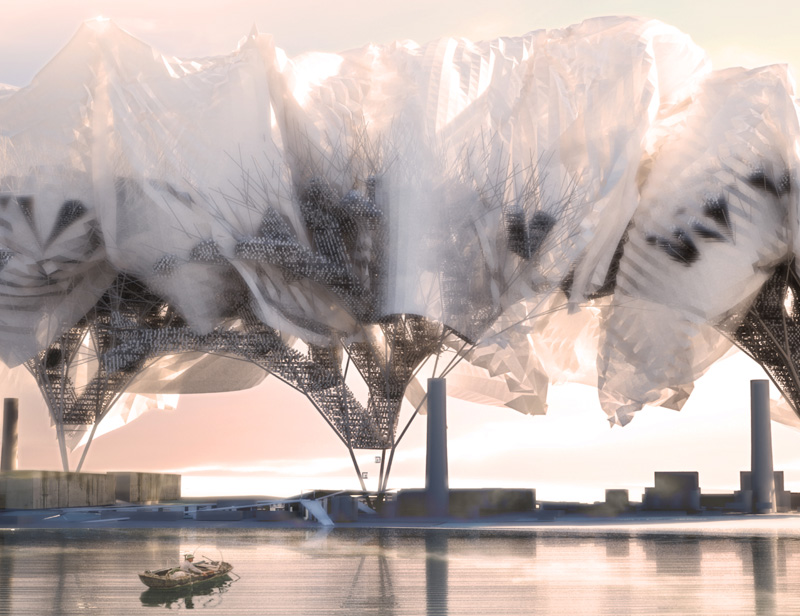
Air pollution is a major problem in the city of Guangzhou, China. The main contributor to the air quality is the outrageous number of industrial facilities within the metropolitan area.

The White Cloud Project is an air purification network of skyscrapers. These are inverted buildings that liberate the base for public use and create a cluster of structural branches with residences and offices on top – almost like a group of trees. The structure is covered by a fine membrane that cleans the air through an ingenious filtering process. The air particles are trapped by the cloth-like structure and washed away by a constant mist. At the same time the collected dust is transported through a secondary branching system to a brick factory on the bottom. Read the rest of this entry »

Coalesce Skyscraper

By:  | March - 7 - 2011

Honorable Mention
2011 Skyscraper Competition

Justin Oh
Canada

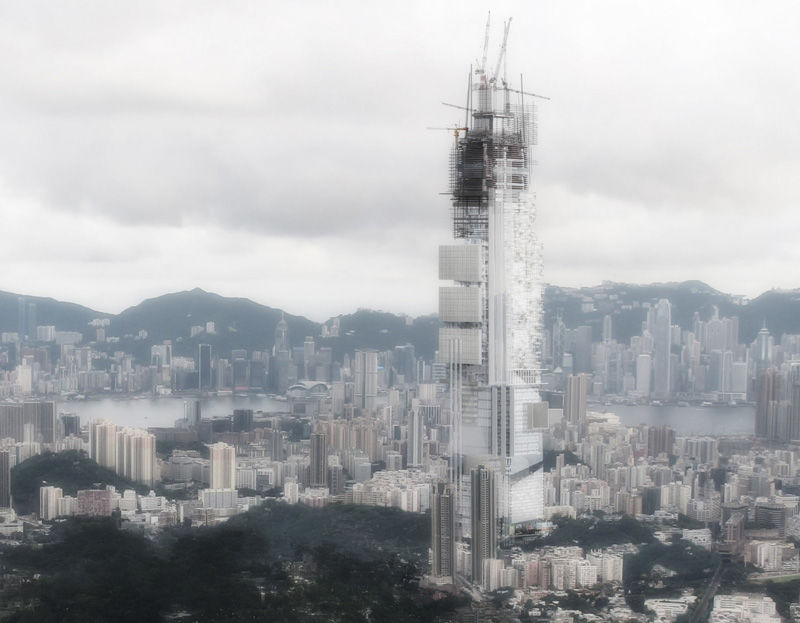
The final height of this skyscraper has not yet been decided, as perpetual development of the project has continued for more than twenty years. Its rich history can be witnessed and analyzed through the changes in the facade, the same way history can be seen in layers of stone or the rings of a tree. The architecture of the skyscraper changes as each firm contributes their own unique design proposals for the next addition to the tower’s elevation – mankind’s skyscraper project of the twenty-first century.

Hong Kong’s Kowloon side is Corbusier’s Plan Voisin, compressed and multiplied. Victoria Harbour has decreased to accommodate endless developments as the majority of the population live and work in skyscrapers. The principles of Coalesce are to discontinue Hong Kong’s public housing estate-style developments and remove existing estates in order to unite the parks on the Kowloon side. The equation of the project: recreational green space substitutes each estate razed, and with each estate razed, the equivalent amount or more leasable area is added to the central skyscraper. With an increase in green concentration at the heart of Kowloon, the district is expected to experience a drop in its uncomfortable temperatures and filter polluted air, while providing recreational space and facilities. Read the rest of this entry »
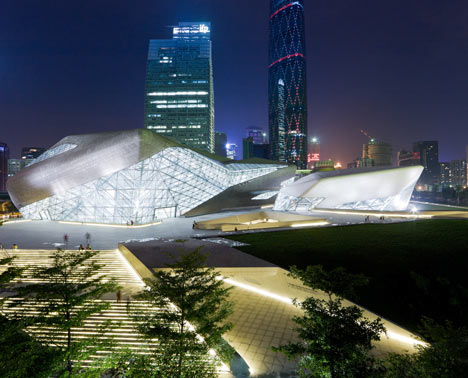
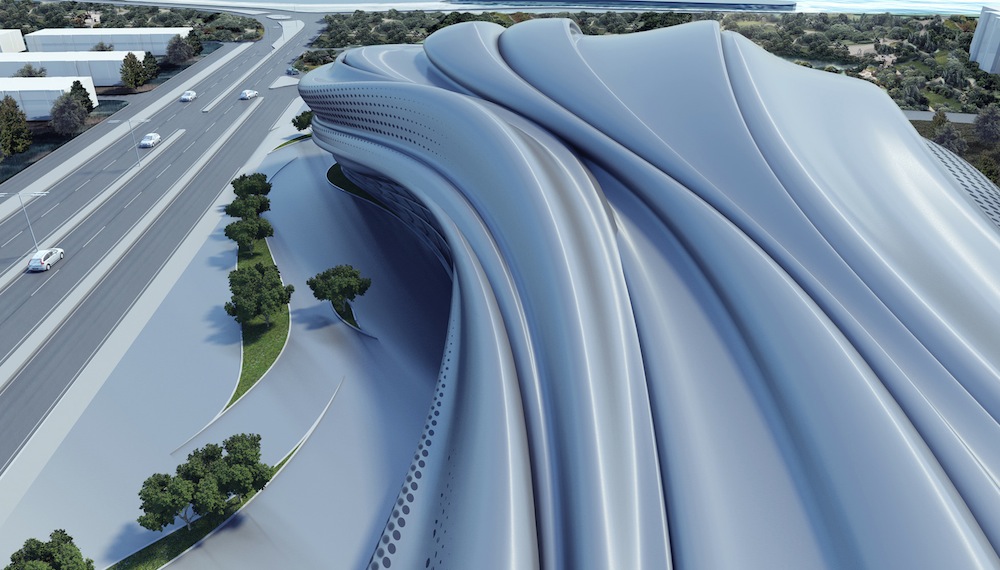
Zaha Hadid Architects announced the completion of the Guangzhou Opera House. The opening ceremony was held this weekend with representatives from various countries around the world. Like pebbles in a stream smoothed by erosion, the Guangzhou Opera House sits in perfect harmony with its riverside location. The Opera House is at the heart of Guangzhou’s cultural development. Its unique twin-boulder design enhances the city by opening it to the Pearl River, unifying the adjacent cultural buildings with the towers of international finance in Guangzhou’s Zhujiang new town. The 1,800-seat auditorium of the Opera House houses the very latest acoustic technology, and the smaller 400-seat multifunction hall is designed for performance art, opera and concerts in the round. Read the rest of this entry »
Boston’s TREEPODS INIATIVE proposes to embody, and artificially enhance, the most important biological characteristic of natural trees: the capacity to clean the air, taking the CO² and releasing O².

Boston’s TREEPODS INIATIVE is a sustainable project leaded by Influx_Studio and ShiftBoston. The aim ff this collaboration is to allow the achievement of Boston’s global goals in terms of carbon reduction programs in the short time, giving us enough time to make the change from the present fossil fuel economy into a new Zero carbon energy economy.

The proposal could be define as a CO2-scrubbing living machine. Treepods may well redesign in an urban radical new way our polluted urban environment, interacting with natural trees, and enhancing its carbon absorption capacity. In that way, those artificial trees don’t replace the natural ones, but they act like small urban “air cleaning infrastructures”. Advanced technologies are actually already developed that allow the capture of the atmospheric carbon dioxide from ambient air in an efficient, economic and sustainable way. Developed by Dr Klaus Lackner, Director of the Lenfest Center for Sustainable Energy at Columbia University, this revolutionary process is based on the discovery of the ‘humidity swing,’ a technology that enables the energy-efficient capture of CO2 from air, allowing to close the carbon cycle and creating a valuable product for beneficial use. Read the rest of this entry »

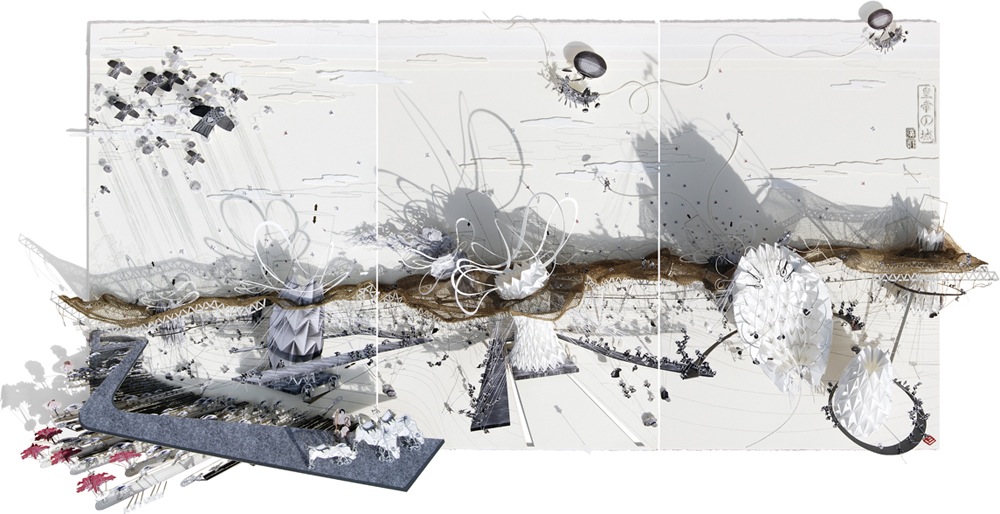
The Emperor’s castle designed by Thomas Hillier originates from a mythical and ancient tale hidden within a woodblock landscape scene created by Japanese Ukiyo-e printmaker, Ando Hiroshige. This tale charts the story of two star-crossed lovers, the weaving Princess and the Cowherd who have been separated by the Princess’s father, the Emperor.

The story begins with four acts that explore the relationships between these characters. Act I introduces the characters illustrating the moment the Princess and the Cowherd fall in love. As time passes the happy couple begin to neglect their duties. The Emperor being a stern ruler who does not tolerate idleness decided to punish the lovers, separating them by a deep and swift lake unassailable by any man. In the final act the Princess’s flying friends the magpies form a feathery bridge across the lake allowing the Princess and Cowherd to renew their pledge of eternal love.

These characters have been replaced and transformed into architectonic metaphors creating an Urban Theatre within the grounds of the Imperial Palace in central Tokyo. The Princess, a flexible, diaphanous knitted membrane, envelopes the spaces below and is fabricated using the surrounding Igusa rush to knit itself ever larger in aim to reach the grass parkland perimeter representing the Cowherd. Linked within this skin is a series of enormous folded plate lung structures. These origami lungs of the Emperor expand and contract creating the sensation of life. The lungs, deployed around the site act as physical barriers that manipulate the knitted skin as it extends towards the outer parkland, these manipulations are controlled and articulated by the Emperor’s army using a series of complex pulley systems which pull back the lungs and the surrounding skin. Read the rest of this entry »

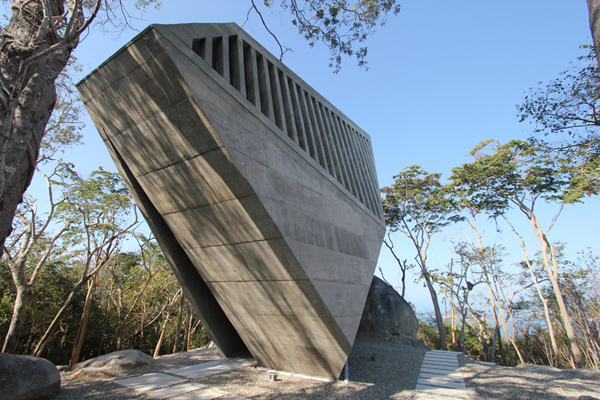
Award-winning Mexican firm BNKR Arquitectura just completed a stunning chapel that overlooks the famous Acapulco Bay in Mexico.

“Our first religious commission was a wedding chapel conceived to celebrate the first day of a couple’s new life. Our second religious commission had a diametrically opposite purpose: to mourn the passing of loved ones. This premise was the main driving force behind the design, the two had to be complete opposites, they were natural antagonists. While the former praised life, the latter grieved death. Through this game of contrasts all the decisions were made: Glass vs. Concrete, Transparency vs. Solidity, Ethereal vs. Heavy, Classical Proportions vs. Apparent Chaos, Vulnerable vs. Indestructible, Ephemeral vs. Lasting…

The client brief was pretty simple, almost naïve: First, the chapel had to take full advantage of the spectacular views. Second, the sun had to set exactly behind the altar cross (of course, this is only possible twice a year at the equinoxes). And last but not least, a section with the first phase of crypts had to be included outside and around the chapel. Metaphorically speaking, the mausoleum would be in perfect utopian synchrony with a celestial cycle of continuous renovation. Read the rest of this entry »
Antartic Observatory / Tada Studio

By:  | February - 28 - 2011

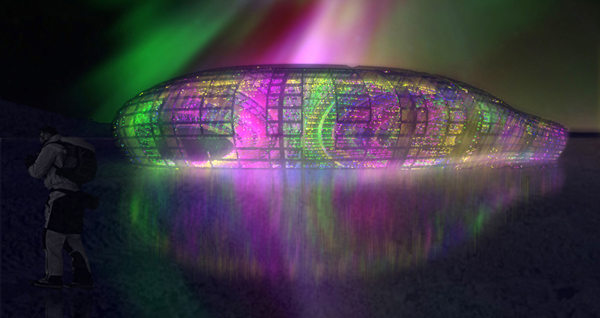
The Antarctic Observatory is a small project designed by Borja Abellán, a member of Tada Studio. The project was designed to control Antarctic Icebergs. The form of the observatory allows snow to provide thermal insulation and water supply. It is half-buried and the facade is translucent, because there are 6 months of daylight.

All modeling has been done with Grasshopper through parametric production and to be able to calculate its adaptation to different solutions and facilitate the analysis of structural elements -using CAD-CAM methods the construction is planned to be easier than normal. Read the rest of this entry »
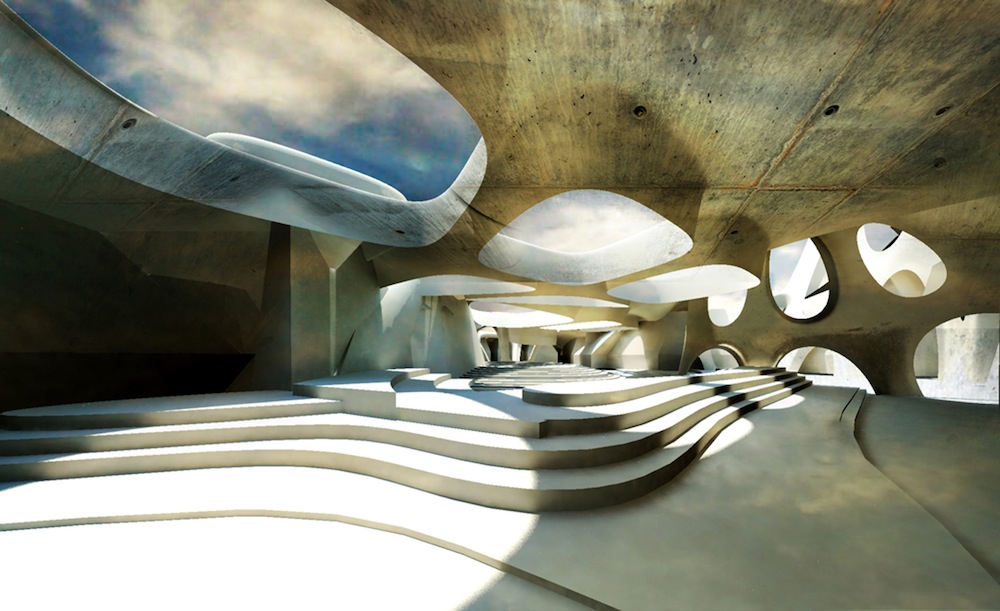
The Cultural Campus designed byKadri Kerge, Jelena Vukmirovic, and Melanie Kotz is to be located near Ismailia, 80km north-east of Cairo, is a self sustainable organism, dealing with extreme climate. The campus consists of a School of Performing Arts (Music, Dance), a School of Visual Arts, a Residence Complex to house students and staff, a Performance Center for Music and Dance and a Contemporary Art Exhibition Gallery. The project is seeking for a new way of creating a modern campus by rediscovering typologies of private and public spaces, and connections between them. Read the rest of this entry »

Opera House in Izmir, Turkey

By:  | February - 24 - 2011

Art has a great role in showing what happens in human beings’ life. Soul, intelligence and the emotions are the reflections of the community, and Art forms the social identities of communities. It also shows us the difference between the various social identities. Global influences effect the types of knowledge acquisitions or the social values in the art, and the artists determine the standards of modern life.

Thus, art centers have many roles beside their fundamental functions that should be participant, shared with society and create a modern level in connection between the citizens and the artists’ works. This concept is the key criteria for the Izmir Opera House Project designed by Emrah Cetinkaya. The project should be reflecting the history, the culture and the modern life in Izmir, furthermore it should be an identity for the city of Izmir.

And competition area also allows us to create an identification or a symbol for a city that because the area can be seen clearly from near surroundings and specially from sea side areas. This situation came to the forefront. So we considered important in it.

Izmir opera house has been designed for being a symbol for izmir. In this way, we thought that izmir will be a center of attraction and also first recognizable preparation place for all domestic and foreign tourists. Read the rest of this entry »