Genetic Architecture – Housing

By:  | January - 29 - 2010

Special Mention – 2007 Housing Competition
Project by: Francesco Gatti, Francesco Lipari, Aurgho Jyoti, Summer Nie

genetic-architecture-1

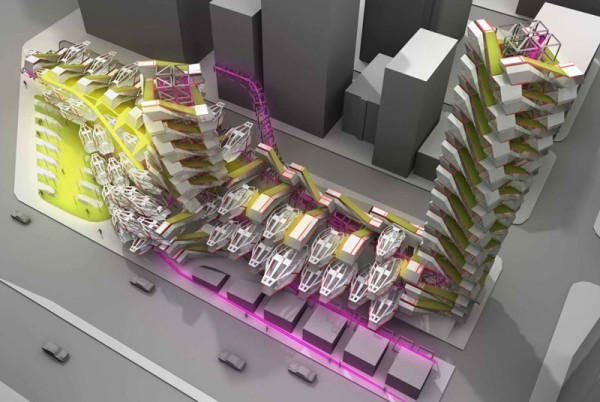
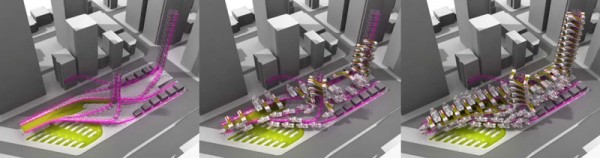
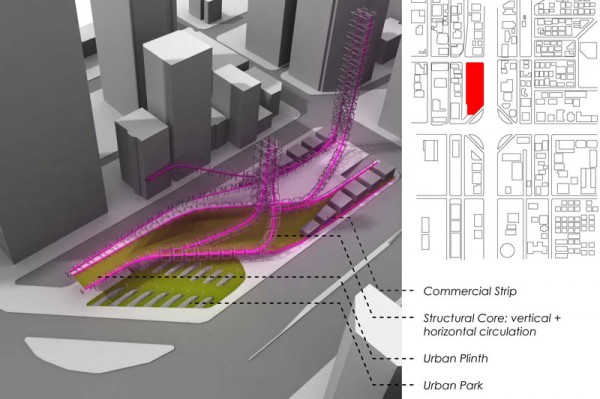
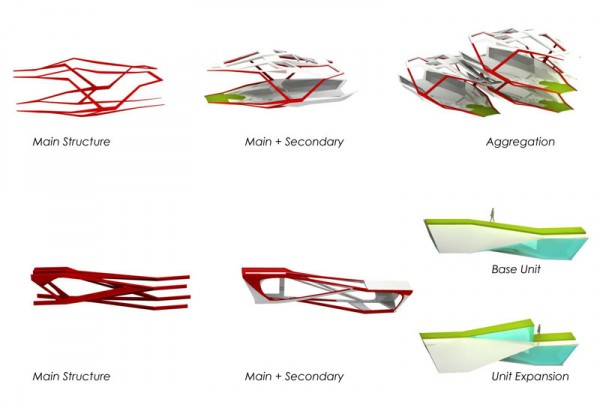
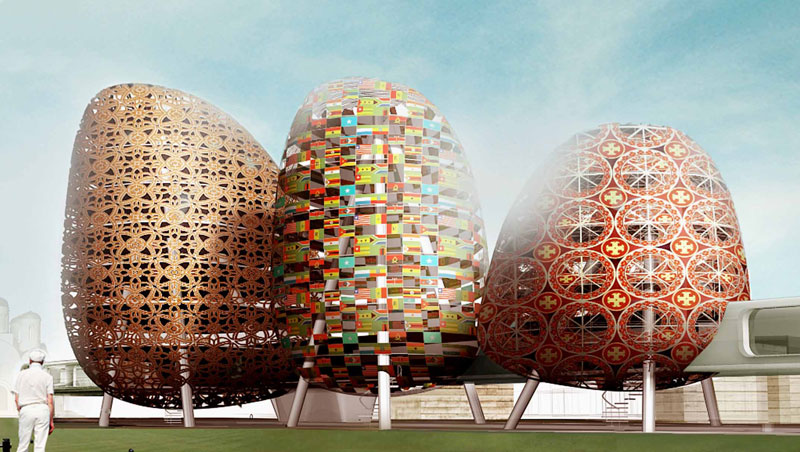
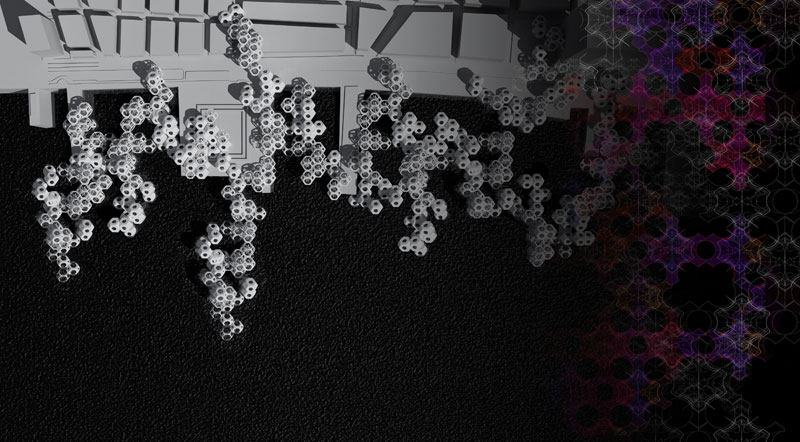
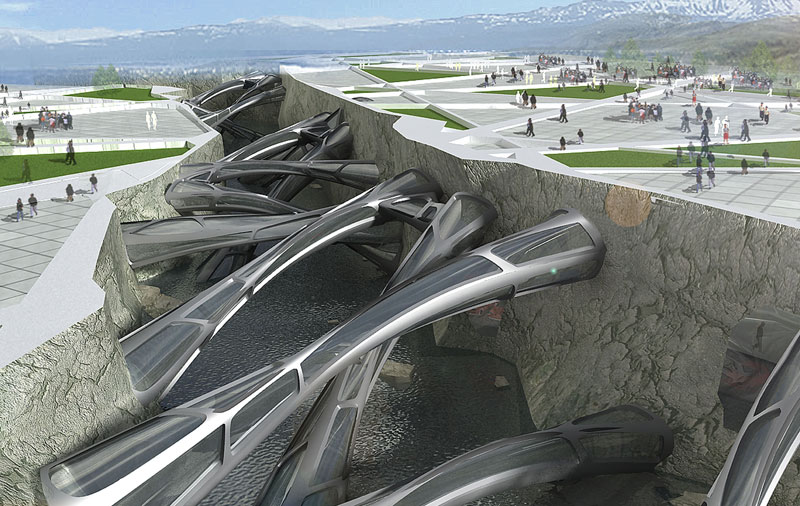
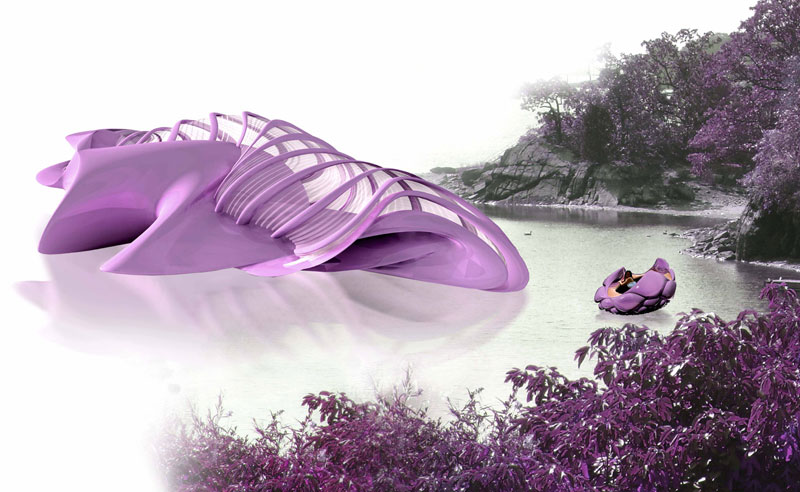
With the convergence of computation and biogenetics in the latter part of the 20th century and subsequent completion of the Human Genome Project, we are now witnessing the emergence of a post-human era, which will transform the way we think and interact with the world at large. Genetic architecture is based on the philosophical notion of genesis.

The design ideates from an existing technological research to generate skin systems as cladding material for a building. Researchers at the Beckman Institute, University of Illinois, have developed the next generation of self-healing material, which mimics human skin by healing itself time after time. Fidia Advanced Biopolymers in Italy has produced innovative technologies that enable human tissues such as cartilage and skin to be regenerated in a laboratory. With the DNA of a particular type of skin, the same skin is produced by the company in required amounts. Read the rest of this entry »

Algorithmic Housing

By:  | January - 28 - 2010

Third place of the 2007 Housing Competition
Project by: Marcin Pilsniak

algorithmic-housing-1

New Housing for Shanghai

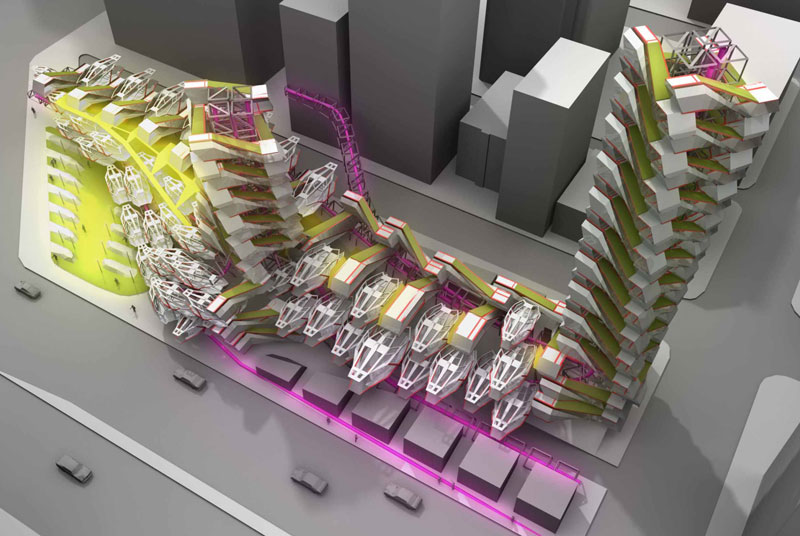
The aim of this project is to explore possible solutions to housing problems in rapidly developing cities worldwide. 

Shanghai was chosen as the location for this study because it is affected by extreme poverty, social segregation, and lack of housing developments.  The city has two radically different faces; the rich and polished, and the poor and crammed, who live with a population density of less than 15 square meters per person.  These problems are the result of a massive influx of people with very low income, who constitute over 60 per cent of its population.  Two age groups are especially affected throughout the city; young adults, with little capital to invest, and elderly residents, that cannot continue working in the physically demanding labor market. Read the rest of this entry »

Housing + Infrastructure

By:  | January - 28 - 2010

Second place of the 2007 Housing Competition
Project by: Tat Lam

housing-infrastructure-1

‘Housing + Infrastructure: An active planning strategy subsidizing low income public housing’

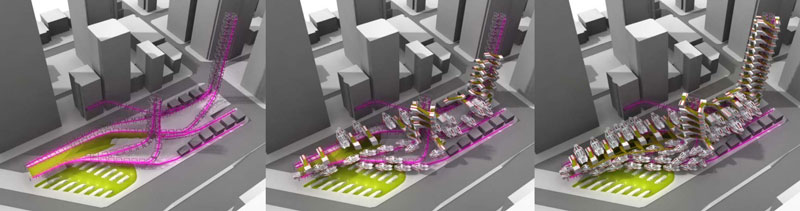
Housing inequity is a common phenomenon throughout the world, in both developed and developing countries. The reasons for this phenomenon are many, but the main factor is the rapid development of the city and the privatization of lands and infrastructure without an adequate urban study. Conventional solutions are generally political and few considerations have been taken from the strategic planning of the urban space. Read the rest of this entry »

Underwater Architecture
During the next few days we will showcase 5  proposals for sustainable underwater architecture. These projects were submitted for the Annual Skyscraper Competition from 2006 to 2009.

Project 5 of 5


Underwater Architecture


The year is 2046 and the North and South Pole icebergs have melted, more than 40 percent of the Earth’s surface is underwater. The challenge is to build a skyscraper undersea with movable spheres and conducting tissue structures. Read the rest of this entry »

First place of the 2007 Housing Competition
Project by: Eduardo McIntosh

temporal-housing-8

Housing, like the majority of architectural genres, has always been a permanent construction attached to the ground for long-term residence. This project explores the possibility of creating a nomadic type of dwelling that should be seen as an industrial product rather than architecture.

In the 1960’s, Archigram designed a ‘Walking City’ in which an entire community could move from one place to another. Although a very innovative concept, it has been proven to be economically and technologically unfeasible over the last 50 years. ‘Capitalist Symbiosis’ is a small scale version of Archigram’s utopian vision, a small inhabitable transportation unit for the global resident. It is consumer product, just like ipods, laptops, and mobile phones. Read the rest of this entry »

Underwater Skyscraper

By:  | January - 27 - 2010

Underwater Architecture
During the next few days we will showcase 5  proposals for sustainable underwater architecture. These projects were submitted for the Annual Skyscraper Competition from 2006 to 2009.

Project 4 of 5

Higinio Llames, Ifigeneia Arvaniti
Spain


Inverted Skyscraper


This proposal understands the need of living in harmony with nature in a sustainable way. There is a close relationship between the building and its surrounding. It could be described as a surface that holds an inverted skyscraper under the sea. The “living spaces” below the sea are independent units with living and working areas while the gathering spaces, farmlands, and recreational areas are located at sea level. Read the rest of this entry »

Floating Country

By:  | January - 27 - 2010

Underwater Architecture
During the next few days we will showcase 5  proposals for sustainable underwater architecture. These projects were submitted for the Annual Skyscraper Competition from 2006 to 2009.

Project 3 of 5

Kaung Jin, Hanjin Yoon, Hye Ri Kim
South Korea


Floating Country


During the last couple of years there has been an increased awareness of the ecological and urban threats of Global Warming. One of the smallest countries, a series of Polynesian islands, known as Tuvalu will be the first country to flood and disappear with the oceans rise. This project examines the possibility of a floating country built as a series of islands positioned like Tuvalu and interconnected by bridges. Read the rest of this entry »

Underwater Architecture
During the next few days we will showcase 5  proposals for sustainable underwater architecture. These projects were submitted for the Annual Skyscraper Competition from 2006 to 2009.

Project 2 of 5

Ha-Hae Kim
South Korea

Underwater City

This project is an investigation for an underwater skyscraper and an artificial island. It is the combination of a Mega Float and a Tension Leg Platform (TLP). Mega Float is a large artificial island and TLP is a buoyant platform held in place by a mooring system.

The submerged main hull of this “Underwater Wonderland” is stabilized by the platform that uses moorings in tension to keep its position.  The main body is an inverse cone with a concrete core that handles the load with radial steel beams at every 30 meters and Tuned Massed Damper to control vibration caused by lateral forces. Read the rest of this entry »

Underwater Architecture
During the next few days we will showcase 5  proposals for sustainable underwater architecture. These projects were submitted for the Annual Skyscraper Competition from 2006 to 2009.

Project 1 of 5

Keith Dewey, Clayton Cowan, Robert Jakovina
Canada

underwater-architecture-3

Gyre creates a new class of eco-tourism by bringing scientists and vacationers together to understand the least known environment of our planet.  As much as a skyscraper is an economical method of reducing footprint on land, Gyre goes a step further by juxtaposing those footprints to the ocean. Its unique design permits the simultaneous application of wind, solar and tidal energy generation technologies. Peaking at a depth of 400 meters, its ample space provides for a comfortable living and working environment, including areas for shops, restaurants, gardens, and recreation. Read the rest of this entry »

Seascraper – Floating City

By:  | January - 25 - 2010

Green Skyscrapers
In the next few days we will showcase 25 innovative proposals for green skyscrapers. These projects were submitted for the Annual Skyscraper Competition from 2006 to 2009.

Project 25 of 25

William Erwin, Dan Fletcher
United States


Seascraper

Seascraper


As global population continues to rise, urban centers are becoming increasingly dense. It will be necessary to develop areas previously believed to be uninhabitable. Seventy percent of the Earth’s surface is water; the Seascraper will provide a low impact sustainable living environment that reduces urban sprawl on land by allowing us to create dwellings in the ocean. The Seascraper is essentially a floating city. It will consist of homes, commercial space, and recreation areas. It will produce all of the energy necessary to support these functions. Read the rest of this entry »