Water-edge Housing in New York City

By:  | February - 2 - 2010

Special Mention – 2007 Housing Competition
Project by: Kyuseon Hong, Kyungjae Kim, Yongju Lee

hive-architecture-5

The water-edge condition of Manhattan has been gradually changed from a swampy sloped wet land to a horizontal hard concrete structure. Even though we have more area for development along the hardened horizontality, the natural environmental qualities have been drastically reduced. Furthermore, the concrete edge is also limiting the boundary of Manhattan’s growth with strict lines. Read the rest of this entry »

The eighth annual international awards competition has named a total of eight category winners, with sixteen additional projects awarded a “Highly Commended” prize by the panel of judges, selected from the hundreds of entries received.  The winning projects showcase an international range of projects and practices, with schemes hailing from Austria, Denmark, Japan, Lebanon, Netherlands, Saudi Arabia, Turkey, and the UK.

The Awards celebrate excellence in design whether for projects on the drawing board which may never be realised, through to projects where construction may have commenced, has created the showpiece design event during the MIPIM conference and exhibition. Read the rest of this entry »
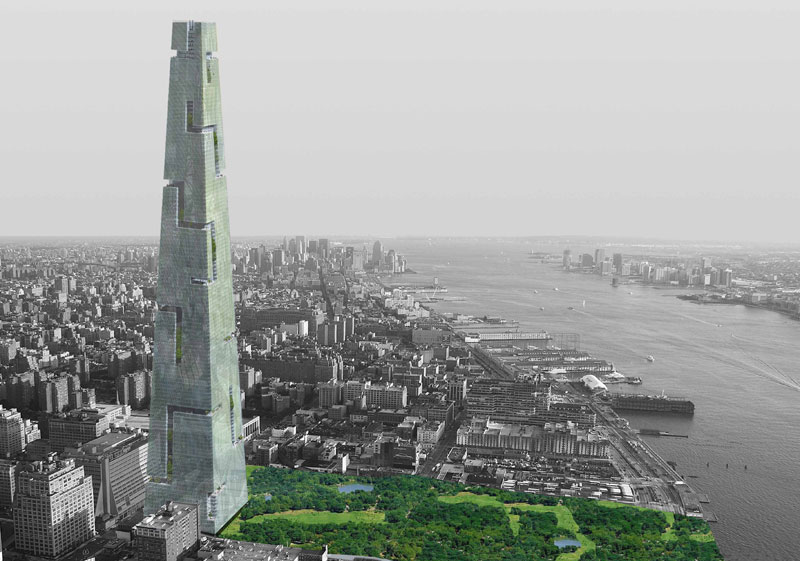
Mikado Housing

By:  | February - 2 - 2010

Special Mention – 2007 Housing Competition
Project by: Laurent Saint-Val, Alexandre Sarazin, Shahyar Shakiba

sticks-house-5

This project explores ‘Mikado’, a pick-up sticks game, as a way to establish design rules and physical/spatial connections for housing organization. The challenge is to create a mediating structure between physically adjacent conditions and public/private programs. This structure is formed by series of architectural ‘sticks’ which have different functions. The first type consists of connectors or bridges, which are used to link different programs. The knots are the areas where different activities are mixed-up and generate a new type of architecture that is physically and theoretically different from traditional dwellings. Finally, the third group is made of flexible voids that provide balance and stability to the system. It is an investigation about fullness and emptiness and its relation to program and circulation. Read the rest of this entry »
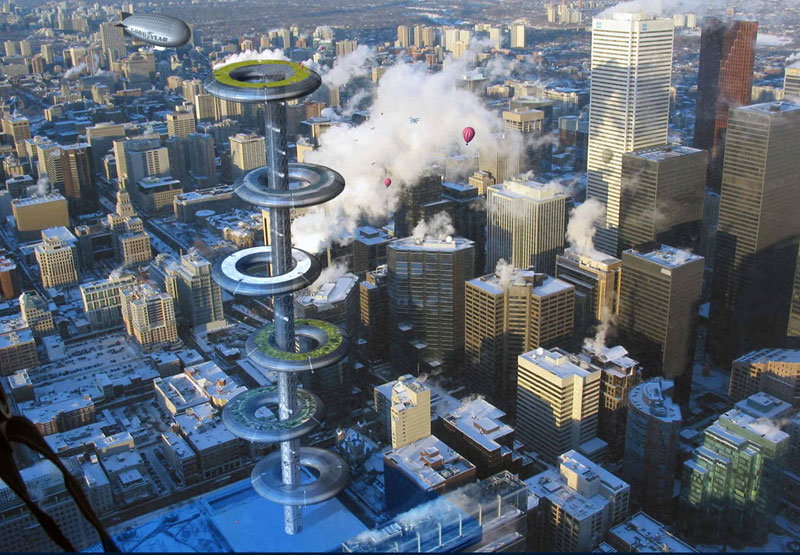
Railway Housing

By:  | February - 1 - 2010

Special Mention – 2007 Housing Competition
Project by: Rainer Erdkoenig, Mark-Anton Siskov

movable-house-1

The concept behind this project is the creation of a ‘Railway Housing’ network across New York City. This is a housing unit that has the ability of moving through the entire network, a temporary living, leisure or business location. It is also possible to buy permanent units in the designated areas. Read the rest of this entry »

Parametric Housing

By:  | January - 31 - 2010

Special Mention – 2007 Housing Competition
Project by: Joseph Choma

parametric-housing-1

Architecture Redefined

 All throughout history people have attempted to redefine the basic meaning of life.  How do you design for the future?  What is the future of housing?  When looking back on history, pre-fabrication became a popular process of mass production of similar units that could be easily assembled.  This process was invented during the industrial revolution when it became crucial for guns to have inter-changeable parts. Now, in an era of mass customization what does being pre-fabricated really mean? 

In the past, machine like processing has always had a direct correlation to human musculature, and making things easier and quicker to build.  Could a machine be based on conscience instead of muscle… like a computer science program? Read the rest of this entry »

Hybrid Evolutionary Housing

By:  | January - 31 - 2010

Special Mention – 2007 Housing Competition
Project by: Geoffrey Elander, Sang Duk Mo

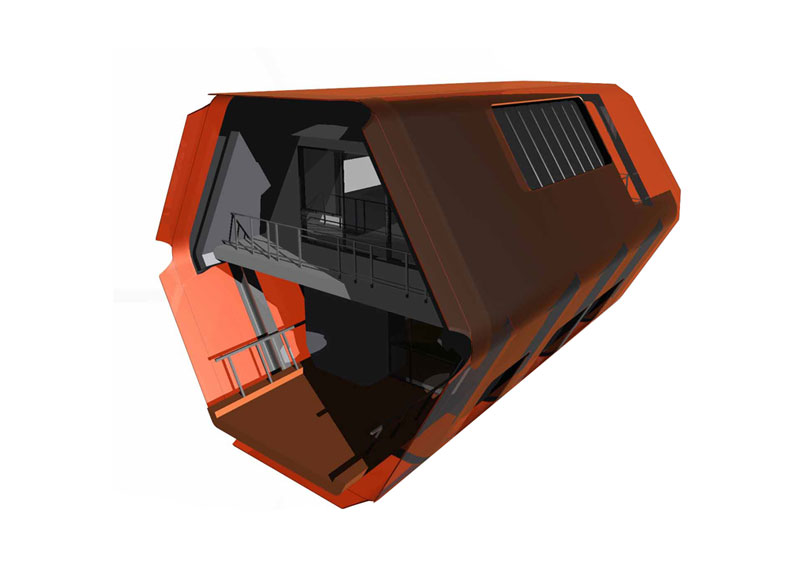
capsule-architecture-1

Hybrid Evolutionary Lifestyles

Accumulation Strategy
This is a community which will grow over time according to market demand. It is not a commercial tower, nor a residential tower, but a constant evolution of both. Central cores define a point of departure for the housing units to attach to and define circulation paths across the building. This system enables development over time and provides an elongated view of the site.

Site Strategy
The surrounding context is defined mostly by large residential and commercial towers which are outlined by areas of industrial and low-rise housing. In response to these conditions two main gestures define the organization of the building throughout the site:
1. Continuation of the density along the main corridor of the towers and creation of an open public space or urban plinth at the main intersection.
2. The height of the new development references the adjacent towers to provide visual continuity between the new construction and the existing buildings.

Structural Strategy
To support the prolonged growth of the new development, the vertical and horizontal circulations are used as structural cores in which the housing and commercial units attach to with their own secondary structure.

Unit Strategy
Two housing units were designed for single individuals and families. The family unit has the ability to expand with an additional module. Temporal units can be rented and placed for a few days or weeks at a time.

capsule-architecture-0

capsule-architecture-2

capsule-architecture-4

capsule-architecture-5

capsule-architecture-6

Shotgun Houses

By:  | January - 30 - 2010

Special Mention – 2007 Housing Competition
Project by: Zui Lig Ng

shotgun-houses-4

Shotgun Chameleon

Inspired by the Shotgun Houses in the Gulf Coast and the Creole Cottages in New Orleans this project is a prefabricated prototype designed to adapt to different types of climates and accommodate a wide range of programs.

The chameleon-like front screen provides a myriad of facade possibilities for different urban contexts and solar/wind orientations. The sides are made out of wood that can be painted in different colors to blend with the existing context. Billboards for commercial use are feasible in the ground floor and louvers allow breezes, provide privacy, and block direct sunlight. Vine trees could cover the screen and act as thermal regulator like the balconies in the French Quarter. The ground floor is delineated by two parallel load-bearing C.M.U. walls on post-tensioned concrete foundation. The rest of the house (floor, walls, and roof) is constructed with structural insulated panels that are economical, quick to install; an advantage of pre-fabrication. Read the rest of this entry »
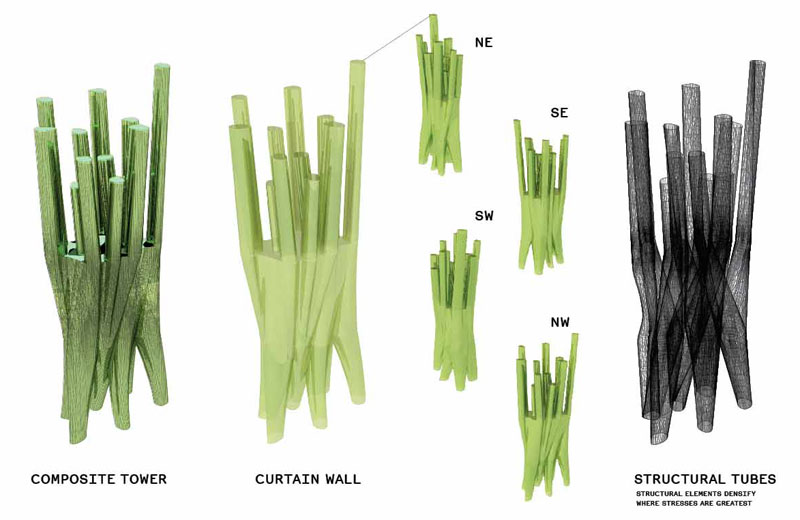
Resilient Stretch Housing

By:  | January - 30 - 2010

Special Mention – 2007 Housing Competition
Project by: YeaHwa Kim,  Ji Young Kim

queens-housing-1

Gradients of Transition:  A Resilient Stretch System

Our concept for the 21st century housing emerges from the complex demands of humans, and their interaction with the environment through technology.  The location of the project is the Bland House in Flushing Queens, New York, where there is a mixture of different cultures, businesses, and social classes that are interconnected through a complex system of transportation hubs. Read the rest of this entry »
Special Mention – 2007 Housing Competition
Project by: Anna Rita Emili, Barbara Pellegrino, Massimo Ilardi

underground-house-1

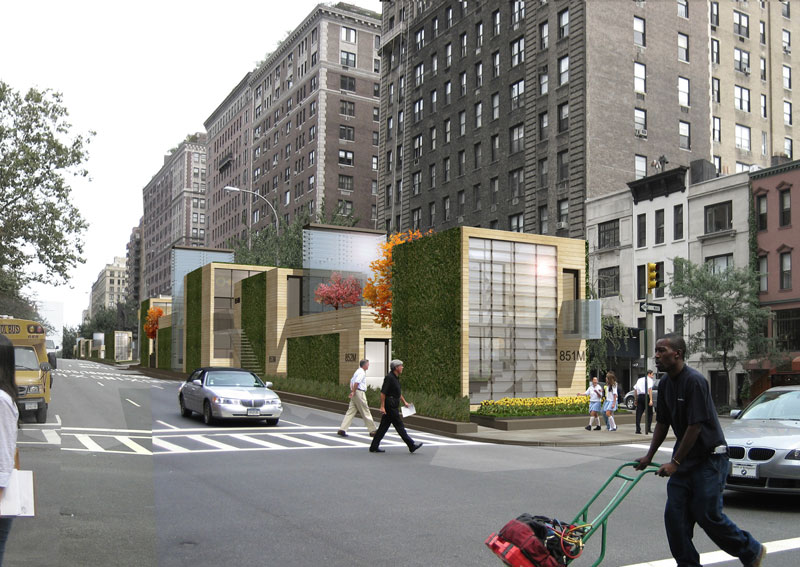
Imagine a landscape where the predominant colors shift from yellow to brown, where the only materials are sand and dry clay, and where variations are determined by slight differences in shades. Imagine yourself in a place characterized by contrasting elements; bright light, strong shadows, total darkness, torrid heat, and intense cold.  You will inhabit a place without references or variations.  

We propose a new kind of residence named ‘Well House’, a universally applicable dwelling or refuge with all the characteristics of hipogeos architecture. Our project is based on the Italian St. Patrizio’s sink, characterized by a series of spaces around a central space that contains water. Read the rest of this entry »

LM-Harbor-Steven-Holl-1

The Progressive Architecture Awards have honored Steven Holl Architects’ LM Harbor Gateway as one of nine 2010 recipients. The Awards are administered by Architect Magazine and this year’s winners were selected from a group of more than 300 projects by a jury including Stan Allen, Adele Chatfield-Taylor, Sarah Dunn, Diane Hoskins, John Peterson, and James Richärd. Read the rest of this entry »