3XN – Mind Your Behaviour

By:  | February - 11 - 2010

Mind Your Behaviour
How Architecture Shapes Behaviour

© Adam Mørk

© Adam Mørk

How can architectural surroundings affect your behaviour?

Architecture can get people talking together. Architecture can calm children in the classroom. Architecture can make passive people more active. Architecture can shape corporate culture. Architecture can encourage people to find new paths, discover new aspects of their city – and of themselves. In short, architecture can shape your behaviour.

Mind Your Behaviour opens February 12 at the Danish Architecture Centre. It will be on display until May 13 2010.

Mind Your Behaviour invites you to step in behind the scenes at one of the largest and most successful architectural companies in Denmark, 3XN, known for prestigious projects such as: Ørestad College, the new Denmark’s Aquarium, ‘The Blue Planet’, Saxo Bank’s award-winning head offices and the Danish Embassy in Berlin. Read the rest of this entry »

Mnemonic code – Digital Extension of the National Library of Austria
Heldenplatz, Vienna

Project by: Phillip Reiner

mnemonic-1

Context:
With the deep historical connection for a long time the Heldenplatz (Square of Heroes) has been the biggest and most important square of Vienna, but still lacks definition. The project aims to change the present usage (national holidays, political representation, military shows,…) to an urban field, open to public occupation and social desires. 

The former Austrian National Library is situated in the Building of the Neue HofburgMnemonic Code is an extension of the already planned underground archive and the amplification for the virtual retrieved data. 

As in a digital library there is no physical connection to the consumed information, the topography  does not only offer a variety of interactional platforms but a complex system that serves as a mnemonic to shift the fluctuating virtual data into a long time memory. Read the rest of this entry »

Silk Skyscraper in India

By:  | February - 8 - 2010

Project submitted to the 2006 Skyscraper Competition
Suzi Winstanley

silk-skyscraper-0

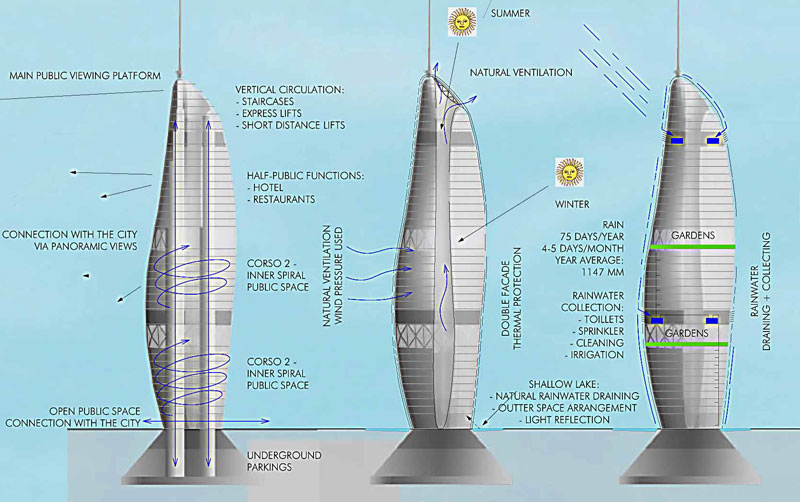
Silk Street is a proposal for a digital textiles supercenter in Chennai, India. A skyscraper, woven in limecrete and bamboo, crosses and combines traditional textile weavers with high-tech industries to instigate an Indian urban manifesto. Read the rest of this entry »

Project submitted to the 2006 Skyscraper Competition
Carlos M Teixeira
Text after the tale “The Building” (O Edifício) by Murilo Rubiao, 1965

sao-paulo-skyscraper-0

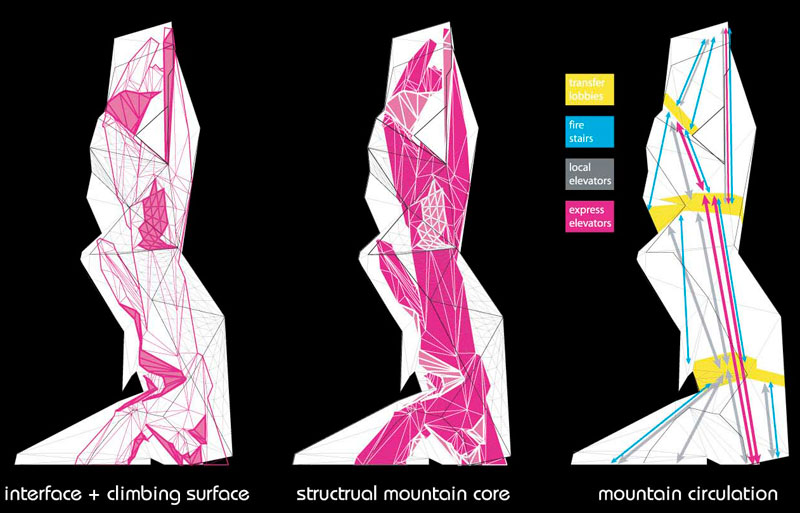
In 2000, The Beatles ex-guru Yogi Maharishi and Brazilian entrepreneur Mario Garnero set forth to the design of Sao Paulo’s Tower, eventually the highest worldwide. Nevertheless, it does not come true. Maharishi Tower, a real-fantastic epic, tells the possible unfolding of the would-be tower, twenty times bigger than the world’s largest skyscraper. Read the rest of this entry »

Versatile Tower in NYC

By:  | February - 6 - 2010

Project submitted to the 2006 Skyscraper Competition
Thomas Coldefy, Isabel Van Haute

versatile-tower-0

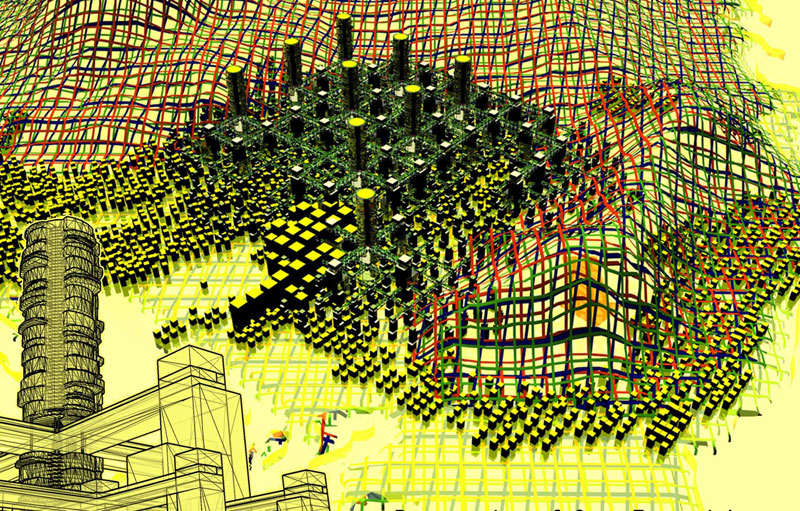
Versatile Tower aims to achieve the vertical layout of its horizontal environment composed of mixed program building blocks and public open spaces such as streets, plazas, and landscape. Its transcription to a vertical layout defines a new “City Grid” animated with similar components. Its occupants find a familiar way (horizontal city) of circulating and interacting by mixing programs throughout the tower. Read the rest of this entry »

Blimp Skyscraper

By:  | February - 5 - 2010

Project submitted to the 2006 Skyscraper Competition
Gianmarco Cavagnino, Andrea Sanna, Francesco Scrimaglio, Chiara Fogliato, Andrea Calvo

blimp-skyscraper-0 

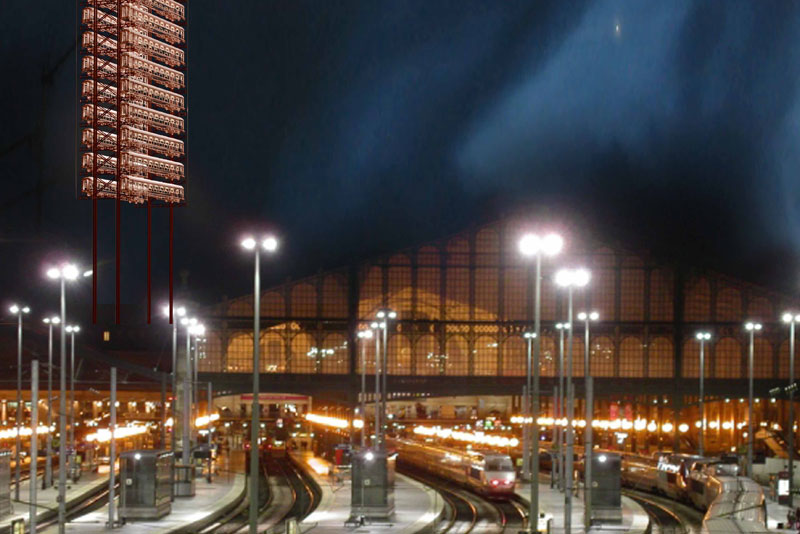
The strenuous work schedule of the inhabitants of a contemporary metropolis leaves no time for recreational activities. Every year cities around the world have less open areas and spaces dedicated to the community. Read the rest of this entry »

Split-Cross Tower

By:  | February - 4 - 2010

Project submitted to the 2006 Skyscraper Competition
Jonathan D. Solomon

split-cross-tower-0

The Split-Cross Tower designed to be in Hong Kong is an investigation of how a building could be an entire nation. A collection of towers are intersected by platforms at various levels with public programs. The idea is to have a community that could live, work, and play in the same structure. The tower’s unique structure and organization include farmlands, corporate offices, seat of the State, trading floors, housing, recreational areas, etc. This new typology could be replicated anywhere in the world and could possibly redefined what a nation is. Read the rest of this entry »
Housing for the 21st Century

By:  | February - 4 - 2010

Special Mention – 2007 Housing Competition
Project by: Dan O’Riley

capsule-living-1

We are still killing the Earth. The temperature is unbearable; the air is almost un-breathable. Our ever increasing population has overrun the planet to the point where there is little open land left and the one available is uninhabitable. We are huddled together in ultra-high density megalopolises like bees in a hive.

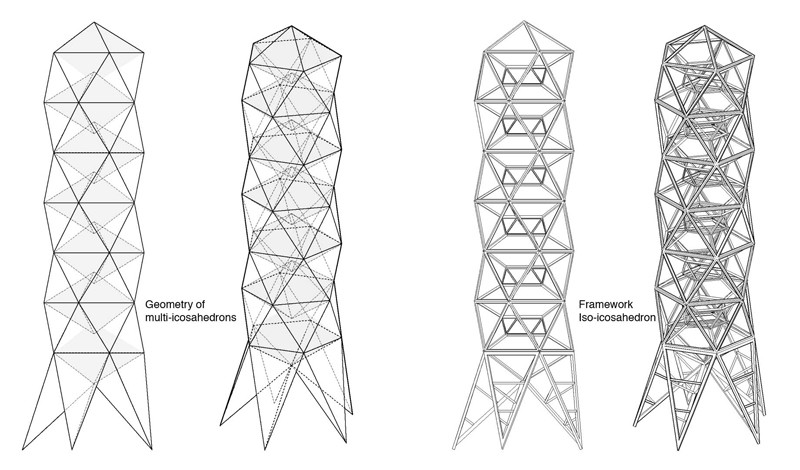
We could live in hexagonal prefabricated units to maximize the density of our cities in an attempt to reverse sprawl and for our own safety. Like the beehive, these hexagonal units efficiently stack and transfer load. These modular units can be stacked and clustered as high and as far as we care to place them. Read the rest of this entry »
Median Income Housing – NYC

By:  | February - 3 - 2010

Special Mention – 2007 Housing Competition
Project by: Ted Porter, Ted Sheridan, Meri Tepper, Ian Roll

median-income-housing-1

In 1924 the Harlem Railroad covered the train viaduct extending from 48th to 96th Streets.  The resulting median is maintained as a generic green space, financed with contributions from high-income residents along Park Avenue.  Median Income Housing (MIH) proposes a much-needed alternative use for this space while maintaining its green nature. 

As of the 2000 census there are 3,021,538 household units in New York City with a median income of $38,293.  Current zoning guidelines encourage residential developments that combine 80% market rate units with 20% qualifying income units.  This project proposes to remedy the current imbalance of Park Avenue housing by adding units for median income users.  With 6 to 10 units per block there is the potential to house over 960 middle and lower income residents in apartments ranging from 400 to 800 square feet. Read the rest of this entry »

Kokuy Architecture – Housing

By:  | February - 3 - 2010

Special Mention – 2007 Housing Competition
Project by: Larisa Kuvtyreva

russia-housing-1

Kokuy Housing

This project is a redevelopment idea for the waste grounds in the suburbs of the Russian city of Kokuy. The majority of the existing houses will be restored and three new egg-shaped buildings will provide the new necessary housing. These structures will be covered with solar panels that will move according to the sunlight. Movable screens cover the entire outer skin and are used to regulate the temperature and the illumination. The main structure is formed by four columns that support a secondary structure around the ‘eggs’. Read the rest of this entry »