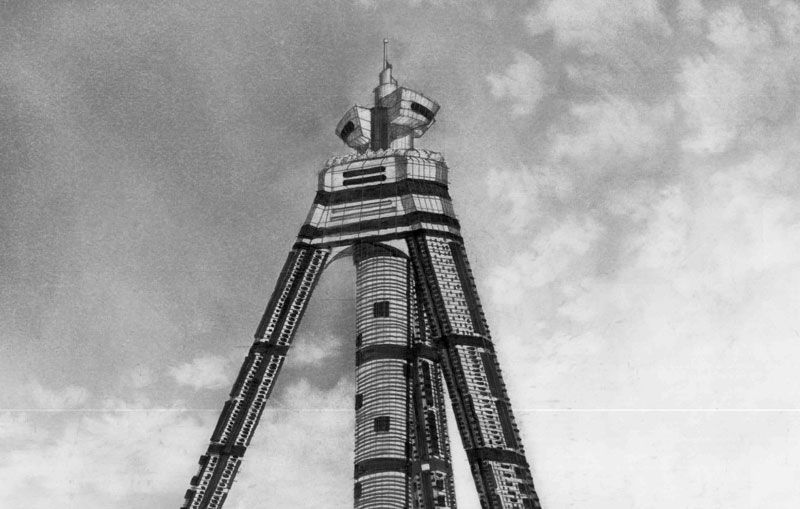
3D City – A New Urban Typology

By:  | February - 21 - 2010

Project submitted to the 2006 Skyscraper Competition
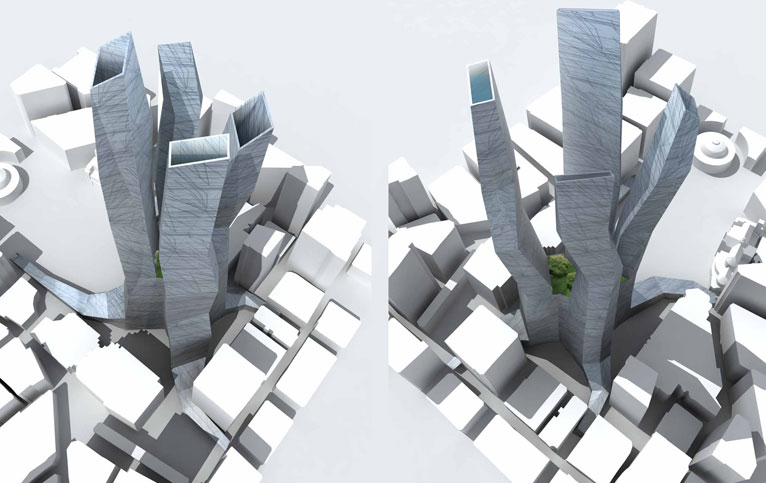
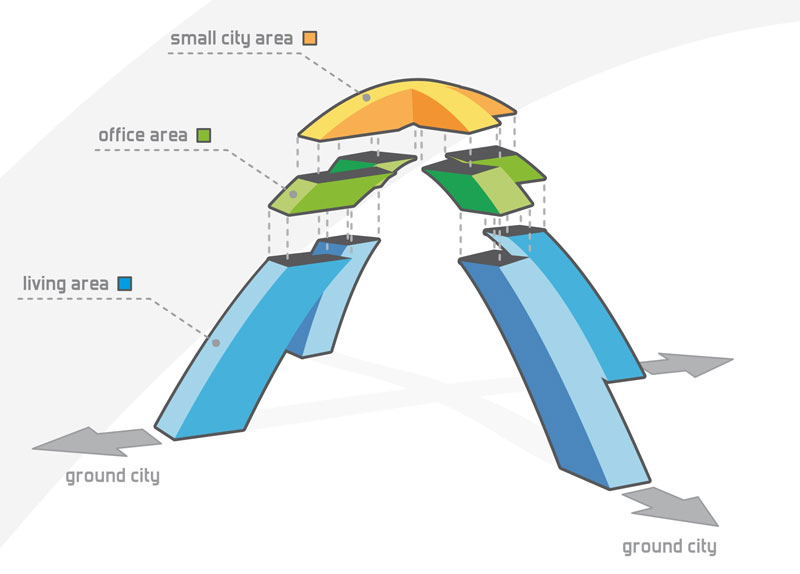
Designed by: Nik Stützle

connected-skyscraper-0

High-rise buildings have always been symbols of economical strength, and necessary for every metropolis to compete as a modern and vital city. This demonstration of power on the other hand mostly has a negative effect on the urban context: because of their size high-rise buildings are difficult to integrate into sensible urban environments and behave like aliens in the city.

Behind impressive facades apartments are still quite minimal; one floor-plan usually is multiplied in vertical, connected by dark elevators and rescue stairs. Narrow corridors and anonym foyers do not really offer an adequate space for social activities. The consequences very often are loneliness of the inhabitants, alienation and criminality, syndromes that contributed to the negative image of high-rise buildings. Read the rest of this entry »
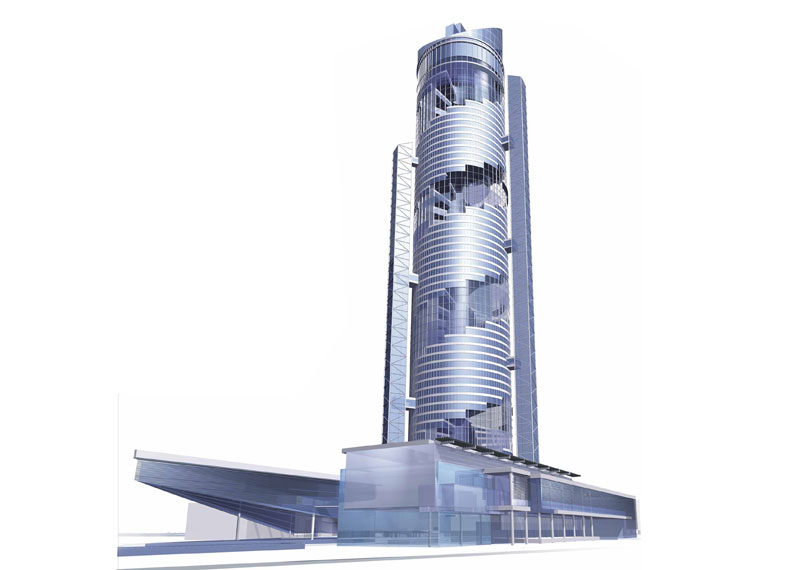
Project submitted to the 2006 Skyscraper Competition
Designed by: Michal Bernasik

puerto-madero-skyscraper-0

Location
The main harbor of Buenos Aires is located in the eastern side of the city with a direct connection to the city center. Traveling in 1929 in South Amerika, Le Corbusier remarked: ‘Oh, Buenos Aires has given its back to the river, never sees it, and does not know it exists’. Sixty years later, in 1989, some efforts were made to revitalize the neglected and separating the capital from the river port – Puerto Madero. The modernization had to bring life into this oldest part of the harbor and to make the city turn its face again to the river. Indeed, the ‘New Puerto Madero’, while not loosing its port character, has now become a popular and vibrant with life district in the heart of Buenos Aires. Read the rest of this entry »
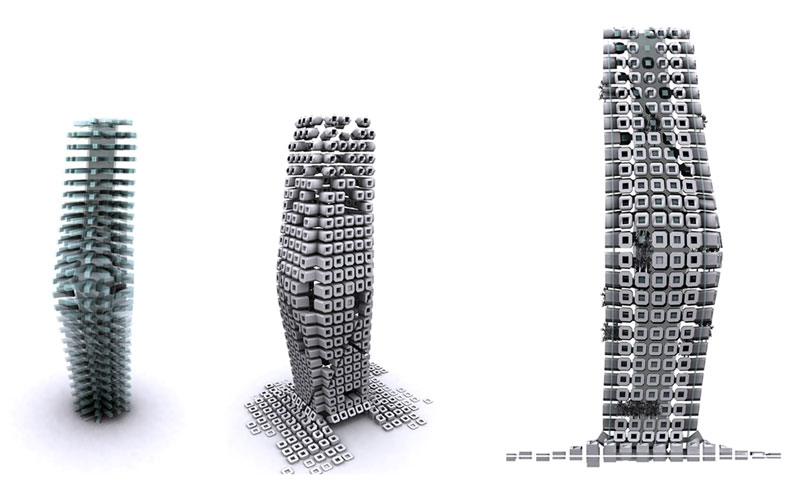
Project submitted to the 2006 Skyscraper Competition
Designed by: Louis Edward 

Fractal Geometry
Fractal geometry is used to describe and analyse the complexity of the irregular shapes in the natural world around us. The most striking property of these ‘fractal’ shapes is their characteristic patterns are found repeatedly at descending scales, so that their parts, at any scale, are similar in shape to the whole.

fractal-city-cape-town-0

Concept
To redistribute the fabric of the skyscraper into a fractal based city network-form within the eco-systemic paradigm. Moving away form building the skyscraper to act as an isolated part toward building skyscrapers to act as part of a whole.  From this point on, the skyscraper cannot be viewed as an isolated entity, although it will still be physically or visually present. The growth or build of a skyscraper thus become an emerging process as part of an evolved urban fabric and not build at once. Read the rest of this entry »
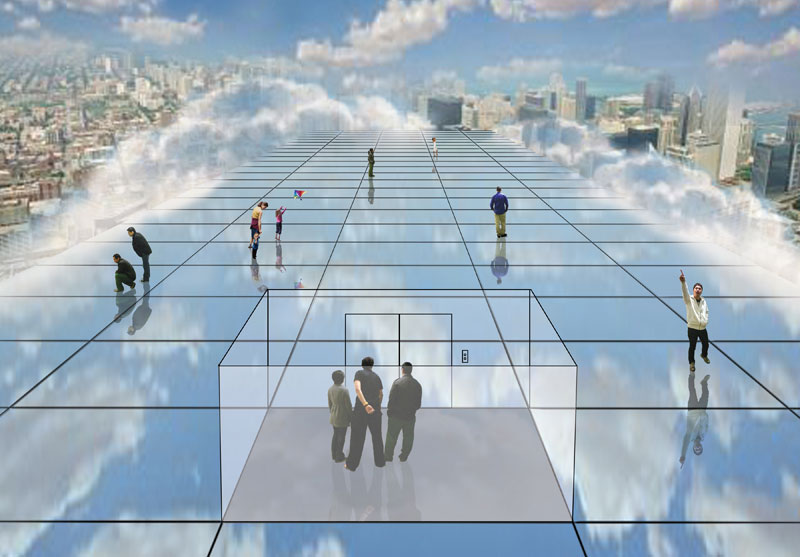
Manhattan Recreational Park Tower

By:  | February - 19 - 2010

Project submitted to the 2006 Skyscraper Competition
Designed by: Andrew Colopy, Aimee Chang

park-tower-0

Welcome to Formiscucity, Manhattan’s premier recreational P.A.R.C. tower – where a new way of life is taking shape!

Formiscucity, located just west of Times Square in Manhattan’s new and most contested real estate, occupies a single city block as an uber-special island within the man-made islands of the city’s 200’ x 800’ block grid system.  The 50-story tower reaches up 600 feet, with a footprint covering 25% of the site to achieve the super density characteristic of Manhattan.  This extreme density promotes diverse interaction as a microcosm of the city itself. Read the rest of this entry »
Project submitted to the 2006 Skyscraper Competition
Designed by: Etienne Feher

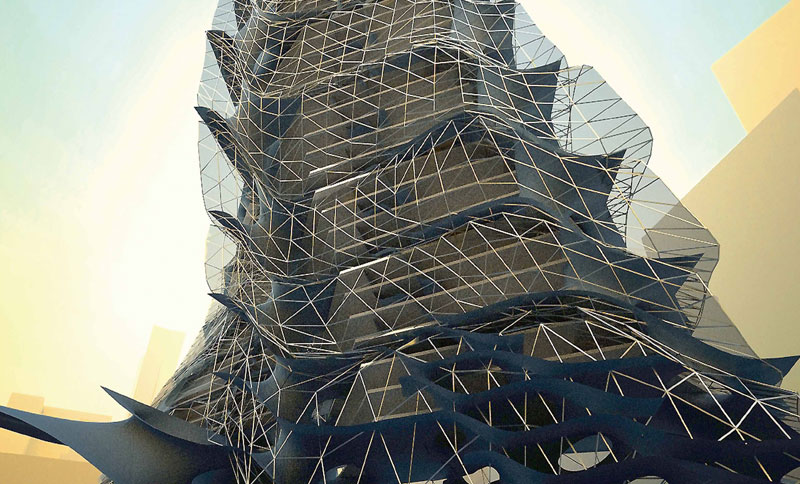
train-architecture-0

The idea behind this project is traveling through Europe. The aim is to discover four major cities within the continent in your own customized wagon. One begins in Paris, continues to Berlin, Budapest, and then Geneva. Four skyscrapers are constructed in each of these cities. These skyscrapers are mere structures receiving and discharging nomadic wagons. The wagons are apartments. Read the rest of this entry »
Inverted Skyscraper – Houston

By:  | February - 16 - 2010

Project submitted to the 2006 Skyscraper Competition
Designed by: Michael Kross

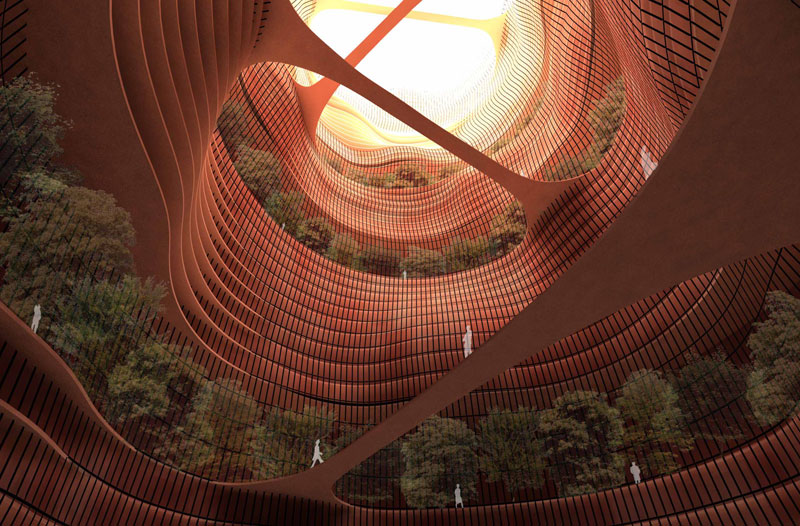
houston-skyscraper-0

Skyscrapers in New York and Chicago have evolved to allow sunlight to penetrate their crowded streets. Their stepped profiles are a logical response to the local climate and zoning restrictions. This project proposes a skyscraper suited for hot weather cities like Houston, Texas.  The shape of the building has been inverted to maximize shadow areas for streets and for the skyscraper itself. Read the rest of this entry »

Bionic City UAE

By:  | February - 16 - 2010

Project submitted to the 2006 Skyscraper Competition
Designed by: Helmut Sprenger, Oliver von der Lippe

UAE-skyscraper-0

This proposal examines the benefits of a field of small footprint skyscrapers. The main concept is to create visually and spatially linked pockets of recreational areas at the ground level. It is common to see deserted streets at night and weekends in downtown areas where traditional skyscrapers do not offer public amenities and visual connection between different spaces is nonexistent. Read the rest of this entry »

Project submitted to the 2006 Skyscraper Competition
Designed by: Thomas Herzig

hongkong-tower-0

The project for the Isoka Tower in Hong Kong studies the possibility of constructing skyscrapers on the water. Its main concept is to provide sustainable housing, offices, and recreational areas to the over crowed city of Hong Kong where land for new developments is extremely expensive and very limited. Read the rest of this entry »
Special Mention – 2007 Housing Competition
Project by: Federico Rossi

parametric-design-1

This project focuses on the development of new housing typology in Oman, generated through the accumulation of independent variables into a system of relationships, where the interdependencies generate a variation of possibilities that is able to adapt to local conditions. The development of inhabitable units will be dependent on environmental variables and eco-sustainable principles to achieve new spatial and per formative configurations. Read the rest of this entry »
Skin Fruit curated by Jeff Koons

By:  | February - 12 - 2010
It's the Mother - Nathalie Djurberg

It's the Mother - Nathalie Djurberg

The New Museum announced details of “Skin Fruit: Selections from the Dakis Joannou Collection,” its much-anticipated exhibition curated by artist Jeff Koons. “Skin Fruit” will be the first exhibition in the United States of the Athens-based Dakis Joannou Collection, renowned as one of the leading collections of contemporary art in the world. This will also be the first exhibition curated by Koons, whose early work inspired the evolution of the Joannou collection. Read the rest of this entry »