From now until January 29, 2012 the Rotonda di via Besana in Milan will host the exhibition “Drawing and Design – Italian patents and creativity” produced by Fondazione Valore Italia and the Ministry of Economic Development and promoted by the Department for Culture, Expo, Fashion and Design of the Municipality of Milan. Read the rest of this entry »

The main purpose is to design a multifunctional complex for people with an interest in knowing about Islam during the time of the Ottoman Empire. The Ottoman Empire was the last big Islamic Empire and one of the most powerful during the Islamic era up until recent times. The building will serve as a hub for social activities and will portray the Ottoman Empire, especially, in an artistic sense.

The building conceived by Yusuf Onder will have a library, museum, lecture rooms, workshop level and a rooftop garden/cafe. Another goal is to offer people a place to learn and understand about this unique, hybrid of, culture and religion and it’s place in the Ottoman Empire in a hope to diffuse the sense of xenophobia towards the religion and culture. This thesis expounds on the, long old, idea of constant integration of religion and culture from history. Read the rest of this entry »

The aim of the Centre designed by Vulmaro Zoffi is essentially to make citizens aware of and prepared for natural disasters using specific training rooms and simulation areas.

To express this intent in architectural forms the architect decided to use the metaphor of a falling raindrop. In fact, when catastrophes occur, the balance of a phenomenon seems broken by a very small force, so it’s possible to find in the micro-event of the falling raindrop some of the primitive geometric forms involved in macro-natural disasters.

A large platform inside the innovative complex, in the form of a broken fragment of a tectonic plate, provides access to the peaceful environment of the greenhouse. This effect results in the gradual merging of two opposing faces of nature: peace and upheaval. The ETFE space of the greenhouse also acts as an open public square surrounded by grass and trees, providing a proper dimension for socializing. Read the rest of this entry »

Shenzhen is one of the most important industrial locations as well as a very popular tourist destination in China. The fast developing city is located in the south of the Guangdong Province, neighbouring the Pearl River delta and Hong Kong. Shenzhen Bao’an International Airport is the fourth largest following Beijing, Shanghai, and Guangzhou in China. In 2008 Massimiliano and Doriana Fuksas Architects won the international competition for the extension of the airport with the design of Terminal 3.

The concept of the project provokes the image of a sculpture with its organic shape. The structure of the building is in steel with a concrete substructure. The skin that envelops the structure, both on the inside and on the outside, shows the honeycomb motive. Read the rest of this entry »

FlexHubDock: Barcelona in 40 years

By:  | December - 18 - 2011

The project was developed by IAAC students Carolina Aguirre, Xiomara Armijo and Carlo Caltabiano during the MAA Emergent Territories Studio directed by Willy Müller. FlexHubDock envisions Barcelona city 40 years later, with the Port Area as new Hub not only for commerce/logistics but for people and the city, rethinking it as a new social layer.

The FlexHubDock is the best example of how Port and City can coexist in harmony. A smart-shared surface will enable the Port area as both a Dock for ships and public Plaza. Depending on the needs for public space and activity as dock, it can be totally managed in real-time, by embedded sensors and network system that receives information of space requirements to begin its transition. In a single day the function and shape of the FlexHubDock can change several times and even share functions. Read the rest of this entry »

Swarm Urbanism / Zhaochen Wang

By:  | December - 18 - 2011

This project is Zhaochen Wang’s  Master of Architecture thesis developed at the University of Southern California. The project is an investigation of swarm intelligence and slime mould and its translation into urban and architectural design. Read the rest of this entry »

Ski Resort in Lapland / BIG

By:  | December - 15 - 2011

The future Ski Village will transform the existing Levi ski resort into a world class destination, offering top quality accommodation and leisure services for skiers of all levels and demands. The proximity to the Kittilä airport ensures easy access to the resort attracting international visitors to Levi village and the whole Lapland region. The Finland-based developer Kassiopeia Finland Oy is investing in its local region as it currently owns and operates Hotel Levi Panorama, Levi Summit Congress Center and Hotel K5 Levi and above and beyond has interests in developing the exquisite Koutalaki area.

“BIG’s visionary approach of combining unique types of accommodation and amenities along with the leisure activities offered at the resort, left the jury in awe. BIG’s ambitious plan challenges traditional thinking and we believe that the collaboration between Kassiopeia Finland and BIG-Bjarke Ingels Group will rise to the occasion.” Jury, Kassiopeia Finland Oy.

Located on a gentle slope, the existing Levi ski center provides the framework for the future Koutalaki Ski Village which is conceived as an extension of the summit and the existing cluster of buildings in Koutalaki. BIG proposes to create a series of buildings that radiate out from a central square and whose ends touch the ground to create four freestanding buildings that each provide access to the roof and allow the skiers to descend from the resort’s rooftop downhill in any direction. The soft curves of the undulating roofs of the four buildings create a visual continuity of the natural land–scape while lending the whole village the unique character of a skislope skyline that creates an inhabited mountain top.

“The Koutalaki Ski Village is conceived as an extension of both the summit and the resort. Grown from the natural topography rather than dropped from the sky – the architecture extends the organic forms of natural landscape creating an inhabitable as well as skiable manmade mountain. As a result, our design for the Koutalaki Ski Village creates a new hybrid integrating distinct identities such as village and resort, shelter and openness, cozy intimacy and natural maj–esty, unique character and careful continuity – or simply – architecture and landscape.” Bjarke Ingels, Founder & Partner, BIG. Read the rest of this entry »

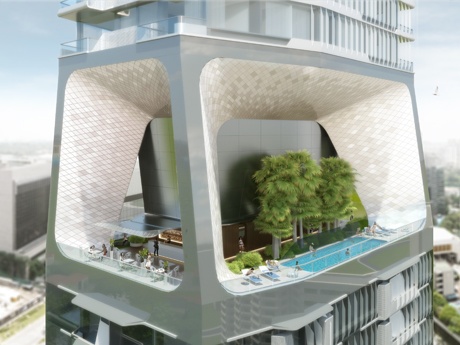
UNStudio’s design for The Scotts Tower in Singapore has been designed to conserve space whilst maximizing live/work/play areas, The Scotts Tower presents a new dimension of functional and flexible vertical space. The Scotts Tower high end residential building is situated on a prime location in Singapore, close to the Orchard Road luxury shopping district and with views encompassing both nearby parkland and the panoramic cityscape of Singapore City.

Ben van Berkel: “An interesting facet of The Scotts Tower is the way that it reacts to the urban context of Singapore. Instead of the more usual means of planning a city horizontally, we have created neighbourhoods in the sky; a vertical city where each zone has its own distinct identity.” The 18,500m2, 31-storey, 231-unit tower consists of 1 to 3-bedroom apartments and 4-bedroom penthouses; expansive landscaped gardens, sky terraces, penthouse roof gardens and diverse recreational facilities.

Neighborhoods in the sky
The concept of The Scotts Tower is that of a vertical city incorporating a variety of residence types and scales. In addition, outdoor green areas in the form of sky terraces, penthouse roof gardens and individual terraces form an important element of the design. The vertical city concept is interpreted on the tower in three scales; the “city”, the “neighbourhood” and the “home”. The three elements of the vertical city concept along with the green areas are bound together by two gestures: the “vertical frame” and the “sky frames”.

The vertical frame organises the tower architecturally in an urban manner. The frame affords the tower the vertical city effect by dividing the four residential clusters into different neighbourhoods.

The sky frames – at the lobby (Level 1 & Level 2) and sky terrace (Level 25) – organise the amenity spaces and green areas of the tower. Read the rest of this entry »

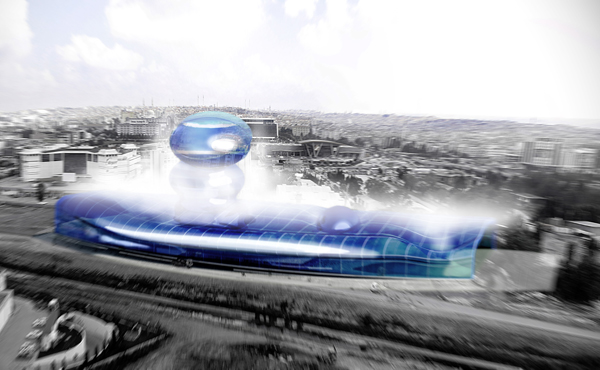
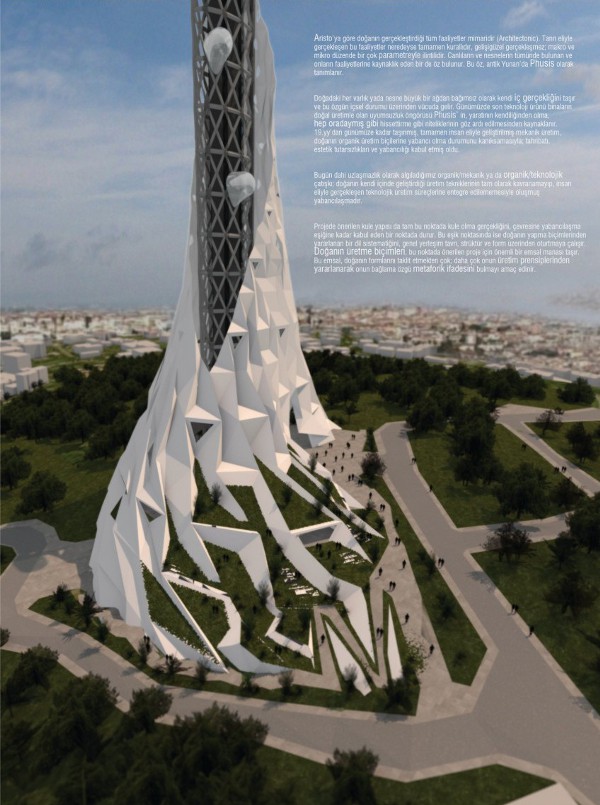
This TV-Radio tower designed by architects Ahmet Unveren and Seckin Maden will be located on the great Camlica Hill – Istanbul, which has an altitude of 240 meters above  sea level. The site consists of 120.000m²  in a natural reserve protected  by the government. The project aims to be an innovative 350 meter high tower that would clean the overall mess of the current TV and radio antennas on the site.

The project is based on the duality of the natural protected site and the tower. This duality comes up with: functional trauma, formal trauma, and spatial trauma. Instead of accepting the disconnection and fixing it; the intention is to utilize the tower as the functional and formal continuation of the natural protected site. Read the rest of this entry »
Pin-plant is an installation designed by Stewart Hicks and Allison Newmeyer from Design With Company like a series of experiments – an examination and interpretation of humanity through anthropomorphism and color. Finding the fantastic in the systematic. What do our desires to personify computer parts express about us? It all began with an old computer motherboard. At first it was a city scape, then a vast mechanical microcosm, with circuits leading this way and that- a garden of forking paths if you may- immediately immense and endless. Aggregating in intense exchanges of information- where color became landmark and organization revealed a scale of part to whole most basic in its arrangement, yet complex in possibility. It’s efficiency a testament to its time. Technology of foreign pieces. But what did we want to do with it? We wanted to give it life to understand it. Aestheticize it until it could be more than a commentary on the mechanics of things. Through sculpture, the conventional exformative connections are disconnected. Read the rest of this entry »