Quantcast

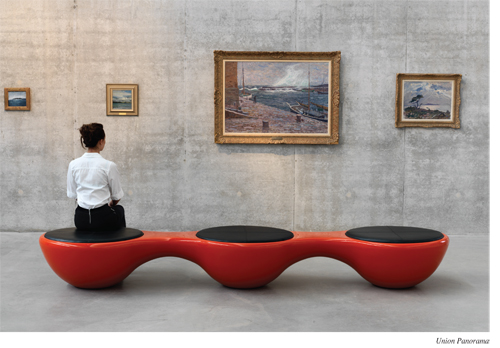
Union Panorama

The Jangir Maddadi Design Bureau, a Sweden-based furniture design studio, has established a line of luxury benches, lamps and planters for interior and exterior spaces that are clean, aesthetically beautiful and utilitarian.

All of the company’s products are crafted locally; using Swedish artisans to design and craft their benches, planters and lamps is a point of pride for the Jangir Maddadi Design Bureau. The company strives to compliment their prioritization of regional artisans and materials with designs that are organic and earthy. Innovation, they stress, and forward-thinking configurations and aesthetics are also vital in their products’ designs, though.

Their pieces are grouped into three categories. The first, the “Union Family” is a line that uses large circles singularly or grouped to create both benches and planters. The planters, available in poured concrete or fiberglass, are large circles that slope proportionally to the ground. The benches are more complex; they are available in a variety of one, two and three- seat configurations. The “Panorama” bench design aligns two or three of the circular seats linearly, but also allows the option for one of the circles to be used as a planter. This design is ideal for hallways and corridors, can seat up to 12, and is, says the company, “inspired by the natural curves of people in movement.” The other possible configuration for benches creates a new type of tripod: three seats are connected in a triangle configuration that allows for both privacy, letting strangers comfortably cohabitate, and also intimacy, allowing a close space for friends to huddle to converse. The bases of the customizable benches are made of fiberglass; the moulds are poured by expert yacht makers on the country’s east coast. The circular seat cushions can be made in a variety of colors from felt, hand-sewn leather made on the Swedish island of Öland, or, in the “yacht” design, teak wood. Read the rest of this entry »
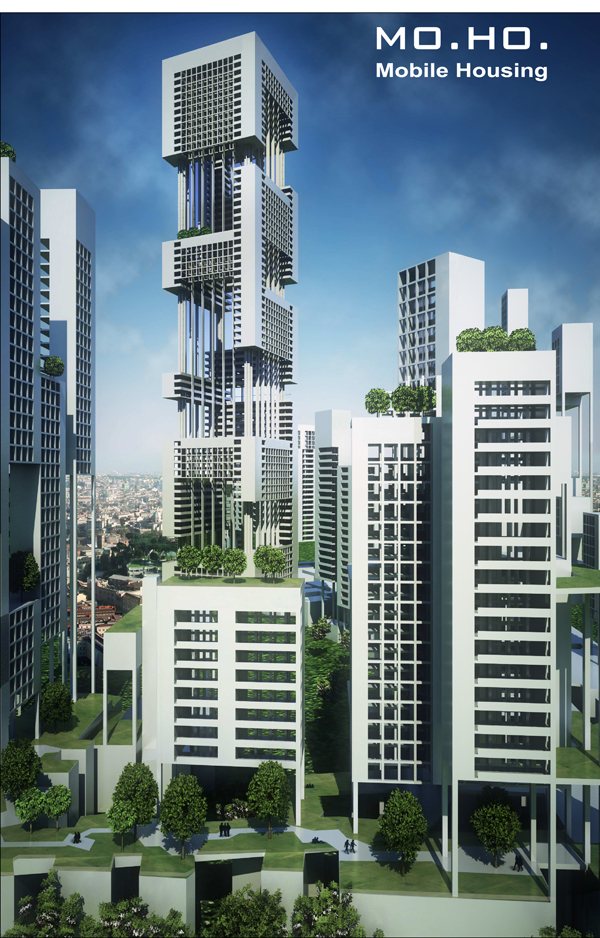
Engineering students Lorenzo Carrino, Andrea Bonamore, Riccardo Franchellucci and Lorenzo Bramonti from Rome, Italy have created, from their historic city, a skyscraper plan that will allow people to move with ease from one world capital to another.

The Mo.Ho., or Mobile Housing design incorporates moveable apartment units, “modules,” that are housed within Mo.Ho. towers or skyscrapers. The towers range between 50 and 80 meters tall, and are built on top of existing structures in an effort to increase density without increasing the city’s covered surface area. The skyscrapers are between 350 and 450 meters tall and can revitalized even the most “degraded” of urban areas, the students say. Their main draw is ample green space realized through green squares, public gardens and sports areas, which are connected via pedestrian green belts.

In Rome, the students have placed a Mo.Ho. skyscraper in the San Lorenzo neighborhood near the Termini station. An overpass highway that runs directly through the neighborhood is overtaken for the building’s implementation, and it is this area that is redeveloped into the greenway. Read the rest of this entry »
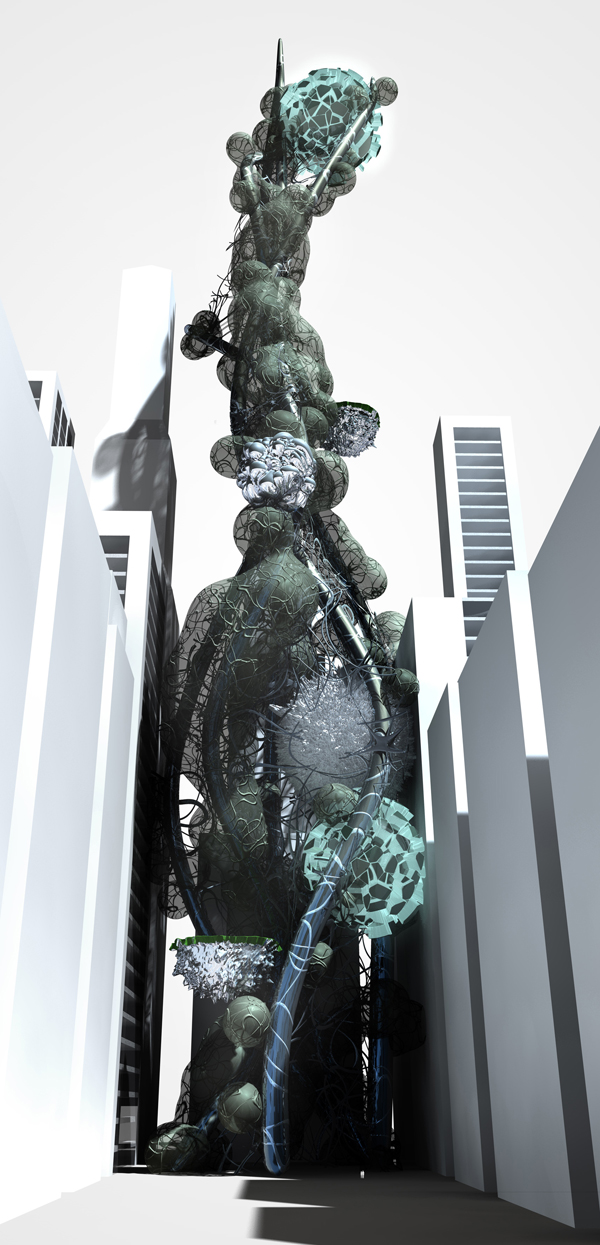
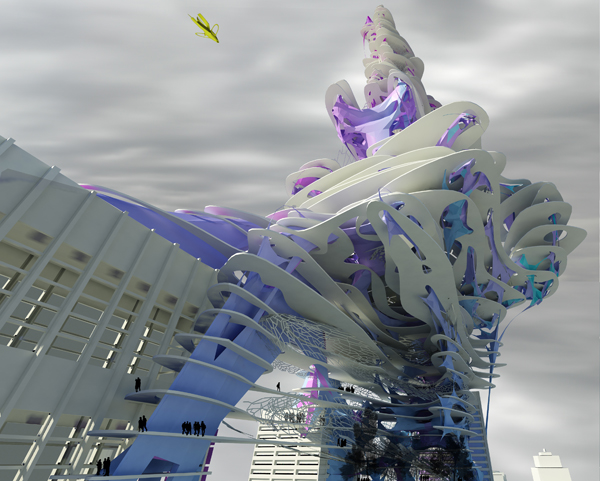
Imagine a giant, amorphous algae vine swallowing a traditional skyscraper.

Now imagine living inside that growth.

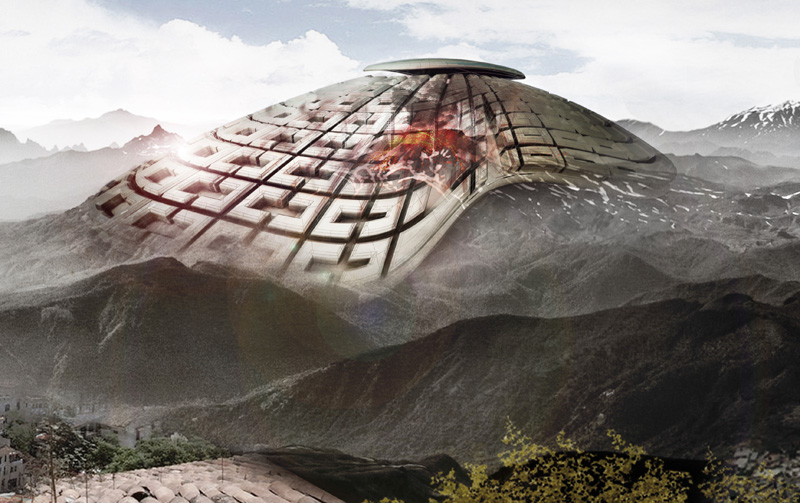
This is precisely what Polish architecture students Karolina Czochańska, Emilia Dekarz, Paweł Dudko and Justyna Krupkowska have proposed with their ‘Saprophyte’ design. In the future, they say, corporations will retreat to the virtual world, and communications will reach a height to where people no longer need to commute from work. People will reclaim urban centers from the corporations that have abandoned them, and, working from home, will need to be served by a more adaptable, flexible and efficient living structure.

The students have combined biology and architecture – biomorphic architecture — to propose a living mass that overtakes typical skyscraper structures and transforms them into buildings that can shrink, grow, split, or change in any way needed by residents. And, the bio mass is self duplicating, meaning new buildings effortlessly appear – they sprout “like flora.”

The design is both economical and effective because, the students say, it is based on the principles of self-sufficiency and energy efficiency. The students reached their design ideas through a study of biomimicry and asking, what can we learn from nature? Read the rest of this entry »
Before modern structures as we know them were developed, man and animal lived together in nature. Gothenburg, Sweden-based architects Joakim Kaminsky, Fredrik Kjellgren, Maria Martinez Fabregas, Alexandra Agapie and Shadi Jalali Heravi with the firm SAR/MSA have proposed reinstating this original cohabitation, but in today’s modern, vertical context.

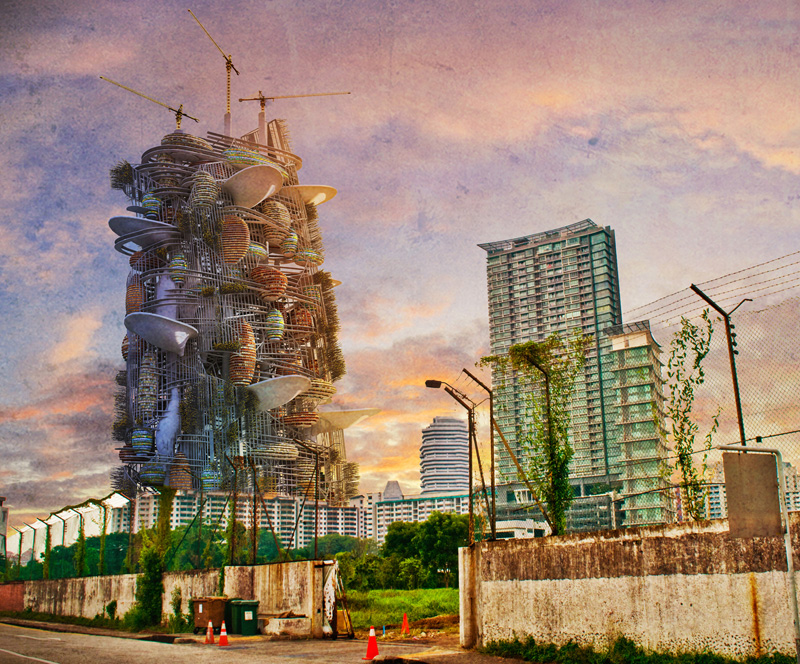
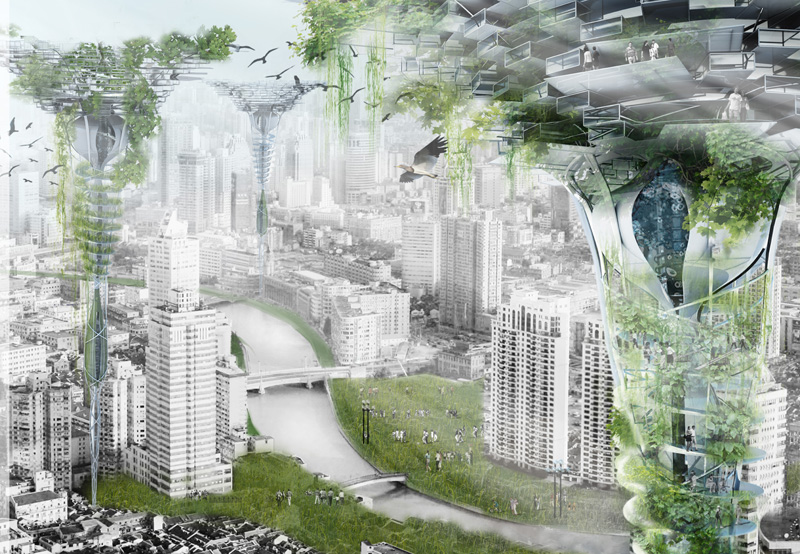
Their concept, called “Alive Architecture,” imagines a skyscraper in Shanghai that houses both human and animal inhabitants within a building that blends the typical domiciles of both: modern building materials in the building’s core protect the building’s mechanical systems, but more primitive materials on the exterior, including wicker, straw, clay, mud and stone mimic a bird’s nest and earlier human building methods as well.

This blending of nature and modernism is the arch that “green architecture” could taken to restore what has been lost in our typical urban centers. Building vertically, the architects argue, solved cities’ density problems, but simultaneously grievously harmed human interaction with other people and with nature. What if the new green architecture were developed as a functional habitat for wildlife, they ask? Read the rest of this entry »
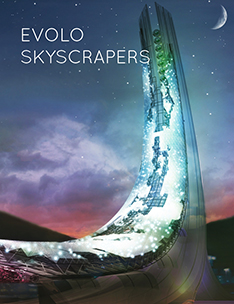
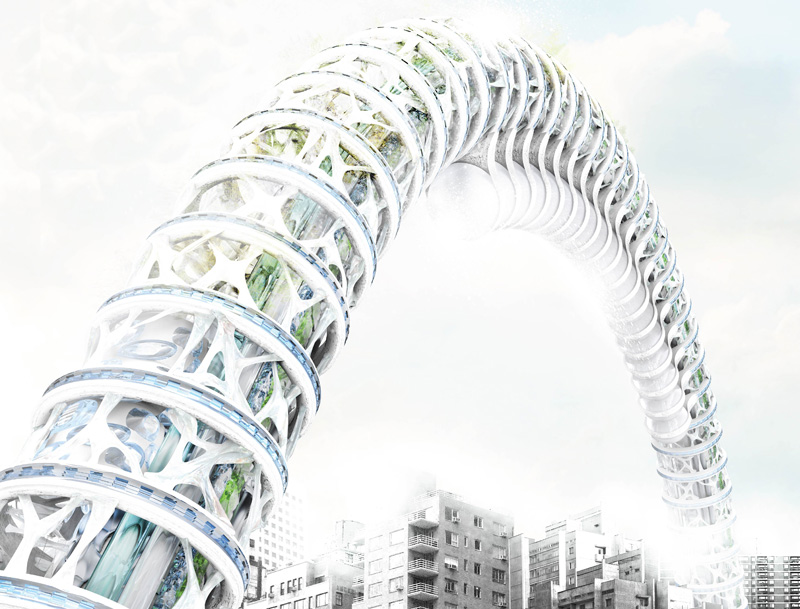
Growing with stringy tentacles off of typical, rectangular high-rise towers is the Sky Cloud, a skyscraper that winds and grows from the ground into a twisting structure that resembles, at the top, an aquatic tail or fin.

The Sky Cloud design, by New Jersey and New York-based architects and designers Patricia Sabater, Christopher Booth and Aditya Chauan, presents a building whose skin and shape are “experimentations of deformation with portals and cellular growth.”  The portals feed the exotic needs of the future: gateways at the skyscraper’s peak allow for arrival and departures of sky taxis and a sky rail system. The building’s cells house a variety of functions, from apartments and hotel rooms to corporate meeting space, a “sky lounge” and a museum of economic crisis. The structure will also feature a park and a resource co-op. Read the rest of this entry »

Planners have long argued against suburban sprawl for the possible health effects it has on residents who are able to avoid physical exercise from behind the wheel. California Polytechnic State University architecture students Thomas Shorey, Ryan Nevius and Baptiste Roult have approached design as health promoter in a more urban manner: design a city vertically to force physical movement and better health.

Their Sky District plan abandons the typical design of buildings where visitors are distributed to floors via easily accessible elevators, saying that method offers “poor architectural design, consumes finite resources and promotes a lazy way of life.” Instead, they propose, arrange city blocks vertically and offer skip-stop elevators and attractive stairways that reward climbers with impressive city views. Not only does this encourage walking, they say, but it also increases opportunities for public interaction. Read the rest of this entry »

If the S.M.A.R.T. tower appears to be in constant motion, it’s only because the structure is covered by a swarm of 100,000 robot bees.

S.M.A.R.T. stands for Swarm Manufacturing and Augmented Reality Technology. Using CAD and LPS (Local Positioning System) data, the bees can be programmed to augment the structure virtually, turning virtual information and data into physical realities. The concept is the vision of Seoul, Korea architects Yoon H. Kim and Yang-Kyu Han.

These bees aren’t interested in honey: these workers will actually build a structure. Each robot is capable of using cartridges filled with agents that enable them to construct literal physical material, which the designers dub “augmented synthetic material.” An amassing of this material forms skyscraper that is conductive, allowing electricity and data to flow throughout the skin of the structure which enables the pulses to be directed to very specific locations. Read the rest of this entry »

The Acadia Tree tower design by Czech architect Petr Pospisil operates from the basic observation that as cities grow and density rises, precious ground space takes on new importance. The design for the Acadia Tree allows for an exciting high rise that is both monumental in scale and look and has a small footprint on the city below.

Three long legs rise high and support a complex of living and commercial spaces on top. The legs themselves have many functions: they house office spaces, the are the location of elevators that whisk people to the tower’s top, and they have plants growing in a middle groove, bringing living foliage to the whole length of the tower, culminating in plentiful green space on the complex that rests on top of the pillars.

The relaxing, green area perched on the three legs is meant to resemble a bird’s nest, providing secure housing, protection and respite. With expanses of grass, trees and even swimming pools, residents living in apartments on this tower enjoy leafy environs and fantastic views. Each apartment even has its own large, landscaped terrace. Read the rest of this entry »

Hong Kong architectural graduate student Kenneth Cheung Shiu Lun is worried about human kind’s consumption. We are killing the earth, Lun argues, and will soon make our own kind extinct as we deplete the planet’s resources.

In Noah’s Tower, Lun has designed an architectural island where the mantra “survival of the fittest” means that those brave enough to leave land will live on into the future. Noah’s Tower, playing off the story of Noah’s Ark, comes with a tagline: “It’s time to face it. Architecture without ground.”

As the earth’s land disappears, refugees gather on temporary floating islands before arriving to the Noah’s Tower complex, which is a series of towers connected by bridges that float and move with the waves and are interchangeable to allow for new linkages as the city grows.

The bridges linking the towers serve a special purpose: not only do they connect the expatriate community, but they serve as a link for residents to the world they left behind. The floating bridges are comprised of two levels, the bottom serving for traffic and the top covered in trees, bringing a connection to nature and the environment that has been lost for residents. Read the rest of this entry »

Egyptian architects and engineers Gehan Ahmed Nagy Radwan, Sameh Morsj Gad El-Rab Morsi and Ahmed Magdy Ali are heavy on idealism and light on literal plans for their design Stairway to Heaven, a skyscraper design that blends reality and dreams to create a new utopian dimension.

Located within the slums of Cairo, the Egyptians’ entry couples the smiling faces of children and women with a futuristic tower plan that stacks spheres and rectangular living units high into the sky. The opposite shapes are symbolic of the different purposes the structure serves: dream bubbles foster idealism, living cells house real life, and a “main core of hyper cubes” fuses the two, as would a time machine, say the architects, in a way that opens a “fourth dimension” to residents. A new reality is what is truly created when blending dreams of the future with the roots of your past, issues of identity and community considerations. Read the rest of this entry »